
M. A. Carrick
Author of The Mask of Mirrors
About the Author
Disambiguation Notice:
M.A. Carrick is the shared pseudonym of Marie Brennan and Alyc Helms.
Series
Works by M. A. Carrick
Non Plus Ultra 1 copy
Tagged
Common Knowledge
Members
Reviews
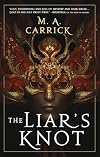
I started the year reading the first instalment in the Rook & Rose trilogy, The Mask of Mirrors, so in a way, it was only fitting that I should come full circle and end the year with its newly released second book, The Liar's Knot.
I had really enjoyed the first book, so my expectations were very high for the second one, even though I was a bit worried about a possible case of "middle book syndrome". But as it turns out, I worried for nothing and my expectations were not only fully met, but show more exceeded by this amazing book!
The Liar's Knot picks up soon after the events of the first book, as everyone struggles to come to terms with what happened and the consequences of that for Nadezra as a whole. There is an impressive amount of secrets going around, and I absolutely loved seeing how the various characters interacted, knowing who was hiding what from whom. What could have easily become an overly complex mess is handled extremely well, with never a moment of confusion (for me at least; there were plenty of those for the characters...) and it's not dragged along any longer than it needs to be.
Because of the high-level duplicitousness in this book, it's extremely easy to accidentally venture into spoiler territory, so I won't go into a lot of detail. Suffice it to say that everything I had enjoyed in the previous book, I absolutely adored in this one.
The characters were fantastic, so complex and fleshed out it was an absolute joy to spend time with them. The cast is big and I still had some difficulty keeping some of the minor characters straight in my head, but I had no trouble at all following the main group. Ren and Vargo confirmed themselves as my absolute faves, but I loved everyone else too, especially some of the newer characters that didn't get quite as much airtime in the first books. The relationships really get room to breathe in this book, and it was a delight to read. The banter between the Rook and the Rose was stellar, and I couldn't get enough of that between Vargo and his spider either!
The worldbuilding is also amazing, complex yet explained in a way that makes it easy to follow and understand. I did struggle with some of the words (which I had almost completely forgotten from the first book), but thankfully I remembered to look for the glossary this time, so that particular crisis was averted! There were plenty of moments for learning and reflection throughout, and I really enjoyed how this book took its time to develop those aspects and the magic system further instead of blindly rushing ahead with the plot.
There were still enough adventure, intrigue, and swashbuckling to keep things moving, including a curse and a secret cult as well as your run-of-the-mill con artistry, criminality, and vigilantism. Oh, and let's not forget masked balls and AMAZING fashion!
The Liar's Knot had everything I dreamed of for the second book in the series, and more! Somehow, it managed to be even more amazing than the first and an all-round fantastic second book. I can't believe I have to wait so long for the next one, but I can't wait to see what comes next!
For more reviews, visit Book for Thought.
I received an e-arc of this book from the publisher via NetGalley in exchange for my honest review. This did not affect my opinion of the book in any way. show less
I had really enjoyed the first book, so my expectations were very high for the second one, even though I was a bit worried about a possible case of "middle book syndrome". But as it turns out, I worried for nothing and my expectations were not only fully met, but show more exceeded by this amazing book!
The Liar's Knot picks up soon after the events of the first book, as everyone struggles to come to terms with what happened and the consequences of that for Nadezra as a whole. There is an impressive amount of secrets going around, and I absolutely loved seeing how the various characters interacted, knowing who was hiding what from whom. What could have easily become an overly complex mess is handled extremely well, with never a moment of confusion (for me at least; there were plenty of those for the characters...) and it's not dragged along any longer than it needs to be.
Because of the high-level duplicitousness in this book, it's extremely easy to accidentally venture into spoiler territory, so I won't go into a lot of detail. Suffice it to say that everything I had enjoyed in the previous book, I absolutely adored in this one.
The characters were fantastic, so complex and fleshed out it was an absolute joy to spend time with them. The cast is big and I still had some difficulty keeping some of the minor characters straight in my head, but I had no trouble at all following the main group. Ren and Vargo confirmed themselves as my absolute faves, but I loved everyone else too, especially some of the newer characters that didn't get quite as much airtime in the first books. The relationships really get room to breathe in this book, and it was a delight to read. The banter between the Rook and the Rose was stellar, and I couldn't get enough of that between Vargo and his spider either!
The worldbuilding is also amazing, complex yet explained in a way that makes it easy to follow and understand. I did struggle with some of the words (which I had almost completely forgotten from the first book), but thankfully I remembered to look for the glossary this time, so that particular crisis was averted! There were plenty of moments for learning and reflection throughout, and I really enjoyed how this book took its time to develop those aspects and the magic system further instead of blindly rushing ahead with the plot.
There were still enough adventure, intrigue, and swashbuckling to keep things moving, including a curse and a secret cult as well as your run-of-the-mill con artistry, criminality, and vigilantism. Oh, and let's not forget masked balls and AMAZING fashion!
The Liar's Knot had everything I dreamed of for the second book in the series, and more! Somehow, it managed to be even more amazing than the first and an all-round fantastic second book. I can't believe I have to wait so long for the next one, but I can't wait to see what comes next!
For more reviews, visit Book for Thought.
I received an e-arc of this book from the publisher via NetGalley in exchange for my honest review. This did not affect my opinion of the book in any way. show less
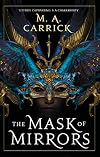
I received this novel from Orbit Books, through NetGalley, in exchange for an honest review: my thanks to both of them for this opportunity.
When I first became aware of The Mask of Mirrors I was intrigued because it promised to portray many of the elements I enjoy in a story, like a daring confidence game, many political maneuverings and an interesting social background. The book contains all of that and much more, delivering a story that went well beyond my initial expectations.
The city of show more Nadezra, formerly the center of the Vraszenian culture, has been for several generations under Liganti domination, the original inhabitants looked on by the conquerors as second-class citizens: in the past, the stipulation of the Accords created a sort of truce between the two factions, but social and political unrest are always ready to erupt at the slightest provocation. Ren, a former Vraszenian street urchin now graduated to successful con artist, has concocted a daring plan to insinuate herself in the powerful Traementis family posing as Renata Viraudax, the daughter of a relative who left Nadezra long ago: once accepted by these Liganti nobles she hopes to be able to enjoy all the comforts of wealth for herself and her adopted sister Tess, now posing as Renata’s maid.
Unfortunately, the Traementis are not as influential or wealthy as they used to be, and Ren finds herself enmeshed in ever-convoluted political schemes geared toward helping the Traementis regain their former status so that she can help herself in turn. This plot-within-plot game, however, turns out to be more than Ren could possibly handle, because it dovetails with someone’s malicious strategy to foment a Vraszenian insurrection whose short- and far-reaching consequences are worryingly unclear….
While I am reluctant to reveal more about the plot to avoid spoiling your pleasure in uncovering it as the story develops, I can enjoy much more freedom in the description of the fascinating background in which the novel is set, and of the wide range of characters peopling it: these two elements blend in a captivating whole, and if the pacing feels slightly on the slow side at the start of the book, I can assure you that once the avalanche starts its inexorable downward shift, it gains speed at a breakneck, breath-stealing pace until the conclusion.
Nadezra is a fascinating place: a city built on a series of islands connected by bridges and waterways, its Venice-like quality enhanced by the description of dark alleys and wide plazas, of canals hosting floating markets or covered by impenetrable fogs that conceal both beauty and misdeeds. It’s also a place of glaring contradictions where the mansions of the affluent give way to the poorest hovels or to the crumbling buildings from which crime lords direct their armies of young thugs. And where magic permeates many of the aspects of everyday life.
The two coexisting cultures engage in different kinds of magic: the Liganti employ numinatria, which requires channeling power through a form of numerology focused by special geometrical shapes, while the Vraszenian prefer a form of Tarot based on a deck of cards that show the pattern shaping any given individual’s life. Moreover, objects can be imbued, i.e. gifted with special properties that make them more effective in their everyday use. In this world magic is so pervasive as to be almost mundane at times, but it also plays a pivotal role in the story arc, and with literally mind-bending effects and consequences.
In such a fascinating background, the characters are equally intriguing, starting with Arenza or Ren, both as herself and in the assumed persona of Renata Viraudax: she is a consummate con artist with a harsh past, playing a dangerous scheme to ensure a comfortable future for herself and her adopted sister Tess. Ren is the perfect representative of Nadezran society, one where playing a part, saying a thing while thinking another, is the rule, and she manages this feat with consummate ability. It took me a little while to warm up to Ren (even though I enjoyed her character from page one) because of the callous way in which she acts, but as the story progressed I was able to see her frailties and insecurities, to learn the horrors of her past and to understand where she comes from, emotionally.
The perfect (and quite enjoyable) foil for Ren is represented by Derossi Vargo, a powerful mobster whose ambitions of cleaning up his act and joining respectable society make him an interesting, multi-layered character whose very unpredictability is his most fascinating quality. To call him ambiguous would be a massive understatement, and he maintains this ambiguity to the very end, where an important revelation enhanced my expectations for the next book in the series, particularly in respect of my deep curiosity about the identity and role of a certain Alsius - if you read the book, you know what I mean…
On the opposite side of the personality spectrum is Grey Serrado, a Vraszenian who joined the the city’s law enforcement ranks and is forced to walk a fine line between the pull of his origins and the need to bring order and justice to a city where both concepts are too often mistreated if not ignored: the tight rope of conflicting loyalties he’s forced to walk soon managed to earn my sympathy, and I hope he will be given more narrative space in the next installments, because I feel there is still an untapped potential there, one that the final section of the novel seems to point at.
And then there is the Rook, a mysterious, hooded and masked figure whose acts in defense of the poor and the weak have become legendary - and have been for some two hundred years, hinting at a series of people taking up that mantle over time.
These are the major players, but there are other figures I was able to appreciate, like Donaia Traementis, the iron lady at the head of the failing house, whose strength of character, even in the face of many adversities, is a delight to behold; or young Tess, Ren’s sidekick, accomplice and moral support, whose skills with needle and fabric offer many delightful descriptions of the gorgeous clothes that are such a great part of the story’s background. But the list does not end here, of course…
I had a great deal of fun with The Mask of Mirrors, its skillful blend of adventure, mystery and drawing-room verbal battles creating a rich, multi-layered story I enjoyed losing myself in: the seamless transitions from day-to-day life to vicious political battles, from high-end social gatherings to drug-induced, reality-bending nightmares, proved to be so compelling that it was hard to put the book down, and I hope that authors Marie Brennan and Alyc Helms - working here under the pen name of M.A. Carrick - will not make us wait too long for the next installment in this very promising series. show less
When I first became aware of The Mask of Mirrors I was intrigued because it promised to portray many of the elements I enjoy in a story, like a daring confidence game, many political maneuverings and an interesting social background. The book contains all of that and much more, delivering a story that went well beyond my initial expectations.
The city of show more Nadezra, formerly the center of the Vraszenian culture, has been for several generations under Liganti domination, the original inhabitants looked on by the conquerors as second-class citizens: in the past, the stipulation of the Accords created a sort of truce between the two factions, but social and political unrest are always ready to erupt at the slightest provocation. Ren, a former Vraszenian street urchin now graduated to successful con artist, has concocted a daring plan to insinuate herself in the powerful Traementis family posing as Renata Viraudax, the daughter of a relative who left Nadezra long ago: once accepted by these Liganti nobles she hopes to be able to enjoy all the comforts of wealth for herself and her adopted sister Tess, now posing as Renata’s maid.
Unfortunately, the Traementis are not as influential or wealthy as they used to be, and Ren finds herself enmeshed in ever-convoluted political schemes geared toward helping the Traementis regain their former status so that she can help herself in turn. This plot-within-plot game, however, turns out to be more than Ren could possibly handle, because it dovetails with someone’s malicious strategy to foment a Vraszenian insurrection whose short- and far-reaching consequences are worryingly unclear….
While I am reluctant to reveal more about the plot to avoid spoiling your pleasure in uncovering it as the story develops, I can enjoy much more freedom in the description of the fascinating background in which the novel is set, and of the wide range of characters peopling it: these two elements blend in a captivating whole, and if the pacing feels slightly on the slow side at the start of the book, I can assure you that once the avalanche starts its inexorable downward shift, it gains speed at a breakneck, breath-stealing pace until the conclusion.
Nadezra is a fascinating place: a city built on a series of islands connected by bridges and waterways, its Venice-like quality enhanced by the description of dark alleys and wide plazas, of canals hosting floating markets or covered by impenetrable fogs that conceal both beauty and misdeeds. It’s also a place of glaring contradictions where the mansions of the affluent give way to the poorest hovels or to the crumbling buildings from which crime lords direct their armies of young thugs. And where magic permeates many of the aspects of everyday life.
The two coexisting cultures engage in different kinds of magic: the Liganti employ numinatria, which requires channeling power through a form of numerology focused by special geometrical shapes, while the Vraszenian prefer a form of Tarot based on a deck of cards that show the pattern shaping any given individual’s life. Moreover, objects can be imbued, i.e. gifted with special properties that make them more effective in their everyday use. In this world magic is so pervasive as to be almost mundane at times, but it also plays a pivotal role in the story arc, and with literally mind-bending effects and consequences.
In such a fascinating background, the characters are equally intriguing, starting with Arenza or Ren, both as herself and in the assumed persona of Renata Viraudax: she is a consummate con artist with a harsh past, playing a dangerous scheme to ensure a comfortable future for herself and her adopted sister Tess. Ren is the perfect representative of Nadezran society, one where playing a part, saying a thing while thinking another, is the rule, and she manages this feat with consummate ability. It took me a little while to warm up to Ren (even though I enjoyed her character from page one) because of the callous way in which she acts, but as the story progressed I was able to see her frailties and insecurities, to learn the horrors of her past and to understand where she comes from, emotionally.
The perfect (and quite enjoyable) foil for Ren is represented by Derossi Vargo, a powerful mobster whose ambitions of cleaning up his act and joining respectable society make him an interesting, multi-layered character whose very unpredictability is his most fascinating quality. To call him ambiguous would be a massive understatement, and he maintains this ambiguity to the very end, where an important revelation enhanced my expectations for the next book in the series, particularly in respect of my deep curiosity about the identity and role of a certain Alsius - if you read the book, you know what I mean…
On the opposite side of the personality spectrum is Grey Serrado, a Vraszenian who joined the the city’s law enforcement ranks and is forced to walk a fine line between the pull of his origins and the need to bring order and justice to a city where both concepts are too often mistreated if not ignored: the tight rope of conflicting loyalties he’s forced to walk soon managed to earn my sympathy, and I hope he will be given more narrative space in the next installments, because I feel there is still an untapped potential there, one that the final section of the novel seems to point at.
And then there is the Rook, a mysterious, hooded and masked figure whose acts in defense of the poor and the weak have become legendary - and have been for some two hundred years, hinting at a series of people taking up that mantle over time.
These are the major players, but there are other figures I was able to appreciate, like Donaia Traementis, the iron lady at the head of the failing house, whose strength of character, even in the face of many adversities, is a delight to behold; or young Tess, Ren’s sidekick, accomplice and moral support, whose skills with needle and fabric offer many delightful descriptions of the gorgeous clothes that are such a great part of the story’s background. But the list does not end here, of course…
I had a great deal of fun with The Mask of Mirrors, its skillful blend of adventure, mystery and drawing-room verbal battles creating a rich, multi-layered story I enjoyed losing myself in: the seamless transitions from day-to-day life to vicious political battles, from high-end social gatherings to drug-induced, reality-bending nightmares, proved to be so compelling that it was hard to put the book down, and I hope that authors Marie Brennan and Alyc Helms - working here under the pen name of M.A. Carrick - will not make us wait too long for the next installment in this very promising series. show less

What a ride this book was! I mean, only by reading the blub I knew this was a book for me: a con artist, a vigilante and crime lord, plus magic? Count me in for the ride!
Ren was an absolute joy as a main character and I loved, loved, loved following her. She definitely has everything it takes to pull off such an elaborate con: she's incredibly smart and knows how to manipulate people, using her knowledge, beauty and talent for disguise to their full effect. She's also fiercely loyal, and I show more adored her relationship with her sister Tess. Multiple POVs alternate throughout the book, and I think that worked extremely well.
I ended up feeling really invested in all the key characters. Each of them had their share of dangerous secrets, and they were all extremely well-rounded and multilayered. Special shoutouts to Vargo, a crime lord trying to work his way into local nobility, and Serrado, the conflicted captain who wants to use the guards' resources to benefit the lower classes instead of the rich. I loved these two so much!
But this is just scratching the surface. In this book there are so. many. characters! The cast is extremely varied and diverse, and it got to the point where I really struggled to remember who everyone was (especially when some of the names look quite similar). I did find out that there was a character list at the end, which I hadn't realised up until I got there (joys of reading the e-arc version!), and I would have definitely consulted it frequently if I had! There was also a glossary, which again would have been very useful had I noticed its existence before getting to the end of the book, since I struggled with remembering a lot of this world's vocabulary. Definitely won't make that mistake again!
The world itself was beautifully built, with its complex society and history. I particularly liked that characters came from different backgrounds, and seeing the world through their eyes made it easier to understand the ethnic, religious and class conflict in the book. The local traditions were especially interesting, and so crucial to the plot, that it was a great pleasure to just learn more about them. The descriptions were quite detailed, which often was nice, but sometimes felt just a tad too long, and didn't really help the pace.
Now, the pace was where my biggest issue with this book was. I often have this problem with adult fantasy books, so it's most likely a case of "it's not you, it's me", but for a large part of the book it just felt as if I was stuck in a loop: it didn't matter how much I read in a sitting, I just wasn't moving forward. As I said, I loved the characters and I enjoyed spending time with them, and the plot was engaging, full of twists and turns and danger and revelations, but still... somehow the pace felt off. Again, this is most probably me rather than the book itself, but it took something away from the experience for me.
Overall, though, The Mask of Mirrors was a really great read. Filled with engaging characters, a complex world, lies, danger, magic and a gripping plot, it's the perfect companion in these long, cold winter days. I'll take the rest of this trilogy now, please and thank you, I need to know what Ren gets up to next!
I received an e-arc of this book for free from the publisher via NetGalley. This did not affect my opinion of the book in any way. show less
Ren was an absolute joy as a main character and I loved, loved, loved following her. She definitely has everything it takes to pull off such an elaborate con: she's incredibly smart and knows how to manipulate people, using her knowledge, beauty and talent for disguise to their full effect. She's also fiercely loyal, and I show more adored her relationship with her sister Tess. Multiple POVs alternate throughout the book, and I think that worked extremely well.
I ended up feeling really invested in all the key characters. Each of them had their share of dangerous secrets, and they were all extremely well-rounded and multilayered. Special shoutouts to Vargo, a crime lord trying to work his way into local nobility, and Serrado, the conflicted captain who wants to use the guards' resources to benefit the lower classes instead of the rich. I loved these two so much!
But this is just scratching the surface. In this book there are so. many. characters! The cast is extremely varied and diverse, and it got to the point where I really struggled to remember who everyone was (especially when some of the names look quite similar). I did find out that there was a character list at the end, which I hadn't realised up until I got there (joys of reading the e-arc version!), and I would have definitely consulted it frequently if I had! There was also a glossary, which again would have been very useful had I noticed its existence before getting to the end of the book, since I struggled with remembering a lot of this world's vocabulary. Definitely won't make that mistake again!
The world itself was beautifully built, with its complex society and history. I particularly liked that characters came from different backgrounds, and seeing the world through their eyes made it easier to understand the ethnic, religious and class conflict in the book. The local traditions were especially interesting, and so crucial to the plot, that it was a great pleasure to just learn more about them. The descriptions were quite detailed, which often was nice, but sometimes felt just a tad too long, and didn't really help the pace.
Now, the pace was where my biggest issue with this book was. I often have this problem with adult fantasy books, so it's most likely a case of "it's not you, it's me", but for a large part of the book it just felt as if I was stuck in a loop: it didn't matter how much I read in a sitting, I just wasn't moving forward. As I said, I loved the characters and I enjoyed spending time with them, and the plot was engaging, full of twists and turns and danger and revelations, but still... somehow the pace felt off. Again, this is most probably me rather than the book itself, but it took something away from the experience for me.
Overall, though, The Mask of Mirrors was a really great read. Filled with engaging characters, a complex world, lies, danger, magic and a gripping plot, it's the perfect companion in these long, cold winter days. I'll take the rest of this trilogy now, please and thank you, I need to know what Ren gets up to next!
I received an e-arc of this book for free from the publisher via NetGalley. This did not affect my opinion of the book in any way. show less
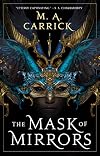
This originally appeared at The Irresponsible Reader.
---
WHAT'S THE MASK OF MIRRORS ABOUT?
What isn't it about, really? In The Princess Bride novel, the fictionalized William Goldman recounts how his father introduced the story to him:
“Does it have any sports in it?”
“Fencing. Fighting. Torture. Poison. True love. Hate. Revenge. Giants. Hunters. Bad men. Good men. Beautifulest ladies. Snakes. Spiders. Beasts of all natures and descriptions. Pain. Death. Brave men. Coward men. Strongest show more men. Chases. Escapes. Lies. Truths. Passion. Miracles."
That would work as a decent start on a list of what this book is about (except the bit about Giants, maybe they'll be in the sequel), but just as a start. There's just no way to say what this book contains briefly. At times it felt like Carrick* took an "everything but the kitchen sink—and all right, we'll throw that in, too" approach.
* Yes, I know that Carrick actually equals two authors, but there's one name on the cover and it's just easier to play along with the conceit for the purposes of this post.
If you find yourself not particularly enjoying a storyline (either at all, or in a particular moment), that's fine, just wait a couple of pages and you'll be on to another that will quite possibly be to your liking.
Yeah, often this kind of thing feels unwieldy, clumsy, and hard to follow. But somehow—Carrick pulls it off. It's a grand-scale novel—focusing on several people, classes, and segments of the city, but feels very contained, very personal, and not all that difficult to take in at once.
I joked while reading this that I didn't know how I was going to be able to talk about this novel in less than 10,000 words. And I really think it's true if I wanted to do a complete job. But no one wants me to do that. So I'll set "complete" aside and go for "almost adequate" instead. The best way to do that is to start our discussion with the initial plotline:
THE LONG CON
Years ago, Ren and Tess were low-level thieves, working for a Fagin-esque character. The sisters split from that group in a fairly dramatic fashion and left the city of Nadežra. Now, they're back to make their fortune. Ren poses as Renata Viraudux, an estranged family member of one of the city's noble families, with Tess at her side as Renata's maid.
The plan is to endear themselves to the Traementis family and to be officially listed as one of them. She can then plunder their accounts and set the two of them up for a comfortable life. Ren had a good period of time working as the maid of the woman she's now pretending is her mother, so she knows her, she knows stories about her family—so she's able to pull off the con pretty well (at least at first).
But there's a catch..the Traementis family is on the verge of falling apart. Tragedy has whittled the family away to Donaia (the family's head and the sister-in-law of Letilia, Renata's supposed mother) and her two children, Leato and Giuna. And the family's material wealth has been chipped away even more. There's enough to barely sustain their lifestyle, and Donaia isn't sure how long she can continue doing that. Some nobility suspects this to be true, but no one other than Donaia knows it—Renata is very ignorant about the status of her targets. Which almost makes her doomed before she begins.
Do note that "almost," because Ren is as clever and resourceful as you could want for this situation. Once she discovers the family's situation, she's not going to let a simple thing like the verge of bankruptcy stop her.
There are times when I almost wanted Ren to get caught—protagonist or not, she has it coming and you will frequently like Leato and Giuna a lot more than her (also, it'd be a lot of fun to see Ren try to get out of it). But overall, you get sucked into her cause and find yourself rooting for her.
In many ways, this story is the heart of the novel. But the more I thought about it as I read—this story is really just an excuse to get Ren involved in everything else going on in Nadežra, and it could practically be eliminated without doing a lot of damage to the book. It is, however, a load-bearing plotline and can't be removed without doing structural damage (it just feels like it). That may seem like a criticism, but it's not intended to be one—I find myself oddly drawn to the idea that there's enough other things of interest and weight going on that you could excise the Primary Plotline and still have a novel worth reading.
THE MASKED VIGILANTE
Nadežra, like all good fictional cities, has a masked vigilante running around. The Rook has been a presence for a couple of centuries, defending the helpless, punishing the wicked—particularly if they're part Of the nobility. The Rook is sort of a Batman/Zorro-esque figure, stepping out of the shadows (or on the rooftops). We meet him first as he comes to duel with an arrogant twit over an offense straight out of Cyrano de Bergerac, and who can resist that? He remains a favorite part of the novel for me, dropping in at pivotal moments, but not becoming a focus for long.
Ren quickly becomes fixated on him and in discovering his identity. It is fun watching her try and try to either discover or figure out his identity.
THE QUEST FOR LEGITIMACY
Derossi Vargo, how do I discuss him? Think Lando Calrissian meets Michael Corleone. Vargo has spent years building and building his power base and at the time that Ren comes to the city, he's at the top of the criminal portion of the city. He's so powerful now that he's itching to shed that side of him and embrace being a legitimate businessman. He just needs the chance.
Renata sees this and forms an alliance with him. He aids her in some of her schemes to prop up the Traementis family's standings and success and she, in turn, will help him with his schemes. Neither fully trusts the other, but they can be of mutual benefit to one another, and that's enough for them. The relationship builds from this point—but both Ren and Vargo are careful enough with their secrets, their plans, and their ambitions to truly let the other see what's going on—but they have that in common and can respect that.
Vargo is charming and suave, and it's easy for the reader or other characters to get swept up in that to the extent that they forget how he got to the position he's in. There's a cunning and ruthless criminal underneath his finery and smooth words. At the end of the day, Vargo is about Vargo's success, and if you're in his way—you need to watch yourself.
AN EYE FOR TAILORING
Now, while I had moments where I thought it'd be good to have Ren captured by the authorities, I never thought that for a moment about her sister, Tess. And Tess is the best argument for keeping Ren free and clear—I just couldn't stomach her being injured or imprisoned herself (and either would happen if Ren fell). She's one of those characters that readers immediately fall in love with and want to treat as a little sister. Woe betide any author who hurts her, I can't imagine readers of this series letting anyone get away with that.
She's Ren's accomplice, for sure, but she's not in her sister's league when it comes to criminal behavior. She's sweet, she's not out to get rich—she just wants enough to be able to have enough money that she could design and make dresses—maybe do a little cooking. There's a hint of a romance for her, and I found myself more invested in her happiness in that than I have been in other romances that form the central plot in several other books lately.
Tess has no magic abilities (that we know of), but she might as well have some when it comes to fabrics. She single-handedly keeps Ren at the forefront of Nadežran fashion, usually using scraps and bargain fabrics from the market. Her reactions to other people's fine tailoring are a delight (she practically swoons the first time she encounters Vargo over the cut of his jacket). Frequently this is the only source of comic relief in some pretty dark places of the novel.
THE CARDS
One of the aspects of this novel, this world, that I appreciated most is a Tarot-like practice. The cards are called a Pattern Deck. Much like Tarot, the cards are cut and dealt out, then interpreted (and there's both an art and a skill involved in that). There are people who read patterns (szoras), some of whom have the gift to truly do this and some are hucksters just making money off gullible patrons. I think it's that fact that sold me on the novel. How often in Fantasy novels do you get that? A magic system that's true, that really works, and yet many/most of its practitioners don't have the necessary ability, yet continue to practice?
THE WORLDBUILDING
As you read this and come across references to cultures and historical events/people, you almost get the impression that Carrick has a two or three-volume set of books on the history and culture of Nadežra to draw from. Not that the text approaches an info dump ever (even when you wouldn't mind a little one), and Carrick is very sparing with the details drawn from my theoretical three volumes.
The world, the various religions, and magic systems, the system of nobility and government the cultures that make up the populace of Nadežra . . . it's all so well and richly developed that it has to impress the reader. I love a good bit of worldbuilding as much as the next guy, and it doesn't get much better than this.
SO, WHAT DID I THINK ABOUT THE MASK OF MIRROR?
Time does not permit me to keep going (and, let's be honest, this is already getting obnoxiously long), so let's try to wrap it up (if only so I can go over my notes and see what all I forgot to mention).
This is an impressive novel. At one point I was going to try to discuss the greater themes this work dealt with. But I think it would be almost as Sisyphean as trying to list the plots in this brief of a post. For a long time, I was going to talk about the futility of vengeance. But I'm not that certain it's correct (maybe by the end of the series, I'll have an idea what they're trying to say about revenge). There's a great deal said about family, loyalty, being trapped by history (personal and cultural), perception, and...you know what? I'm falling into that trap I'd tried to avoid. There's a lot to chew on while reading beyond the story and characters—and you'll easily keep mulling on the novel and whatever themes you were more interested in from it for days.
Carrick has a wonderful style, there are some very cleverly assembled sentences here—and the way the story is told is clever and impressive, also. There were times when I didn't care all that much about the characters being focused on or a storyline, but I couldn't stop reading, I had to know what was going to happen next. I'm not sure how that's possible to have no (conscious) investment or interest in people or what's happening to them, but an intense desire to know what's next for them. But Carrick does it—and does it in such a way that pretty soon I was interested in at least the story or characters again (usually both).
The plots (individually considered) are complex and layered, meticulously assembled and paced well throughout the novel's progress. Then Carrick takes them and weaves them together in an intricate and smart way to make these plotlines a rich tapestry. The skill necessary for this, and the effect this has is stunning. I am a little concerned that when the sequel is published I won't be able to remember enough of this to be able to dive in—and that's the worst thing I can say about the book.
I can't quite bring myself to give this all 5 stars, but I don't feel too bad, when I cross-post this to platforms that won't let me get away with half-stars I'll end up rounding up. It's entertaining, it's impressive, it's richly and wonderfully told, it's complex and filled with complex and developed characters. It's as difficult to succinctly evaluate the book as it is to describe it.
I guess I should just say: read The Mask and the Mirror, it's absolutely worth your time and you'll thank me for it. You'll also see why I'm having trouble crystallizing my thoughts. show less
---
WHAT'S THE MASK OF MIRRORS ABOUT?
What isn't it about, really? In The Princess Bride novel, the fictionalized William Goldman recounts how his father introduced the story to him:
“Does it have any sports in it?”
“Fencing. Fighting. Torture. Poison. True love. Hate. Revenge. Giants. Hunters. Bad men. Good men. Beautifulest ladies. Snakes. Spiders. Beasts of all natures and descriptions. Pain. Death. Brave men. Coward men. Strongest show more men. Chases. Escapes. Lies. Truths. Passion. Miracles."
That would work as a decent start on a list of what this book is about (except the bit about Giants, maybe they'll be in the sequel), but just as a start. There's just no way to say what this book contains briefly. At times it felt like Carrick* took an "everything but the kitchen sink—and all right, we'll throw that in, too" approach.
* Yes, I know that Carrick actually equals two authors, but there's one name on the cover and it's just easier to play along with the conceit for the purposes of this post.
If you find yourself not particularly enjoying a storyline (either at all, or in a particular moment), that's fine, just wait a couple of pages and you'll be on to another that will quite possibly be to your liking.
Yeah, often this kind of thing feels unwieldy, clumsy, and hard to follow. But somehow—Carrick pulls it off. It's a grand-scale novel—focusing on several people, classes, and segments of the city, but feels very contained, very personal, and not all that difficult to take in at once.
I joked while reading this that I didn't know how I was going to be able to talk about this novel in less than 10,000 words. And I really think it's true if I wanted to do a complete job. But no one wants me to do that. So I'll set "complete" aside and go for "almost adequate" instead. The best way to do that is to start our discussion with the initial plotline:
THE LONG CON
Years ago, Ren and Tess were low-level thieves, working for a Fagin-esque character. The sisters split from that group in a fairly dramatic fashion and left the city of Nadežra. Now, they're back to make their fortune. Ren poses as Renata Viraudux, an estranged family member of one of the city's noble families, with Tess at her side as Renata's maid.
The plan is to endear themselves to the Traementis family and to be officially listed as one of them. She can then plunder their accounts and set the two of them up for a comfortable life. Ren had a good period of time working as the maid of the woman she's now pretending is her mother, so she knows her, she knows stories about her family—so she's able to pull off the con pretty well (at least at first).
But there's a catch..the Traementis family is on the verge of falling apart. Tragedy has whittled the family away to Donaia (the family's head and the sister-in-law of Letilia, Renata's supposed mother) and her two children, Leato and Giuna. And the family's material wealth has been chipped away even more. There's enough to barely sustain their lifestyle, and Donaia isn't sure how long she can continue doing that. Some nobility suspects this to be true, but no one other than Donaia knows it—Renata is very ignorant about the status of her targets. Which almost makes her doomed before she begins.
Do note that "almost," because Ren is as clever and resourceful as you could want for this situation. Once she discovers the family's situation, she's not going to let a simple thing like the verge of bankruptcy stop her.
There are times when I almost wanted Ren to get caught—protagonist or not, she has it coming and you will frequently like Leato and Giuna a lot more than her (also, it'd be a lot of fun to see Ren try to get out of it). But overall, you get sucked into her cause and find yourself rooting for her.
In many ways, this story is the heart of the novel. But the more I thought about it as I read—this story is really just an excuse to get Ren involved in everything else going on in Nadežra, and it could practically be eliminated without doing a lot of damage to the book. It is, however, a load-bearing plotline and can't be removed without doing structural damage (it just feels like it). That may seem like a criticism, but it's not intended to be one—I find myself oddly drawn to the idea that there's enough other things of interest and weight going on that you could excise the Primary Plotline and still have a novel worth reading.
THE MASKED VIGILANTE
Nadežra, like all good fictional cities, has a masked vigilante running around. The Rook has been a presence for a couple of centuries, defending the helpless, punishing the wicked—particularly if they're part Of the nobility. The Rook is sort of a Batman/Zorro-esque figure, stepping out of the shadows (or on the rooftops). We meet him first as he comes to duel with an arrogant twit over an offense straight out of Cyrano de Bergerac, and who can resist that? He remains a favorite part of the novel for me, dropping in at pivotal moments, but not becoming a focus for long.
Ren quickly becomes fixated on him and in discovering his identity. It is fun watching her try and try to either discover or figure out his identity.
THE QUEST FOR LEGITIMACY
Derossi Vargo, how do I discuss him? Think Lando Calrissian meets Michael Corleone. Vargo has spent years building and building his power base and at the time that Ren comes to the city, he's at the top of the criminal portion of the city. He's so powerful now that he's itching to shed that side of him and embrace being a legitimate businessman. He just needs the chance.
Renata sees this and forms an alliance with him. He aids her in some of her schemes to prop up the Traementis family's standings and success and she, in turn, will help him with his schemes. Neither fully trusts the other, but they can be of mutual benefit to one another, and that's enough for them. The relationship builds from this point—but both Ren and Vargo are careful enough with their secrets, their plans, and their ambitions to truly let the other see what's going on—but they have that in common and can respect that.
Vargo is charming and suave, and it's easy for the reader or other characters to get swept up in that to the extent that they forget how he got to the position he's in. There's a cunning and ruthless criminal underneath his finery and smooth words. At the end of the day, Vargo is about Vargo's success, and if you're in his way—you need to watch yourself.
AN EYE FOR TAILORING
Now, while I had moments where I thought it'd be good to have Ren captured by the authorities, I never thought that for a moment about her sister, Tess. And Tess is the best argument for keeping Ren free and clear—I just couldn't stomach her being injured or imprisoned herself (and either would happen if Ren fell). She's one of those characters that readers immediately fall in love with and want to treat as a little sister. Woe betide any author who hurts her, I can't imagine readers of this series letting anyone get away with that.
She's Ren's accomplice, for sure, but she's not in her sister's league when it comes to criminal behavior. She's sweet, she's not out to get rich—she just wants enough to be able to have enough money that she could design and make dresses—maybe do a little cooking. There's a hint of a romance for her, and I found myself more invested in her happiness in that than I have been in other romances that form the central plot in several other books lately.
Tess has no magic abilities (that we know of), but she might as well have some when it comes to fabrics. She single-handedly keeps Ren at the forefront of Nadežran fashion, usually using scraps and bargain fabrics from the market. Her reactions to other people's fine tailoring are a delight (she practically swoons the first time she encounters Vargo over the cut of his jacket). Frequently this is the only source of comic relief in some pretty dark places of the novel.
THE CARDS
One of the aspects of this novel, this world, that I appreciated most is a Tarot-like practice. The cards are called a Pattern Deck. Much like Tarot, the cards are cut and dealt out, then interpreted (and there's both an art and a skill involved in that). There are people who read patterns (szoras), some of whom have the gift to truly do this and some are hucksters just making money off gullible patrons. I think it's that fact that sold me on the novel. How often in Fantasy novels do you get that? A magic system that's true, that really works, and yet many/most of its practitioners don't have the necessary ability, yet continue to practice?
THE WORLDBUILDING
As you read this and come across references to cultures and historical events/people, you almost get the impression that Carrick has a two or three-volume set of books on the history and culture of Nadežra to draw from. Not that the text approaches an info dump ever (even when you wouldn't mind a little one), and Carrick is very sparing with the details drawn from my theoretical three volumes.
The world, the various religions, and magic systems, the system of nobility and government the cultures that make up the populace of Nadežra . . . it's all so well and richly developed that it has to impress the reader. I love a good bit of worldbuilding as much as the next guy, and it doesn't get much better than this.
SO, WHAT DID I THINK ABOUT THE MASK OF MIRROR?
Time does not permit me to keep going (and, let's be honest, this is already getting obnoxiously long), so let's try to wrap it up (if only so I can go over my notes and see what all I forgot to mention).
This is an impressive novel. At one point I was going to try to discuss the greater themes this work dealt with. But I think it would be almost as Sisyphean as trying to list the plots in this brief of a post. For a long time, I was going to talk about the futility of vengeance. But I'm not that certain it's correct (maybe by the end of the series, I'll have an idea what they're trying to say about revenge). There's a great deal said about family, loyalty, being trapped by history (personal and cultural), perception, and...you know what? I'm falling into that trap I'd tried to avoid. There's a lot to chew on while reading beyond the story and characters—and you'll easily keep mulling on the novel and whatever themes you were more interested in from it for days.
Carrick has a wonderful style, there are some very cleverly assembled sentences here—and the way the story is told is clever and impressive, also. There were times when I didn't care all that much about the characters being focused on or a storyline, but I couldn't stop reading, I had to know what was going to happen next. I'm not sure how that's possible to have no (conscious) investment or interest in people or what's happening to them, but an intense desire to know what's next for them. But Carrick does it—and does it in such a way that pretty soon I was interested in at least the story or characters again (usually both).
The plots (individually considered) are complex and layered, meticulously assembled and paced well throughout the novel's progress. Then Carrick takes them and weaves them together in an intricate and smart way to make these plotlines a rich tapestry. The skill necessary for this, and the effect this has is stunning. I am a little concerned that when the sequel is published I won't be able to remember enough of this to be able to dive in—and that's the worst thing I can say about the book.
I can't quite bring myself to give this all 5 stars, but I don't feel too bad, when I cross-post this to platforms that won't let me get away with half-stars I'll end up rounding up. It's entertaining, it's impressive, it's richly and wonderfully told, it's complex and filled with complex and developed characters. It's as difficult to succinctly evaluate the book as it is to describe it.
I guess I should just say: read The Mask and the Mirror, it's absolutely worth your time and you'll thank me for it. You'll also see why I'm having trouble crystallizing my thoughts. show less
Lists
Awards

You May Also Like


Associated Authors
Statistics
- Works
- 5
- Members
- 1,525
- Popularity
- #16,865
- Rating
- 4.2
- Reviews
- 31
- ISBNs
- 32
- Languages
- 2