
Leslie T. Chang
Author of Factory Girls: From Village to City in a Changing China
About the Author
Image credit: Promo photo from Random House
Works by Leslie T. Chang
Associated Works
Lapham's Quarterly - Lines of Work: Volume IV, Number 2, Spring 2011 (2011) — Contributor — 32 copies, 2 reviews
Tagged
Common Knowledge
- Birthdate
- 1969
- Gender
- female
- Education
- Harvard University
- Occupations
- journalist
- Relationships
- Hessler, Peter (husband)
- Nationality
- USA
- Birthplace
- New York, USA
- Places of residence
- Ridgway, Colorado, USA
China
Cairo, Egypt - Associated Place (for map)
- USA
Members
Reviews
t is very hard to get reliable generalizations about today's China, thus the need for Chang's personal approach were we see the country one person and one snap shot at a time (mainly two girl's lives). My large complaint about the book is the author's inclusion of her family's history although full of interest that had so little to do with those young women working in the south of China. Compared with my own piece by piece knowledge of China's rural and small town populace the stories show more presented show great authenticity and insight and the relatively few generalizations expressed seem fair, needed and heightened while showing the reader some examples of the vital changes taking place in China.
Quotes: (page 30) “ So Dongguan was a place with conflicting versions of its past---one of a high-profile rejection of foreign presence in China, the other a stealthy embrace of it. Every Chinese school child learns about the burning of opium. But from the Taiping Handbag Factory, which did not appear in any textbook, I could trace a direct line to everyone I met in Dongguan...”
(page 316) 'The Chinese today have a trouble relationship with their past. On the surface, they take pride in it---China has five thousand years of history is constantly reminded as an American---but there is an aversion to going much deeper than the level of a Qing Dynasty television soap opera. Why did a great civilization collapse so rapidly when confronted by the West? What made people turn so readily on each other---in workplaces, in villages in families---during the political movements of the 1950s and 1960s? And how could they pick up their lives afterward as if nothing had happened?
The last question is the easiest: through forgetting. The Communist Party has not acknowledged the scale of catastrophes like the famine of the late 1950s and the Cultural Revolution.” show less
Quotes: (page 30) “ So Dongguan was a place with conflicting versions of its past---one of a high-profile rejection of foreign presence in China, the other a stealthy embrace of it. Every Chinese school child learns about the burning of opium. But from the Taiping Handbag Factory, which did not appear in any textbook, I could trace a direct line to everyone I met in Dongguan...”
(page 316) 'The Chinese today have a trouble relationship with their past. On the surface, they take pride in it---China has five thousand years of history is constantly reminded as an American---but there is an aversion to going much deeper than the level of a Qing Dynasty television soap opera. Why did a great civilization collapse so rapidly when confronted by the West? What made people turn so readily on each other---in workplaces, in villages in families---during the political movements of the 1950s and 1960s? And how could they pick up their lives afterward as if nothing had happened?
The last question is the easiest: through forgetting. The Communist Party has not acknowledged the scale of catastrophes like the famine of the late 1950s and the Cultural Revolution.” show less
Late in the book there is a disturbing account of a small-scale business operation in an apartment in Dongguan, Guangdong Province. The male running it keeps his female underlings working all day and forbids to them to leave the apartment except for a few hours once a week; they sleep in a cramped dormitory-style bedroom. Quiz: this operation is A) a brothel, B) a sweatshop, C) a religious cult, D) none of the above. D is correct: it's a private English language school for adults, mainly show more female factory workers between jobs who want to gain English credentials. Their teacher's notion of language learning is, like so much in China, quantitative-based and modeled on the factory assembly line: a machine he invented rapidly rotate words which the students must memorize as they flash by. This episode in Leslie Chang's book is representative in presenting two aspects of life in China for the hundreds of millions of migrant workers trying to achieve career stability or success in the city. On the one hand, there is the optimistic assessment, emphasized by Chang throughout the book, namely the freedom migrants now have to leave the village and go where opportunity beckons, with increasing numbers of success stories, primarily for female migrants, who often paradoxically enjoy greater freedom than males due to the obligations of male migrants to return to the village and care for their family. As Chang recounts with the stories of two migrants she befriended and followed for two years, Min and Chunming, the choices young Chinese women from the countryside now have at their disposal for upward mobility can be compared to the freedom and allure of worldwide travel young people from the developed world enjoy.
On the other hand, there is a powerful counterforce holding many Chinese back from freedom and autonomy: the imposing psychological control of group conformity. As a longtime American resident in China, I see this all the time in numerous guises among all social strata, not just migrants (and I write about this in my website attached to my Amazon profile). Although it is true that working conditions in factories have been improving over the past few years as workers learn about their rights and bargaining power through better communication (the internet) as well as negative publicity about labor exploitation at Foxconn, this still largely applies to skilled factory workers. For countless other workers in the service industry (restaurants, shop workers, the sex industry), working conditions remain awful - 12-14 hour days, 1-2 days off per month, minimum wage. Educated white-collar workers, for their part, experience a different kind of exploitation, hardly less grim: typically just as long working hours (though varying considerably from company to company) or 24-hour cellphone monitoring when off work, with elaborate penalty systems for failure to respond immediately to cellphone summons or other minor infractions (one highly educated female I know who worked as a journalist for a national newspaper quit because they were docking too much of her pay each month for largely unspecified penalties).
So returning to the aforementioned English training school, where Chang would describe the conditions experienced by these women as a matter of personal freedom and choice, we also recoil at the psychological coercion involved, which prevents them from rebelling, protesting and leaving. To be sure, this school is a bizarre exception, and most English schools in China, even unaccredited ones, are run like normal schools, with students present only during class hours. But another book needs to be written that deals with the dark side of China's economic success, even in these upwardly mobile times. It's good to have Chang's upbeat account, but for every migrant who achieves success like Min, how many millions of Chinese (including the educated class) remain locked and paralyzed in their internal cages of fear and anger, quietly spending their entire waking hours making superiors rich while they receive a pittance (not to mention the horrifying ongoing problem of companies that don't pay their workers at all, even an entire year's promised wages, folding up operations just before the Spring Festival and disappearing). After years of teaching in Chinese universities, I could see the mental slavery all around me on university campuses, which unlike universities almost anywhere in the world, are completely void of any signs of student protests. Largely enabling and ensuring China's economic expansion, in short, is group coercion and internalized fear on a scale few other societies know. show less
On the other hand, there is a powerful counterforce holding many Chinese back from freedom and autonomy: the imposing psychological control of group conformity. As a longtime American resident in China, I see this all the time in numerous guises among all social strata, not just migrants (and I write about this in my website attached to my Amazon profile). Although it is true that working conditions in factories have been improving over the past few years as workers learn about their rights and bargaining power through better communication (the internet) as well as negative publicity about labor exploitation at Foxconn, this still largely applies to skilled factory workers. For countless other workers in the service industry (restaurants, shop workers, the sex industry), working conditions remain awful - 12-14 hour days, 1-2 days off per month, minimum wage. Educated white-collar workers, for their part, experience a different kind of exploitation, hardly less grim: typically just as long working hours (though varying considerably from company to company) or 24-hour cellphone monitoring when off work, with elaborate penalty systems for failure to respond immediately to cellphone summons or other minor infractions (one highly educated female I know who worked as a journalist for a national newspaper quit because they were docking too much of her pay each month for largely unspecified penalties).
So returning to the aforementioned English training school, where Chang would describe the conditions experienced by these women as a matter of personal freedom and choice, we also recoil at the psychological coercion involved, which prevents them from rebelling, protesting and leaving. To be sure, this school is a bizarre exception, and most English schools in China, even unaccredited ones, are run like normal schools, with students present only during class hours. But another book needs to be written that deals with the dark side of China's economic success, even in these upwardly mobile times. It's good to have Chang's upbeat account, but for every migrant who achieves success like Min, how many millions of Chinese (including the educated class) remain locked and paralyzed in their internal cages of fear and anger, quietly spending their entire waking hours making superiors rich while they receive a pittance (not to mention the horrifying ongoing problem of companies that don't pay their workers at all, even an entire year's promised wages, folding up operations just before the Spring Festival and disappearing). After years of teaching in Chinese universities, I could see the mental slavery all around me on university campuses, which unlike universities almost anywhere in the world, are completely void of any signs of student protests. Largely enabling and ensuring China's economic expansion, in short, is group coercion and internalized fear on a scale few other societies know. show less
Factory Girls is set mostly in the Guangdong province of China where, among other things, 1/3 of the world's shoes and are made. The girls who go out from their rural farms to try to earn money and find an exciting life working in factories are the epitome of Norman Rockwell American cliched individualism. In fact cliche seem to be the basis for much of their planning. They are taken advantage of at every turn, cheated, mistreated, overlooked and overused and keep on striving for a better show more life. The book is fascinating on both a political and personal level. These young girls, and 80% of the workers in the factories are young women, come from farms where they have little power, where the living is communal, where the eldest male is the person to make decisions about everyone's life. They go to factories where they are all on their own, and they emphasize the fact that there is no one to help them, their decisions are their own. The bunk in factory rooms with 4 to 11 other women, they work 8 (at the least) to a mandated 12 or more hours a day with Sundays and maybe half day Saturdays (when business is slow) off. They scheme to find a way to earn a few hundred more yuan a month. They jump factory to factory, they turn to their families for advice but frequently don't heed it, they send money home to the farm but begin spending for themselves. They buy shoes and clothes, makeup, vitamin supplements and above all cell phones - their life lines. They meet men, they have affairs, they may not marry, they fall for pyramid schemes and they start their own businesses. They chase the American dream of personal and financial independence. I think most American women would never want their lives, but it appears more and more rural Chinese are going out to the factories and never going home to family control again. China is changing. These women don't care about politics, but the release from the power of family authority must effect the politics of the country, I would think. show less
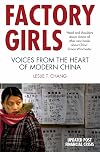
Most books written about modern day China are patronising rubbish. its all so terrible, its all going to fall apart, it can't last. etc etc This is exceptional in its honest, sympathetic and human treatment of real people and real lives, and is shows how - just as is in the west - the industrial revolution is giving women the power to change and control their own lives, and to find their own paths. Yes factory conditions are bad, and the ability to "eat bitterness" is a pre requisite just as show more it was in America in the 19th century and Britain in the 18th century. But millions jump at the chance, not just for small wages but for the chance to be part of the modern world and for individual freedom. And this new found economic independence and personal liberty is changing family relations and the fabric of society very quickly.
The book focuses on two young women, Min and Chungmin, and their struggles to advance up the economic ladder, with little education and no support but their own wits and intelligence. Are they representative? Probably not - they were open minded enough to make the friendship of a foreign, albeit Chinese speaking, journalist. Are their stories typical? Very much so and as Chang herself points out the story of Napoleon's lowest foot soldier is more important that the story of Napoleon.
I couldn't agree more. A tremendous book show less
The book focuses on two young women, Min and Chungmin, and their struggles to advance up the economic ladder, with little education and no support but their own wits and intelligence. Are they representative? Probably not - they were open minded enough to make the friendship of a foreign, albeit Chinese speaking, journalist. Are their stories typical? Very much so and as Chang herself points out the story of Napoleon's lowest foot soldier is more important that the story of Napoleon.
I couldn't agree more. A tremendous book show less
Lists
Awards


You May Also Like


Associated Authors
Statistics
- Works
- 2
- Also by
- 1
- Members
- 1,092
- Popularity
- #23,527
- Rating
- 3.9
- Reviews
- 45
- ISBNs
- 29
- Languages
- 7
- Favorited
- 3