
Anand Gopal
Author of No Good Men Among the Living: America, the Taliban, and the War through Afghan Eyes
About the Author
Anand Gopal is a journalist and author of No Good Men Among the Living: America, the Taliban and the War Through Afghan Eyes, which describes the travals of three Afghans caught in the war on terror. It was a finalist for the 2015 Pulitzer Prize in non-fiction, the 2014 National Book Award and the show more 2015 Helen Bernstein Award. It was awarded the 2015 Ridenhour Prize for demonstrating "why the United States' emphasis on counterterrorism at the expense of nation-building and reconciliation inadvertently led to the Taliban's resurgence after 2001. Gopal is notable for his reporting in Afghanistan and the Middle East. He is believed to be one of the few Western journalists to have embedded with the Taliban, an experience that forms part of the basis of No Good Men Among the Living. In 2012 Gopal reported for Harper's Magazine on the town of Taftanaz in Syria, which suffered a massacre at the hands of the regime of Bashar al-Assad. In 2014 he reported for Harper's on a murderous U.S.-backed police chief in Kandahar, Afghanistan. He has reported for the Wall Street Journal, the Christian Science Monitor and Harpers and other outlets. (Bowker Author Biography) show less
Image credit: from Arizona State University faculty page
Works by Anand Gopal
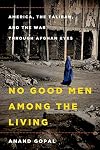
No Good Men Among the Living: America, the Taliban, and the War through Afghan Eyes (2014) 380 copies, 23 reviews
The Anti-Inauguration: Building Resistance in the Trump Era (2016) — Contributor — 33 copies, 1 review
Associated Works
Tagged
Common Knowledge
- Gender
- male
- Education
- Columbia University (PhD)
- Occupations
- Assistant Research Professor, Center on the Future of War, School of Politics and Global Studies, Arizona State University
Writer for The New Yorker
Afghanistan War Commission, Commissioner
Wallstreet Journal, Afghanistan Correspondent - Awards and honors
- Ridenhour Prize for Journalism (2015)
- Nationality
- USA
- Places of residence
- Arizona, USA
Manhattan, New York, USA - Map Location
- USA
Members
Reviews
A useful companion read to 'The Good War', this book is less focussed on and covers fewer of the strategic failings of the coalition intervention, but contains some moving personal stories, and brings out very clearly an element of American strategic ignorance in Afghanistan which that book did not describe in such detail: coalition forces injected themselves into what they saw as a war against the Taliban, when in fact the Taliban were only relatively recent victors in a longer civil war show more that had descended into inter-tribal conflicts that still lay close under the surface. When coalition forces chose whom to engage with to promote their anti-Taliban agenda, they often unwittingly engaged with one tribe and its leader, and so implicitly against a rival tribe and its leader. Smart tribal leaders fed disinformation to coalition forces in order to use them in the age-old game of deploying foreign imperial force against local rivals. This was at the root of much of the disaster as coalition soldiers arrested, imprisoned, tortured and killed people fingered by their tribal allies masquerading as anti-Taliban, pro-government loyalists. The author records tit-for-tat games of life and death, including one where two rival centres of government in a city were simultaneously raided in the night with extreme violence. The result of operating with ignorance of the local scene was captivity to the interests and prejudices of canny local leaders pursuing vendettas, and jails from Bagram to Guantanamo filled with innocent people accused of Taliban and AQ connections. The author says the Americans did by far the worst job in this regard because they were by far the most willing to deploy force in service of their goals. The book argues that this is the process that caused the Taliban insurgency to regroup from an initial post-invasion demise in which the movement quickly collapsed and leaders and footsoldiers sought to come in from the cold. This issue is the most important strategic point the book has to make, and it has much less to say than 'The Good War' about the roles of opium, patriarchy or competing agencies, so I recommend reading 'The Good War' and this book for a rounded picture of the failure. show less
Black and white thinking just doesn't work in a gray labyrinth. That's why America -- and the Soviet Union earlier -- struggled in seeking to fashion Afghanistan's government and politics. Perhaps there should be a rule requiring Afghanistan be colored gray on any map as a warning about how gray and tangled it is. At least that's my conclusion from reading Anand Gopal's No Good Men Among the Living: America, the Taliban, and the War through Afghan Eyes. Although attempting to tell the story show more of America's military efforts in Afghanistan from the perspective of the Afghanis, it provides a much deeper insight.
Gopal, who was an Afghanistan correspondent for The Wall Street Journal and The Christian Science Monitor, spent a great deal of time traveling the country, seeking to meet and understand various elements of the society. With hundreds of hours of interviews and who knows how many dangerous miles, he uses the lives of enemy, ally and civilian to explore life there since 9/11. Although discussing numerous other fighters and tribal leaders, No Good Men Among the Living is built around a Taliban commander (who was among many who tried to surrender to the U.S.), a member of the U.S.-backed Afghan government (who was among many using that relationship to build wealth and power and extract revenge against rivals), and a Kabul University-educated woman (who ends up a burqa-clad housewife in a remote, conservative village).
What do their lives tell us? That almost any alliance is subject to change when there is an advantage in doing so. That the clannish nature of the various ethnic groups creates fissures that greatly influence alliances and loyalties, fissures outsiders may not recognize and certainly may never understand. That urban and rural life are dramatically different worlds. That putting people and things into black and white categories is largely fatal to any attempt to create a "better" Afghanistan.
Take the Taliban commander, Mullah Cable, for example. Cable, a Pashtun whose given name is Akbar Gul, has no formal religious instruction. He ended up in the Taliban (largely-Pashtun based) when his brother and cousin were executed in Kabul by a Uzbek militia group that was part of the Northern Alliance. Still a teenager, Cable joined a Pashtun militia group and by 2001 was a leading frontline commander for the Taliban. It was during this time he became known as Mullah Cable -- using a cable as a whip. Yet September 12, 2001, didn't dawn with him seeking jihad against the United States, a place he can't find on a map. Rather, he and many others intended to surrender and abandoned the Taliban all together. He made his way to Kabul for a while and then left for Pakistan, hoping to "piece together a Taliban-free future" and a "life at peace." Gopal then details how the ethnic and political rivalries between and among the Northern Alliance, former Taliban and various ethnic groups led this new potential ally -- or, at least, a neutral noncombatant -- back to Pakistan and to becoming a member of a newly resurgent Taliban.
The flip side of the coin is Jan Muhammad, who rose from being a school janitor to a commander of the U.S.-backed mujahedeen fighting the Soviets to governing and leading thousands of fighters in Orzugan, a southern Afghanistan province. He lost that position when the Taliban came into power and joined an anti-Taliban group associated with Hamid Karzai, who would become the country's president following the U.S. invasion. Muhammad, a longtime friend of Karzai's, became a close adviser but was arrested by the Taliban and thrown into prison. His scheduled execution was averted by the U.S. invasion and Karzai made him governor of Orzugan the following year. Although an ally, Muhammad and others who governed various areas in the provinces had access to millions of U.S. dollars and the ear of the U.S. military. Frequently, they used that ear to solidify their control, identifying competitors and rivals as terrorists, resulting in arrests, detention, torture and U.S. raids and bombings that killed innocents.
Perhaps the most intriguing story is Heela's, in part because of its seeming incongruity. She and her husband lived and worked in Kabul, where the restrictions on women were far less than in the countryside. After mujahedeen took Kabul and three years before the Taliban prevailed in the civil war, the Supreme Court issued a decree that the government dismiss female employees and close schools for girls because "schools are whorehouses and centers of adultery." The decree also said women should not leave their homes unless absolutely necessary and only after asking their husbands' permission and, if they did, "they are to cover themselves completely."
The following summer, the civil war led Heela and her husband to escape to his home village in Orzugan, where such restrictive rules had existed for decades. Yet this college-educated woman took to her full body burqa and quickly adapted to the strictures on her activities. When her husband surreptitiously takes her and their children to the pharmacy he runs in a nearby village after the U.S. invasion, it is the only family outing she had while living in the province. Yet while Heela comports with the local views on the role of women, those in power recognize the potential of an educated woman in the provinces. The Taliban arrange for her to be trained in midwifery and nursing. The Karzai government selects her to supervise a vocational training center and help register woman voters. Yet the ongoing internecine conflicts lead to family tragedy and, ultimately, she would be elected to the National Assembly to represent those who frowned upon and opposed those activities and the modernity her pre-village life represented.
No Good Men Among the Living demonstrates how, from the era of Soviet control until today, every ally, enemy and citizen encountered and adapted to shifting alliances and governments. Gopal's explanation of the historic background to these shifting camps and political situations is among the best I've read. The men in power did so in ways that would benefit them most. Women were far more constrained not just by the type of government but tradition and location. The bad guys might have been good guys. The good guys may have been little different from the bad guys. The book's examples of how our "allies" exploited U.S. power are devastating and how U.S. policy would "create enemies where there were none." Amidst all this, the population was left to deal with whomever was perceived as good or bad at the time -- something that was not always congruent with the view of the U.S. military -- and the results of the U.S. belief that the war on terror be a matter of black and white. As Gopal points out, “Living a war is different from fighting one; it mean keeping yourself somewhere in the gray area of survival.”
At times, No Good Men Among the Living seems to gloss over the actions of the Taliban and focus more on somewhat localized tribal and ethnic rivalries and power struggles. Likewise, little is said about the role of Pakistan in these events and the resurgence of the Taliban. Yet one point Gopal brings home is that the Taliban sprung from and thus represents a part of Afghan culture and politics. The U.S., like Russia and Britain before it, is, and always will be, an outside power whose own aims dramatically alter the balance of power and the lives of all Afghanis.
(Originally posted at A Progressive on the Prairie.) show less
Gopal, who was an Afghanistan correspondent for The Wall Street Journal and The Christian Science Monitor, spent a great deal of time traveling the country, seeking to meet and understand various elements of the society. With hundreds of hours of interviews and who knows how many dangerous miles, he uses the lives of enemy, ally and civilian to explore life there since 9/11. Although discussing numerous other fighters and tribal leaders, No Good Men Among the Living is built around a Taliban commander (who was among many who tried to surrender to the U.S.), a member of the U.S.-backed Afghan government (who was among many using that relationship to build wealth and power and extract revenge against rivals), and a Kabul University-educated woman (who ends up a burqa-clad housewife in a remote, conservative village).
What do their lives tell us? That almost any alliance is subject to change when there is an advantage in doing so. That the clannish nature of the various ethnic groups creates fissures that greatly influence alliances and loyalties, fissures outsiders may not recognize and certainly may never understand. That urban and rural life are dramatically different worlds. That putting people and things into black and white categories is largely fatal to any attempt to create a "better" Afghanistan.
Take the Taliban commander, Mullah Cable, for example. Cable, a Pashtun whose given name is Akbar Gul, has no formal religious instruction. He ended up in the Taliban (largely-Pashtun based) when his brother and cousin were executed in Kabul by a Uzbek militia group that was part of the Northern Alliance. Still a teenager, Cable joined a Pashtun militia group and by 2001 was a leading frontline commander for the Taliban. It was during this time he became known as Mullah Cable -- using a cable as a whip. Yet September 12, 2001, didn't dawn with him seeking jihad against the United States, a place he can't find on a map. Rather, he and many others intended to surrender and abandoned the Taliban all together. He made his way to Kabul for a while and then left for Pakistan, hoping to "piece together a Taliban-free future" and a "life at peace." Gopal then details how the ethnic and political rivalries between and among the Northern Alliance, former Taliban and various ethnic groups led this new potential ally -- or, at least, a neutral noncombatant -- back to Pakistan and to becoming a member of a newly resurgent Taliban.
The flip side of the coin is Jan Muhammad, who rose from being a school janitor to a commander of the U.S.-backed mujahedeen fighting the Soviets to governing and leading thousands of fighters in Orzugan, a southern Afghanistan province. He lost that position when the Taliban came into power and joined an anti-Taliban group associated with Hamid Karzai, who would become the country's president following the U.S. invasion. Muhammad, a longtime friend of Karzai's, became a close adviser but was arrested by the Taliban and thrown into prison. His scheduled execution was averted by the U.S. invasion and Karzai made him governor of Orzugan the following year. Although an ally, Muhammad and others who governed various areas in the provinces had access to millions of U.S. dollars and the ear of the U.S. military. Frequently, they used that ear to solidify their control, identifying competitors and rivals as terrorists, resulting in arrests, detention, torture and U.S. raids and bombings that killed innocents.
Perhaps the most intriguing story is Heela's, in part because of its seeming incongruity. She and her husband lived and worked in Kabul, where the restrictions on women were far less than in the countryside. After mujahedeen took Kabul and three years before the Taliban prevailed in the civil war, the Supreme Court issued a decree that the government dismiss female employees and close schools for girls because "schools are whorehouses and centers of adultery." The decree also said women should not leave their homes unless absolutely necessary and only after asking their husbands' permission and, if they did, "they are to cover themselves completely."
The following summer, the civil war led Heela and her husband to escape to his home village in Orzugan, where such restrictive rules had existed for decades. Yet this college-educated woman took to her full body burqa and quickly adapted to the strictures on her activities. When her husband surreptitiously takes her and their children to the pharmacy he runs in a nearby village after the U.S. invasion, it is the only family outing she had while living in the province. Yet while Heela comports with the local views on the role of women, those in power recognize the potential of an educated woman in the provinces. The Taliban arrange for her to be trained in midwifery and nursing. The Karzai government selects her to supervise a vocational training center and help register woman voters. Yet the ongoing internecine conflicts lead to family tragedy and, ultimately, she would be elected to the National Assembly to represent those who frowned upon and opposed those activities and the modernity her pre-village life represented.
No Good Men Among the Living demonstrates how, from the era of Soviet control until today, every ally, enemy and citizen encountered and adapted to shifting alliances and governments. Gopal's explanation of the historic background to these shifting camps and political situations is among the best I've read. The men in power did so in ways that would benefit them most. Women were far more constrained not just by the type of government but tradition and location. The bad guys might have been good guys. The good guys may have been little different from the bad guys. The book's examples of how our "allies" exploited U.S. power are devastating and how U.S. policy would "create enemies where there were none." Amidst all this, the population was left to deal with whomever was perceived as good or bad at the time -- something that was not always congruent with the view of the U.S. military -- and the results of the U.S. belief that the war on terror be a matter of black and white. As Gopal points out, “Living a war is different from fighting one; it mean keeping yourself somewhere in the gray area of survival.”
At times, No Good Men Among the Living seems to gloss over the actions of the Taliban and focus more on somewhat localized tribal and ethnic rivalries and power struggles. Likewise, little is said about the role of Pakistan in these events and the resurgence of the Taliban. Yet one point Gopal brings home is that the Taliban sprung from and thus represents a part of Afghan culture and politics. The U.S., like Russia and Britain before it, is, and always will be, an outside power whose own aims dramatically alter the balance of power and the lives of all Afghanis.
(Originally posted at A Progressive on the Prairie.) show less

Anand Gopal's "Days of Love and Rage: A Story of Ordinary People Forging a Revolution" is a massive piece of journalism. It is a Studs Terkel-like collection of interviews and vignettes with people from the town of Manbij, a mixed Arab/Kurdish town that changed hands several times during the Syrian Civil War.
I appreciate and respect Gopal's insistence in using common folks to tell the story of Manbij. Although the book is quite big, it feels much smaller because he moves in and out of the show more interviews.
This book gives Syria's devastating war a very human touch. show less
I appreciate and respect Gopal's insistence in using common folks to tell the story of Manbij. Although the book is quite big, it feels much smaller because he moves in and out of the show more interviews.
This book gives Syria's devastating war a very human touch. show less
 This review was written for LibraryThing Early Reviewers.
Anand Gopal does a brilliant job of reportage but the only conclusion the reader can make is that nothing good ever happened in Afghanistan and it is unlikely that anything good ever will.
The book title is true, and there is no good life for anyone in Afghanistan. Especially under the Taliban, warlords, and US boots on the ground. This recent history follows 3 Afghanis: a Taliban commander, a warlord backed by the US, and a housewife who becomes a member of the government after her husband show more is brutally murdered by the warlord's uncle.
No invaders have ever done anything right in this horrible country, where the only thing that grows is poppies for opium. The terrain is so hostile that groups of poor farmers devolve into warring tribes. The US helps the warlords to overthrow the Soviets, who never belonged in their country either. Then the warlords, who were poor farmers, kill civilians during their protracted, useless battles. Schools and stores are closed during each regime. No one gets an education. Women are never permitted to leave their homes. Corrupt officials suck up to whomever's in power at the time and switch sides whenever the winds blows. And then the Taliban comes into power. And then the US backs Karzai, who can also rot in hell with his misbegotten wealth stolen from misguided relief efforts.
Honestly? I believe this entire country should be abandoned and set up as a no-man's land. Perhaps the various tribes could resettle in the surrounding countries like Uzbekistan, Tajikistan, Turkmenistan, Pakistan, Iran. The constant warfare, miserable daily lives of most of the citizenry, the overwhelming corruption, the invading armies who know nothing of the back history (or they'd stay far, far away)- the all of it make for as close to hell as can be imagined on this planet. show less
The book title is true, and there is no good life for anyone in Afghanistan. Especially under the Taliban, warlords, and US boots on the ground. This recent history follows 3 Afghanis: a Taliban commander, a warlord backed by the US, and a housewife who becomes a member of the government after her husband show more is brutally murdered by the warlord's uncle.
No invaders have ever done anything right in this horrible country, where the only thing that grows is poppies for opium. The terrain is so hostile that groups of poor farmers devolve into warring tribes. The US helps the warlords to overthrow the Soviets, who never belonged in their country either. Then the warlords, who were poor farmers, kill civilians during their protracted, useless battles. Schools and stores are closed during each regime. No one gets an education. Women are never permitted to leave their homes. Corrupt officials suck up to whomever's in power at the time and switch sides whenever the winds blows. And then the Taliban comes into power. And then the US backs Karzai, who can also rot in hell with his misbegotten wealth stolen from misguided relief efforts.
Honestly? I believe this entire country should be abandoned and set up as a no-man's land. Perhaps the various tribes could resettle in the surrounding countries like Uzbekistan, Tajikistan, Turkmenistan, Pakistan, Iran. The constant warfare, miserable daily lives of most of the citizenry, the overwhelming corruption, the invading armies who know nothing of the back history (or they'd stay far, far away)- the all of it make for as close to hell as can be imagined on this planet. show less
Lists
Awards


You May Also Like


Associated Authors
Statistics
- Works
- 4
- Also by
- 1
- Members
- 449
- Popularity
- #54,621
- Rating
- 4.2
- Reviews
- 38
- ISBNs
- 7
