

Lisa Bevere
Author of Kissed the Girls and Made Them Cry: Why Women Lose When We Give In
About the Author
Lisa Bevere's books include Fight Like a Girl, Lioness Arising , and Girls with Swords. A founder along with her husband of Messenger International. (Bowker Author Biography)
Image credit: via Amazon.com
Series
Works by Lisa Bevere
Without Rival: Embrace Your Identity and Purpose in an Age of Confusion and Comparison (2016) 214 copies, 2 reviews
Be Angry But Don't Blow It! Maintaining Your Passion Without Losing Your Cool (2000) 181 copies, 2 reviews
You Are Not What You Weigh: Escaping the Lie and Living the Truth (Inner Beauty Series) (1998) 77 copies, 1 review
It's Not How You Look, It's What You See: Change Your Perspective--Change Your Life (2014) 23 copies
Fiercely Loved: God’s Wild Thoughts about You (A 90-Day Devotional for Women with Daily Bible Readings and Encouragement) (2022) 15 copies, 1 review
Forte - Devocionais para uma vida poderosa e apaixonada (Em Portugues do Brasil) (2019) 9 copies, 1 review
Girls With Swords: How To Carry Your Cross Like A Hero (Curriculum Sessions) 4 Audio Cd Set 4 copies
Look Beyond What You See: Finding Your Worth in the Eyes of God (Inner Beauty Series, 3) (2002) 4 copies
Girls With Swords (#6) 3 copies
See It 3 copies
Pureza é Poder 2 copies
Füreinander da sein: Eine deiner größten Stärken wartet nur darauf, von dir entdeckt zu werden (2008) 2 copies
Lioness Arising #2 2 copies
Kissed the Girls and Made Them Cry: Why Women Lose When They Give in (Multimedia Curriculum Kit) (2004) 2 copies
Ärgere dich, aber sündige nicht: Erhalte deine Leidenschaft, ohne die Ruhe zu verlieren (2004) 2 copies
Fete Inarmate cu Sabii 1 copy
Building Biblical Community 1 copy
Mens Wat is jou waarde? 1 copy
Ausser Kontrolle und begeistert darüber!: Wie du Gott das Steuer deines Lebens überlässt (2009) 1 copy
Ca diamantul 1 copy
Lioness Arising #16 1 copy
Lioness Arising #15 1 copy
Lioness Arising #4 1 copy
Girls with Swords 1 copy
Lioness Arising #1 1 copy
Lioness Arising #3 1 copy
Lioness Arising #5 1 copy
Lioness Arising #17 1 copy
Lioness Arising #6 1 copy
Lioness Arising #8 1 copy
Lioness Arising #11 1 copy
Lioness Arising #12 1 copy
Lioness Arising #13 1 copy
Lioness Arising #14 1 copy
Dynamic intamcy for men 1 copy
Tagged
Common Knowledge
- Birthdate
- 1960-06-06
- Gender
- female
- Relationships
- Bevere, John (husband)
- Nationality
- USA
- Places of residence
- Colorado Springs, Colorado, USA
- Associated Place (for map)
- Colorado, USA
Members
Reviews

I don't think I'm the right audience for this book. While I agree with a very tiny amount of what the author is saying, most of her suggestions are outlandish and bizarre. What I object to most, however, is how she misrepresents her sources. Most egregiously, Ms. Bevere writes about the article Pedophile, Child Lover, or Minor-Attracted Person? Attitudes Toward Labels Among People Who are Sexually Attracted to Children, which she represents as society moving toward agreement that pedophiles show more should be labeled as a "minor-attracted person". I read this entire article (which is open access) and that is not at all what it says. The discussion section of the articles starts with, "The purpose of the current study was to investigate the label preferences of people who are sexually attracted to children." In other words, the authors sought out ONLY the opinions of pedophiles, not society as a whole. Ms. Bevere's writing implies that the study says that modern society is gung-ho for this change, which is completely untrue. After this academic dishonesty, I had a hard time reading the rest of the book. show less
 This review was written for LibraryThing Early Reviewers.
Full disclosure I received an Early Reviewer copy of this book through LibraryThing which means that I did request a copy of this book but I did not pay for it. I say that only because paying for this book may have changed my rating some.
Ever since my college days I have been very interested in the way feminism and the idea of what being female means interact especially in literature and the real world. And I think it is very important to keep an open mind in this area as humans are ever show more evolving which means that feminism and the idea of female needs to evolve also. And this is where this book started to go wrong for me. But let me provide some details of what I mean.
The author, Lisa Bevere, opens the book with the description of a dream involving dragons. In keeping with the accepted meaning of dragons in the Bible, these dragons are harbingers of something terrible and Bevere struggles with why the women in her dream would be nurturing baby dragons which obviously are agents of evil; this lays the ground work for the entire book. I believe she had this dream and I believe that her interpretation of the dream upholds her belief that the way to reclaim the "divine identity" of woman that seems to have fallen by the wayside is to return to the Bible and to follow it religiously (no sarcasm or judgment of this belief intended). After all, religious freedom means being allowed to practice religion as one chooses.
But, having been raised in a Christian church where women were not given enough credit for protecting their families and where evangelism was preached but only if it was to like-minded people, I struggle with any direction to return to a previous time. After all, adapting is what keeps all of us moving forward, whereas digging in ones heels and refusing to move forward only causes you to get run over. And maybe if the author had stuck to religion this may have been a worthy argument.
However, and this is the crux of my issue with this book, there are arguments against the evolution of language and some blatant Bible shopping to back up the points made. There are many Bible "quotations" that do not include the appropriate references which is unfortunate when part of the argument is to return to the Word and study it. In addition, Bevere uses several different translations of the Bible without providing a clear argument for choosing one translation over another especially when the difference in the translations may contradict each other. This takes me back to the original reference to dragons, which may or may not be the result of an evolution of language. Seemingly, there is some debate over whether "dragon" is the appropriate translation of the word "tannin" in the original Hebrew. (While this is an interesting debate, I would not begin to argue one side or the other but it is important to note.)
Finally, this book does a fair amount of glossing over some of the issues that are actually making it hard to maintain a traditional view of femininity. A lot of the argument in this book revolves around insulating oneself from the world while at the same time creating new connections with people. In one instance, someone asks how to talk with a friend who is dealing with gender disphoria and the answer is to tell them to just wait for the next life when all will be well. In another instance a shooting in a Christian school by a trans-male is referenced but there is no context as to what this shooting has to do with the purpose of the book; in fact, I had to hunt down the referenced newspaper article to even find what that shooting was about and was disappointed to not get an answer there either. And probably the biggest issue in the book comes in Chapter 9. In this chapter, Bevere quotes from 1 Timothy where Paul talks about how worship should be performed. This verse specifies men but the author takes it upon herself to assure us that Paul meant to include women when he wrote this. This is an awful lot of conjecture based on very little evidence.
I gave this book 3 stars because I think that it could make an interesting basis for a Bible study that also includes opinions from Bible scholars. But ultimately the book did not give me much hope for "reclaiming our divine identity" because I am not sure that there has ever been a clear understanding of what exactly the Christian idea of femininity is beyond being subservient to men in home and church. show less
Ever since my college days I have been very interested in the way feminism and the idea of what being female means interact especially in literature and the real world. And I think it is very important to keep an open mind in this area as humans are ever show more evolving which means that feminism and the idea of female needs to evolve also. And this is where this book started to go wrong for me. But let me provide some details of what I mean.
The author, Lisa Bevere, opens the book with the description of a dream involving dragons. In keeping with the accepted meaning of dragons in the Bible, these dragons are harbingers of something terrible and Bevere struggles with why the women in her dream would be nurturing baby dragons which obviously are agents of evil; this lays the ground work for the entire book. I believe she had this dream and I believe that her interpretation of the dream upholds her belief that the way to reclaim the "divine identity" of woman that seems to have fallen by the wayside is to return to the Bible and to follow it religiously (no sarcasm or judgment of this belief intended). After all, religious freedom means being allowed to practice religion as one chooses.
But, having been raised in a Christian church where women were not given enough credit for protecting their families and where evangelism was preached but only if it was to like-minded people, I struggle with any direction to return to a previous time. After all, adapting is what keeps all of us moving forward, whereas digging in ones heels and refusing to move forward only causes you to get run over. And maybe if the author had stuck to religion this may have been a worthy argument.
However, and this is the crux of my issue with this book, there are arguments against the evolution of language and some blatant Bible shopping to back up the points made. There are many Bible "quotations" that do not include the appropriate references which is unfortunate when part of the argument is to return to the Word and study it. In addition, Bevere uses several different translations of the Bible without providing a clear argument for choosing one translation over another especially when the difference in the translations may contradict each other. This takes me back to the original reference to dragons, which may or may not be the result of an evolution of language. Seemingly, there is some debate over whether "dragon" is the appropriate translation of the word "tannin" in the original Hebrew. (While this is an interesting debate, I would not begin to argue one side or the other but it is important to note.)
Finally, this book does a fair amount of glossing over some of the issues that are actually making it hard to maintain a traditional view of femininity. A lot of the argument in this book revolves around insulating oneself from the world while at the same time creating new connections with people. In one instance, someone asks how to talk with a friend who is dealing with gender disphoria and the answer is to tell them to just wait for the next life when all will be well. In another instance a shooting in a Christian school by a trans-male is referenced but there is no context as to what this shooting has to do with the purpose of the book; in fact, I had to hunt down the referenced newspaper article to even find what that shooting was about and was disappointed to not get an answer there either. And probably the biggest issue in the book comes in Chapter 9. In this chapter, Bevere quotes from 1 Timothy where Paul talks about how worship should be performed. This verse specifies men but the author takes it upon herself to assure us that Paul meant to include women when he wrote this. This is an awful lot of conjecture based on very little evidence.
I gave this book 3 stars because I think that it could make an interesting basis for a Bible study that also includes opinions from Bible scholars. But ultimately the book did not give me much hope for "reclaiming our divine identity" because I am not sure that there has ever been a clear understanding of what exactly the Christian idea of femininity is beyond being subservient to men in home and church. show less
This review was written for LibraryThing Early Reviewers.Fiercely Loved: God’s Wild Thoughts about You (A 90-Day Devotional for Women with Daily Bible Readings and Encouragement) by Lisa Bevere

**Thanks to Baker Publishing for the free copy of this book** The daily devotions were encouraging and well written. What turned me off about the book were the Bible scriptures using the Message and The Passion Translation versions and the author's emphasis included . I loathe these versions because it takes away from the original language into someone's opinion to make the scripture sound more hip and modern. This book is for females and some may find it empowering.
Example:
Psalm 45:11 show more (NKJV) So the King will greatly desire your beauty; He is your Lord, worship Him.
(KJV) So shall the king greatly desire thy beauty: For he is thy Lord; and worship thou him
-------
(TPT) For your royal Bridegroom is ravished by your beautiful brightness. Bow in reverence before him, for he is your Lord!
(MSG) Be here—the king is wild for you. Since he’s your lord, adore him show less
Example:
Psalm 45:11 show more (NKJV) So the King will greatly desire your beauty; He is your Lord, worship Him.
(KJV) So shall the king greatly desire thy beauty: For he is thy Lord; and worship thou him
-------
(TPT) For your royal Bridegroom is ravished by your beautiful brightness. Bow in reverence before him, for he is your Lord!
(MSG) Be here—the king is wild for you. Since he’s your lord, adore him show less
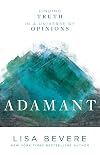
Lisa Bevere interests her readers right from the start by increasing their understanding and history of the word "Adamant". This in itself is worth reading the book for; quite a fresh concept.
Adamant is related to Christ as our Rock,"our Cornerstone, unmovable and invincible source of life".
Lisa covers many topics related to Adamant such as the Intimacy of God, Love, Truth and Transformation; each leading to the climax of Adamant in Holiness.
The book ends with the practicality of each of us show more being Adamant in our life, "I am Adamant". Throughout the book, Lisa, provokes her readers to realise that being wrapped in the reality of the Holy God, Son and Spirit should change the way they interact with the Lord and the world they live in.
Lisa successfully weaves in the Trinity and the importance of their roles; causing the reader to lift up their eyes and increase their understanding of the Majesty and Magnificence of the Lord.
Adamant is the book that readers could read over again and gain insights and snippets each time, that will enhance their understanding of the Lord and ways in which they can be transformed more into His likeness.
One quote that Lisa used, continues to resonate with me,
"We are not human beings having a spiritual experience, we are spiritual beings having a human experience" Pierre Teilhard de Chardin show less
Adamant is related to Christ as our Rock,"our Cornerstone, unmovable and invincible source of life".
Lisa covers many topics related to Adamant such as the Intimacy of God, Love, Truth and Transformation; each leading to the climax of Adamant in Holiness.
The book ends with the practicality of each of us show more being Adamant in our life, "I am Adamant". Throughout the book, Lisa, provokes her readers to realise that being wrapped in the reality of the Holy God, Son and Spirit should change the way they interact with the Lord and the world they live in.
Lisa successfully weaves in the Trinity and the importance of their roles; causing the reader to lift up their eyes and increase their understanding of the Majesty and Magnificence of the Lord.
Adamant is the book that readers could read over again and gain insights and snippets each time, that will enhance their understanding of the Lord and ways in which they can be transformed more into His likeness.
One quote that Lisa used, continues to resonate with me,
"We are not human beings having a spiritual experience, we are spiritual beings having a human experience" Pierre Teilhard de Chardin show less
You May Also Like


Associated Authors
Statistics
- Works
- 79
- Members
- 2,361
- Popularity
- #10,869
- Rating
- 3.6
- Reviews
- 37
- ISBNs
- 111
- Languages
- 8
- Favorited
- 1
