
Anthony Brandt
Author of The Man Who Ate His Boots: The Tragic History of the Search for the Northwest Passage
About the Author
Works by Anthony Brandt
The Man Who Ate His Boots: The Tragic History of the Search for the Northwest Passage (2010) 306 copies, 12 reviews
The North Pole: A Narrative History (National Geographic Adventure Classics) (2005) 54 copies, 1 review
The South Pole: A Narrative History of the Exploration of Antarctica (National Geographic Adventure Classics) (2004) 44 copies
The Pushcart Book of Essays: The Best Essays from a Quarter-Century of the Pushcart Prize (2002) 16 copies, 1 review
The Runaway Species 4 copies
Sound reasoning 2 copies
Associated Works
The Exploration of the Colorado River and Its Canyons (1875) — Introduction, some editions — 788 copies, 6 reviews
MHQ: The Quarterly Journal of Military History — Summer 2014 (2014) — Author "Perfect Storm at Tenochtitlán, 1521" — 4 copies
MHQ: The Quarterly Journal of Military History — Summer 2016 (2016) — Author "Blind Bear at Bay" — 4 copies
MHQ: The Quarterly Journal of Military History — Spring 2015 (2015) — Author "1793: Lessons of the Vendée" — 3 copies
MHQ: The Quarterly Journal of Military History — Autumn 2016 (2016) — Author "General Kearny's California Trek, 1846" — 2 copies
Tagged
Common Knowledge
- Other names
- Brandt, Anthony Scott (birth name)
- Birthdate
- 1936-11-21
- Gender
- male
- Education
- Princeton University
Columbia University - Occupations
- writer
editor
critic
historian
magazine journalist - Organizations
- National Geographic Society
American Heritage - Nationality
- USA
- Birthplace
- Westfield, New Jersey, USA
- Places of residence
- Sag Harbor, New York, USA
- Associated Place (for map)
- USA
Members
Reviews
The Pushcart book of essays : the best essays from a quarter-century of the Pushcart prize by Anthony Brandt
With consummate skill and considerable insight, JCO has written a disquieting novel that explores from multiple perspectives predation, obsession, compulsion, seduction, retribution, and self-delusion. I felt squeamish at times. I sometimes wanted to look away and stop reading. I felt admiration for JCO’s formidable talent and respect for her daunting willingness to portray such a despicable character and depict society’s love-hate relationship with fame, unconscionable behavior and show more immorality. I wonder how she cleanses and refreshes her mind and spirit after delving so deeply into the underbelly of humanity. For me, this book lost a star because it really is too long…its length and subject matter require a persistent reader. show less
England spent a lot of time searching for a Northwest Passage for their ships. Brandt covers the gamut of efforts to find it, many of which ended tragically, and some which, miraculously enough, ended with everyone back home in England, although without having found the passage. One of the early attempts that was so incredible as to sound fictional was the 17th-century voyage of Thomas James. He had to winter in the Arctic, and to avoid having his ship crushed by ice or swept away, he and show more his crew deliberately sunk the ship, then pulled it back up in the spring, repaired it, and sailed it home. Now that's chutzpah.
All the explorers were audacious, but some were poorly equipped to handle the rigors of Arctic exploration. The insistence on doing things the European way instead of learning from the Inuit often resulted in unnecessary deaths. Stubbornness and ethnocentrism blinded the explorers to the fact that the Inuit built igloos and wore furs not because they didn't know any better, but because these were actually great tools for survival. Stubbornness was also a big part of the reason there were so many missions to Canada in the first place. When captains and their crews keep disappearing, dying, or barely limping back home without results, it seems that sane people might start to wonder if finding the passage is even worth it; obviously, it's not going to be easy going even when and if it's found. But the English chose to hang their pride on the project, so sanity didn't enter into the equation.
Many expeditions are discussed in the book, so it can sometimes be hard to keep track of the various names and the timeline. It would also probably be beneficial to familiarize yourself with a map of the area, as there are a lot of bays, straits and inlets described. The book seems like a pretty good overview of the whole endeavor, and it's made me want to read up some more on a couple of the expeditions, particularly John Franklin's, which is talked about at length and has apparently been an inspiration for a number of fictional versions of events. show less
All the explorers were audacious, but some were poorly equipped to handle the rigors of Arctic exploration. The insistence on doing things the European way instead of learning from the Inuit often resulted in unnecessary deaths. Stubbornness and ethnocentrism blinded the explorers to the fact that the Inuit built igloos and wore furs not because they didn't know any better, but because these were actually great tools for survival. Stubbornness was also a big part of the reason there were so many missions to Canada in the first place. When captains and their crews keep disappearing, dying, or barely limping back home without results, it seems that sane people might start to wonder if finding the passage is even worth it; obviously, it's not going to be easy going even when and if it's found. But the English chose to hang their pride on the project, so sanity didn't enter into the equation.
Many expeditions are discussed in the book, so it can sometimes be hard to keep track of the various names and the timeline. It would also probably be beneficial to familiarize yourself with a map of the area, as there are a lot of bays, straits and inlets described. The book seems like a pretty good overview of the whole endeavor, and it's made me want to read up some more on a couple of the expeditions, particularly John Franklin's, which is talked about at length and has apparently been an inspiration for a number of fictional versions of events. show less
The Man Who Ate His Boots: The Tragic History of the Search for the Northwest Passage by Anthony Brandt
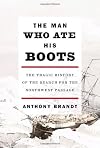
Anthony Brandt tells a surprisingly interesting story of the British search for the Northwest Passage - a long-sought route to the Far East by going around the Americas to the north. While he briefly covers early efforts, the core of the book focuses on the first half of the 1800s and men like John Ross, William Edward Parry, James Clark Ross (nephew to the elder Ross), and John Franklin - the man who literally ate his boots to avoid starvation.
"Risk is the essence of exploration" (pg 140), show more but the search turned out to be a fools errand. Yes, there is a Northwest Passage (several, in fact), but it's frozen and impassable nearly year round and includes some of the most inhospitable places on earth. Ships became trapped in the ice that sometimes towered over them and men died of starvation, scurvy and exposure to subzero temperatures (as much as 70 below). And yet the British saw this exploration as their duty and a matter of national pride, and persisted. It's unfortunate they didn't have enough humility to adopt some of the practices of the local Inuit tribes, who successfully live in such harsh conditions.
Brandt makes this period of history come alive with vivid descriptions of the elements, the explorers and the expeditions. He places the motivations in perspective, and makes it all more interesting than I had anticipated. The book is detailed and might be more information than some readers will want (nearly 400 fairly dense pages in my advance copy), and suffers from repetition sometimes but is highly readable. It started kind of slowly for me but really picked up, and I finished the last 60-70 pages at a run. I really enjoyed reading it. (Those who enjoyed Endurance: Shackleton's Incredible Voyage by Alfred Lansing, and Sea of Glory: America's Voyage of Discovery, The U.S. Exploring Expedition, 1838-1842 by Nathaniel Philbrick will enjoy this book as well). show less
"Risk is the essence of exploration" (pg 140), show more but the search turned out to be a fools errand. Yes, there is a Northwest Passage (several, in fact), but it's frozen and impassable nearly year round and includes some of the most inhospitable places on earth. Ships became trapped in the ice that sometimes towered over them and men died of starvation, scurvy and exposure to subzero temperatures (as much as 70 below). And yet the British saw this exploration as their duty and a matter of national pride, and persisted. It's unfortunate they didn't have enough humility to adopt some of the practices of the local Inuit tribes, who successfully live in such harsh conditions.
Brandt makes this period of history come alive with vivid descriptions of the elements, the explorers and the expeditions. He places the motivations in perspective, and makes it all more interesting than I had anticipated. The book is detailed and might be more information than some readers will want (nearly 400 fairly dense pages in my advance copy), and suffers from repetition sometimes but is highly readable. It started kind of slowly for me but really picked up, and I finished the last 60-70 pages at a run. I really enjoyed reading it. (Those who enjoyed Endurance: Shackleton's Incredible Voyage by Alfred Lansing, and Sea of Glory: America's Voyage of Discovery, The U.S. Exploring Expedition, 1838-1842 by Nathaniel Philbrick will enjoy this book as well). show less
I've been missing my nonfiction kicks. I thought this one sounded fantastic, so I picked it up to revel in all the grand things that creativity does (and why we need to foster it, dammit).
Of course, books like this are pretty much preaching to the choir. The people who read them are usually very aware of the uses and needs and the universality of the IDEA of creativity.
No matter who you are, where you come from, you're just as likely to be creative or not creative, as is your natural show more proclivity. No amount of money or lifestyle can change it, but conversely, all creative works, whether scientific, by expression, or composition, necessarily draws from the ideas and forms that came before it. In other words, no art is created in a vacuum and the creation of true creativity can't be forced.
This book is perfect for those self-selected readers because it doesn't skimp on the myriad examples of how all kinds of creativity informs each kind. Music and math have long been tied tightly together, but so is innovation to science fiction, math to graphics, and hundreds of other interconnections that lead from disparate sources like paleontology to windshields to instruction manuals aboard the Apollo to any number of meme-revolutions to the technological breakthroughs we have today, each one building on the next.
From a personal standpoint, I point to the explosion of novelists out there now. They're all building on each other and revolutionizing the direction of storytelling faster and faster, diving into stagnation and even faster revolutions until we get some truly astounding works.
Each is Bending, Breaking, Bending, and Blending the things that came before.
As a nonfiction work on what creativity is and why it should be encouraged, it delves mostly into the sociological slant but it also doesn't stint on the personal reasons. As in, why each and every one of us needs to keep our minds supple, and why the counter-arguments are bogus since we do all of the three B's anyway. :) The argument is to expand it across all areas so that the ideas can continue to cross-pollinate. :)
Do I agree with this sentiment?
HELL YES. Did I self-select myself to read this book? Hell Yes. Am I biased as all hell? Hell yes.
Is it wrong? No. I think all the ideas expressed make perfect sense. Even objectively. :) So there. show less
Of course, books like this are pretty much preaching to the choir. The people who read them are usually very aware of the uses and needs and the universality of the IDEA of creativity.
No matter who you are, where you come from, you're just as likely to be creative or not creative, as is your natural show more proclivity. No amount of money or lifestyle can change it, but conversely, all creative works, whether scientific, by expression, or composition, necessarily draws from the ideas and forms that came before it. In other words, no art is created in a vacuum and the creation of true creativity can't be forced.
This book is perfect for those self-selected readers because it doesn't skimp on the myriad examples of how all kinds of creativity informs each kind. Music and math have long been tied tightly together, but so is innovation to science fiction, math to graphics, and hundreds of other interconnections that lead from disparate sources like paleontology to windshields to instruction manuals aboard the Apollo to any number of meme-revolutions to the technological breakthroughs we have today, each one building on the next.
From a personal standpoint, I point to the explosion of novelists out there now. They're all building on each other and revolutionizing the direction of storytelling faster and faster, diving into stagnation and even faster revolutions until we get some truly astounding works.
Each is Bending, Breaking, Bending, and Blending the things that came before.
As a nonfiction work on what creativity is and why it should be encouraged, it delves mostly into the sociological slant but it also doesn't stint on the personal reasons. As in, why each and every one of us needs to keep our minds supple, and why the counter-arguments are bogus since we do all of the three B's anyway. :) The argument is to expand it across all areas so that the ideas can continue to cross-pollinate. :)
Do I agree with this sentiment?
HELL YES. Did I self-select myself to read this book? Hell Yes. Am I biased as all hell? Hell yes.
Is it wrong? No. I think all the ideas expressed make perfect sense. Even objectively. :) So there. show less
Lists
You May Also Like


Associated Authors
Statistics
- Works
- 20
- Also by
- 6
- Members
- 824
- Popularity
- #30,962
- Rating
- 3.8
- Reviews
- 18
- ISBNs
- 38
- Languages
- 4