
Joan C. Williams
Author of White Working Class: Overcoming Class Cluelessness in America
About the Author
Joan G. Williams is Distinguished Professor of Law, 1066 Foundation Chair, and Director of the Center for Work life Law at the University of California, Hastings College of the Law.
Works by Joan C. Williams
White Working Class, With a New Foreword by Mark Cuban and a New Preface by the Author: Overcoming Class Cluelessness in America (2019) 33 copies
Outclassed: How the Left Lost the Working Class and How to Win Them Back (2025) 31 copies, 2 reviews
Tagged
Common Knowledge
- Canonical name
- Williams, Joan C.
- Legal name
- Williams, Joan Chalmers
- Birthdate
- 1952
- Gender
- female
- Education
- Yale University (BA|1974)
Harvard Law School (JD)
Massachusetts Institute of Technology (MA) - Occupations
- writer
professor - Organizations
- Center for Worklife Law
University of California, Hastings College of Law - Relationships
- Goldhagen Sarah Williams (sister)
Williams, Norman, Jr. (father) - Nationality
- USA
- Associated Place (for map)
- USA
Members
Reviews
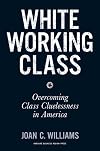
Williams writes like the friend who tells you your outfit doesn't look good on you, and does it with such love that you're glad for the awkward truth. Quite a few writers have nibbled around the edges of what progressives miss in their rush to condemn Trump and the people who voted for him. Williams takes each too-easy assertion (they're racist, they're stupid, they're uneducated, etc etc etc) and puts it in the context of people who in fact were voting their own self-interest. Whether she show more makes it easier for progressives (of whom I am one) to take off the blinders that pretty much guarantee we'll lose the next elections too is more than I can say, but it's a great start! show less
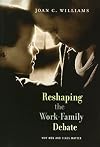
In Reshaping the Work-Family Debate, law professor Joan Williams writes as a progressive feminist for an audience of progressive elites. Her dual purpose is to reframe A) conversations about work/family 'balance,' caregiving, related public policy, and gender and B) progressive elites' perceptions of working class people and self-perceptions, which Williams sees as impeding a politically-effective coalition that could change the game in US politics for the better. Roughly speaking, the first show more 3 chapters do A; chapter 4 steps back to stake a claim for a particular type of feminist theory and analysis (what she calls "reconstructive feminism"), and the final 2 chapters do B.
Chapters 1-3 are absolutely excellent. Here, Williams looks at US cultures of work through the lens of the separate spheres ideology, by which women are natural homemakers and nurturers while men are naturally-competitive public beings and breadwinners. (She doesn't go into this, but this logic of separate spheres doesn't just produce notions of dramatic & inherent sex-based difference problematic/limiting gender stereotypes for both men and women--it also feeds the notion of complementarism, the idea that every man needs a woman and vice versa and that children need a mother and a father, which is to say ... heteronormativity and generalized nastiness.) These chapters use close analysis, anecdotes, and statistical data effectively and are very engaging. They deal with work/family policies (which are absolute crap in the US) in the larger context of workplace culture, parenting culture, and our gender system (with as much if not more attention to masculinity as to femininity)--all with a careful sensitivity to the different implications of all these systems along lines of class and race. Good business!
Chapter 4 strikes me as more problematic (and also more poorly edited: after the first three chapters, the whole book feels more thrown-together, with more proofreading-level errors and a less compelling sense of direction/purpose/coherence). This is the 'theory' chapter, which deals with various feminist traditions and advocates for a particular one; its big-picture idea is that feminist analysis needs to happen along several distinct axes (work/family, sex/violence, queer theory, and perhaps others) rather than trying to use one "tool" for these jobs. Williams raises useful points, especially in advocating for a feminism that strives to illuminate gender rather than "women" and in breaking down the easy distinction between "sameness feminism" and "difference feminism." But I don't think it's quite true that "retheoriz[ing] the work-family axis [...] has significant implications for the other two axes but is best analyzed apart from them" (113): particularly, queer theory has a lot to offer on the dynamics that are central to Williams' analysis of paid labor and caregiving as gendered arenas. I am deeply uncomfortable with the idea of reconstructive (or any kind of) feminism as "a 'queer eye for the straight guy' (and girl)" (142). And I have absolutely no idea why she believes that "intersectionality as a metaphor itself reinforces white privilege and heteronormativity, by erasing the fact that women of color are no more and no less at the intersection of race and gender than are white women, and gay women are no more and no less at the intersection of sexuality and gender than are straight women" (145)--for me, intersectionality has been a way to think and teach about how all our identities are complicated nexuses of identities that carry interacting strains of privilege and disadvantage.
Finally, chapters 5-6 just seem to lose the focus and purposefulness of the earlier chapters. In turning to progressive politics more broadly, Williams sometimes seems to use work/family issues as a recurring example rather than as the point. The issues addressed here are so important: working class culture, professional-managerial culture, how we all see each other and ourselves, and how coalition-building could work better to improve all our lives. But they're also HUGE. And I think that hugeness contributes to a great deal of overgeneralization. Williams sensibly avoids the much-contested and (in a US context) basically meaningless term "middle class." But lumping together everybody but the poor and the wealthy as "working class" makes it hard to talk, as she does, about class cultures: there's a great deal of diversity in there. And of course, unavoidably, the studies she cites use wildly differing definitions of the various classes, using different proxies for class (income, education, etc.) as well as different cutoff points for each class status/culture. So that's messy, though not the author's fault.
One last concern: building coalitions shouldn't mean abandoning basic moral values or throwing groups of real human beings under buses. Williams writes: "The uncomfortable reality is that progressives, gay and straight, need to come to terms with the fact that if the goal is to build a coalition around economic issues--including health insurance--crucial coalition partners may feel differently about gay marriage and other equality issues. If coalition building is considered an important goal, progressives will have to give our leaders the room to maneuver as they attempt to defuse cultural issues as a key political force. This includes issues we hold near and dear. For me, as a feminist, to acknowledge that abortion rights fuel class conflict is upsetting. That does not mean I will give up my own deeply held commitments, but it does mean that I talk about them differently and will go out of my way to signal respect for those who disagree with me in arenas where they and I can find common ground" (205). And later: "[...] Democrats need to do something much deeper than relabel our chosen positions on abortion, gay rights, and so forth as 'family values'" (213)--as though anti-racism, women's control over our own bodies, and the equal rights of LGBTQ people/families are somehow unloaded 'choices' and as though the language we use to describe them is not really very important. I do agree with Williams that we need to think strategically, and also that progressive elites need to take working class people (but not just the white straight male ones!) and working class cultures (but not just the white straight masculine ones!) seriously. But I think the balance here is tipping over in potentially-scary ways. show less
Chapters 1-3 are absolutely excellent. Here, Williams looks at US cultures of work through the lens of the separate spheres ideology, by which women are natural homemakers and nurturers while men are naturally-competitive public beings and breadwinners. (She doesn't go into this, but this logic of separate spheres doesn't just produce notions of dramatic & inherent sex-based difference problematic/limiting gender stereotypes for both men and women--it also feeds the notion of complementarism, the idea that every man needs a woman and vice versa and that children need a mother and a father, which is to say ... heteronormativity and generalized nastiness.) These chapters use close analysis, anecdotes, and statistical data effectively and are very engaging. They deal with work/family policies (which are absolute crap in the US) in the larger context of workplace culture, parenting culture, and our gender system (with as much if not more attention to masculinity as to femininity)--all with a careful sensitivity to the different implications of all these systems along lines of class and race. Good business!
Chapter 4 strikes me as more problematic (and also more poorly edited: after the first three chapters, the whole book feels more thrown-together, with more proofreading-level errors and a less compelling sense of direction/purpose/coherence). This is the 'theory' chapter, which deals with various feminist traditions and advocates for a particular one; its big-picture idea is that feminist analysis needs to happen along several distinct axes (work/family, sex/violence, queer theory, and perhaps others) rather than trying to use one "tool" for these jobs. Williams raises useful points, especially in advocating for a feminism that strives to illuminate gender rather than "women" and in breaking down the easy distinction between "sameness feminism" and "difference feminism." But I don't think it's quite true that "retheoriz[ing] the work-family axis [...] has significant implications for the other two axes but is best analyzed apart from them" (113): particularly, queer theory has a lot to offer on the dynamics that are central to Williams' analysis of paid labor and caregiving as gendered arenas. I am deeply uncomfortable with the idea of reconstructive (or any kind of) feminism as "a 'queer eye for the straight guy' (and girl)" (142). And I have absolutely no idea why she believes that "intersectionality as a metaphor itself reinforces white privilege and heteronormativity, by erasing the fact that women of color are no more and no less at the intersection of race and gender than are white women, and gay women are no more and no less at the intersection of sexuality and gender than are straight women" (145)--for me, intersectionality has been a way to think and teach about how all our identities are complicated nexuses of identities that carry interacting strains of privilege and disadvantage.
Finally, chapters 5-6 just seem to lose the focus and purposefulness of the earlier chapters. In turning to progressive politics more broadly, Williams sometimes seems to use work/family issues as a recurring example rather than as the point. The issues addressed here are so important: working class culture, professional-managerial culture, how we all see each other and ourselves, and how coalition-building could work better to improve all our lives. But they're also HUGE. And I think that hugeness contributes to a great deal of overgeneralization. Williams sensibly avoids the much-contested and (in a US context) basically meaningless term "middle class." But lumping together everybody but the poor and the wealthy as "working class" makes it hard to talk, as she does, about class cultures: there's a great deal of diversity in there. And of course, unavoidably, the studies she cites use wildly differing definitions of the various classes, using different proxies for class (income, education, etc.) as well as different cutoff points for each class status/culture. So that's messy, though not the author's fault.
One last concern: building coalitions shouldn't mean abandoning basic moral values or throwing groups of real human beings under buses. Williams writes: "The uncomfortable reality is that progressives, gay and straight, need to come to terms with the fact that if the goal is to build a coalition around economic issues--including health insurance--crucial coalition partners may feel differently about gay marriage and other equality issues. If coalition building is considered an important goal, progressives will have to give our leaders the room to maneuver as they attempt to defuse cultural issues as a key political force. This includes issues we hold near and dear. For me, as a feminist, to acknowledge that abortion rights fuel class conflict is upsetting. That does not mean I will give up my own deeply held commitments, but it does mean that I talk about them differently and will go out of my way to signal respect for those who disagree with me in arenas where they and I can find common ground" (205). And later: "[...] Democrats need to do something much deeper than relabel our chosen positions on abortion, gay rights, and so forth as 'family values'" (213)--as though anti-racism, women's control over our own bodies, and the equal rights of LGBTQ people/families are somehow unloaded 'choices' and as though the language we use to describe them is not really very important. I do agree with Williams that we need to think strategically, and also that progressive elites need to take working class people (but not just the white straight male ones!) and working class cultures (but not just the white straight masculine ones!) seriously. But I think the balance here is tipping over in potentially-scary ways. show less
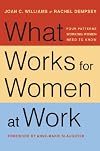
I have mixed reactions about this book. On the good side, the book is thoroughly researched with original work. The authors interviewed dozens of women in dozens of work settings about their workplace experiences. It covers the field comprehensively and leaves no important issue untouched. Topics include things like marital work-sharing, being a mother in the workplace, generational changes, and working with other women. It even has a summary of twenty action points in a chapter near the show more end.
I especially appreciated the chapter about women of color. This topic is often neglected in business books and in society at large. Their experiences should receive more exploration so that we can all learn to treat those from these subgroups better. Black women receive a prominent place, but the different types of Asian women are not neglected. Women's issues are not just white women's issues. Each group - and indeed, each person - has their own reactions to biased experiences, and it's helpful to filter through all the noise in this special category.
As for weaknesses, I'm still not sure what the "four patterns" that I should have learned. Maybe it's because I listened to the audiobook, and these patterns are more obvious in print. Second, the book seemed to rely on data collection heavily from the legal field. I wanted to observe that a broader, more rigorous framework might have been used to gather the data. I don't work in legal settings, but rather in biomedical research, so making constant reference to power struggles over policy seems somewhat weird to me. Perhaps generalizing about "women at work" is an impossible task in today's workplace.
Although male, I work with female-heavy teams. I read this book to appreciate each of their challenges in a better, more supportive way. I believe that aim was accomplished. As younger generations arise with an increased appreciation of gender-fluidity, I'm curious how these dynamics will change and how some will persist. For true progress to be made, more men like me need to learn to appreciate the challenges women face in the workplace. Gender affects us all, and awareness can only help businesses - and individual careers - take advantage of dealing with these dynamics in healthy ways. Reading this book would be a good first step. show less
I especially appreciated the chapter about women of color. This topic is often neglected in business books and in society at large. Their experiences should receive more exploration so that we can all learn to treat those from these subgroups better. Black women receive a prominent place, but the different types of Asian women are not neglected. Women's issues are not just white women's issues. Each group - and indeed, each person - has their own reactions to biased experiences, and it's helpful to filter through all the noise in this special category.
As for weaknesses, I'm still not sure what the "four patterns" that I should have learned. Maybe it's because I listened to the audiobook, and these patterns are more obvious in print. Second, the book seemed to rely on data collection heavily from the legal field. I wanted to observe that a broader, more rigorous framework might have been used to gather the data. I don't work in legal settings, but rather in biomedical research, so making constant reference to power struggles over policy seems somewhat weird to me. Perhaps generalizing about "women at work" is an impossible task in today's workplace.
Although male, I work with female-heavy teams. I read this book to appreciate each of their challenges in a better, more supportive way. I believe that aim was accomplished. As younger generations arise with an increased appreciation of gender-fluidity, I'm curious how these dynamics will change and how some will persist. For true progress to be made, more men like me need to learn to appreciate the challenges women face in the workplace. Gender affects us all, and awareness can only help businesses - and individual careers - take advantage of dealing with these dynamics in healthy ways. Reading this book would be a good first step. show less
Our differences are chasms
There are of course, no classes in the USA, officially. But dice the stats and you will find strata that become gaping divisions the deeper you dive. Joan Williams has taken that dive, and has described the classes as succinctly as I have ever seen. It verges on the ethnographic.
She looks at the world through white working class eyes, and it is a different view and way of life. Without disposable income, family, church and neighbors take on new importance. The show more immobility of workers stems from the absolute need to maintain and benefit from those links. Moving to another state for a new low paying job makes no sense.
They are also suspicious of, if not totally against college education. “Know-it-alls” don’t fit the network. Government is anathema too. Handouts, entitlements and other Republican characterizations of government services have taken solid hold in the white working class. “Keep your government hands off my Medicare“ and condemning Obamacare while treasuring the Affordable Care Act are two manifestations of this self-defeating stance. Nearly 92% of Americans have benefited from some federal program, but more than 50% insist they’ve never touched a dollar from the government. The white working class resents the poor who qualify for aid, while the elites, looking down on both of them, don’t even know there are two other classes. (And they can be split further, into black and Hispanic, very different from the white.) Williams calls this Class Cluelessness and applies it directly to the elites running the political parties.
White Working Class is jammed with facts and stats, reinforcing Williams’ points. But there are two rather important facts that she misses. People with no rights come to believe that is a just and natural way, and that they cannot do better. That’s how the feudal system survived. It explains why the working class supports tax cuts for the rich and nothing for themselves. (Williams thinks they approve out of hatred of the poor.) The other fact is that 48% of jobs in the USA pay minimum wage or less, so college education and job mobility have no appeal. Unless someone is willing and able to address the inequality issue, things will only get worse. It is allowing the West to drift to “authoritarian nationalism.”
David Wineberg show less
There are of course, no classes in the USA, officially. But dice the stats and you will find strata that become gaping divisions the deeper you dive. Joan Williams has taken that dive, and has described the classes as succinctly as I have ever seen. It verges on the ethnographic.
She looks at the world through white working class eyes, and it is a different view and way of life. Without disposable income, family, church and neighbors take on new importance. The show more immobility of workers stems from the absolute need to maintain and benefit from those links. Moving to another state for a new low paying job makes no sense.
They are also suspicious of, if not totally against college education. “Know-it-alls” don’t fit the network. Government is anathema too. Handouts, entitlements and other Republican characterizations of government services have taken solid hold in the white working class. “Keep your government hands off my Medicare“ and condemning Obamacare while treasuring the Affordable Care Act are two manifestations of this self-defeating stance. Nearly 92% of Americans have benefited from some federal program, but more than 50% insist they’ve never touched a dollar from the government. The white working class resents the poor who qualify for aid, while the elites, looking down on both of them, don’t even know there are two other classes. (And they can be split further, into black and Hispanic, very different from the white.) Williams calls this Class Cluelessness and applies it directly to the elites running the political parties.
White Working Class is jammed with facts and stats, reinforcing Williams’ points. But there are two rather important facts that she misses. People with no rights come to believe that is a just and natural way, and that they cannot do better. That’s how the feudal system survived. It explains why the working class supports tax cuts for the rich and nothing for themselves. (Williams thinks they approve out of hatred of the poor.) The other fact is that 48% of jobs in the USA pay minimum wage or less, so college education and job mobility have no appeal. Unless someone is willing and able to address the inequality issue, things will only get worse. It is allowing the West to drift to “authoritarian nationalism.”
David Wineberg show less
Lists
Awards


You May Also Like


Associated Authors
Statistics
- Works
- 11
- Members
- 498
- Popularity
- #49,659
- Rating
- 4.0
- Reviews
- 17
- ISBNs
- 36