
David Attenborough
Author of Life on Earth: A Natural History
About the Author
Series
Works by David Attenborough
A Life on Our Planet: My Witness Statement and a Vision for the Future (2020) 949 copies, 24 reviews
Amazing Rare Things: The Art of Natural History in the Age of Discovery (2007) 362 copies, 8 reviews
Drawn From Paradise: The Discovery, Art and Natural History of the Birds of Paradise (2012) 91 copies, 1 review
Journeys to the Past: Travels in New Guinea, Madagascar, and the Northern Territory of Australia (1981) 71 copies, 2 reviews
The Blue Planet Seas of Life: Ocean World / Frozen Seas [2001 TV series] (2004) — Narrator — 19 copies
The Blue Planet Seas of Life: Seasonal Seas / Coral Seas [2001 TV series] (2002) — Narrator — 16 copies
Madagascar: The Land Where Evolution Ran Wild [2011 TV Mini-series] (2011) — Director; Narrator — 14 copies
Life / Planet Earth: Special Edition (Both Narrated by David Attenborough) [Blu-ray] (2011) 9 copies
Zoo Quest for a Dragon 8 copies
Micro Monsters 8 copies
The Early Years: "Zoo Quest for a Dragon", "Quest in Paradise", "Quest Under Capricorn": The Collection (BBC Radio Collection) (2002) 7 copies, 1 review
The Tribal Eye [TV series] 6 copies
Tribal Encounters: Ethnic Objects Collected by David Attenborough - Exhibition Catalogue (Leicestershire Museums publication) (1981) 5 copies
National Geographic: Wild India 3 copies
The Living Planet - Volumes 1 & 2 2 copies
Hunstein - Korowori: sculpture from the Sepik Hills, New Guinea — Contributor — 2 copies
Trials of Life: Growing Up 2 copies
Descent Into the Mariana Trench 2 copies
Os Desafios da Vida 2 copies
Hummingbirds 2 copies
David Attenborough and the Empire of the Ants | Documentary | NON-USA Format | PAL | Region 4 Import - Australia (2017) 2 copies
Our planet 2 copies
The Living Planet - Volumes 5 & 6 2 copies
David Attenborough's Tasmania | Documentary | NON-USA Format | PAL | Region 4 Import - Australia (2018) 2 copies
Oceaan 1 copy
Secret lives of orangutans 1 copy
Savannah 1 copy
Dive training 2020 1 copy
David Attenborough 2 Books Collection Set (Adventures of a Young Naturalist & Journeys to the Other Side of the World) (2021) 1 copy
Planet Earth part 1 1 copy
Secret Garden BBC {2026} E5 1 copy
The Life Trilogy Boxset 1 copy
The Eloquent Communicators 1 copy
Ayrton's Animals 1 copy
Trials of Life: Arriving 1 copy
Trials of Life: Finding Food 1 copy
Trials of Life: Homemaking 1 copy
BBC: Charles Darwin [DVD] 1 copy
Maan pienimmät [DVD] 1 copy
Journeys of The Past 1 copy
Islands 1 copy
Plants 1 copy
The life of mammals vol. 4 1 copy
The life of mammals vol. 3 1 copy
The life of mammals vol 2 1 copy
The life of mammals vol 1 1 copy
Prehistoric Planet 2 1 copy
Climate Change: The Facts 1 copy
Ein Leben auf unserem Planeten: Die Zukunftsvision des berühmtesten Naturfilmers der Welt (2020) 1 copy
Life in Colour {2021} E3 1 copy
Nature: Birds of the Gods 1 copy
BBC Earth: Human Planet 1 copy
The Mating Game Yr 1 1 copy
Prehistoric Planet 1 copy
Associated Works
Digging Dinosaurs: The Search That Unraveled the Mystery of Baby Dinosaurs (1988) — Foreword, some editions — 421 copies, 4 reviews
Wild Flowers of Britain and North West Europe (New Generation Guides) (1987) — General Editor — 53 copies
Peter and the Wolf and The Young Person's Guide to the Opera (1978) — Narrator — 30 copies, 1 review
Endeavouring Banks: Exploring Collections from the Endeavour Voyage 1768-1771 (2016) — Foreword; Contributor — 29 copies
New Generation Guide to the Butterflies and Day-Flying Moths of Britain and Europe (1989) — General Editor — 17 copies
Tiger: Spy in the Jungle [2008 TV series] — Narrator — 4 copies
State of Nature 2016 — Foreword, some editions — 3 copies
Antarctic: On the Frozen Sea [1993 film] — Narrator — 2 copies
The Guardian and Observer guides to nature spotting : part 1 : animals — Contributor — 1 copy
Tagged
Common Knowledge
- Canonical name
- Attenborough, David
- Legal name
- Attenborough, David Frederick
- Birthdate
- 1926-05-08
- Gender
- male
- Education
- University of Cambridge (MA|Clare College)
London School of Economics
Wyggeston Grammar School for Boys, Leicester, England, UK - Occupations
- broadcaster
naturalist
writer - Organizations
- BBC
Royal Botanic Gardens, Kew (trustee)
University of Cambridge, Clare College (Honorary Fellow)
Fauna and Flora International (Vice-President)
British Museum (trustee)
Friends of Richmond Park (show all 10)
Blood Pressure Association
North American Native Plant Society
Institute of Biology (Honorary Fellow, 2000)
Royal Navy - Awards and honors
- Knight Bachelor (1985)
Order of the Companions of Honour (1996)
Order of the British Empire (Commander, 1974)
Royal Victorian Order (Commander, 1991)
Royal Society (Fellow, 1983)
Order of Merit (2005) (show all 54)
Order of St Michael and St George (Knight Grand Cross, 2020)
Society of Antiquaries of London (Honorary Fellow, 2007)
American Academy of Arts & Sciences (Foreign Honorary Member, 1991)
Order of Merit of the Italian Republic (Commander, 2023)
Australian Academy of Science (Corresponding Member, 2012)
Royal Academy of Arts (Honorary Fellow, 1992)
Linnean Society (Honorary Fellow, 1999)
Prince of Asturias Award (2009)
Moscow Society of Naturalists (Honorary Member, 2017)
Royal Canadian Geographical Society Gold Medal (2017)
The Culture Show British Icon Award (2006)
British Naturalists' Association Peter Scott Memorial Award (2007)
Nierenburg Prize (2005)
International Cosmos Prize (2000)
Zoological Society of London (Honorary Fellow, 1998)
Descartes Prize (2004)
Kew International Medal (1996)
Primetime Emmy Awards for Outstanding Narrator (2018, 2019)
Daytime Emmy Award for Outstanding Daytime Personality – Non-Daily (2025)
Stephen Hawking Medal for Science Communication (2024)
Cherry Kearton Medal and Award (1972)
Kalinga Prize for the Popularization of Science (1981)
Michael Faraday Prize (2003)
Royal Society of the Protection of Birds Medal (2000)
Caird Medal (2004)
José Vasconcelos World Award of Education (2004)
Royal Photographic Society Progress medal and Honorary Fellowship (2008)
Fonseca Prize (2010)
Queensland Museum Medal (2010)
Society for the History of Natural History Founders' Medal (2011)
Association for International Broadcasting International TV Personality of the year (2011)
IUCN Phillips Memorial Medal (2012)
Peabody Award (2015)
Britain-Australia Society Award (2017)
National Television Awards (2006)
BAFTA Fellowship (1979)
The Perfect World Foundation Award (2018)
Landscape Institute Medal for Lifetime Achievement (2019)
Landscape Institute (Honorary Fellow, 2019)
World Economic Forum Crystal Award (2019)
Indira Gandhi Peace Prize (2019)
Chatham House Prize (2019)
Champions of the Earth Lifetime Achievement Award (2021)
United Nations Environment Programme Champion of the Earth (2022)
43rd News and Documentary Emmy Awards Lifetime Achievement Award (2022)
BAFTA Desmond Davis Award (1970)
Gold Blue Peter Badge (2016)
Green Blue Peter Badge (2019) - Relationships
- Attenborough, Richard (brother)
Attenborough, F. L. (father)
Attenborough, John (brother) - Nationality
- UK
- Birthplace
- Isleworth, Middlesex, England, UK
- Places of residence
- Richmond, London, England, UK
College House, University College, Leicester, England, UK - Map Location
- England, UK
Members
Discussions
AI assisted David Attenborough cat documentaries... in Cats, books, life is good. (August 2024)
Reviews
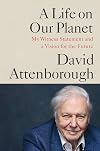
David Attenborough’s A Life on Our Planet is a lucid, insightful memoir that documents the author’s experience as a writer and broadcaster who helped establish natural history as a matter of public interest. He notes the declines in biodiversity that have marked each of his nine decades and argues that increasing biodiversity is the key to solving the climate crisis. Despite evidence to the contrary, Attenborough is optimistic about our ability to prevent a sixth mass extinction. The show more steps he recommends are all achievable if we have the political will. Unfortunately, none of them is politically easy. Can we limit fishing in a third of the ocean fisheries? Can we cut our meat consumption by a significant percentage? Can we stop deforestation and convert farmland to wilderness? If we can, we may ensure that the Anthropocene is not the shortest of ecological eras. show less
LIFE ON EARTH by David Attenborough (and read by him as well) was a good pick to listen to during finals week - not so engaging that I keep listening to find out what happens next at the expense of getting my grading done, but engaging enough to take my mind off my grading and other responsibilities when I needed a break, or was cooking, etc. I will say that I found it more relaxing to listen to in the chapters when he's describing things that I'm somewhat familiar with, but don't know well show more (i.e. the chapters on plants and invertebrates.) The chapters on vertebrates, however, were somewhat less relaxing to listen to, as I spent the whole time listening very carefully for any mistakes.
One thing Attenborough does very well in this book is connect the evolution of traits together, helping explain why certain traits evolved when they did. For example, as vascular plants evolved, there was a selective advantage for getting taller in order to better compete for light. But then, once plants started getting taller, there was a selective advantage to herbivores that could reach the tasty parts of the plants, which led to the evolution of flying insects, which in turn contributed to the evolution of the flowering plants to use those insects as targeted pollinators vs. relying on wind pollination. Some of it is almost certainly adaptationism / just-so-story-ism, but he does an excellent job of connecting various pieces together into a coherent whole.
He does get some stuff wrong -- some factual details that may have just gotten missed in the 40th anniversary update of the text, but also other places where the way he frames evolutionary history is... antiquated at best. The most egregious (in my opinion) is that he repeatedly refers to various living organisms as "primitive", and refers to non-mammalian synapsids (everything that is more closely related to mammals than any other living organism, but is not technically a true mammal -- includes things like Dimetrodon, the sail-back "dinosaur") as "reptiles". Which: No. Absolutely not. Synapsids split from the branch that would become reptiles over 200 million years ago. (He also calls early tetrapods like Tiktaalik "amphibians", which: they were almost certainly amphibious, but they were absolutely not the same as modern amphibians.)
But overall: Enjoyable to listen to Attenborough's narration even without the amazing visuals of a nature documentary. show less
One thing Attenborough does very well in this book is connect the evolution of traits together, helping explain why certain traits evolved when they did. For example, as vascular plants evolved, there was a selective advantage for getting taller in order to better compete for light. But then, once plants started getting taller, there was a selective advantage to herbivores that could reach the tasty parts of the plants, which led to the evolution of flying insects, which in turn contributed to the evolution of the flowering plants to use those insects as targeted pollinators vs. relying on wind pollination. Some of it is almost certainly adaptationism / just-so-story-ism, but he does an excellent job of connecting various pieces together into a coherent whole.
He does get some stuff wrong -- some factual details that may have just gotten missed in the 40th anniversary update of the text, but also other places where the way he frames evolutionary history is... antiquated at best. The most egregious (in my opinion) is that he repeatedly refers to various living organisms as "primitive", and refers to non-mammalian synapsids (everything that is more closely related to mammals than any other living organism, but is not technically a true mammal -- includes things like Dimetrodon, the sail-back "dinosaur") as "reptiles". Which: No. Absolutely not. Synapsids split from the branch that would become reptiles over 200 million years ago. (He also calls early tetrapods like Tiktaalik "amphibians", which: they were almost certainly amphibious, but they were absolutely not the same as modern amphibians.)
But overall: Enjoyable to listen to Attenborough's narration even without the amazing visuals of a nature documentary. show less
Sir David Attenborough is well-known to fans of the BBC in the United Kingdom for his interesting explorations on various topics, especially ones relating to natural history. In this book, he further dives into natural history about how the world has changed during his lifetime. His picture is quite bleak, with much of our wilderness becoming subsumed by humanity’s growth. Still, he manages to propose several hopeful strategies out of this crisis if we begin immediately to act.
Attenborough show more has the reputation of being able to make journalistic explorations supremely interesting, and this book is no exception. He voyages down the decades of his life, beginning before World War II. He charts how natural biodiversity has been steadily lost and how humans have begun to manage the balance of the planet. To no one’s surprise, human management (started in the 1950s) has not gone well. Oceans have been depleted of fish, and the fraction of uninhibited wilderness has greatly decreased.
As depressing as the early stages of this work are, the end offers specific remedies for our position. He leaves us not with just a dystopia. He identifies strategic ways to increase fish stores while restoring economies of fishing. He shows us how we all can adjust our meat-heavy diets to soy-based and plant-based foods. In particular, we can cut down the percentage of beef in our diets because a pound of beef takes more agriculture to develop than other forms of meat. Energy must be transitioned from fossil fuels to other forms of energy.
Human survival must become our common currency even more than making money. Many of these solutions are cost-neutral – they cost about as much as our current solutions – but they are green-positive by helping to reduce costs to the environment. Some economists are theorizing how to create a financial cost to offset the environmental impacts of harmful technologies. Unfortunately, reliance on old ways of classical economics will lead to destructive outcomes to humanity.
The general public needs to hear this argument. It’s perhaps the most eloquent piece about contemporary climate change that I’ve read to date. Unfortunately, many (in America, at least) will reject even listening to this jeremiad because they revel in ignorance. Once again, contemporary social problems limit scientific progress in humans. Will the recurring modern story repeat itself? We know where we need to get to and how we need to get there; we just lack the collective determination to see the course. Or will Attenborough’s eloquent plea, amongst others’ informative pleas, light our way? show less
Attenborough show more has the reputation of being able to make journalistic explorations supremely interesting, and this book is no exception. He voyages down the decades of his life, beginning before World War II. He charts how natural biodiversity has been steadily lost and how humans have begun to manage the balance of the planet. To no one’s surprise, human management (started in the 1950s) has not gone well. Oceans have been depleted of fish, and the fraction of uninhibited wilderness has greatly decreased.
As depressing as the early stages of this work are, the end offers specific remedies for our position. He leaves us not with just a dystopia. He identifies strategic ways to increase fish stores while restoring economies of fishing. He shows us how we all can adjust our meat-heavy diets to soy-based and plant-based foods. In particular, we can cut down the percentage of beef in our diets because a pound of beef takes more agriculture to develop than other forms of meat. Energy must be transitioned from fossil fuels to other forms of energy.
Human survival must become our common currency even more than making money. Many of these solutions are cost-neutral – they cost about as much as our current solutions – but they are green-positive by helping to reduce costs to the environment. Some economists are theorizing how to create a financial cost to offset the environmental impacts of harmful technologies. Unfortunately, reliance on old ways of classical economics will lead to destructive outcomes to humanity.
The general public needs to hear this argument. It’s perhaps the most eloquent piece about contemporary climate change that I’ve read to date. Unfortunately, many (in America, at least) will reject even listening to this jeremiad because they revel in ignorance. Once again, contemporary social problems limit scientific progress in humans. Will the recurring modern story repeat itself? We know where we need to get to and how we need to get there; we just lack the collective determination to see the course. Or will Attenborough’s eloquent plea, amongst others’ informative pleas, light our way? show less
When I borrowed [b:A Life on Our Planet: My Witness Statement and a Vision for the Future|53916142|A Life on Our Planet My Witness Statement and a Vision for the Future|David Attenborough|https://i.gr-assets.com/images/S/compressed.photo.goodreads.com/books/1608723131l/53916142._SY75_.jpg|84272267] from the library, I anticipated that it would probably make me cry. And indeed it did, at the very end. In the first half of the book, David Attenborough summarises his career as an extraordinary show more communicator of the natural world's beauty and wonder. Successive chapters give the world population, atmospheric carbon concentration, and percentage of remaining wilderness at different points in his life. These range from 1937 (2.3 billion people, 280 carbon ppm, and 66% wilderness) to 2020 (7.8 billion, 415 ppm, and 35%), starkly summarising the depletion of the environment:
The second half of the book briefly warns of the disasters that lie ahead if we continue to exploit the environment as we have been, then provides a detailed (albeit inevitably brief) set of suggestions for avoiding disaster, subtitled 'how to rewild the world'. These are based on impressively clear synthesis of a huge amount of information; a full bibliography and set of references are provided. The tone is hopeful and many examples of projects around the world are included. Many were familiar, for example the Knepp Estate from the wonderful [b:Wilding|38891828|Wilding|Isabella Tree|https://i.gr-assets.com/images/S/compressed.photo.goodreads.com/books/1521964296l/38891828._SY75_.jpg|60437379]. For more on food and agriculture, I also recommend [b:Regenesis: Feeding the World Without Devouring the Planet|58838928|Regenesis Feeding the World Without Devouring the Planet|George Monbiot|https://i.gr-assets.com/images/S/compressed.photo.goodreads.com/books/1647260230l/58838928._SY75_.jpg|93035508]. I knew very little about rewilding the sea, so found that part particularly interesting and informative.
The C world is not mentioned, but the hopeful vision of a possible future that Attenborough advances is essentially anti-capitalist. I was pleased that the book does not argue that the harms caused by over-commodification of nature can be dealt with by commodifying nature even more, as is all too common:
Although much of the material covered was not new to me, I enjoyed the way it was presented here, richly illustrated and described in Attenborough's voice. Kudos to his collaborators for helping to capture this, as usually I don't 'hear' books while reading them. Yet I could hear his voice with all its amazing sincerity while reading [b:A Life on Our Planet: My Witness Statement and a Vision for the Future|53916142|A Life on Our Planet My Witness Statement and a Vision for the Future|David Attenborough|https://i.gr-assets.com/images/S/compressed.photo.goodreads.com/books/1608723131l/53916142._SY75_.jpg|84272267] and found it a moving experience. David Attenborough has a unique ability to communicate that we really do live in a wonderful world; who can avoid melancholy knowing that it is being destroyed in pursuit of shareholder returns. show less
Since the 1950s, on average, wild animal populations have more than halved. When I look back at my earlier films now, I realise that, although I felt I was out there in the wild, wandering through a pristine natural world, that was an illusion. Those forests and plains and seas were already emptying. Many of the larger animals were already rare. A shifting baseline has distorted our perception of all life on Earth. We have forgotten that there were once temperate forest that would days to traverse, herds of bison that would take four hours to pass, and flocks of birds so vast and dense that they darkened the skies. Those things were normal only a few lifetimes ago. Not any more. We have become accustomed to an impoverished planet.
The second half of the book briefly warns of the disasters that lie ahead if we continue to exploit the environment as we have been, then provides a detailed (albeit inevitably brief) set of suggestions for avoiding disaster, subtitled 'how to rewild the world'. These are based on impressively clear synthesis of a huge amount of information; a full bibliography and set of references are provided. The tone is hopeful and many examples of projects around the world are included. Many were familiar, for example the Knepp Estate from the wonderful [b:Wilding|38891828|Wilding|Isabella Tree|https://i.gr-assets.com/images/S/compressed.photo.goodreads.com/books/1521964296l/38891828._SY75_.jpg|60437379]. For more on food and agriculture, I also recommend [b:Regenesis: Feeding the World Without Devouring the Planet|58838928|Regenesis Feeding the World Without Devouring the Planet|George Monbiot|https://i.gr-assets.com/images/S/compressed.photo.goodreads.com/books/1647260230l/58838928._SY75_.jpg|93035508]. I knew very little about rewilding the sea, so found that part particularly interesting and informative.
The C world is not mentioned, but the hopeful vision of a possible future that Attenborough advances is essentially anti-capitalist. I was pleased that the book does not argue that the harms caused by over-commodification of nature can be dealt with by commodifying nature even more, as is all too common:
The danger with pricing nature purely on the amount of carbon it captures and stores is that carbon becomes the only thing that matters to us. It oversimplifies nature's value to us, but, worse, it may lead us to imagine that fast-growing eucalyptus plantations are as valuable as biodiverse forest. We may chose to use the farmland no longer required for food production purely for monocultures of bioenergy crops rather than restoring woodlands. Carbon capture and storage is extremely important, but it isn't everything. It won't stop the sixth mass extinction. To create a stable and healthy world, it is bioversity that we ought to be cherishing.
Although much of the material covered was not new to me, I enjoyed the way it was presented here, richly illustrated and described in Attenborough's voice. Kudos to his collaborators for helping to capture this, as usually I don't 'hear' books while reading them. Yet I could hear his voice with all its amazing sincerity while reading [b:A Life on Our Planet: My Witness Statement and a Vision for the Future|53916142|A Life on Our Planet My Witness Statement and a Vision for the Future|David Attenborough|https://i.gr-assets.com/images/S/compressed.photo.goodreads.com/books/1608723131l/53916142._SY75_.jpg|84272267] and found it a moving experience. David Attenborough has a unique ability to communicate that we really do live in a wonderful world; who can avoid melancholy knowing that it is being destroyed in pursuit of shareholder returns. show less
Lists
Climate Change (1)
Shaking a Leg (1)
Awards


You May Also Like


Associated Authors
Statistics
- Works
- 265
- Also by
- 38
- Members
- 13,084
- Popularity
- #1,780
- Rating
- 4.2
- Reviews
- 145
- ISBNs
- 512
- Languages
- 19
- Favorited
- 30


