
About the Author
Dan Jurafsky is the recipient of a MacArthur "Genius Grant" and professor and chair of linguistics at Stanford University, where he specializes in computational linguistics. He and his wife live in San Francisco.
Works by Dan Jurafsky
Associated Works
Tagged
Common Knowledge
- Legal name
- Jurafsky, Daniel
- Birthdate
- 20th century
- Gender
- male
- Education
- University of California, Berkeley (PhD|Computer Science), 1992
University of California, Berkeley (BS|Linguistics), 1983 - Occupations
- Professor of Linguistics and Computer Science
- Organizations
- Stanford University
University of Colorado at Boulder - Awards and honors
- MacArthur Fellowship (2002)
- Short biography
- Dan Jurafsky is Professor of Linguistics, Professor of Computer Science, and Jackson Eli Reynolds Professor in Humanities at Stanford University.
He is the recipient of a 2002 MacArthur Fellowship, a member of the American Academy of Arts and Sciences, and a fellow of the Association for Computational Linguistics, the Linguistics Society of America, and the American Association for the Advancement of Science. Dan is the co-author with Jim Martin of the widely-used textbook "Speech and Language Processing", and co-created with Chris Manning the first massively open online course in Natural Language Processing. His trade book "The Language of Food: A Linguist Reads the Menu" was a finalist for the 2015 James Beard Award. His research ranges widely across NLP as well as its applications to the behavioral and social sciences.
Dan was born in New York and grew up in California, received a B.A in Linguistics in 1983 and a Ph.D. in Computer Science in 1992 from the University of California at Berkeley, was a postdoc 1992-1995 at the International Computer Science Institute, and was on the faculty of the University of Colorado, Boulder until moving to Stanford in 2003. Dan and his wife Janet live in the Bernal Heights neighborhood of San Francisco. - Nationality
- USA
- Birthplace
- New York, USA
- Places of residence
- San Francisco, California, USA
- Associated Place (for map)
- USA
Members
Reviews
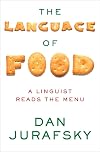
This book is about three of my favourite topics: history, food and language. Dan Jurafsky is a linguist whose research looks at what the migration and evolution of words can reveal about history, politics, psychology amongst other things. I think he has achieved a good balance between readability / accessibility and depth of research - it's actually a very 'academic' book, supported by detailed references and citations, but still very readable, partly because he uses many examples from his show more own experiences living in San Francisco. My only criticism is that the book is packed with annotations (equivalent to footnotes or references) that are not actually marked on the main text. I can understand that too many annotation symbols would be distracting, but discovering them at the end of the book doesn't seem very helpful (short of beginning the book all over again). Including them as footnotes at the bottom of each page would make a richer reading experience. This book has also taught me about the scope of modern-day linguistics research, enough to encourage me to perhaps try and look up his academic papers. I like how he has placed linguistics at the intersection of psychology, sociology, anthropology and history. show less
This book is about three of my favourite topics: history, food and language. Dan Jurafsky is a linguist whose research looks at what the migration and evolution of words can reveal about history, politics, psychology amongst other things. I think he has achieved a good balance between readability / accessibility and depth of research - it's actually a very 'academic' book, supported by detailed references and citations, but still very readable, partly because he uses many examples from his show more own experiences living in San Francisco. My only criticism is that the book is packed with annotations (equivalent to footnotes or references) that are not actually marked on the main text. I can understand that too many annotation symbols would be distracting, but discovering them at the end of the book doesn't seem very helpful (short of beginning the book all over again). Including them as footnotes at the bottom of each page would make a richer reading experience. This book has also taught me about the scope of modern-day linguistics research, enough to encourage me to perhaps try and look up his academic papers. I like how he has placed linguistics at the intersection of psychology, sociology, anthropology and history. show less
This book is about three of my favourite topics: history, food and language. Dan Jurafsky is a linguist whose research looks at what the migration and evolution of words can reveal about history, politics, psychology amongst other things. I think he has achieved a good balance between readability / accessibility and depth of research - it's actually a very 'academic' book, supported by detailed references and citations, but still very readable, partly because he uses many examples from his show more own experiences living in San Francisco. My only criticism is that the book is packed with annotations (equivalent to footnotes or references) that are not actually marked on the main text. I can understand that too many annotation symbols would be distracting, but discovering them at the end of the book doesn't seem very helpful (short of beginning the book all over again). Including them as footnotes at the bottom of each page would make a richer reading experience. This book has also taught me about the scope of modern-day linguistics research, enough to encourage me to perhaps try and look up his academic papers. I like how he has placed linguistics at the intersection of psychology, sociology, anthropology and history. show less
The history of food is a fascinating one but until reading this book I hadn't considered much the source of our names for foods and I had no idea how much they had migrated and changed over the centuries. The amount of, now, obscure connections of our foods is rather mind blowing. Who knew there was such a strong connection between fish and chips, ceviche and the ancient Middle East? Who knew the Middle East was the source of so much of the foods and processing techniques we still use today? show more Heck who knew there was a relationship between word sounds and food tastes?
This was well written, engaging and very, very educational, I love learning new things and I learned a lot with this book. show less
This was well written, engaging and very, very educational, I love learning new things and I learned a lot with this book. show less
Lists
You May Also Like


Associated Authors
Statistics
- Works
- 5
- Also by
- 1
- Members
- 722
- Popularity
- #35,165
- Rating
- 3.9
- Reviews
- 10
- ISBNs
- 19
- Languages
- 2
- Favorited
- 1