

Benjamin H. D. Buchloh
Author of Neo-Avantgarde and Culture Industry: Essays on European and American Art from 1955 to 1975
About the Author
Benjamin H.D. Buchloh is Andrew W. Mellon Professor of Modern Art at Harvard University. He is the author of Neo-Avantgarde and Culture Industry: Essays on European and American Art from 1955 to 1975 (MIT Press, 2001) and editor of October.
Works by Benjamin H. D. Buchloh
Neo-Avantgarde and Culture Industry: Essays on European and American Art from 1955 to 1975 (2001) 56 copies, 1 review
Premises: Invested Spaces in Visual Arts, Architecture, & Design from France : 1958-1998 (Guggenheim Museum Publications) (1998) 24 copies
Experiments in the Everyday: Allan Kaprow and Robert Watts--Events, Objects, Documents (an exhibition catalogue) (2000) 8 copies
Gerhard Richter [3 Volume Boxed Set] Band I: Katalog Der Ausstellung, Band II Texte, Band III Werkubersicht/Catalogue Raisonne 1962-1993 (1993) 5 copies
Décollage, les affichistes 1 copy
Entrevista de salida 1 copy
Art & Ideology. 1 copy
Associated Works
Tagged
Common Knowledge
- Birthdate
- 1941-11-15
- Gender
- male
- Occupations
- art historian
- Nationality
- Germany
- Birthplace
- Cologne, North Rhine-Westphalia, Germany
- Associated Place (for map)
- North Rhine-Westphalia, Germany
Members
Reviews

Writings 1973–1983 on Works 1969–1979 is an essential document of a decade of formative work by Michael Asher. Originally published in 1983, the book presents 33 works through the artist’s writings, photographic documentation, architectural floor plans, exhibition announcements, and other ephemera.
Asher did not create traditional art objects; instead, he chose to alter the existing institutional apparatus through which art is presented, creating work dependent on the architectural, show more social, or economic systems that undergird how art is produced and experienced. For example, in 1974, he removed the partition wall dividing the office and gallery space of the Claire Copley Gallery in Los Angeles. In another work from 1978, Asher had a bronze replica of a nineteenth-century sculpture of George Washington moved from the exterior of the Art Institute of Chicago to a room in the museum that housed eighteenth-century art, changing its location, but also its function from a public monument to an indoor sculpture, as it was originally intended.
Due to its site specificity and immateriality, Asher’s work ceased to exist after an exhibition, which makes this highly sought-after book the definitive mode through which one can gain insight into the work he made during this period. As the artist states in the introduction: “This book as a finished product will have a material permanence that contradicts the actual impermanence of the art-work, yet paradoxically functions as a testimony to that impermanence of my production.”
Initiated by Kasper König, Writings 1973-1983 on Works 1969-1979 was originally co-published by the Press of the Nova Scotia College of Art and Design and the Museum of Contemporary Art, Los Angeles, and was largely shaped by Asher’s close collaboration with art historian Benjamin H.D. Buchloh, who succeeded König as editor of the press. show less
Asher did not create traditional art objects; instead, he chose to alter the existing institutional apparatus through which art is presented, creating work dependent on the architectural, show more social, or economic systems that undergird how art is produced and experienced. For example, in 1974, he removed the partition wall dividing the office and gallery space of the Claire Copley Gallery in Los Angeles. In another work from 1978, Asher had a bronze replica of a nineteenth-century sculpture of George Washington moved from the exterior of the Art Institute of Chicago to a room in the museum that housed eighteenth-century art, changing its location, but also its function from a public monument to an indoor sculpture, as it was originally intended.
Due to its site specificity and immateriality, Asher’s work ceased to exist after an exhibition, which makes this highly sought-after book the definitive mode through which one can gain insight into the work he made during this period. As the artist states in the introduction: “This book as a finished product will have a material permanence that contradicts the actual impermanence of the art-work, yet paradoxically functions as a testimony to that impermanence of my production.”
Initiated by Kasper König, Writings 1973-1983 on Works 1969-1979 was originally co-published by the Press of the Nova Scotia College of Art and Design and the Museum of Contemporary Art, Los Angeles, and was largely shaped by Asher’s close collaboration with art historian Benjamin H.D. Buchloh, who succeeded König as editor of the press. show less
Neo-avantgarde and culture industry : essays on European and American art from 1955 to 1975 by Benjamin H. D. Buchloh
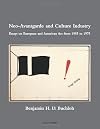
Named one of The Art Book's Best Books of the Decade (March 2003).
Some critics view the postwar avant-garde as the empty recycling of forms and strategies from the first two decades of the twentieth century. Others view it, more positively, as a new articulation of the specific conditions of cultural production in the postwar period. Benjamin Buchloh, one of the most insightful art critics and theoreticians of recent decades, argues for a dialectical approach to these positions.
This show more collection contains eighteen essays written by Buchloh over the last twenty years. Each looks at a single artist within the framework of specific theoretical and historical questions. The art movements covered include Nouveau Realisme in France (Arman, Yves Klein, Jacques de la Villegle) art in postwar Germany (Joseph Beuys, Sigmar Polke, Gerhard Richter), American Fluxus and pop art (Robert Watts and Andy Warhol), minimalism and postminimal art (Michael Asher and Richard Serra), and European and American conceptual art (Daniel Buren, Dan Graham). Buchloh addresses some artists in terms of their oppositional approaches to language and painting, for example, Nancy Spero and Lawrence Weiner. About others, he asks more general questions concerning the development of models of institutional critique (Hans Haacke) and the theorization of the museum (Marcel Broodthaers); or he addresses the formation of historical memory in postconceptual art (James Coleman).
One of the book's strengths is its systematic, interconnected account of the key issues of American and European artistic practice during two decades of postwar art. Another is Buchloh's method, which integrates formalist and socio-historical approaches specific to each subject. show less
Some critics view the postwar avant-garde as the empty recycling of forms and strategies from the first two decades of the twentieth century. Others view it, more positively, as a new articulation of the specific conditions of cultural production in the postwar period. Benjamin Buchloh, one of the most insightful art critics and theoreticians of recent decades, argues for a dialectical approach to these positions.
This show more collection contains eighteen essays written by Buchloh over the last twenty years. Each looks at a single artist within the framework of specific theoretical and historical questions. The art movements covered include Nouveau Realisme in France (Arman, Yves Klein, Jacques de la Villegle) art in postwar Germany (Joseph Beuys, Sigmar Polke, Gerhard Richter), American Fluxus and pop art (Robert Watts and Andy Warhol), minimalism and postminimal art (Michael Asher and Richard Serra), and European and American conceptual art (Daniel Buren, Dan Graham). Buchloh addresses some artists in terms of their oppositional approaches to language and painting, for example, Nancy Spero and Lawrence Weiner. About others, he asks more general questions concerning the development of models of institutional critique (Hans Haacke) and the theorization of the museum (Marcel Broodthaers); or he addresses the formation of historical memory in postconceptual art (James Coleman).
One of the book's strengths is its systematic, interconnected account of the key issues of American and European artistic practice during two decades of postwar art. Another is Buchloh's method, which integrates formalist and socio-historical approaches specific to each subject. show less
October 42 -Art, Theory, Criticism, Politics. Broodthaers: Writings, Interviews, Photographs. by Benjamin H. D. Buchloh

"While the original impulse to edit this issue was occasioned in part by the tenth anniversary of Broodthaers's death, it also originated in the desire to counteract both the work's obscurity and the falsification inherent in its art historical institutionalization. Moreover, it was our desire to have Marcel Broodthaers's work reconsidered (or rather, since it is all but unknown in the United States, to suggest it for a first consideration) in relation to currently dominant cultural show more practices and their respective capacity and willingness to re flect upon their discursive, institutional, and economic status."
Benjamin H. D. Buchloh in the Introductory Note
The back cover features an Untitled Poem by Marcel Broodthaers, 1968. It includes the whole phrase UN COUP DE DÉS JAMAIS N‘ABOLIRA LE HASARD and is comparing the alphabet to a dice, referring to the 26 letters as sides of a dice. show less
Benjamin H. D. Buchloh in the Introductory Note
The back cover features an Untitled Poem by Marcel Broodthaers, 1968. It includes the whole phrase UN COUP DE DÉS JAMAIS N‘ABOLIRA LE HASARD and is comparing the alphabet to a dice, referring to the 26 letters as sides of a dice. show less
Published on the occasion of the exhibition Gerhard Richter: Eight Gray; Showcasing specially commissioned work from the internationally renowned artist Gerhard Richter, this exhibition catalogue for the Deutsche Guggenheim Berlin details his experiments with the mirror and its relationship to painting. Richter often adds a layer of colour behind the glass surfaces, thus complicating and compromising the clarity and "truth" expected from the glass. The shifting, hazy reflections articulate show more the elusive nature of the reality artists struggle to imitate. For Richter, there is no one vision, no certitude. Representing nothingness - the void - the eight large grey mirrors recall for the artist a kind of "momento mori". The publication focuses on the commissioned project and the importance of the "Mirror" series; projects in glass, grey monochromes; and in related works in Richter's career. Nearly 50 drawings and related works dating from 1965 to the present as well as studies for the Berlin installation are illustrated. The catalogue also includes an essay by Richter expert Ben Buchloh. show less
You May Also Like


Associated Authors
Statistics
- Works
- 43
- Also by
- 6
- Members
- 365
- Popularity
- #65,882
- Rating
- 4.1
- Reviews
- 7
- ISBNs
- 49
- Languages
- 3