
Frederick Lewis Allen (1890–1954)
Author of Only Yesterday: An Informal History of the 1920s
About the Author
Image credit: Findagrave.com
Works by Frederick Lewis Allen
Since Yesterday: The 1930s in America, September 3, 1929 to September 3, 1939 (1940) 447 copies, 3 reviews
Associated Works
An American Album: One Hundred and Fifty Years of Harper's Magazine (2000) — Contributor — 146 copies, 1 review
Gentlemen, Scholars and Scoundrels: A Treasury of the Best of Harper's Magazine from 1850 to the Present (1972) — Contributor — 62 copies
Tagged
Common Knowledge
- Birthdate
- 1890-07-05
- Date of death
- 1954-02-13
- Gender
- male
- Education
- Harvard University (AM|1913)
Harvard College (AB|1912) - Occupations
- editor
historian - Organizations
- The Atlantic Monthly
The Century
Harper's Magazine - Relationships
- Rogers, Agnes (wife)
- Nationality
- USA
- Birthplace
- Boston, Massachusetts, USA
- Places of residence
- Boston, Massachusetts, USA
New York, New York, USA - Place of death
- New York, New York, USA
- Associated Place (for map)
- New York, USA
Members
Reviews
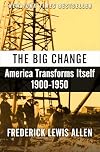
Summary: A social history of the United States from 1900 to 1950 chronicling the expansion of the middle class, the technological changes that occurred, and the impact of two World Wars and the Depression.
Want to know what life was like for your grandparents or great grandparents, and the changes they saw in their lifetimes? This is a great book for understanding what the U.S. was like during the first half of the Twentieth Century. It was fascinating for me, as someone born two years after show more this work was first published in 1952. The book ends just before I began and the last chapters describe well the Baby Boom years of the early 1950s, and describe well the changes my own parents saw in their growing up years.
Frederick Lewis Allen was a popular, rather than academic historian who served in a variety of editorial positions including editor-in-chief of Harpers Magazine from 1941 until shortly before his death in February of 1954. He was a contemporary of such popular historians as Allen Nevins, Douglas Southall Freeman, Bernard DeVoto, and Carl Sandburg. The Big Change was his last work, and a National Book Award finalist in 1953. He also wrote histories on the decades of the 1920's (Only Yesterday) and 1930's (Since Yesterday) as well as an economic history of the U.S. from 1890 up to the Depression (The Lords of Creation). All of these works have been re-published recently by Open Road Integrated Media.
While not having read the other works, I sense that this book is a synthesis of all of them that not only summarizes each of the periods covered by the others, but does so with an eye to the transformation of the United States from an economy with a small percent of very rich who lived in extravagant homes and vast disparities of wealth and poverty to a post-World War II economy with a huge expansion of consumer goods, mass communication via radio and TV, and changing cities with the vast migrations from rural to urban setting, including Blacks (called Negroes in Allen's time) from the Jim Crow South.
The first part of the book covers the beginning of this period, describing the technology of the period, including the beginnings of the automobile age, the robber barons and their wealth and a relatively limited government, at least until Teddy Roosevelt. Part two chronicles the changes Roosevelt and the muckrakers brought, the growth of mass production, including the revolution Henry Ford led, the 1920's as the last gasp of the old order, the grinding experience of the Depression, and the acceleration of economic and social change brought on by the war experience. The third part talks gives an economic and social description of the country at the end of the period, describing the growing middle class, the reduction of wealth disparities due to progressive taxes, and the alternative form of luxury spending of the period known as the expense account. He also chronicles the leveling influence of education, mass media, and the wide availability of goods once the exclusive preserve of the wealthy.
He concludes with the apprehensions of the early years of the Cold War and McCarthyism, the concerns about an increasingly large government and large corporations, and the growth of educational and economic opportunities for many and the vibrancy of private organizations and individual initiative in the country. Discussions of racial faultlines anticipate both the Civil Rights movement of the 1960's, and the growing affluence anticipates the counter-culture reaction of the later 60's and early 70's.
His style is very readable, even a bit "chatty". The origin of the book was a Harpers article and it has the feel of a well-informed communicator who knows his audience well enough to engage with them directly. Reading this nearly 65 years after it was first published brings home to me how much we have changed since then--the complexities of a post-Soviet, post 9/11 era, the boom in information technology and the interconnectedness of everything, and the social changes of an increasingly diverse nation. This is a transformation I've lived through and makes me wonder who will write "Big Change II." Whoever that may be, Allen's book provides a great jumping-off point.
________________________________
Disclosure of Material Connection: I received this book free from the publisher via Netgalley. I was not required to write a positive review. The opinions I have expressed are my own. show less
Want to know what life was like for your grandparents or great grandparents, and the changes they saw in their lifetimes? This is a great book for understanding what the U.S. was like during the first half of the Twentieth Century. It was fascinating for me, as someone born two years after show more this work was first published in 1952. The book ends just before I began and the last chapters describe well the Baby Boom years of the early 1950s, and describe well the changes my own parents saw in their growing up years.
Frederick Lewis Allen was a popular, rather than academic historian who served in a variety of editorial positions including editor-in-chief of Harpers Magazine from 1941 until shortly before his death in February of 1954. He was a contemporary of such popular historians as Allen Nevins, Douglas Southall Freeman, Bernard DeVoto, and Carl Sandburg. The Big Change was his last work, and a National Book Award finalist in 1953. He also wrote histories on the decades of the 1920's (Only Yesterday) and 1930's (Since Yesterday) as well as an economic history of the U.S. from 1890 up to the Depression (The Lords of Creation). All of these works have been re-published recently by Open Road Integrated Media.
While not having read the other works, I sense that this book is a synthesis of all of them that not only summarizes each of the periods covered by the others, but does so with an eye to the transformation of the United States from an economy with a small percent of very rich who lived in extravagant homes and vast disparities of wealth and poverty to a post-World War II economy with a huge expansion of consumer goods, mass communication via radio and TV, and changing cities with the vast migrations from rural to urban setting, including Blacks (called Negroes in Allen's time) from the Jim Crow South.
The first part of the book covers the beginning of this period, describing the technology of the period, including the beginnings of the automobile age, the robber barons and their wealth and a relatively limited government, at least until Teddy Roosevelt. Part two chronicles the changes Roosevelt and the muckrakers brought, the growth of mass production, including the revolution Henry Ford led, the 1920's as the last gasp of the old order, the grinding experience of the Depression, and the acceleration of economic and social change brought on by the war experience. The third part talks gives an economic and social description of the country at the end of the period, describing the growing middle class, the reduction of wealth disparities due to progressive taxes, and the alternative form of luxury spending of the period known as the expense account. He also chronicles the leveling influence of education, mass media, and the wide availability of goods once the exclusive preserve of the wealthy.
He concludes with the apprehensions of the early years of the Cold War and McCarthyism, the concerns about an increasingly large government and large corporations, and the growth of educational and economic opportunities for many and the vibrancy of private organizations and individual initiative in the country. Discussions of racial faultlines anticipate both the Civil Rights movement of the 1960's, and the growing affluence anticipates the counter-culture reaction of the later 60's and early 70's.
His style is very readable, even a bit "chatty". The origin of the book was a Harpers article and it has the feel of a well-informed communicator who knows his audience well enough to engage with them directly. Reading this nearly 65 years after it was first published brings home to me how much we have changed since then--the complexities of a post-Soviet, post 9/11 era, the boom in information technology and the interconnectedness of everything, and the social changes of an increasingly diverse nation. This is a transformation I've lived through and makes me wonder who will write "Big Change II." Whoever that may be, Allen's book provides a great jumping-off point.
________________________________
Disclosure of Material Connection: I received this book free from the publisher via Netgalley. I was not required to write a positive review. The opinions I have expressed are my own. show less
Only Yesterday: An Informal History of the 1920s (Harper Perennial Modern Classics) by Frederick Lewis Allen
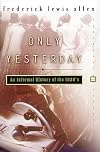
Lessons That Go Unheeded
History teaches many lessons but people are bad pupils. Not just people today, but people throughout history have ignored the lessons taught by events preceding them. Consequently, we repeat mistakes over and over again. Those new to Only Yesterday will only have to read a few chapters to see how true these statements are, because the parallels between the 1920s and current times are numerous. Errors made then are still being made today. Read it for yourself to see show more the truth in this.
Only Yesterday is a contemporaneous history published two years after the 1929 stock market crash, as well as shortly after the Florida Land Bubble bust that began in 1925 (and is argued to be the precipitating cause of the Great Depression by Christopher Knowlton in his recent book, Bubble in the Sun). Frederick Lewis Allen worked as a contributor to Harper’s Magazine, later, in 1941, assuming the position of editor-in-chief. Readers will enjoy his breezy and often tongue-in-cheek style, making this anything but a dry trudge.
Allen covers all the highlights of the years 1919 through 1929, among them the incapacitated years of Woodrow Wilson, the scandal-plagued presidency of Warren G. Harding, the Red Scare spearheaded by AG Mitchell Palmer, the complacent and laissez-faire presidency of Calvin Coolidge, the disaster that was Prohibition, the rise of organized crime that features Al Capone, the rising popularity of spectator sports starring Tunney, Ruth, and others, the adoption of more liberal mores, the books and intellectual arguments of the times, and the financials of the day, among them the above mentioned Florida Land Bubble, the plight of American farmers, intermingling of business and religion, margin buying, unregulated mutual trusts, boosterism, and other like factors resulting in the Stock Market Crash of 1929. Readers cannot help but be struck by the similarities, especially in government and business, to what we are experiencing today.
To emphasize this, readers will find much that rings true in this brief quote from the Red Scare pages: “There is a certain grim humor in the fact that what Mr. Palmer did during the next three months was done by him as the chief legal officer of an Administration which had come into power to bring about the New Freedom.” Palmer-ism burned hot in America for a time with some pretty terrible consequences, as this passage reveals: “The intolerance of those days took many forms. Almost inevitably it took the form of an ugly flare-up of feeling against the Negro, the Jew, and the Roman Catholic. The notions of group loyalty and of hatred, expanded during war-time and then suddenly denied their intended expression, found a perverted release in the persecution not only of supposed radicals, but also of other elements which to the dominant American group—the white Protestants—seemed alien or ‘un-American.’” Yes, it is as if we are gazing into a mirror and seeing ourselves.
So, here’s a book of its times that speaks as truly of our own, with lessons for us all. Americans should spend a couple of hours with it, and maybe, hopefully, draw some lesson from it. show less
History teaches many lessons but people are bad pupils. Not just people today, but people throughout history have ignored the lessons taught by events preceding them. Consequently, we repeat mistakes over and over again. Those new to Only Yesterday will only have to read a few chapters to see how true these statements are, because the parallels between the 1920s and current times are numerous. Errors made then are still being made today. Read it for yourself to see show more the truth in this.
Only Yesterday is a contemporaneous history published two years after the 1929 stock market crash, as well as shortly after the Florida Land Bubble bust that began in 1925 (and is argued to be the precipitating cause of the Great Depression by Christopher Knowlton in his recent book, Bubble in the Sun). Frederick Lewis Allen worked as a contributor to Harper’s Magazine, later, in 1941, assuming the position of editor-in-chief. Readers will enjoy his breezy and often tongue-in-cheek style, making this anything but a dry trudge.
Allen covers all the highlights of the years 1919 through 1929, among them the incapacitated years of Woodrow Wilson, the scandal-plagued presidency of Warren G. Harding, the Red Scare spearheaded by AG Mitchell Palmer, the complacent and laissez-faire presidency of Calvin Coolidge, the disaster that was Prohibition, the rise of organized crime that features Al Capone, the rising popularity of spectator sports starring Tunney, Ruth, and others, the adoption of more liberal mores, the books and intellectual arguments of the times, and the financials of the day, among them the above mentioned Florida Land Bubble, the plight of American farmers, intermingling of business and religion, margin buying, unregulated mutual trusts, boosterism, and other like factors resulting in the Stock Market Crash of 1929. Readers cannot help but be struck by the similarities, especially in government and business, to what we are experiencing today.
To emphasize this, readers will find much that rings true in this brief quote from the Red Scare pages: “There is a certain grim humor in the fact that what Mr. Palmer did during the next three months was done by him as the chief legal officer of an Administration which had come into power to bring about the New Freedom.” Palmer-ism burned hot in America for a time with some pretty terrible consequences, as this passage reveals: “The intolerance of those days took many forms. Almost inevitably it took the form of an ugly flare-up of feeling against the Negro, the Jew, and the Roman Catholic. The notions of group loyalty and of hatred, expanded during war-time and then suddenly denied their intended expression, found a perverted release in the persecution not only of supposed radicals, but also of other elements which to the dominant American group—the white Protestants—seemed alien or ‘un-American.’” Yes, it is as if we are gazing into a mirror and seeing ourselves.
So, here’s a book of its times that speaks as truly of our own, with lessons for us all. Americans should spend a couple of hours with it, and maybe, hopefully, draw some lesson from it. show less
Only Yesterday: An Informal History of the 1920s (Harper Perennial Modern Classics) by Frederick Lewis Allen
Lessons That Go Unheeded
History teaches many lessons but people are bad pupils. Not just people today, but people throughout history have ignored the lessons taught by events preceding them. Consequently, we repeat mistakes over and over again. Those new to Only Yesterday will only have to read a few chapters to see how true these statements are, because the parallels between the 1920s and current times are numerous. Errors made then are still being made today. Read it for yourself to see show more the truth in this.
Only Yesterday is a contemporaneous history published two years after the 1929 stock market crash, as well as shortly after the Florida Land Bubble bust that began in 1925 (and is argued to be the precipitating cause of the Great Depression by Christopher Knowlton in his recent book, Bubble in the Sun). Frederick Lewis Allen worked as a contributor to Harper’s Magazine, later, in 1941, assuming the position of editor-in-chief. Readers will enjoy his breezy and often tongue-in-cheek style, making this anything but a dry trudge.
Allen covers all the highlights of the years 1919 through 1929, among them the incapacitated years of Woodrow Wilson, the scandal-plagued presidency of Warren G. Harding, the Red Scare spearheaded by AG Mitchell Palmer, the complacent and laissez-faire presidency of Calvin Coolidge, the disaster that was Prohibition, the rise of organized crime that features Al Capone, the rising popularity of spectator sports starring Tunney, Ruth, and others, the adoption of more liberal mores, the books and intellectual arguments of the times, and the financials of the day, among them the above mentioned Florida Land Bubble, the plight of American farmers, intermingling of business and religion, margin buying, unregulated mutual trusts, boosterism, and other like factors resulting in the Stock Market Crash of 1929. Readers cannot help but be struck by the similarities, especially in government and business, to what we are experiencing today.
To emphasize this, readers will find much that rings true in this brief quote from the Red Scare pages: “There is a certain grim humor in the fact that what Mr. Palmer did during the next three months was done by him as the chief legal officer of an Administration which had come into power to bring about the New Freedom.” Palmer-ism burned hot in America for a time with some pretty terrible consequences, as this passage reveals: “The intolerance of those days took many forms. Almost inevitably it took the form of an ugly flare-up of feeling against the Negro, the Jew, and the Roman Catholic. The notions of group loyalty and of hatred, expanded during war-time and then suddenly denied their intended expression, found a perverted release in the persecution not only of supposed radicals, but also of other elements which to the dominant American group—the white Protestants—seemed alien or ‘un-American.’” Yes, it is as if we are gazing into a mirror and seeing ourselves.
So, here’s a book of its times that speaks as truly of our own, with lessons for us all. Americans should spend a couple of hours with it, and maybe, hopefully, draw some lesson from it. show less
History teaches many lessons but people are bad pupils. Not just people today, but people throughout history have ignored the lessons taught by events preceding them. Consequently, we repeat mistakes over and over again. Those new to Only Yesterday will only have to read a few chapters to see how true these statements are, because the parallels between the 1920s and current times are numerous. Errors made then are still being made today. Read it for yourself to see show more the truth in this.
Only Yesterday is a contemporaneous history published two years after the 1929 stock market crash, as well as shortly after the Florida Land Bubble bust that began in 1925 (and is argued to be the precipitating cause of the Great Depression by Christopher Knowlton in his recent book, Bubble in the Sun). Frederick Lewis Allen worked as a contributor to Harper’s Magazine, later, in 1941, assuming the position of editor-in-chief. Readers will enjoy his breezy and often tongue-in-cheek style, making this anything but a dry trudge.
Allen covers all the highlights of the years 1919 through 1929, among them the incapacitated years of Woodrow Wilson, the scandal-plagued presidency of Warren G. Harding, the Red Scare spearheaded by AG Mitchell Palmer, the complacent and laissez-faire presidency of Calvin Coolidge, the disaster that was Prohibition, the rise of organized crime that features Al Capone, the rising popularity of spectator sports starring Tunney, Ruth, and others, the adoption of more liberal mores, the books and intellectual arguments of the times, and the financials of the day, among them the above mentioned Florida Land Bubble, the plight of American farmers, intermingling of business and religion, margin buying, unregulated mutual trusts, boosterism, and other like factors resulting in the Stock Market Crash of 1929. Readers cannot help but be struck by the similarities, especially in government and business, to what we are experiencing today.
To emphasize this, readers will find much that rings true in this brief quote from the Red Scare pages: “There is a certain grim humor in the fact that what Mr. Palmer did during the next three months was done by him as the chief legal officer of an Administration which had come into power to bring about the New Freedom.” Palmer-ism burned hot in America for a time with some pretty terrible consequences, as this passage reveals: “The intolerance of those days took many forms. Almost inevitably it took the form of an ugly flare-up of feeling against the Negro, the Jew, and the Roman Catholic. The notions of group loyalty and of hatred, expanded during war-time and then suddenly denied their intended expression, found a perverted release in the persecution not only of supposed radicals, but also of other elements which to the dominant American group—the white Protestants—seemed alien or ‘un-American.’” Yes, it is as if we are gazing into a mirror and seeing ourselves.
So, here’s a book of its times that speaks as truly of our own, with lessons for us all. Americans should spend a couple of hours with it, and maybe, hopefully, draw some lesson from it. show less
I found this to be one of the most fascinating history books I have ever read. The book was originally written in 1931, so the information and comments in the book were untainted by later events. Allen's writing style is casual, informative, and peppered with hilarious asides that kept me engaged through the whole book. My very favorite part was a quotation from John F. Carter in the September 1920 issue of Atlantic Monthly: "The older generation had certainly pretty well ruined this world show more before passing it on to us. They give us this thing, knocked to pieces, leaky, red-hot, threatening to blow up; and then they are surprised that we don't accept it with the same attitude of pretty, decorous enthusiasm with which they received it, way back in the 'eighties." Sound familiar? I read this simultaneously with a book about 1890-1918, and a book about the stock market in the 2000s, and realized that it is true: the more things change, the more they stay the same. show less
Lists
Awards


You May Also Like


Associated Authors
Statistics
- Works
- 16
- Also by
- 6
- Members
- 2,436
- Popularity
- #10,538
- Rating
- 4.0
- Reviews
- 45
- ISBNs
- 62
- Favorited
- 1