
Stephen R. Donaldson
Author of Lord Foul's Bane
About the Author
Stephen Donaldson, 1947 - Novelist Stephen Donaldson was born on May 13, 1947 in Cleveland, Ohio to James R. Donaldson, a medical missionary, and Mary Ruth Reeder, a prosthetist. His father was an orthopedic surgeon that worked with lepers in India. He lived in India between the ages of three to show more sixteen and while listening to one of his father's lectures on leprosy, he conceived the legendary Thomas Covenant. Donaldson attended the College of Wooster, Ohio and graduated in 1968. Afterwards, he spent two years being a conscientious objector doing hospital work in Akron and then attended Kent University where he received an M.A. in English. Donaldson's publishing debut was with "Lord Foul's Bane" (1977), which was the first book in the fantasy trilogy entitled The Chronicles of Thomas Covenant, the Unbeliever. It was named best novel of the year by the British Fantasy Society and received the John W. Campbell Award for Best New Writer, in 1979. He followed with the sequel series The Second Chronicles of Thomas Covenant, also set in The Land, starting with "Daughter of Regals," and then the Mordant's Need series with "The Mirror of Her Dreams" and "A Man Rides Through." Donaldson is also the author of the Gap Into series of science fiction adventure that began with "The Real Story" and followed with "Forbidden Knowledge," "A Dark and Hungry God Arises," and "Chaos and Order." In addition to the awards he received for his first novel/series, Donaldson has also received the Balrog Fantasy Award for Best Novel for "The Wounded Land" in 1981 and for "The One Tree" in 1983, the Saturn Award for Best Fantasy Novel for "The One Tree" in 1983, the Balrog Fantasy Award for Best Collection for "Daughter of Regals and Other Tales" in 1985, and the Science Fiction Book Club Award for Best Book of the Year for "The Mirror of Her Dreams" in 1988 and "A Man Rides Through" in 1989. He also received The College of Wooster Distinguished Alumni Award in 1989, the WIN/WIN Popular Fiction Readers Choice Award for Favorite Fantasy Author in 1991, the Atlanta Fantasy Fair Award for Outstanding Achievement in 1992 and the President's Award, The International Association for the Fantastic in the Arts in 1997. (Bowker Author Biography) show less
Series
Works by Stephen R. Donaldson
The First AND Second Chronicles of Thomas Covenant (Lord Foul's Bane, The Illearth War, The Power That Preserves, The Wounded Land, The One Tree, White Gold Wielder) (1990) 30 copies, 1 review
The Fantasy & Science Fiction Book of Unicorns, Volume 2 — Contributor — 14 copies
The Gap Series: The Real Story, Forbidden Knowledge, A Dark and Hungry God Arises, Chaos and Order, This Day All Gods Die (1996) 4 copies
2002 3 copies
Gap Into - Vision, Conflict and Madness (The Real Story, Forbidden Knowledge, Chaos and Order) 2 copies
Verbotenes Wissen 1 copy
World Tales 1 copy
The Second Chronicles of Thomas Covenant Books Two and Three (The One Tree and White Gold Welder) (1982) 1 copy
Pitchwife's Battle 1 copy
Heut Sterben Alle Götter 1 copy
1996 1 copy
Associated Works
Bauchelain and Korbal Broach, Volume 1 (2007) — Introduction, some editions — 542 copies, 14 reviews
A Very Large Array: New Mexico Science Fiction and Fantasy (1987) — Contributor — 35 copies, 3 reviews
Last Drink Bird Head : A Flash Fiction Anthology for Charity (2009) — Contributor — 33 copies, 1 review
Tagged
Common Knowledge
- Legal name
- Donaldson, Stephen Reeder
- Other names
- Stephens, Reed
Donaldson, Stephen - Birthdate
- 1947-05-13
- Gender
- male
- Education
- The College of Wooster (B.A. | English | 1968)
Kent State University (MA|English|1971) - Occupations
- fantasy writer
- Organizations
- American Contract Bridge League
International Association for the Fantastic in the Arts
Contributing Editor, The Journal of the Fantastic in the Arts - Awards and honors
- John W. Campbell Award (1979)
The College of Wooster Distinguished Alumni Award (1989)
WIN/WIN Popular Fiction Readers Choice Award for Favorite Fantasy Author (1991)
Atlanta Fantasy Fair Award for Outstanding Achievement (1992)
President's Award, The International Association for the Fantastic in the Arts (1997) - Agent
- Howard Morhaim (Howard Morhaim Literary Agency)
- Short biography
- Born in 1947 in Cleveland, Ohio, Stephen R. Donaldson lived in India (where his father was a medical missionary) until 1963. He graduated from the College of Wooster (Ohio) in 1968, served two years as a conscientious objector during the Vietnam War, doing hospital work in Akron, then attended Kent State University, where he received his M.A. in English in 1971.After dropping out of his Ph.D. program and moving to New Jersey in order to write fiction, Donaldson made his publishing debut with the first "Covenant" trilogy in 1977. That enabled him to move to a healthier climate. He now lives in New Mexico.The novels for which he is best known have received a number of awards. However, the achievements of which he is most proud are the ones that seemed the most unlikely. In 1993 he received a Doctor of Literature degree from the College of Wooster, and in 1994 he gained a black belt in Shotokan karate from Sensei Mike Heister and Anshin Personal Defense.After completing the five-book, seven-year Gap sequence of science fiction novels, Donaldson spent quite some time "on vacation." However, he has now returned to work. His most recent book prior to The Man Who Fought Alone was a second collection of short fiction, Reave the Just and Other Tales. He is currently hard at work on "The Last Chronicles of Thomas Covenant".
- Nationality
- USA
- Birthplace
- Cleveland, Ohio, USA
- Places of residence
- India
Akron, Ohio, USA
New Jersey, USA
Corrales, New Mexico, USA
Albuquerque, New Mexico, USA - Map Location
- Ohio, USA
Members
Reviews
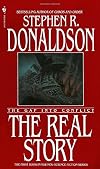
Still love this. It's totally repulsive and it abuses your senses, but the characters are hateful, sorrowful, evil and good enough to sink your teeth in and shake vigorously. They are crazy, bloody and utterly beaten down... yet they keep getting back up and fighting.
Power That Preserves (The Chronicles of Thomas Covenant the Unbeliever Book 3) by Stephen R. Donaldson
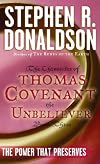
The awesomeness of this book almost makes up for the tortuousness of the first book, and part of the 2nd book. Donaldson is an expert at writing about suffering. Every character in these books suffers from start to almost finish. A couple get lucky and make it to the end still alive, heavily scarred. I've seen this kind of plot structure in story arcs in comic books. Just completely beat the hell out of the heroes, make it seem like there's absolutely no way the good guys can win, and then show more they do. Except that Donaldson makes it so painful, that in the end you don't know if they really did win, considering how broken and damaged they are now. And unlike comic books, these heroes don't come back.
I guess, it's kind of original in fantasy novels, so I appreciate that, just not sure I want to read more of it. I hated Covenant almost the entire time. When one of his companions was someone who he had wronged and they loved him, I was delighted by thinking that he would suffer for it. Then I realized that he loves suffering and was always looking for a reason to be even more negative, so that ruined it for me.
BUT this still got 4 stars. What I loved, corrupted giants, friendly giants, ancient artifacts of power, huge sieges of ancient strongholds, lots and lots of magic, the deep history of the land, and of course, finally some good news for the good guys. About that good news, a couple people have talked about the "victory chapter". I loved it, but it seems like the key to it was "the oath of peace", which always seemed kind of lame to me. Like, "our whole world is being destroyed and everyone is being killed, but we better be nice and make sure we don't hurt the bad guys too much, unless we absolutely have to." Again, it almost became like a superhero trope, "we don't kill villains". show less
I guess, it's kind of original in fantasy novels, so I appreciate that, just not sure I want to read more of it. I hated Covenant almost the entire time. When one of his companions was someone who he had wronged and they loved him, I was delighted by thinking that he would suffer for it. Then I realized that he loves suffering and was always looking for a reason to be even more negative, so that ruined it for me.
BUT this still got 4 stars. What I loved, corrupted giants, friendly giants, ancient artifacts of power, huge sieges of ancient strongholds, lots and lots of magic, the deep history of the land, and of course, finally some good news for the good guys. About that good news, a couple people have talked about the "victory chapter". I loved it, but it seems like the key to it was "the oath of peace", which always seemed kind of lame to me. Like, "our whole world is being destroyed and everyone is being killed, but we better be nice and make sure we don't hurt the bad guys too much, unless we absolutely have to." Again, it almost became like a superhero trope, "we don't kill villains". show less
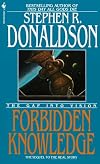
I'm totally loving this series all over again.
I remember the main points, and the details are great. It's a step above a space opera for me. The universe is dark, misogynistic, empty and the feeling of doom pervades the corners. Power and control are the most valuable currencies.
The characters are perverse and lush. This isn't a story of heroes or heroines. There's not a single likeable person, nor is there a single character who can't be understood to one degree or another.
Even Morn does show more horrible things to people who don't play to her self-interest. She's a terribly abused and naive person who can't grasp what's happening to her. She is her own worst enemy in Forbidden Knowledge. She's been blind for so long that she can't grasp reality and clings to anything that will ease her battered mind and allow escape. But, everyone does it in Forbidden Knowledge. They deal with their own limitations by skirting them dishonestly. show less
I remember the main points, and the details are great. It's a step above a space opera for me. The universe is dark, misogynistic, empty and the feeling of doom pervades the corners. Power and control are the most valuable currencies.
The characters are perverse and lush. This isn't a story of heroes or heroines. There's not a single likeable person, nor is there a single character who can't be understood to one degree or another.
Even Morn does show more horrible things to people who don't play to her self-interest. She's a terribly abused and naive person who can't grasp what's happening to her. She is her own worst enemy in Forbidden Knowledge. She's been blind for so long that she can't grasp reality and clings to anything that will ease her battered mind and allow escape. But, everyone does it in Forbidden Knowledge. They deal with their own limitations by skirting them dishonestly. show less
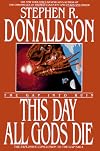
What a series. It's finally done. I'm really glad that I made the decision to re-read the series and finish up the last book. This book was the only book in the series that wasn't a reread for me.
The conclusion was satisfying and wrapped up the story in grand space-opera fashion. Everyone had their appropriate end, with one exception.
Angus Thermopyle. In the just world, he would have died with Fasner and his yacht would have been destroyed. But, Angus lives on as a super pirate “working show more for the UMPC”. There's something profoundly wrong with that after his life of depravity and evil. His forced redemption as a wired human doesn't make up for what he did to Morn, Davies or Marc Vestabule.
I suppose it's a twist on the normal plotting, but everyone else had such a deserved conventional ending that his stuck out as a sour note.
I get the need to explain what had happened before, but it got a bit repetitious in this book. Much of the dialogue could have been trimmed back in this massive volume. Still, it was good to see history through varied eyes.
The battles remained a strong point in this book. The characters were well drawn and multifaceted.
By the fifth book my love for many of them had grown so strong — Particularly Vector Shaheed in his weakened, arthritic middle-age amid his claims of cowardice. He was the strongest of them all, no matter what his claim.
I wanted to forgive Angus, but couldn't. I wanted Morn to walk away from Min Donner, but she didn't. I mourned for Pup in a way that Mikka couldn't. I was happy that Davies found his own voice.
I would have given anything for someone to punch Hashi right in his fucking face.
This series isn't for everyone. It's certainly not for anyone who can't handle books that refuse to flinch away from violence and abuse, including rape. It's not for people who can't handle women who use their sexuality as a weapon or a tool. It's not a book that excuses doing bad things for the right reasons or doing good things for the wrong reasons. It is a book that shows there are consequences for every action you take, and those consequences can be dire. show less
The conclusion was satisfying and wrapped up the story in grand space-opera fashion. Everyone had their appropriate end, with one exception.
I suppose it's a twist on the normal plotting, but everyone else had such a deserved conventional ending that his stuck out as a sour note.
I get the need to explain what had happened before, but it got a bit repetitious in this book. Much of the dialogue could have been trimmed back in this massive volume. Still, it was good to see history through varied eyes.
The battles remained a strong point in this book. The characters were well drawn and multifaceted.
By the fifth book my love for many of them had grown so strong — Particularly Vector Shaheed in his weakened, arthritic middle-age amid his claims of cowardice. He was the strongest of them all, no matter what his claim.
I would have given anything for someone to punch Hashi right in his fucking face.
This series isn't for everyone. It's certainly not for anyone who can't handle books that refuse to flinch away from violence and abuse, including rape. It's not for people who can't handle women who use their sexuality as a weapon or a tool. It's not a book that excuses doing bad things for the right reasons or doing good things for the wrong reasons. It is a book that shows there are consequences for every action you take, and those consequences can be dire. show less
Lists
Antiheroes (1)
Missing Books (1)
Favorite Series (1)
Unread books (1)
al.vick-series (4)
Read in 2006 (2)
Awards


You May Also Like


Associated Authors
Statistics
- Works
- 93
- Also by
- 21
- Members
- 54,693
- Popularity
- #274
- Rating
- 3.8
- Reviews
- 581
- ISBNs
- 594
- Languages
- 14
- Favorited
- 137


