
Steven Erikson
Author of Gardens of the Moon
About the Author
Steven Erikson, a pseudonym used by Steven Rune Lundin, was born in Toronto, Canada on October 7, 1959. He is an anthropologist and archaeologist by training and a graduate of the Iowa Writer's Workshop. He is the author of the Malazan Book of the Fallen series and the Bauchelain and Korbal Broach show more series. (Bowker Author Biography) show less
Disambiguation Notice:
Please distinguish between this Steven Erikson (1959-____), author of Gardens of the Moon, and Steve Erickson (1950-____), author of Days Between Stations. Thank you.
Series
Works by Steven Erikson
The Second Collected Tales of Bauchelain & Korbal Broach: Three Short Novels of the Malazan Empire (2018) 98 copies, 1 review
Walk in Shadow 31 copies
Legacies of Betrayal 7 copies
I giardini della luna. Una storia tratta dal libro Malazan dei Caduti. Ediz. speciale (Vol. 1) (2025) 2 copies
Stolen Voices/Vacant Rooms (Stolen Voices by Steve Lundin/Broken Rooms by Mitch Parry) (1993) 2 copies
Bauchelain and Korbal Broach 2 copies
Midnight Tides • The Bonehunters 2 copies
Amnesiascope 1 copy
Buzun Anıları 1 copy
This Rich Evil Sound 1 copy
Quashie Trapp Blacklight 1 copy
Associated Works
Tagged
Common Knowledge
- Legal name
- Lundin, Steve Rune
- Birthdate
- 1959-10-07
- Gender
- male
- Education
- Iowa Writers' Workshop
- Occupations
- novelist
anthropologist
archaeologist - Short biography
- Steven Erikson se ve skutečnosti jmenuje Steve Rune Lundin. Pseudonym si zvolil podle rodného jména své matky, milovnice dobrodružných románů. Narodil se v kanadském Torontu v roce 1959. Vystudoval paleontologii a 18 let jezdil po vykopávkách v Jižní a Střední Americe. Tak poznal i svou ženu. Spolu se přestěhovali do Anglie, kde však nemohl najít odpovídající místo, takže byl nucen vykonávat různé kancelářské práce. S těmi mohl praštit až ve chvíli, kdy jeho Měsíční zahrady sklidily obrovský úspěch. Autorova popularita má i svou příjemnou stranu – patří k nejlépe placeným autorům tohoto žánru. Nyní se věnuje pouze psaní, jeho cyklus Malazská Kniha padlých má už osm dílů (z plánovaných deseti). Napsal i humornou novelu Potoky krve, popisující dobrodružství nekromantů Korbala a Bauchelaina a jejich lokaje.
Jeho oblíbenými autory jsou například Tom Clancy, Robert Ludlum, Stephen King, Glen Cook a Ursula Le Guinová. V oblibě má i RPG hry, vycházející ze systému GURPS. (Fantasy Planet) - Nationality
- Canada
- Birthplace
- Toronto, Ontario, Canada
- Places of residence
- Winnipeg, Manitoba, Canada
UK
Victoria, British Columbia, Canada - Disambiguation notice
- Please distinguish between this Steven Erikson (1959-____), author of Gardens of the Moon, and Steve Erickson (1950-____), author of Days Between Stations. Thank you.
- Associated Place (for map)
- Canada
Members
Discussions
Reread of Malazan on Tor.com in FantasyFans (August 2010)
Reviews

I was warned in advance that this fifth book brings the story to an entirely new continent with an almost entirely new cast of characters. That had me braced for some heavy lifting, but within the first hundred pages I was as deeply engaged in this volume as any that came before, if not more so.
For the first time in this series I felt like I was reading a conventional novel, and - despite my admiration for the unusual structure of prior volumes - this book is better for it. Erikson still show more fits in plenty of philosophical introspection, obtuse poetry, grim foreshadowing and elaborate metaphors but this time without getting in the way of the story. I've developed enough comfort with this world now that I never felt disoriented - although I've a deep appreciation for the scene in which one character finally asks another: "What's a warren?". Well-rounded characters to care about, humour that turns on parlance, action scenes on a scale to match the prior volumes - all of the best ingredients are here.
There was some very striking imagery in this volume, with key scenes I'm not liable to forget. From the halfway point on, this book frequently had my pulse going. No middle volume quandary here - for me this is definitely the high point of the series so far. show less
For the first time in this series I felt like I was reading a conventional novel, and - despite my admiration for the unusual structure of prior volumes - this book is better for it. Erikson still show more fits in plenty of philosophical introspection, obtuse poetry, grim foreshadowing and elaborate metaphors but this time without getting in the way of the story. I've developed enough comfort with this world now that I never felt disoriented - although I've a deep appreciation for the scene in which one character finally asks another: "What's a warren?". Well-rounded characters to care about, humour that turns on parlance, action scenes on a scale to match the prior volumes - all of the best ingredients are here.
There was some very striking imagery in this volume, with key scenes I'm not liable to forget. From the halfway point on, this book frequently had my pulse going. No middle volume quandary here - for me this is definitely the high point of the series so far. show less
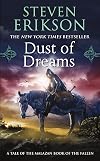
At this point I find it near impossible to write a plot summary as there is so much going, but I'll give it a try. Events pick up immediately after where book 7 ends. The Bonehunters are in Letheras contemplating their next move. Their allies, the Khundryl Burned Tears and The Perish, are making preparations to join them in facing down the ultimate enemy. The Barghast have returned to what they think of as their ancestral homeland and find things not what they expected. Several factions of show more T'lan Imass have awoken to a distant call and they need to decide how to answer. Add to this Elder Gods, K’Chain Che’Malle, Elient, Jaghut, Forkrul Assail and new gods and the mind reels.
Dust of Dreams is the ninth book in the Malazan Book of the Fallen series. There is an Author's Note with a warning that this book is different and for the first time in the series to expect a cliffhanger ending as it is meant to be the first half of the grand finale. This set my expectation for a long slow build, which is pretty much what we get. Many story lines going all the way back tot he first book are brought together as we march towards the end of this series. This is a talent of Eriksons that never ceases to amaze me given how complicated the story is at this point.
The tone starts off grim in the prologue and while Erikson works in moments of levity to help break things up that feeling is an undercurrent throughout the novel. This is not in itself a bad thing. It is more like the darkness before the storm and lends a sense of urgency.
For those that enjoy the philosophical parts of these novels you will not be disappointed by Dust of Dreams. Many of the discussions between characters or just an individual's personal thoughts are quite thought provoking.
I like how Erikson refuses to state who is "good" and who is "evil". Insight is given into characters and factions previously thought of negatively and showing them in a new, sympathetic light. It's yet another way these books make you think.
Erikson outdid himself in the final chapters of this book. The convergence is mind blowing in scope, the action intense. My heart was racing as I read, emotions high. I'm still feel a little numb in the aftermath. I had debated reading something else before finishing the series and know I can't wait that long. It will be straight on to The Crippled God for me! show less
Dust of Dreams is the ninth book in the Malazan Book of the Fallen series. There is an Author's Note with a warning that this book is different and for the first time in the series to expect a cliffhanger ending as it is meant to be the first half of the grand finale. This set my expectation for a long slow build, which is pretty much what we get. Many story lines going all the way back tot he first book are brought together as we march towards the end of this series. This is a talent of Eriksons that never ceases to amaze me given how complicated the story is at this point.
The tone starts off grim in the prologue and while Erikson works in moments of levity to help break things up that feeling is an undercurrent throughout the novel. This is not in itself a bad thing. It is more like the darkness before the storm and lends a sense of urgency.
For those that enjoy the philosophical parts of these novels you will not be disappointed by Dust of Dreams. Many of the discussions between characters or just an individual's personal thoughts are quite thought provoking.
I like how Erikson refuses to state who is "good" and who is "evil". Insight is given into characters and factions previously thought of negatively and showing them in a new, sympathetic light. It's yet another way these books make you think.
Erikson outdid himself in the final chapters of this book. The convergence is mind blowing in scope, the action intense. My heart was racing as I read, emotions high. I'm still feel a little numb in the aftermath. I had debated reading something else before finishing the series and know I can't wait that long. It will be straight on to The Crippled God for me! show less
The Wurms of Blearmouth: A Malazan Tale of Bauchelain and Korbal Broach (The Malazan Book of the Fallen) by Steven Erikson
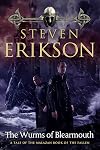
I was recently scrolling through the Tor website looking for something new to read when I stumbled upon the word, ‘grimlark’. I was so taken by the word that I actually didn’t notice what book it was describing because it was the perfect descriptive word for the book I was reading at the time, The Wurms of Blearmouth, the latest novella by author Steven Erikson about his unlikely trio, necromanceers Beauchelain and Broach and their manservant, Emancipor Reese also known as Mancy the show more Unlucky for the fact that every ship he has sailed on has sunk and all his previous masters have met untimely deaths.
After their ship sinks (not too surprising with Mancy on board) and the three are stranded on Spendrugle, a small village populated by reavers, wreckers, gods, and dead folk. Lord Fangatooth Claw, tyrant and usurper, when he’s not torturing his brother, has declared that all visitors be brought to the Keep to be killed, a directive the townsfolk are more than happy to comply with. Unfortunately for him, he’s never had visitors like Beauchelain and Broach before. Turns out tyrants just don’t have the staying power they used to.
Anyone who is a fan of Erikson’s Malazan Book of the Fallen won’t be surprised to learn that there is a huge cast here, many already familiar as well as a host of new ones all with wonderfully descriptive names like Coingood, scribe for the aforementioned Fangatooth Claw. Nor will they be surprised to discover that this huge cast consists of some of the oddest, darkest and most unlikable characters they will encounter in gritty realism, a form of fantasy known for odd, dark, and unlikable. Or that, despite this, Erikson makes us like his characters against our better judgment because of the humour, both subtle and not so subtle, he infuses into the mix. The Wurms of Blearmouth is a complex, intelligent, and darkly funny tale and proves again why Erikson is considered one of the best of the modern fantasy writers. show less
After their ship sinks (not too surprising with Mancy on board) and the three are stranded on Spendrugle, a small village populated by reavers, wreckers, gods, and dead folk. Lord Fangatooth Claw, tyrant and usurper, when he’s not torturing his brother, has declared that all visitors be brought to the Keep to be killed, a directive the townsfolk are more than happy to comply with. Unfortunately for him, he’s never had visitors like Beauchelain and Broach before. Turns out tyrants just don’t have the staying power they used to.
Anyone who is a fan of Erikson’s Malazan Book of the Fallen won’t be surprised to learn that there is a huge cast here, many already familiar as well as a host of new ones all with wonderfully descriptive names like Coingood, scribe for the aforementioned Fangatooth Claw. Nor will they be surprised to discover that this huge cast consists of some of the oddest, darkest and most unlikable characters they will encounter in gritty realism, a form of fantasy known for odd, dark, and unlikable. Or that, despite this, Erikson makes us like his characters against our better judgment because of the humour, both subtle and not so subtle, he infuses into the mix. The Wurms of Blearmouth is a complex, intelligent, and darkly funny tale and proves again why Erikson is considered one of the best of the modern fantasy writers. show less
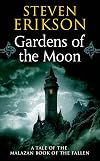
Steven Erikson’s expansive, epic fantasy series, The Malazan Book of the Fallen, begins here in Gardens of the Moon with an incredibly detailed, almost overwhelming introduction to a world at war, a world of strange magics, shadow realms, and interfering gods. The cast of characters is huge, but the book comes with an incredibly helpful guide called the Dramatis Personae, and after a while the characters you didn’t think you’d be able to tell apart become individuals you care about. show more
While there is so much to learn – from names to history to richly imagined magic systems – everything flows naturally; you'll learn what you need to know without feeling like you're reading a history book. Gardens of the Moon is a fantastic fantasy novel in its own right, though most readers agree that while the book is not weak in any way, it is the weakest of the ten titles in The Malazan Book of the Fallen, so I can't wait to read the rest of the series. I would suggest this book to anyone who loves role playing video games and epic fantasy, and I would advise them not to worry about the steep learning curve – just keep reading, pay attention, and enjoy a book unlike any you’ve read before. show less
While there is so much to learn – from names to history to richly imagined magic systems – everything flows naturally; you'll learn what you need to know without feeling like you're reading a history book. Gardens of the Moon is a fantastic fantasy novel in its own right, though most readers agree that while the book is not weak in any way, it is the weakest of the ten titles in The Malazan Book of the Fallen, so I can't wait to read the rest of the series. I would suggest this book to anyone who loves role playing video games and epic fantasy, and I would advise them not to worry about the steep learning curve – just keep reading, pay attention, and enjoy a book unlike any you’ve read before. show less
Lists
Awards


You May Also Like


Associated Authors
Statistics
- Works
- 78
- Also by
- 11
- Members
- 38,403
- Popularity
- #470
- Rating
- 4.1
- Reviews
- 810
- ISBNs
- 555
- Languages
- 15
- Favorited
- 171
