
Adam Mickiewicz (1798–1855)
Author of Pan Tadeusz
About the Author
Mickiewicz was born in Lithuania to the family of a landless lawyer. He received a solid classical education at Wilno University, then the best in Poland. Arrested in 1823 for suspected revolutionary activities, he was exiled to Russia in 1825. His four and a half years there were a period of show more poetical and social success. He became a friend of Aleksandr Pushkin and a welcome figure in aristocratic salons. In 1829, Mickiewicz left Russia. During the 1831 uprising, he appeared briefly in Prussian Poland and subsequently joined the Great Emigration in Paris, where he was viewed as the spiritual leader of the exiles. During the early 1840's, Mickiewicz became a follower of the Lithuanian mystic Towianski, a move that finished him as a poet and made him unpopular with most of his fellow exiles. After the outbreak of the Crimean War, his anti-Russian activities brought the poet to Turkey, where he died in late 1855. His remains were transferred to a crypt in Wawel Castle in Cracow in 1890. Although his education in classical literature left a perceptible trace on his poetic diction, Mickiewicz was both the initiator of the romantic movement and one of its great figures. His literary position was established in 1822 with the publication of a short but striking anthology of poems. His subsequent ballads and historical poems were even finer; however, he reached special heights in his dramatic cycle "Forefathers' Eve" (1823). Mickiewicz's Russian period is distinguished by the creation of sonnets (especially the Crimean Sonnets cycle) and of the poem "Konrad Wallenrod" (1826--27). A period of relative poetic sterility, that began after "Konrad Wallenrod," ended in 1832 when Mickiewicz published his Books of the Polish Nation, a work in biblical prose that aspired to be the gospel of emigres and is the clearest example of Polish national messianism. In 1832, Mickiewicz also wrote "Forefathers' Eve, Part III" which he loosely connected with the earlier dramatic cycle, and in which he considered Poland's relationship with Russia through the prism of an intense personal vision. Mickiewicz's last masterpiece is "Pan Tadeusz" (1834) which continues the traditions of the epic and, to a degree, represents a turning away on the poet's part from romanticism. The poem deals with life in Lithuania from 1811 to 1812. A large number of characters, all of whom are basically good, and a wealth of lovingly described details of nature and the country society, combine to make "Pan Tadeusz" an extraordinary, if idealized, canvas of everyday life. (Bowker Author Biography) show less
Disambiguation Notice:
Adam Mickiewicz was born a Russian citizen, three years after the Third Partition of the Polish-Lithuanian Commonwealth had caused his family lands to become part of the Russian Empire. Descended from Polish nobility, he was a champion of Polish nationalism, both through his poetry and through direct political activism, for which he was sentenced to internal exile within the Russian Empire. He eventually received permission to leave Russia, and spent the rest of his life in exile.
Image credit: Credit: Vezenberg & Co., St. Petersburg, circa 1880-1886
(George Kennan Papers,
LoC Prints and Photographs Division,
LC-USZ62-128272)
(George Kennan Papers,
LoC Prints and Photographs Division,
LC-USZ62-128272)
Works by Adam Mickiewicz
Powieści poetyckie 6 copies
UTWORY DRAMATYCZNE 3 6 copies
Dzieła poetyckie. T. 2, Powieści poetyckie ; Księgi narodu polskiego i pielgrzymstwa polskiego (1992) 4 copies
Dziady część II,IV i I 4 copies
The Sonnets: Including The Erotic Sonnets, The Crimean Sonnets, and Uncollected Sonnets (2018) 4 copies
Delphi Collected Poetical Works of Adam Mickiewicz (Illustrated) (Delphi Poets Series) (2017) 4 copies
I sonetti di Crimea e altre poesie 4 copies
Wybor pism 4 copies
Poems 4 copies
Tadeusz Soplica - Canti 3 copies
Wybor poezji 3 copies
Dzieła poetyckie. 1. Wiersze 3 copies
To lubię... 3 copies
Scritti politici 3 copies
Dziadów część III 2 copies
Poems by Adam Mickiewicz 2 copies
Utwory wybrane. [T. 1], Wiersze 2 copies
Śmierć Pułkownika 2 copies
Romantyczność 2 copies
Pan Tadeusz czyli ostatni zajazd na Litwie. Historia szlachecka z roku 1811 i 1812 we dwunastu ksiegach wierszem (2018) 2 copies
Pisma Adama Mickiewicza. T. 2 2 copies
Dzieła poetyckie 2 copies
Eilėraščiai. Poemos 2 copies
Listy. Cz. 2, 1830-1841 2 copies
Сонеты 2 copies
Trybuna Ludów 2 copies
Dziady : cz. II i IV 2 copies
Adam Mickiewicz, 1798-1855 2 copies
Proza artystyczna i pisma krytyczne 2 copies
パン・タデウシュ〈上〉 2 copies
Listy. Cz. 4, 1849-1855 2 copies
Listy. Cz. 3, 1842-1848 2 copies
Listy. Cz. 1, 1815-1829 2 copies
Dziady 2 copies
Dudarz 1 copy
Listy. Cz. 2 1 copy
Trybuna Ludów 1 copy
Dziady. Część trzecia 1 copy
Listy. Cz. 1 1 copy
Lilije 1 copy
Pisma różne 1 copy
Do przyjaciół 1 copy
Pierwiosnek 1 copy
Listy. Cz. 3 1 copy
Tukaj albo próby przyjaźni 1 copy
Rękawiczka 1 copy
Стихотворения ; Поэмы 1 copy
Kurhanek Maryli 1 copy
Стихотворения и поэмы 1 copy
Dziady cz. III 1 copy
Pan Tadeusz 4 1 copy
Dziady cz. II, IV i I 1 copy
Utwory wybrane T.1-5 1 copy
Pan Tadeusz I 1 copy
Les Slaves 1 copy
Le Livre Des Polonais 1 copy
Rybka 1 copy
Dziady część II, IV i I 1 copy
Dziady. Cz. 3 1 copy
Forefathers : Transl. into English verse by Count Potocki of Montalk. Foreword by Wiktor Weintraub 1 copy
Dziady, część IV 1 copy
Ballady i romanse. Sonety 1 copy
Mickiewicz-dzieciom 1 copy
Pisma prozą. Cz. 2, Księgi narodu i pielgrzymstwa polskiego ; Pisma polityczne z lat 1832-1835 1 copy
Wiersze-4 1 copy
Utwory dramatyczne Dziady 1 copy
Poemas 1 copy
Mickiewicz In Song 1 copy
Grażyna [Dokument dźwiękowy] 1 copy
Poems / Translated Mainly by Jack Lindsay; with Six Original Wood-Engravings by Dennis Postle (1957) 1 copy
Wiersze-5 1 copy
Wiersze-3 1 copy
Pisma prozą Tom 2 1 copy
Wiersze-2 1 copy
Wiersze-1 1 copy
Balady i romanse 1 copy
The Great Improvisation 1 copy
Poezye Adama Mickewicza 1 copy
Lis i Koziol 1 copy
Pisma prozą Tom 1 1 copy
Pisma prozą Tom 3 1 copy
Przyjaciele Złote Bajki 1 copy
Przyjaciele 1 copy
Utwory wybrane. T. 5 Listy 1 copy
Utwory wybrane. T. 3 Dziady 1 copy
Selected poetry & prose 1 copy
Dziadów część III 1 copy
t. 01 - Wiersze 1 copy
Konfederaci barscy 1 copy
Dzieła. T. 12, Trybuna Ludów 1 copy
Pani Twardowska i inne bajki 1 copy
Стихотворения Поэмы 1 copy
Associated Works
World Poetry: An Anthology of Verse from Antiquity to Our Time (1998) — Contributor — 500 copies, 2 reviews
Diabli wiedza co... — Contributor — 4 copies
Tagged
Common Knowledge
- Canonical name
- Mickiewicz, Adam
- Legal name
- Mickiewicz, Adam Bernard
- Other names
- Мицкевич, Адам Бернард
- Birthdate
- 1798-07-24
- Date of death
- 1855-11-26
- Gender
- male
- Education
- University of Vilno
- Occupations
- poet
dramatist
editor
political activist
professor (Slavic Languages and Literatures, Latin Literature) - Organizations
- The Philomaths
Lausanne Academy
Collège de France
Mickiewicz Legion - Relationships
- Pavlova, Karolina (pupil)
- Nationality
- Russia
- Birthplace
- Zaosie, Lithuania Governorate, Russian Empire (now Belarus)
- Places of residence
- Novogrudok, Slonim Governorate, Russian Empire
Kaunas, Vilna Governorate, Russian Empire
St Petersburg, Russian Empire
Moscow, Russian Empire
Crimea, Russian Empire
Rome, Papal States (show all 10)
Poznan, Kingdom of Prussia
Dresden, Saxony
Paris, France
Lausanne, Switzerland - Place of death
- Constantinople, Ottoman Empire (now Istanbul, Turkey)
- Burial location
- Champeaux cemetery, Montmorency, France (1861)
National bards' crypt, Wawel cathedral, Kraków, Poland (1890) - Map Location
- Belarus
- Disambiguation notice
- Adam Mickiewicz was born a Russian citizen, three years after the Third Partition of the Polish-Lithuanian Commonwealth had caused his family lands to become part of the Russian Empire. Descended from Polish nobility, he was a champion of Polish nationalism, both through his poetry and through direct political activism, for which he was sentenced to internal exile within the Russian Empire. He eventually received permission to leave Russia, and spent the rest of his life in exile.
Members
Reviews
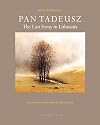
As Pushkin is to Russia, and Shevchenko is to Ukraine, so Mickiewicz is to Poland, its national poet. The English translation of this book is not easy to find even in Poland, but I was lucky enough to get my hands on this brilliant modern translation from Bill Johnston in the Pan Tadeusz Museum in Wrocław. I have to say that after reading it, it’s criminal to me that it isn’t better known or more highly regarded outside of Poland.
It’s an epic story told in verse, complete with show more literary references to classic literature, but if that sounds intimidating or dry, nothing could be further from the truth. The book is highly approachable and engaging from beginning to end. The all-too-human characters are cleverly developed, and the story is told with both restraint and concision. There is humor, romance, merriment, and feuding amongst landowners. The rural setting is beautifully evoked throughout the book by Mickiewicz, who had clearly spent time in nature.
Mickiewicz wrote the book from France in 1834 when Poland’s uprisings against its partitioning had failed, but he makes the setting 1811-12, at a time when there was hope that in siding with Napoleon, who had carved out the short-lived Duchy of Warsaw, that they would regain the full independence of the Polish-Lithuanian Commonwealth and their former glory days. Readers at the time knew how tragically that would turn out, and this combined with Mickiewicz’s childhood memories of a time that was slipping past make the book incredibly poignant. Readers today also know of how partitioning and subjugation in the 18th and 19th centuries would segue to an eerily similar invasion from both Germany and the Soviet Union in the 20th, with outrageous atrocities that are still hard to fathom. It all makes for a very stirring read, particularly at the end with his epilogue, when he laments the fate of his country, as well as cherishes his childhood memories.
This should be required reading for anyone travelling to Poland, and I can’t recommend this edition highly enough. The introduction from Johnston, thoughtful translation, and helpful notes all enhance what is a great book. As he points out with such insight, “Perhaps one of the reasons Pan Tadeusz is so popular is precisely that it beautifully melds two impossible longings – for a future free and independent Poland, and for the lost Poland of the past. The interplay between these two unslaked desires provides a mighty emotional tension at the heart of the poem.”
Just this quote on Poland, which reverberated within me as I toured the country, getting greater insight into such a sad history, and wondering how one could even go on afterwards:
“The blood, though, spilled in Poland lately,
The tears that flood the land completely,
The glory that still echoes quietly –
We had no strength to think of these!
For nations can face such agonies
That, gazing upon their misery,
Even Courage stands helplessly.” show less
It’s an epic story told in verse, complete with show more literary references to classic literature, but if that sounds intimidating or dry, nothing could be further from the truth. The book is highly approachable and engaging from beginning to end. The all-too-human characters are cleverly developed, and the story is told with both restraint and concision. There is humor, romance, merriment, and feuding amongst landowners. The rural setting is beautifully evoked throughout the book by Mickiewicz, who had clearly spent time in nature.
Mickiewicz wrote the book from France in 1834 when Poland’s uprisings against its partitioning had failed, but he makes the setting 1811-12, at a time when there was hope that in siding with Napoleon, who had carved out the short-lived Duchy of Warsaw, that they would regain the full independence of the Polish-Lithuanian Commonwealth and their former glory days. Readers at the time knew how tragically that would turn out, and this combined with Mickiewicz’s childhood memories of a time that was slipping past make the book incredibly poignant. Readers today also know of how partitioning and subjugation in the 18th and 19th centuries would segue to an eerily similar invasion from both Germany and the Soviet Union in the 20th, with outrageous atrocities that are still hard to fathom. It all makes for a very stirring read, particularly at the end with his epilogue, when he laments the fate of his country, as well as cherishes his childhood memories.
This should be required reading for anyone travelling to Poland, and I can’t recommend this edition highly enough. The introduction from Johnston, thoughtful translation, and helpful notes all enhance what is a great book. As he points out with such insight, “Perhaps one of the reasons Pan Tadeusz is so popular is precisely that it beautifully melds two impossible longings – for a future free and independent Poland, and for the lost Poland of the past. The interplay between these two unslaked desires provides a mighty emotional tension at the heart of the poem.”
Just this quote on Poland, which reverberated within me as I toured the country, getting greater insight into such a sad history, and wondering how one could even go on afterwards:
“The blood, though, spilled in Poland lately,
The tears that flood the land completely,
The glory that still echoes quietly –
We had no strength to think of these!
For nations can face such agonies
That, gazing upon their misery,
Even Courage stands helplessly.” show less
Lithuania! My homeland! You are health alone.
Your worth can only ever be known by one
Who’s lost you. Today I see and tell anew
Your lovely beauty, as I long for you.
Pan Tadeusz: The Last Forray Into Lithuania by Adam Mickiewicz and the new translation by Bill Johnston is an epic poem about the divided Poland and Lithuania. Mickiewicz was a Polish poet, dramatist, essayist, publicist, translator, professor of Slavic literature, and political activist. He is regarded as the national poet in show more Poland, Lithuania, and Belarus. Johnston is a prolific Polish language literary translator and Professor of comparative literature at Indiana University. His work has helped to expose English-speaking readers to classic and contemporary Polish poetry and fiction.
Pan Tadeusz is a poem for those interested in Polish/Lithuanian history or heritage. Most Americans would know little of Polish history except for the opening of World War II. Those who remember the Cold War will recall, despite Gerald Ford's assertion, that Poland was under Communist control and the US does not recognize the incorporation of Lithuania into the USSR. Poland has lived a rather quiet history as a nation for those living today. Poland was a historically a cultural and military territory. Part of the problem also comes with what is Poland. Its size has varied, and it ceased to exist as a nation more than once. My great grandmother's immigration papers said she was born in Russian occupied Poland claiming Polish as her nationality. With borders that changed so often, it is not hard to imagine how one person could be the national poet of three different countries.
Pan Tadeusz is a rather long poem covering five days in 1811 and two days in 1812. It contains a bit of a Shakespeare theme (Romeo and Juliet) and a bit of Les Miserables' to the barricades. Johnston provides a detailed introduction which helps clarify regional realities of the time and a translation that remains true to the original intent including the humor. The verse flows well, and much of the rhyme remains in place, not every line rhymes, but there is enough to keep the read locked into the rhythm of the poetry. There does not seem to be any forced wording in the translation; it is easily readable.
Johnston's translation of Pan Tadeusz brings the Polish classic in an enjoyable form to the English language readers without losing the original intention and form. Both the author and translator include notes characters, locations, as well as translations where words don't seem to have a word for word replacement. An exceptionally well done original work and rendering. show less
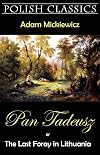
Perhaps the translation doesnt render the poetry well, but I still found it enjoyable to read. Like the introduction says it's a cross between Don Quixote and Iliad with some nice pastoral work thrown in.
Herr Tadeusz eller Sista fejden i Litauen : en berättelse ur lantadelns liv från åren 1811 och 1812 i tolv böcker på vers by Adam Mickiewicz

Adam Bernard Mickiewicz, född 24 december 1798 i Zaosie nära Nowogródek, då i Ryska imperiet, nu i Vitryssland, död 26 november 1855 vid Konstantinopel, polsk författare, ofta ansedd som Polens nationalskald. Mickiewicz är den polska romantiska poesins främste representant.
1834 utgav han i Paris sitt litterära storverk, verseposet Pan Tadeusz czyli Ostatni zajazd na Litwie (Herr Tadeusz eller Sista fejden i Litauen). Denna verkligt klassiska hjältedikt i homerisk stil återspeglar show more förträffligt det borttynande polska adelssamhällets inre och yttre liv i början av 1800-talet, då Napoleons tåg till östra Europa väckte nya förhoppningar i de polska sinnena. Många av de tecknade personerna är återgivna efter naturen, stundtals i komisk belysning, men med en djup underström av patriotisk sympati. show less
1834 utgav han i Paris sitt litterära storverk, verseposet Pan Tadeusz czyli Ostatni zajazd na Litwie (Herr Tadeusz eller Sista fejden i Litauen). Denna verkligt klassiska hjältedikt i homerisk stil återspeglar show more förträffligt det borttynande polska adelssamhällets inre och yttre liv i början av 1800-talet, då Napoleons tåg till östra Europa väckte nya förhoppningar i de polska sinnena. Många av de tecknade personerna är återgivna efter naturen, stundtals i komisk belysning, men med en djup underström av patriotisk sympati. show less
Lists
Awards


You May Also Like


Associated Authors
Statistics
- Works
- 188
- Also by
- 4
- Members
- 1,112
- Popularity
- #23,103
- Rating
- 3.7
- Reviews
- 5
- ISBNs
- 247
- Languages
- 12
- Favorited
- 6

