
Emmanuel Todd
Author of After the Empire: The Breakdown of the American Order
About the Author
Emmanuel Todd Is an historian and sociologist at the National Institute of Demographic Studies (INED), Paris
Image credit: Emmanuel Todd le 3 novembre 2014
Works by Emmanuel Todd
A Convergence of Civilizations: The Transformation of Muslim Societies Around the World (2007) — Author — 69 copies
Lineages of Modernity: A History of Humanity from the Stone Age to Homo Americanus (2017) 59 copies, 1 review
Allah n'y est pour rien ! : Sur les révolutions arabes et quelques autres (2011) 11 copies, 1 review
Η ήττα της Δύσης 1 copy
Η ήττα της Δύσης 1 copy
Associated Works
Tagged
Common Knowledge
- Legal name
- Todd, Emmanuel Guillaume Francis Robert
- Birthdate
- 1951-05-16
- Gender
- male
- Education
- Institut d'Etudes Politiques de Paris
University of Cambridge (PhD) - Occupations
- Ingénieur de recherche à l'Institut national d'études démographiques (INED)
- Relationships
- Todd, Olivier (Père)
Nizan, Paul (Grand-père)
Lévy-Strauss, Claude (Arrière petit-cousin)
Todd, David (Fils)
Le Roy Ladurie, Emmanuel (Professeur)
Leslett, Peter (Directeur de thèse) (show all 7)
Nizan, Anne-Marie (mère) - Nationality
- France
- Birthplace
- Saint-Germain-en-Laye, Yvelines, Île-de-France, France
- Map Location
- France
- Associated Place (for map)
- France
Members
Reviews
After the Empire: The Breakdown of the American Order (European Perspectives: A Series in Social Thought and Cultural Criticism) by Emmanuel Todd

Pretty persuasive- it does make sense out of some of the weirdnesses we've seen lately in America's foreign policy, and it's recommended on that count.
I will mention that Todd seems to have some serious issues with women; the only real vitriol in the entire book is aimed at American women and particularly feminists. He is very comfortable with the idea of men oppressing women (cultural diversity!), but not at all comfortable about women objecting to being oppressed (apparently cultural show more diversity does not extend THAT far!).
Also, based on current trends in France about the wearing of burqas etc., he is dead wrong about how tolerant France is about seeing such as a purely cultural matter; this is relevant since he's holding up France (he's French) as a Good Example of how America OUGHT to be (i.e., tolerant of the oppression of women, apparently). He also turns a blind eye to other racial and cultural prejudices in France, while coming down hard on such things in the US. show less
I will mention that Todd seems to have some serious issues with women; the only real vitriol in the entire book is aimed at American women and particularly feminists. He is very comfortable with the idea of men oppressing women (cultural diversity!), but not at all comfortable about women objecting to being oppressed (apparently cultural show more diversity does not extend THAT far!).
Also, based on current trends in France about the wearing of burqas etc., he is dead wrong about how tolerant France is about seeing such as a purely cultural matter; this is relevant since he's holding up France (he's French) as a Good Example of how America OUGHT to be (i.e., tolerant of the oppression of women, apparently). He also turns a blind eye to other racial and cultural prejudices in France, while coming down hard on such things in the US. show less
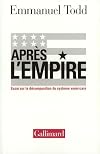
A glimmer of hope when i first read it, back then in the so distant now 2001. Here was a historian who had seen through all the hype about the US, and while they were menacing us with global shock and awe, he shouted that the king was naked. And explained it in clear language. And even earlier, was the only one to predict USSR's demise, based on arguments drawn from historical demography. His minor flaws, like a certain macho attitude and conservative politics, seemed trivial then to me. show more Must be read. show less

Todd's book was bound to cause controversy. It appeared in its original form while feelings were still high after the killings last January. However, his critique of the emotional response and his use of demographics to breakdown and analyze the people who turned out to protest in the days after the massacre is very important.
The book is very readable and adds a lot to the debate about contemporary France, the decline of religion in general and Catholicism in particular as well as the rise show more of xenophobia and Islamophobia that seem to be filling the Catholic void.
The thesis is not perfect, there are a lot of presuppositions that are unproven and Todd has prejudices and blind spots of his own. There are a lot of turns of phrase that sound elegant in French but when translated into English sound clunky. There is a good book trying to escape from Todd's work, hopefully it will come along soon. show less
The book is very readable and adds a lot to the debate about contemporary France, the decline of religion in general and Catholicism in particular as well as the rise show more of xenophobia and Islamophobia that seem to be filling the Catholic void.
The thesis is not perfect, there are a lot of presuppositions that are unproven and Todd has prejudices and blind spots of his own. There are a lot of turns of phrase that sound elegant in French but when translated into English sound clunky. There is a good book trying to escape from Todd's work, hopefully it will come along soon. show less
The Explanation of Ideology: Family Structure and Social Systems (Family, Sexuality and Social Relations in Past Times) by Emmanuel Todd

An Anthropological Explanation of Ideology?, September 19, 2004
An amazing book that is, unfortunately, very difficult to find. Todd provides an anthropological definition of family structures and shows how many ideological structures have mapped, with remarkable precision, to certain family structures. There are seven definable family types, which are defined by attitudes towards spouse selection, attitudes towards symmetry in family/social (inheritance & law) relations, and attitudes show more towards whether married children can live at home. Spouse selection within these families can be decided by custom - usually the preference is cousins - or parents, or the two getting married are free to decide. Laws of inheritance can be egalitarian, non-egalitarian or indifferent. That is the inheritance is either divided equally between all - in practice this usually means all sons, or divided unequally - one son only receives the patrimony, or any which way you please. These family types are defined as follows:
1. Absolute Nuclear Family:
a. Spouse selection: Free, but obligatory exogamy.
b. Inheritance: Indifference - no precise rules, frequent use of wills.
c. Family Home: no cohabitation of married children with their parents.
d. Representative Nations, Peoples, Regions: Anglo-Saxon world, Holland, Denmark.
e. Representative Ideology: Christianity, Capitalism, `Libertarian' Liberalism, and Feminism.
2. Egalitarian Nuclear Family:
a. Spouse selection: Free, but obligatory exogamy.
b. Inheritance: Egalitarian - equality between brothers.
c. Family Home: no cohabitation of married children with their parents.
d. Representative Nations, Regions: northern France, northern Italy, central & southern Spain, central Portugal, Greece, Romania, Poland, Latin America, Ethiopia.
e. Representative Ideology: Christianity (Catholicism); the "Liberte, Egalite, Fraternite" form of Liberalism.
3. Authoritarian Family:
a. Spouse selection: Parents, little or no marriage between children of brothers.
b. Inheritance: Anti-Egalitarian - inequality between brothers, transfer of patrimony to one son.
c. Family Home: cohabitation of the married heir with his parents.
d. Representative Nations, Peoples, Regions: Germany, Austria, Sweden, Norway, Belgium, Bohemia, Scotland, Ireland, peripheral regions of France, northern (Basque) Spain, northern Portugal, Japan, Korea, Jews, Romany Gypsies.
e. Representative Ideology: Fascism, various separatist and autonomous (anti-universalist) movements.
4: Exogamous Community Family:
a. Spouse selection: Parents, no marriage between the children of two brothers.
b. Inheritance: Egalitarian - equality between brothers.
c. Family Home: cohabitation of married sons with their parents.
d. Representative Nations, Regions: Russia, Yugoslavia, Slovakia, Bulgaria, Hungary, Finland, Albania, central Italy, China, Vietnam, Cuba and north India.
e. Representative Ideology: Communism, Socialism.
5. Endogamous Community Family:
a. Spouse selection: Custom, frequent marriage between the children of brothers.
b. Inheritance: Egalitarian - equality between brothers.
c. Family Home: cohabitation of married sons with their parents.
d. Representative Nations, Peoples, Regions: Arab world, Turkey, Iran, Afghanistan, Pakistan, Azerbaijan, Turkmenistan, Uzbekistan, Tadzhikistan.
e. Representative Ideology: Islam.
6. Asymmetrical Community Family:
a. Spouse selection: Custom, prohibition on marriages between the children of brothers, but a preference for marriages between the children of brothers and sisters.
b. Inheritance: Egalitarian - equality between brothers.
c. Family Home: cohabitation of married sons with their parents.
d. Representative Regions: southern India.
e. Representative Ideology:
7: Anomic Family:
a. Spouse selection: Free, but without obligatory exogamy; consanguine marriage possible and sometimes frequent.
b. Inheritance: Indifference - uncertainty about equality between brothers, inheritance rules egalitarian in theory but uncertain in practice.
c. Family Home: cohabitation of married children with parents rejected in theory but accepted in practice.
d. Representative Nations, Peoples, Regions:
e. Representative Ideology: Buddhism, Christianity, and Communism, but potentially anything.
This translation dates from 1985 though it was published earlier in that decade in France. He predicts the fall of the Soviet Union because the satellite states (like Poland) and internal (Moslem) `satellite states' will prove non-absorbable. He also predicts that the USA Islam were heading towards conflict because of, in large part, Anglo-Saxon feminism. The predictive power of this anthropological approach is also visible in the deep anti-universalism of the authoritarian family. The gypsies, for instance, refuse to be absorbed by other cultures even though they have no identifiable ideological commitments. Naturally, in this short note I cannot bring out all the insights, originality and subtlety of the text, though he does leave the impression that family structure can explain everything - it can't. ...Still, this text is well worth hunting down. show less
An amazing book that is, unfortunately, very difficult to find. Todd provides an anthropological definition of family structures and shows how many ideological structures have mapped, with remarkable precision, to certain family structures. There are seven definable family types, which are defined by attitudes towards spouse selection, attitudes towards symmetry in family/social (inheritance & law) relations, and attitudes show more towards whether married children can live at home. Spouse selection within these families can be decided by custom - usually the preference is cousins - or parents, or the two getting married are free to decide. Laws of inheritance can be egalitarian, non-egalitarian or indifferent. That is the inheritance is either divided equally between all - in practice this usually means all sons, or divided unequally - one son only receives the patrimony, or any which way you please. These family types are defined as follows:
1. Absolute Nuclear Family:
a. Spouse selection: Free, but obligatory exogamy.
b. Inheritance: Indifference - no precise rules, frequent use of wills.
c. Family Home: no cohabitation of married children with their parents.
d. Representative Nations, Peoples, Regions: Anglo-Saxon world, Holland, Denmark.
e. Representative Ideology: Christianity, Capitalism, `Libertarian' Liberalism, and Feminism.
2. Egalitarian Nuclear Family:
a. Spouse selection: Free, but obligatory exogamy.
b. Inheritance: Egalitarian - equality between brothers.
c. Family Home: no cohabitation of married children with their parents.
d. Representative Nations, Regions: northern France, northern Italy, central & southern Spain, central Portugal, Greece, Romania, Poland, Latin America, Ethiopia.
e. Representative Ideology: Christianity (Catholicism); the "Liberte, Egalite, Fraternite" form of Liberalism.
3. Authoritarian Family:
a. Spouse selection: Parents, little or no marriage between children of brothers.
b. Inheritance: Anti-Egalitarian - inequality between brothers, transfer of patrimony to one son.
c. Family Home: cohabitation of the married heir with his parents.
d. Representative Nations, Peoples, Regions: Germany, Austria, Sweden, Norway, Belgium, Bohemia, Scotland, Ireland, peripheral regions of France, northern (Basque) Spain, northern Portugal, Japan, Korea, Jews, Romany Gypsies.
e. Representative Ideology: Fascism, various separatist and autonomous (anti-universalist) movements.
4: Exogamous Community Family:
a. Spouse selection: Parents, no marriage between the children of two brothers.
b. Inheritance: Egalitarian - equality between brothers.
c. Family Home: cohabitation of married sons with their parents.
d. Representative Nations, Regions: Russia, Yugoslavia, Slovakia, Bulgaria, Hungary, Finland, Albania, central Italy, China, Vietnam, Cuba and north India.
e. Representative Ideology: Communism, Socialism.
5. Endogamous Community Family:
a. Spouse selection: Custom, frequent marriage between the children of brothers.
b. Inheritance: Egalitarian - equality between brothers.
c. Family Home: cohabitation of married sons with their parents.
d. Representative Nations, Peoples, Regions: Arab world, Turkey, Iran, Afghanistan, Pakistan, Azerbaijan, Turkmenistan, Uzbekistan, Tadzhikistan.
e. Representative Ideology: Islam.
6. Asymmetrical Community Family:
a. Spouse selection: Custom, prohibition on marriages between the children of brothers, but a preference for marriages between the children of brothers and sisters.
b. Inheritance: Egalitarian - equality between brothers.
c. Family Home: cohabitation of married sons with their parents.
d. Representative Regions: southern India.
e. Representative Ideology:
7: Anomic Family:
a. Spouse selection: Free, but without obligatory exogamy; consanguine marriage possible and sometimes frequent.
b. Inheritance: Indifference - uncertainty about equality between brothers, inheritance rules egalitarian in theory but uncertain in practice.
c. Family Home: cohabitation of married children with parents rejected in theory but accepted in practice.
d. Representative Nations, Peoples, Regions:
e. Representative Ideology: Buddhism, Christianity, and Communism, but potentially anything.
This translation dates from 1985 though it was published earlier in that decade in France. He predicts the fall of the Soviet Union because the satellite states (like Poland) and internal (Moslem) `satellite states' will prove non-absorbable. He also predicts that the USA Islam were heading towards conflict because of, in large part, Anglo-Saxon feminism. The predictive power of this anthropological approach is also visible in the deep anti-universalism of the authoritarian family. The gypsies, for instance, refuse to be absorbed by other cultures even though they have no identifiable ideological commitments. Naturally, in this short note I cannot bring out all the insights, originality and subtlety of the text, though he does leave the impression that family structure can explain everything - it can't. ...Still, this text is well worth hunting down. show less
Lists
You May Also Like


Associated Authors
Statistics
- Works
- 23
- Also by
- 1
- Members
- 1,044
- Popularity
- #24,665
- Rating
- 3.7
- Reviews
- 15
- ISBNs
- 110
- Languages
- 16
- Favorited
- 4

