
Neil F. Comins
Author of Discovering the Universe
About the Author
Neil F. Comins has contributed numerous articles to Astronomy magazine and is professor of physics and astronomy at the University of Maine
Works by Neil F. Comins
What if the Moon Didn't Exist? : Voyages to Earths That Might Have Been (1993) 187 copies, 4 reviews
What If the Earth Had Two Moons?: And Nine Other Thought-Provoking Speculations on the Solar System (2010) 117 copies, 5 reviews
The Traveler's Guide to Space: For One-Way Settlers and Round-Trip Tourists (2007) 13 copies, 3 reviews
Tagged
Common Knowledge
- Canonical name
- Comins, Neil F.
- Birthdate
- 1951
- Gender
- male
- Education
- Cornell University (BS|1972|Engineering Physics)
University of Maryland (MS|Astrophysics|1974)
University College, Cardiff, Wales, UK (PhD|Physics|1978) - Occupations
- professor (physics and astronomy at the University of Maine)
- Nationality
- USA
- Places of residence
- New York, New York, USA (birthplace)
- Associated Place (for map)
- New York, USA
Members
Reviews

Interesting idea, poorly executed. Author Neil Comins is an astronomy professor at the University of Maine. The premise of What If the Moon Didn’t Exist? is alternative solar system astronomy; Comins presents a series of scenarios for alternate Earths, giving each a cute little name: Solon, where the Moon never formed; Lunholm, where the Moon is much closer; Petiel, where the Earth has less mass; Urania, where the Earth’s axis is tilted 90° to the plane of the ecliptic like Uranus; show more Granstar, where the Sun is more massive; Antar, where a supernova goes off near the solar system; Cerberon, where another star passes through the solar system; Diablo, where a black hole passes through Earth; and two versions of Earth, one where our eyes are sensitive to other wavelengths and one where the ozone layer is depleted (the book dates from 1993, where ozone depletion rather than climate change was the man-made disaster du jour.)
The ideas are interesting enough; the main problem is there are no illustrations, no physics and mathematics to speak of, and Comins often strays outside of astronomy into biology and human behavior. The “no illustrations” problem comes to the fore when Comins discusses his hypothetical Urania; he has to explain seasonality on the extant Earth and seasonality on Urania solely with text, leading to extremely awkward constructions like asking the reader to imagine holding a pen over paper at a 23 ½° angle and then drawing circles while keeping the wrist stiff; his description of the seasons on the imaginary Urania has to go through even more convolutions.
Somewhat more unsettling, since Comins is an astronomer, is his explanation of oceans tides (which figure on the moonless Solon and the “supermoon” Lunholm). This is Comin’s explanation of why there are high tides on opposite sides of the Earth:
“The reason there is a second high tide on the opposite side of the Earth is the Moon pulls the bulk of the Earth away from the oceans on the far side.”
This is just plain wrong (or, at best, extremely misleading); the reason there are tides on opposite sides of the Earth is tides are raised by the horizontal component of solar and lunar gravitational attraction, not the vertical component. There’s a good explanation on the NOAA web site; see Section 4, “The Tractive Force”.
Comins gets into similar trouble when he strays into biology; in his chapter on the potential effects of a nearby supernova (his hypothetical one is 50 light years away) he devotes a couple of paragraphs to the mutations that will be caused by supernova gamma rays and X-rays, hypothesizing such things as mutant mice with poisonous fur, mutant wheat that poisons competing strains, and even mutant humans. This is the “mutation as magic” realm of comic book superheroes; in anything more complicated than bacteria, recombination is a – well, astronomically – more powerful force for genetic change than point mutations.
All that being said, some of the ideas presented are intriguing. I’d like to have a solar system simulation program that would allow me to try out some of the ideas; cursory googling doesn’t reveal anything that allows me to start out with the extant solar system and play around with solar evolution and planetary parameters, but I’m sure something will turn up. show less
The ideas are interesting enough; the main problem is there are no illustrations, no physics and mathematics to speak of, and Comins often strays outside of astronomy into biology and human behavior. The “no illustrations” problem comes to the fore when Comins discusses his hypothetical Urania; he has to explain seasonality on the extant Earth and seasonality on Urania solely with text, leading to extremely awkward constructions like asking the reader to imagine holding a pen over paper at a 23 ½° angle and then drawing circles while keeping the wrist stiff; his description of the seasons on the imaginary Urania has to go through even more convolutions.
Somewhat more unsettling, since Comins is an astronomer, is his explanation of oceans tides (which figure on the moonless Solon and the “supermoon” Lunholm). This is Comin’s explanation of why there are high tides on opposite sides of the Earth:
“The reason there is a second high tide on the opposite side of the Earth is the Moon pulls the bulk of the Earth away from the oceans on the far side.”
This is just plain wrong (or, at best, extremely misleading); the reason there are tides on opposite sides of the Earth is tides are raised by the horizontal component of solar and lunar gravitational attraction, not the vertical component. There’s a good explanation on the NOAA web site; see Section 4, “The Tractive Force”.
Comins gets into similar trouble when he strays into biology; in his chapter on the potential effects of a nearby supernova (his hypothetical one is 50 light years away) he devotes a couple of paragraphs to the mutations that will be caused by supernova gamma rays and X-rays, hypothesizing such things as mutant mice with poisonous fur, mutant wheat that poisons competing strains, and even mutant humans. This is the “mutation as magic” realm of comic book superheroes; in anything more complicated than bacteria, recombination is a – well, astronomically – more powerful force for genetic change than point mutations.
All that being said, some of the ideas presented are intriguing. I’d like to have a solar system simulation program that would allow me to try out some of the ideas; cursory googling doesn’t reveal anything that allows me to start out with the extant solar system and play around with solar evolution and planetary parameters, but I’m sure something will turn up. show less
What If the Earth Had Two Moons?: And Nine Other Thought-Provoking Speculations on the Solar System by Neil F. Comins
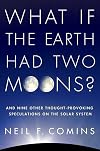
2.5 stars.
Parts of it were interesting, but nothing is really gained by reading the introductory vignettes. Unlike others, I won't criticize the renaming of the different scenario planets because of the way the names were subsequently used in the discussion. Thanks to the unknown library patron who pointed out the mistakes in the text which I had glossed over. Actually, some of the information was dated, even for 2010. Perhaps it's a consequence of the chapters having been written show more separately.
However, the almost exclusive use of Imperial units throughout is inexcusable. Talking about a scale of 10^-13 inches is nonsense. Talking about the temperature of stars in Fahrenheit is just...ugh (I don't care if he quotes them Kelvin too). The author even brought up slugs! [A slug is an American Imperial unit of mass.] show less
Parts of it were interesting, but nothing is really gained by reading the introductory vignettes. Unlike others, I won't criticize the renaming of the different scenario planets because of the way the names were subsequently used in the discussion. Thanks to the unknown library patron who pointed out the mistakes in the text which I had glossed over. Actually, some of the information was dated, even for 2010. Perhaps it's a consequence of the chapters having been written show more separately.
However, the almost exclusive use of Imperial units throughout is inexcusable. Talking about a scale of 10^-13 inches is nonsense. Talking about the temperature of stars in Fahrenheit is just...ugh (I don't care if he quotes them Kelvin too). The author even brought up slugs! [A slug is an American Imperial unit of mass.] show less
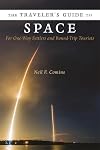
What to expect on your tour beyond the Karman line (about a hundred kilometers above the surface of the Earth) and, more importantly, how it will affect you physiologically and psychologically. It’s reasonable to expect you will feel awed by the sight of the planet as a whole. And it’s almost guaranteed that you will need your motion discomfort bag. They don’t call the training planes where astronauts learn about the effects of free fall and microgravity “Vomit Comets” for nothing. show more When the inner ear can no longer tell which way is down the most common symptom is nausea. Other common symptoms of “Space Adaptation Syndrome or space sickness are … headaches, disorientation, sweating and loss of appetite” Until your heart adapts it will pump an excess blood to your upper body and your face will swell. On a suborbital flight you will only experience these discomforts for the few minutes, but if you continue on into orbit these symptoms generally subside within three days.
Comins also gives a description of the sights to see beyond Earth, on the Moon, comets, asteroids, and on Mars and its moons as well as a basic introduction to the physics of space and space flight. The book is clearly written and scientifically sound. show less
Comins also gives a description of the sights to see beyond Earth, on the Moon, comets, asteroids, and on Mars and its moons as well as a basic introduction to the physics of space and space flight. The book is clearly written and scientifically sound. show less
The Traveler’s Guide to Space, by Neil F. Comins, is much more than a travel guide. This book is packed with scientific facts and other interesting phenomenon about space travel. For the reader who is willing to wade through the fluff to get to the facts, it is very interesting and entertaining. In some instances, I thought I was reading a salesman’s pitch for why I need to book a space vacation.
The book opens with an overview of space and the science pertaining to space and travel in show more space. From that point, the reader is lead on the journey of what to expect when you become a space traveler. The good and the bad about space travel is revealed in great detail, from the types of training required for the various possible space destinations, to the adjustments of living in space through to returning back to Earth. The last section of the book deals mainly with being a space tourist at a destination outside of Earth’s atmosphere with the main focus being on our Moon, the moons of Mars and Mars. The book concludes with a small section about of emigrating to Mars and/or returning to Earth.
The book abounds with details about every aspect of space travel. In fact, the detail was so good I can only give a very general overview. It is obvious that Mr. Comins is well-informed on the subject. The relatively unknown facts is what I found to be the most interesting thing about the book. For example, I did not know that oral hygiene in space was of a particular concern because the rate of bacteria growth is much greater than on Earth. Gross, but true.
This is a great book for any science buff, travel enthusiast, or reader, like myself, who loves to discover quirky facts. There is some amount of unnecessary fluff (I did not need to be told numerous times to be sure to collect rock specimens) but not so much that it turned me off. This is most definitely a book I could reread to cement my knowledge of space travel and get all those quirky facts into my long term memory.
Disclosure: I received a copy of this book from Columbia University Press, via Net Galley, in exchange for my honest review. show less
The book opens with an overview of space and the science pertaining to space and travel in show more space. From that point, the reader is lead on the journey of what to expect when you become a space traveler. The good and the bad about space travel is revealed in great detail, from the types of training required for the various possible space destinations, to the adjustments of living in space through to returning back to Earth. The last section of the book deals mainly with being a space tourist at a destination outside of Earth’s atmosphere with the main focus being on our Moon, the moons of Mars and Mars. The book concludes with a small section about of emigrating to Mars and/or returning to Earth.
The book abounds with details about every aspect of space travel. In fact, the detail was so good I can only give a very general overview. It is obvious that Mr. Comins is well-informed on the subject. The relatively unknown facts is what I found to be the most interesting thing about the book. For example, I did not know that oral hygiene in space was of a particular concern because the rate of bacteria growth is much greater than on Earth. Gross, but true.
This is a great book for any science buff, travel enthusiast, or reader, like myself, who loves to discover quirky facts. There is some amount of unnecessary fluff (I did not need to be told numerous times to be sure to collect rock specimens) but not so much that it turned me off. This is most definitely a book I could reread to cement my knowledge of space travel and get all those quirky facts into my long term memory.
Disclosure: I received a copy of this book from Columbia University Press, via Net Galley, in exchange for my honest review. show less
Lists
You May Also Like


Statistics
- Works
- 17
- Members
- 818
- Popularity
- #31,175
- Rating
- 3.6
- Reviews
- 18
- ISBNs
- 72
- Languages
- 5