
Howard Whitley Eves (1911–2004)
Author of An Introduction to the History of Mathematics
About the Author
Works by Howard Whitley Eves
Mathematical Circles Revisited: A Second Collection of Mathematical Stories and Anecdotes (Eves Series in Mathematics) (1972) 26 copies
Mathematical Circles Squared: A Third Collection of Mathematical Stories and Anecdotes (Eves Series in Mathematics) (1972) 16 copies
Mathematical Circles: Mathematical Circles Adieu and Return to Mathematical Circles, Volume III (Mathematical Association of America) (2003) 13 copies
Return to Mathematical Circles: A Fifth Collection of Mathematical Stories and Anecdotes (Liveright New Writer) (1987) 11 copies
Mathematical Circles: Revisited Mathematical and Circles Squared, Volume II (Mathematical Association of America) (2003) 10 copies
Functions of a complex variable 5 copies
The Otto Dunkel Memorial Problem Book: The American Mathematical Monthly, V64, No. 7, Part 2 (2013) 2 copies
In Mathematical Circles A Selection Of Mathematical Stories And Anecdotes Quadrants I And II [2 Volumes] (1969) 1 copy
Fundamentals of Geometry 1 copy
Tagged
Common Knowledge
- Canonical name
- Eves, Howard Whitley
- Birthdate
- 1911-01-10
- Date of death
- 2004-06-06
- Gender
- male
- Occupations
- mathematician
- Organizations
- University of Maine
Mathematical Association of America - Awards and honors
- George Pólya Award (1992)
- Nationality
- USA
- Associated Place (for map)
- USA
Members
Reviews
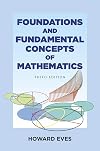
This is an excellent book tracing the history of deductive procedures and key concepts relevant to the foundation of modern mathematics, specific focus on deductive axiomatics and the utility of generality.
The book starts with babylonian and egyptian empirical mathematics which were based upon experience and induction, contrast them to deduction, and then moves onto material axiomatics and Euclids elements. Next we encounter non-euclidiean geometry as a shaking up in the foundations of math, show more and then we encounter generalizations of geometry and hilberts axiomatic treatment of geometry.
Following this we get an introduction to algebraic structure with comments on algebra before it was realized that the laws of "normal" algebra could be dropped (eg: commutation) -- called here "the liberation of algebra, analagous to the liberation of geometry (dropping the parallel postulate) -- to give way to new (and useful) structures such as Hamilton's Quaternions, and Caley's Matrices. Fields, and ordered fields are presented. Groups are presented along with their utility to geometry. In the problems you can get introduced to other structures as well, such as rings.
Next up we get a full statement of the formal axiomatic method and it's importance to pure mathematics. Pure mathematics is contrasted to applied mathematics which in this view is verifying concrete models or interpretations of a pure systems. Illuminatings examples are given.
Finally in the last three chapters you see an overview of how to construct the real numbers based on the smaller axiom set of the naturals following a chain of definitional introductions naturals => integers => rationals => reals => complex numbers and what this means for the foundations of math. Then you get a brief intro to set theory and logic along discussions on some of the philosophic issues.
Splendid book. You can read this with no background whatsoever and you will come away having learned many important concepts and notions which will serve you very well if you continue to take the path of exploring the world of mathematics. show less
The book starts with babylonian and egyptian empirical mathematics which were based upon experience and induction, contrast them to deduction, and then moves onto material axiomatics and Euclids elements. Next we encounter non-euclidiean geometry as a shaking up in the foundations of math, show more and then we encounter generalizations of geometry and hilberts axiomatic treatment of geometry.
Following this we get an introduction to algebraic structure with comments on algebra before it was realized that the laws of "normal" algebra could be dropped (eg: commutation) -- called here "the liberation of algebra, analagous to the liberation of geometry (dropping the parallel postulate) -- to give way to new (and useful) structures such as Hamilton's Quaternions, and Caley's Matrices. Fields, and ordered fields are presented. Groups are presented along with their utility to geometry. In the problems you can get introduced to other structures as well, such as rings.
Next up we get a full statement of the formal axiomatic method and it's importance to pure mathematics. Pure mathematics is contrasted to applied mathematics which in this view is verifying concrete models or interpretations of a pure systems. Illuminatings examples are given.
Finally in the last three chapters you see an overview of how to construct the real numbers based on the smaller axiom set of the naturals following a chain of definitional introductions naturals => integers => rationals => reals => complex numbers and what this means for the foundations of math. Then you get a brief intro to set theory and logic along discussions on some of the philosophic issues.
Splendid book. You can read this with no background whatsoever and you will come away having learned many important concepts and notions which will serve you very well if you continue to take the path of exploring the world of mathematics. show less
You May Also Like


Associated Authors
Statistics
- Works
- 32
- Members
- 756
- Popularity
- #33,638
- Rating
- 3.6
- Reviews
- 4
- ISBNs
- 40
- Languages
- 2