
Josef Čapek (1887–1945)
Author of R.U.R. and The Insect Play (Oxford Paperbacks)
About the Author
Image credit: Josef Capek
Works by Josef Čapek
All About Doggie and Pussycat: How They Kept House and All Sorts of Other Things As Well (1929) 92 copies, 2 reviews
Povidejme si, deti 9 copies
Adam the Creator 5 copies
Histoires de chien et de chat : Sur la façon dont ils vivaient ensemble et sur bien d'autres choses encore (2008) 4 copies
Rodné krajiny 2 copies
O sobě 2 copies
Publicistika 2 1 copy
Oheň a touha 1 copy
Knihy o umění 1 copy
Ledacos : feuilletony 1 copy
Rozprávky o psíčkovi a mačičke : Ako spolu gazdovali a ešte o všelijakých iných veciach (2010) 1 copy
O pejskovi a kočičce 1 copy
Umění přírodních národů 1 copy
Husaion V. 1 copy
Modre Debe 1 copy
The Land of Many Names 1 copy
Zářivé hlubiny a jiné prosy 1 copy
Josef Čapek : [catalogue for the Josef Čapek Exhibition at the Prague Castle Riding School from 7 Oct 2009 - 17 Jan 2010] (2009) 1 copy
Kam odešly lané 1 copy
Povídejmesi, děti 1 copy
Associated Works
Tagged
Common Knowledge
- Canonical name
- Čapek, Josef
- Legal name
- Čapek, Josef
- Birthdate
- 1887-03-23
- Date of death
- 1945-04
- Gender
- male
- Education
- Academie Colarossi, Paris
School of Applied Arts, Prague, Czech Republic - Occupations
- painter
illustrator
essayist
playwright
novelist
translator (show all 10)
poet
graphic artist
children's book illustrator
children's book author - Relationships
- Čapek, Karel (brother)
Čapek, Karel & Josef (gestalt entity)
Poláček, Karel (friend) - Short biography
- Josef Čapek was born in Hronov, Bohemia, then in Austria-Hungary, later Czechoslovakia, now the Czech Republic. His younger brother was Karel Čapek. In 1890, the family moved to Úpice, where Josef was unsuccessful at school, although his artistic talent was noted. Later he went to a German-speaking vocational school for weaving in Vrchlabí. After graduating in 1903, he worked for a year in a factory. In 1904, he moved to Prague, where he studied at the School of Applied Arts and met his future wife, Jarmila Pospíšilová. He went to Paris in 1910 to attend the Colarossi Academy. When his brother came to visit, they wrote the first draft of the play Loupežník (The Robber) together. He collaborated with Karel on a number of other plays and short stories, the most famous of which was Ze života hmyzu (The World We Live In/The Insect Play), premiered in 1922. Independently, Josef wrote the utopian play Země mnoha jmen (Land of Many Names) and several novels, as well as essays. He was named by his brother as the true inventor of the term "robot." As a painter of the Cubist school, Josef Čapek developed his own playful, minimalist style. His illustrated collection of stories Povídání o Pejskovi a Kočičce (English translation, The Adventures of Puss and Pup, 1975), first published in 1927, is a beloved classic of Czech children's literature. He worked for 18 years as a cartoonist, editor, and art critic for Lidové noviny, a daily newspaper in Prague. Due to his pointed criticism of Nazism, Josef was arrested by the Gestapo after the German invasion of Czechoslovakia in 1939 and deported to the concentration camps at Dachau and Buchenwald, where he spent two and a half years. In 1942, he was transferred to Sachsenhausen, where he secretly wrote a long poem dedicated to Karel, translated English, Spanish, and Norwegian poetry, and made small pencil drawings. In February 1945, he was sent to Bergen-Belsen, where he wrote Poems from a Concentration Camp (published posthumously). He died during a typhus epidemic at the camp. In the decades since his death, several short films, television productions, and a feature film have been produced based on Josef Čapek's work. These include The Shadow of the Ferns (based on the novel Stín kapradiny), released in 1986.
- Nationality
- Czech Republic
- Birthplace
- Hronov, Bohemia (Austria-Hungary, now Czech Republic)
- Places of residence
- Prague, Czechoslovakia
Paris, France - Place of death
- Bergen-Belsen concentration camp
- Burial location
- Vyšehrad cemetery, Prague, Czech Republic (symbolic grave)
Members
Reviews
All About Doggie and Pussycat: How They Kept House and All Sorts of Other Things As Well by Josef Čapek

A dog and a cat live together and have silly adventures. Cute stories and the illustrations are nice.

It seems particularily powerful to me that Josef Čapek died in the concentration camp of Bergen-Belsen. One of the only voices we can hear of the millions silenced in those camp.
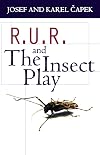
Less excited about this one, from language to observations. (This edition repping my edition of just Ze života hmyzu.)
R.U.R. (Rossum's Universal Robots) was written in 1920, premiered in Prague early in 1921, was performed in New York in 1922, and published in English translation in 1923. Virtually every encyclopedia or textbook etymology of the word "robot" mentions the play R.U.R. Although the immediate worldwide success of the play immediately popularized the word (supplanting the earlier "automaton"), it was actually not Karel Capek but his brother Josef, also a respected Czech writer, who coined the show more word. The Czech word robota means "drudgery" or "servitude"; a robotnik is a peasant or serf. Although the term today conjures up images of clanking metal contraptions, Capek's Robots (always capitalized) are more accurately the product of what we would now call genetic engineering.
The translator (Paul Selver) changed the play quite a bit while preparing the English version, combining two Robot characters into one, and considerably toning down the ending. If you're interested in reading the play as it was originally presented to American audiences, read the 1920s version (most university libraries will have a copy -- it was tremendously popular in its day).
In the 1990s, a new translation, with much better dialogue and a chilling new final speech (new to English audiences, anyway) by the Robot Damon, was published in a Capek reader called Toward the Radical Center (with a short introduction by Arthur Miller).
[http://jerz.setonhill.edu/resources/RUR/]
Written just before WWII the Insect Play is a wonderful fantasy full of political allegory and social commentary. It is important to keep in mind when reading the Insect Play that Josef Capek died in a Nazi concentration camp. show less
The translator (Paul Selver) changed the play quite a bit while preparing the English version, combining two Robot characters into one, and considerably toning down the ending. If you're interested in reading the play as it was originally presented to American audiences, read the 1920s version (most university libraries will have a copy -- it was tremendously popular in its day).
In the 1990s, a new translation, with much better dialogue and a chilling new final speech (new to English audiences, anyway) by the Robot Damon, was published in a Capek reader called Toward the Radical Center (with a short introduction by Arthur Miller).
[http://jerz.setonhill.edu/resources/RUR/]
Written just before WWII the Insect Play is a wonderful fantasy full of political allegory and social commentary. It is important to keep in mind when reading the Insect Play that Josef Capek died in a Nazi concentration camp. show less
Lists
Awards

You May Also Like


Associated Authors
Statistics
- Works
- 65
- Also by
- 7
- Members
- 452
- Popularity
- #54,271
- Rating
- 4.1
- Reviews
- 6
- ISBNs
- 63
- Languages
- 10