
David Farrell Krell
Author of Basic Writings
About the Author
David Farrell Krell is Emeritus Professor of Philosophy at DePaul University and Brauer Distinguished Visiting Professor of German Studies at Brown University.
Image credit: via Brown University
Works by David Farrell Krell
Intimations of Mortality: Time, Truth, and Finitude in Heidegger's Thinking of Being (1986) 27 copies
The Purest of Bastards: Works of Mourning, Art, and Affirmation in the Thought of Jacques Derrida (2000) 13 copies
Derrida and Our Animal Others: Derrida's Final Seminar, the Beast and the Sovereign (2013) 12 copies
Associated Works
Tagged
Common Knowledge
- Canonical name
- Krell, David Farrell
- Birthdate
- 1944
- Gender
- male
- Education
- Duquesne University
- Occupations
- philosopher
Professor Emeritus of Philosophy - Organizations
- DePaul University
- Nationality
- USA
- Associated Place (for map)
- USA
Members
Reviews
I didn't really know what I was getting in for. I just wanted to flip through it to see what all the fuss was about, but it didn't turn out to be that kind of book. Parts of it are really beautiful, kind of terribly beautiful. Here is an example:
"At bottom, the ordinary is not ordinary; it is extra-ordinary. The essence of truth, that is, of unconcealedness, is dominated throughout by a denial. Yet this denial is not a defect or a fault, as though truth were an unalloyed unconcealedness that show more has rid itself of everything concealed. If truth could accomplish this, it would no longer be itself. This denial, in the form of a double concealment, belongs to the essence of truth as unconcealedness. Truth, in its essence, is un-truth."
And then two pages later: "Beauty is one way in which truth essentially occurs as unconcealedness."
And then two more pages later: "Truth is un-truth, insofar as there belongs to it the reservoir of the not-yet-revealed, the un-uncovered, in the sense of concealment."
It kind of made me think someone should just write a poem about it instead. But then here is another quote which seemed almost like a direct challenge: "Occasionally we still have the feeling that violence has long been done to the thingly element of things and that thought has played a part in this violence, for which reason people disavow thought instead of taking pains to make it more thoughtful."
There is something so seductive about a sentence that begins "The essence of truth," even (especially) if it concludes with un-truth. show less
"At bottom, the ordinary is not ordinary; it is extra-ordinary. The essence of truth, that is, of unconcealedness, is dominated throughout by a denial. Yet this denial is not a defect or a fault, as though truth were an unalloyed unconcealedness that show more has rid itself of everything concealed. If truth could accomplish this, it would no longer be itself. This denial, in the form of a double concealment, belongs to the essence of truth as unconcealedness. Truth, in its essence, is un-truth."
And then two pages later: "Beauty is one way in which truth essentially occurs as unconcealedness."
And then two more pages later: "Truth is un-truth, insofar as there belongs to it the reservoir of the not-yet-revealed, the un-uncovered, in the sense of concealment."
It kind of made me think someone should just write a poem about it instead. But then here is another quote which seemed almost like a direct challenge: "Occasionally we still have the feeling that violence has long been done to the thingly element of things and that thought has played a part in this violence, for which reason people disavow thought instead of taking pains to make it more thoughtful."
There is something so seductive about a sentence that begins "The essence of truth," even (especially) if it concludes with un-truth. show less
I am not a serious or studied student of philosophy -- just an avid reader that enjoys venturing into this area. Consequently, most of this I am sure went over my head. Still, I got a lot out of it. My feeling is that Heidegger stood at the transition of the consummation of classic philosophy. This makes him post-Nietzschean overtly. I believe it accurate to say he want to move past Nietzsche as a dead end down nihilism avenue. In seeking to advance the study of philosophy, Heidegger feels show more it must be reset and this means evaluating premises and considering them anew. This leads him to ask what is Being, Time (and both together), Language, etc. With defining being he points out the limitations language. To define "Being" one start "'Being' is..." Well, let me stop right there, with "is" a conjugation of "being" and any definition you do is a useless recursion. Helpfully he gives us a word to frame the apparent uniqueness of human existence (being): Dasein.
By asking these questions and exploring etymological and poetical references I don't feel Heidegger has settled anything other than pointing out the need to go back to square one and find a new path forward. Then, at the end of four decades of through anthologized here he announces the twilight of the gods in a Nietzschean move with "The End of Philosophy and the Task of Thinking" which concludes with, "The task of thinking would then be the surrender of previous thinking to the determination of the matter of thinking."
Isn't this the sort of self-referential argument mired in its own language Heidegger had been explaining to be of no value? I must have missed something and hope to read this again some day. show less
By asking these questions and exploring etymological and poetical references I don't feel Heidegger has settled anything other than pointing out the need to go back to square one and find a new path forward. Then, at the end of four decades of through anthologized here he announces the twilight of the gods in a Nietzschean move with "The End of Philosophy and the Task of Thinking" which concludes with, "The task of thinking would then be the surrender of previous thinking to the determination of the matter of thinking."
Isn't this the sort of self-referential argument mired in its own language Heidegger had been explaining to be of no value? I must have missed something and hope to read this again some day. show less
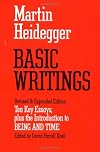
Basic writings: From Being and time (1927) to The task of thinking (1964) (His Works) by Martin Heidegger

In "The Question Concerning Technology," Heidegger claims were are chained to technology, which he defines as both a tool and a human activity (311-312). For Heidegger, "Technology is a way of revealing," rooted in the Greek techie, which means both activities and skills of a craftsman, but also arts, something poetic, a "bringing-forth" (318). By the "essence" of technology, Heidegger means its "enframing," its ability to bring forth a totality where everything is available and show more manipulatable (Krell 309). This, of course, is a danger that blocks poiesis (331, 335), but it also makes possible the saving power of poeisis, the arts that we can use to counteract the totality of technology (341). show less
Lists
Awards

You May Also Like


Associated Authors
Statistics
- Works
- 27
- Also by
- 7
- Members
- 2,023
- Popularity
- #12,707
- Rating
- 4.0
- Reviews
- 4
- ISBNs
- 83
- Languages
- 2