
Michel-Rolph Trouillot (1949–2012)
Author of Silencing the Past: Power and the Production of History
About the Author
Michel-Rolph Trouillot (1949-2012) was one of the most prominent Haitian scholars working in the United States. He was the director of the Institute for Global Studies in Culture, Power, and History and Krieger/Eisenhower Distinguished Professor in Anthropology at Johns Hopkins University. Hazel V. show more Carby is the Charles C. and Dorothea S. Dilley Professor of African American Studies, professor of American studies, and director of the Initiative on Race, Gender, and Globalization at Yale University. show less
Works by Michel-Rolph Trouillot
Associated Works
Novel History: Historians and Novelists Confront America's Past and Each Other (2001) — Contributor — 139 copies, 1 review
The Butterfly's Way: Voices from the Haitian Dyaspora in the United States (2001) — Contributor — 70 copies, 1 review
Cultivation and Culture: Labor and the Shaping of Slave Life in the Americas (1993) — Contributor — 37 copies
Tagged
Common Knowledge
- Canonical name
- Trouillot, Michel-Rolph
- Birthdate
- 1949
- Date of death
- 2012-07-05
- Gender
- male
- Education
- City University of New York (BS|History)
Johns Hopkins (PhD|Anthropology) - Occupations
- Professor of Anthropology and Social Sciences, University of Chicago
- Nationality
- Haiti
- Birthplace
- Haiti
- Place of death
- Chicago, Illinois, USA
- Map Location
- Haiti
Members
Reviews
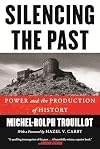
This book should be read after or while watching Exterminate All the Brutes (2021) a four-part miniseries by Raoul Peck. The series indicates it is based on Trouillot's book. They investigate the same issues and Peck is very respectful of Trouillot, who died in 2012. It is about the parts we neglect to mention when recording history and the parts we reshape to our needs. But it's more than that too. It investigates how narration is necessary for us, but also how it also dictates to us. show more Trouillot wants us to understand how working to uncover silences will dictate how we shape or are shaped in the future. It's about power and how, amidst our appalling historical lapses, we can be optimistic - if we choose to see history as something not dredged from the past, but something immediately present.
For those interested in history it's a must-read. It's academic and will not impress those who can't slow down and reread a paragraph five times to try to grasp it, who refuse to do research when a term befuddles them or an event is unknown to them. For me, the history of the Haitian revolution was an eye-opener. I need to do more work here. show less
For those interested in history it's a must-read. It's academic and will not impress those who can't slow down and reread a paragraph five times to try to grasp it, who refuse to do research when a term befuddles them or an event is unknown to them. For me, the history of the Haitian revolution was an eye-opener. I need to do more work here. show less
While much of this book focuses on the history of his native country of Haiti, Trouillot's goal is broader: an epistemological re-evaluation of how our perceptions of history are formed. Of how we understand history to be true. Of how opinions come to be historical fact. It's not light reading, but easy enough to absorb when he moves from the theoretical to the specific. He goes beyond the commonplace "History is written by the victors" to demonstrate by example the four stages leading to show more this end result.
Those four stages are the moments when decisions are made, intentionally or otherwise, that affect what we come to perceive as history: at the time original records are (or are not) created; at the time those records are selected for retention; at the time they are retrieved and put into a narrative; and at the time that narrative is evaluated for significance. Omissions ("silences") at any point can alter our interpretation of past events.
Silences result not just from disdain or prejudice, but from the fact that the reality is "unthinkable" to the recorder/archiver/narrative developer/evaluator. The Haitian revolution of 1791-1804 provides a vivid example: that the slaves could have, on their own, desired, organized and successfully concluded their own revolutionary war was an idea inconceivable by the French or most others interpreting the record. This section brought to mind a book I read not long ago, [b:Sea People: The Puzzle of Polynesia|40536236|Sea People The Puzzle of Polynesia|Christina Thompson|https://i.gr-assets.com/images/S/compressed.photo.goodreads.com/books/1542039373l/40536236._SY75_.jpg|19226650]. The reality of how the South Pacific was colonized remained unknown (at least outside Polynesian oral history) for hundreds of years because Europeans simply couldn't accept that the Polynesian outriggers could have travelled the distances it has since been proved that they can.
The book is a brilliant framework, illustrating the inherent reasons that the true histories of blacks, women, native populations, and others have been omitted from history. Since we continue to struggle with the ways in which these perceptions mold actions and opinions in the 21st century these are ideas that bear thinking about. show less
Those four stages are the moments when decisions are made, intentionally or otherwise, that affect what we come to perceive as history: at the time original records are (or are not) created; at the time those records are selected for retention; at the time they are retrieved and put into a narrative; and at the time that narrative is evaluated for significance. Omissions ("silences") at any point can alter our interpretation of past events.
Silences result not just from disdain or prejudice, but from the fact that the reality is "unthinkable" to the recorder/archiver/narrative developer/evaluator. The Haitian revolution of 1791-1804 provides a vivid example: that the slaves could have, on their own, desired, organized and successfully concluded their own revolutionary war was an idea inconceivable by the French or most others interpreting the record. This section brought to mind a book I read not long ago, [b:Sea People: The Puzzle of Polynesia|40536236|Sea People The Puzzle of Polynesia|Christina Thompson|https://i.gr-assets.com/images/S/compressed.photo.goodreads.com/books/1542039373l/40536236._SY75_.jpg|19226650]. The reality of how the South Pacific was colonized remained unknown (at least outside Polynesian oral history) for hundreds of years because Europeans simply couldn't accept that the Polynesian outriggers could have travelled the distances it has since been proved that they can.
The book is a brilliant framework, illustrating the inherent reasons that the true histories of blacks, women, native populations, and others have been omitted from history. Since we continue to struggle with the ways in which these perceptions mold actions and opinions in the 21st century these are ideas that bear thinking about. show less
Silencing the Past: Power and the Production of History
Michel-Rolph Trouillot
Beacon Press
March 2015
978-0807080535
At a time when educational “reformers” push to reduce not only the sciences, but also the humanities towards quantifiable, or more accurately testable, quanta of knowledge, the study of historical production is an increasingly important counter-balance to ideological efforts to constrain and sanitize historical knowledge. These reductions, far from just a banal attempt to show more analyze student performance, are part of the process of historical production themselves, playing out in school boards across the United States. Recent reactionary consternation to the revamping of the AP History curriculum demonstrates the jejune nature of the well-worn aphorism, history is written by the victors.
In Silencing the Past, Michel-Rolph Trouillot encourages us to unmask this aphorism to interrogate a number of productive forces. Far from the victors, as modern school boards and states have shown, history is written by the living for reasons so often disconnected and distantly related to the event. From the act of labeling—did Columbus “discover” or “encounter”—to establishing the importance of the event—was the landing important to those living in 1492—Trouillot focuses the reader on the many considerations involved in the construction of historical narratives. From Columbus’s journey through the Haitian Revolution and the Alamo to the Holocaust, he uses these historical events to push the reader to recognize historical actors who, removed from the events they narrated, gave life to historical lore in ways and for reasons that so often served themselves and the present.
Silencing the Past is an encompassing examination of these productive forces backdropped mainly by the Haitian Revolution. Trouillot strikes an impressive middle-ground between an academic text, useful and piquant for those who already have a passing familiarity with postmodernism and ideas of historical construction, and an evocative read for a lay audience, who at most would need a cursory Google search over a few theoretical concepts of which they might be unfamiliar. show less
Michel-Rolph Trouillot
Beacon Press
March 2015
978-0807080535
At a time when educational “reformers” push to reduce not only the sciences, but also the humanities towards quantifiable, or more accurately testable, quanta of knowledge, the study of historical production is an increasingly important counter-balance to ideological efforts to constrain and sanitize historical knowledge. These reductions, far from just a banal attempt to show more analyze student performance, are part of the process of historical production themselves, playing out in school boards across the United States. Recent reactionary consternation to the revamping of the AP History curriculum demonstrates the jejune nature of the well-worn aphorism, history is written by the victors.
In Silencing the Past, Michel-Rolph Trouillot encourages us to unmask this aphorism to interrogate a number of productive forces. Far from the victors, as modern school boards and states have shown, history is written by the living for reasons so often disconnected and distantly related to the event. From the act of labeling—did Columbus “discover” or “encounter”—to establishing the importance of the event—was the landing important to those living in 1492—Trouillot focuses the reader on the many considerations involved in the construction of historical narratives. From Columbus’s journey through the Haitian Revolution and the Alamo to the Holocaust, he uses these historical events to push the reader to recognize historical actors who, removed from the events they narrated, gave life to historical lore in ways and for reasons that so often served themselves and the present.
Silencing the Past is an encompassing examination of these productive forces backdropped mainly by the Haitian Revolution. Trouillot strikes an impressive middle-ground between an academic text, useful and piquant for those who already have a passing familiarity with postmodernism and ideas of historical construction, and an evocative read for a lay audience, who at most would need a cursory Google search over a few theoretical concepts of which they might be unfamiliar. show less
 This review was written for LibraryThing Early Reviewers.
I missed Michel Rolph Trouillot's Silencing the Past: Power and Production of History the first time around. I'm glad I had a chance to see it in its twentieth anniversary edition. Trouillot is inspiring in his passion, clear in his terminology, exquisitely precise in his explanations of facts and theories, and straightforward in his examples. And inspiring. I want to go back to reading and analyzing history.
The book takes the adage “history is written by the winners” and expands it show more with a challenge. “History is the fruit of power, but power itself is never so transparent that its analysis becomes superfluous. The ultimate mark of power may be its invisibility, the ultimate challenge, the exposition of its roots.” [xxiii] Each historical narrative has its own unique silences; issues and people left out of the history. These are created when a singular concept had to be addressed / repressed / silenced. Because of these differences, the methods of researching and reversing the silences need to be specially tailored to each, so voices can be investigated and exposed.
The points where “silences” most often enter the records and narratives are made apparent and I think I now have tools needed to see these silences in any history book or article I read.
I need to research the facts and find access to tools to help me find where my own thoughts are blinded by the “impossibilities” he discusses. “When reality does not coincide with deeply held beliefs, human beings tend to phrase interpretations that force reality within the scope of these beliefs. They devise formulas to repress the unthinkable and to bring it back within the realm of accepted discourse.” [72] This is what happened during the precursors to the Saint Domingo / Haiti slave rebellion. The slave-owners, the local government leaders, and the European governments which depended on slaves simply could not see the facts that we see as showing stronger rebel slaves. Slaves simply do not rebel. Period. It was unthinkable. “How does one write the history of the impossible?” [73]
The Notes section of the book is helpful, and it has an index, but because Trouillot died in 2012, Beacon Press's characteristic “resources for further study” could not be appended. I really miss that, as I want to go on, and am not sure how. show less
The book takes the adage “history is written by the winners” and expands it show more with a challenge. “History is the fruit of power, but power itself is never so transparent that its analysis becomes superfluous. The ultimate mark of power may be its invisibility, the ultimate challenge, the exposition of its roots.” [xxiii] Each historical narrative has its own unique silences; issues and people left out of the history. These are created when a singular concept had to be addressed / repressed / silenced. Because of these differences, the methods of researching and reversing the silences need to be specially tailored to each, so voices can be investigated and exposed.
The points where “silences” most often enter the records and narratives are made apparent and I think I now have tools needed to see these silences in any history book or article I read.
I need to research the facts and find access to tools to help me find where my own thoughts are blinded by the “impossibilities” he discusses. “When reality does not coincide with deeply held beliefs, human beings tend to phrase interpretations that force reality within the scope of these beliefs. They devise formulas to repress the unthinkable and to bring it back within the realm of accepted discourse.” [72] This is what happened during the precursors to the Saint Domingo / Haiti slave rebellion. The slave-owners, the local government leaders, and the European governments which depended on slaves simply could not see the facts that we see as showing stronger rebel slaves. Slaves simply do not rebel. Period. It was unthinkable. “How does one write the history of the impossible?” [73]
The Notes section of the book is helpful, and it has an index, but because Trouillot died in 2012, Beacon Press's characteristic “resources for further study” could not be appended. I really miss that, as I want to go on, and am not sure how. show less
This review was written for LibraryThing Early Reviewers.Lists
Awards

You May Also Like


Associated Authors
Statistics
- Works
- 8
- Also by
- 4
- Members
- 1,014
- Popularity
- #25,404
- Rating
- 4.2
- Reviews
- 26
- ISBNs
- 22
- Languages
- 1
