
Clifford A. Pickover
Author of The Math Book: 250 Milestones in the History of Mathematics
About the Author
Clifford Pickover is a prolific author, having published more than forty books, translated into over a dozen languages, on topics ranging from science and mathematics to religion, art, and history. He received his PhD from Yale University's Department of Molecular Biophysics and Biochemistry, holds show more over forty U.S. patents, and is an associate editor for several scientific journals. His research has received considerable attention from media outlets ranging from CNN and WIRED to The New York Times, and his Web site, www.pickover.com, has received millions of visits. show less
Image credit: Richard Dickison
Works by Clifford A. Pickover
Surfing through Hyperspace: Understanding Higher Universes in Six Easy Lessons (1999) 227 copies, 1 review
Death and the Afterlife: A Chronological Journey, from Cremation to Quantum Resurrection (Union Square & Co. Chronologies) (2015) 215 copies
Strange Brains and Genius: The Secret Lives Of Eccentric Scientists And Madmen (1998) 206 copies, 3 reviews
Sex, Drugs, Einstein & Elves: Sushi, Psychedelics, Parallel Universes and the Quest for Transcendence (2005) 185 copies, 3 reviews
A Passion for Mathematics: Numbers, Puzzles, Madness, Religion, and the Quest for Reality (2005) 174 copies
The Mobius Strip: Dr. August Mobius's Marvelous Band in Mathematics, Games, Literature, Art, Technology, and Cosmology (2006) 162 copies
The Zen of Magic Squares, Circles, and Stars: An Exhibition of Surprising Structures across Dimensions (2002) 94 copies, 2 reviews
Artificial Intelligence: An Illustrated History: From Medieval Robots to Neural Networks (Union Square & Co. Illustrated Histories) (2019) 79 copies, 1 review
A Beginner's Guide to Immortality: Extraordinary People, Alien Brains, and Quantum Resurrection (2006) 56 copies, 1 review
The Science Book: From Darwin to Dark Energy, 250 Milestones in the History of Science (Sterling Milestones) (2018) 49 copies
The Book of Black: Black Holes, Black Death, Black Forest Cake and Other Dark Sides of Life (2013) 16 copies
Brain Bogglers: Wise Isis 1 copy
Brain Bogglers: Think Tank 1 copy
Brain Bogglers: Yin or Yang 1 copy
Brain Bogglers: Spidery Math 1 copy
Brain Bogglers: Café Enigma 1 copy
Associated Works
This Will Make You Smarter: New Scientific Concepts to Improve Your Thinking (Edge Question Series) (2012) — Contributor — 904 copies, 17 reviews
What Is Your Dangerous Idea? Today's Leading Thinkers on the Unthinkable (2007) — Contributor — 668 copies, 8 reviews
Tagged
Common Knowledge
- Canonical name
- Pickover, Clifford A.
- Legal name
- Pickover, Clifford Alan
- Other names
- Pickover, Cliff
- Birthdate
- 1957-08-15
- Gender
- male
- Education
- Franklin and Marshall College (BA | 1978 | Biology )
Yale University (M.Phil | 1980 | Ph.D | 1982 | Molecular Biophysics and Biochemistry) - Occupations
- research scientist
editor
author
mathematician - Organizations
- Thomas J. Watson Research Center | IBM
IBM Journal of Research and Development - Nationality
- USA
- Birthplace
- Ocean Township, Ocean County, New Jersey, USA
- Associated Place (for map)
- New Jersey, USA
Members
Reviews

There's nothing else like this in the genre of computer graphics books. It contains a dazzling variety of mappings from quantifiable phenomena to computer graphics. The graphics make it possible for human beings to recognize patterns they would not have otherwise been able to see. This book requires some mental effort on the part of the reader, but the reader who sticks with it will find that the very nature of visual perception itself, as well as its relationship to reality, becomes a show more phenomenon that inspires childlike wonder. show less
Sex, Drugs, Einstein & Elves: Sushi, Psychedelics, Parallel Universes and the Quest for Transcendence by Clifford A. Pickover
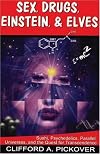
Drugs, me, me, me, Proust, me, me, I love me, and more me. Ps. Technology=God. Did I mention, me?
Like a homeless Alzheimer’s patient, Sex, Drugs, Einstein, & Elves meanders over so much terrain that writing a review is a bit like tracking the trajectory of every pellet in a shotgun blast. It’s filled with the kind of cocktail party chatter you might use to pick up a Mensa member at their convention after-party. He spends a paragraph on an idea and then moves on without staking out any show more true analytical critique. It feels much like an aging indie rocker going on about “Yeah, I dig Yo La Tengo’s cover of Speeding Motorcycle; no, not the version on Fake Book, the one they recorded live with Daniel Johnston who was patched over the phone when they were doing a show at WFMU, it’s on Genius Love = Yo La Tengo, disk 1.” Puts me off lunch.
To be fair, I didn’t mind the meandering nature. Although numerous sections were uninteresting, he changes subjects so rapidly that something more intriguing comes up quickly. And a quick read is what I recommend…skim over the subjects that don’t do it for you. Computer generated poetry? I’d rather boil my hand.
The one chapter that did rivet me was the one on DMT. Like most of the book, it’s a survey of other people’s experiences with a bit of speculation mixed in. And yet, the epitome of this author’s naïveté is that he cheerily admits he’s never taken a psychedelic drug…but oooh, his novels and his art work are so psychedelic, he doesn’t need to! Even so, reading about the similarities between many of the drug experiences is fascinating. Pickover plays up the similarities so much that he thinks it’s possible that there really is a parallel dimension out there that DMT puts us in touch with. Unfortunately, he never considers the cultural similarities and influences that might be linking these experiences…nor does he contrast the modern tripper with the true tribal shamans who communed with Nature Gods rather than the Machine Elves of Timothy Leary fame. Regardless of the truth of the matter, just reading about these mind-bending experiences is quite a treat and worth the price of this book.
I’m also glad he brings up the history of Ibogaine (Iboga), a psychedelic substance that some users in the 60s found had completely eliminated their addiction to heroine, cocaine, and even alcohol. Unfortunately, the U.S. government declared it a controlled substance due to its psychedelic nature. It was not even permitted for laboratory testing purposes and still is not. A great example of moralistic suppression of a potentially life-saving medication. Pickover does a great service by highlighting this substance made from the bark of a tree.
Sadly, the book goes on 150 pages further.
It’s Pickover’s pomposity and blind optimism that really got to me. I was nauseated by his self-love. Oh, he’s so fascinating…clearly. He quite frequently mentions and recommends his other books throughout this book. Because they’re just so great too, you wouldn’t want to miss them. He’s really proud of how many books he’s written. In his chapter on publishing, he blithely tosses off the actual monetary advances he gets for his books. Some of his ideas on reality are so clever, you can read more about them in his clever sci fi novels. He spends a bit of time on his previous book dedications and drops how he’s been interviewed “countless times.” His love affair with his own quaint little town of Shrub Oak and its “mall” (seriously, he loves the mall) are embarrassingly parochial.
He spends a lot of time on Proust. Yeah, Proust is awesome. Too bad Pickover’s overindulgent references to Proust give the impression that he’s trying to create a halo around his own book by filling it with the romantic language of Swann’s Way—whether intentionally or not. The commentary on Proust is merely summarized criticism by more thoughtful reviewers. (Pickover attempts to cast a similarity between himself and Walter Benjamin, too). Here are some examples of how he indirectly attempts to associate himself with Proust’s greatness, “Thinking about Proust’s strange realities, I developed several novels that deal with what I call neorealities” and “Proust’s town of Combray, like my own Shrub Oak, is the kind of small town where…” and so on. He conveniently mentions how many times Proust’s novel was rejected and lo-and-behold, this very work by Pickover was rejected repeatedly as well! I wonder why?
His chapter on “writing tips” is absolutely embarrassing and guarantees beyond any prayer of a doubt that I will never read his fiction. “Avoid using an omniscient narrator” “Short better than long for dialogue.” “Buy a National Geographic. Page through it and select a setting for your novel. Look at the photos to help you create a vivid description.” HURL!!!!
I could have handled the la-di-dah arrogance, but what really made me angry bubbled up in the last fourth of the book: his techno-apologism. He foresees all of society’s problems as being solved in the future by technology and science. This Wired-enamor minus the rah-rah capitalism (in fact, he seems oblivious to almost all economic issues) is dangerously naïve at best and criminally ignorant at worst. We still have war and torture and rape and murder and starvation. And global warming (caused by technology) which he conveniently never mentions. But somehow being able to “download our consciousness into a computer” or robot is going to solve the worlds problems. Not only do I not believe this technology is possible, but his optimism is not born out by history. Better technology just means better ways to kill and maim. More efficient, more brutal war. Is an iPhone 3Gs really worth it? Does it make us happier? Who is the “we” made happier by technology? The rich continue to be privileged and live easier lives. The shanty towns in Sao Paolo continue to overflow. The homeless refugees in Iraq. The genocide in Darfur. These folks don’t give a shit about your goddamn AI program that frankly will NOT become conscious like a Terminator despite your confidence it will. All we really need are a very few tangible things. Fresh water. Food. Some shelter. Companionship and community. Technology is just what we crave because we’re alienated. We’ve constructed a society that requires it. In order to keep growth going. Economics depends on growth. Too bad growth is also cancer. I read somewhere that the Mayan’s may have killed themselves off by overpopulating/overusing the environment where they lived. Who says that can’t happen to our species as a whole?
Don’t get me wrong, I’m not a Luddite. I desire product as much as the next joe. But I don’t believe in its value. I know it’s because I’m culturally brainwashed. I think every time I exchange money for product it steals a piece of me. Whether it be my safety or my soul. But I do it anyway. Until I get bored with product and buy next product. Or want better, more advanced product.
Pickover is a sort of spiritualist materialist, without ever reconciling the two. (God is a mathematician.) Unfortunately, his materialist view is typically reductionist: biological or psychological phenomena, can be reduced to physical phenomena and can thus be programmed into a computer. This assertion isn’t much more than a religious belief. There is no accepted reductionist theory of consciousness. DNA replication can’t be explained by subatomic properties. Even subatomic properties only lend themselves to probabilities NOT programming. How do numbers capture the feeling of a breeze? The phenomenon itself, not the neurons that trigger the feeling. There is no subroutine for self-awareness. Do androids dream of electric sheep? “Nature is mathematics,” he says. Somewhere in the infinitely repeating digits of Pi, for example, is a representation of you. I assert against his assertion that a living thing cannot be capture in numbers. Living is a process, not a thing. It can’t be frozen in digits. The universe just IS. Math is a human way to interpret the universe. Pickover’s universe is like The Matrix, if a good one instead of an evil one. Is a breath of air math? Is a dream mathematical? Or is it just what it is?
“The Internet will dissolve away nations as we know them today. Humanity becomes a single hive mind, with a group intelligence, as geography becomes putty in the hands of the Internet sculptor.” You don’t think that it might be more likely that we find new and better ways to enslave each other for wealth? “Some researchers have even suggested that humans are at less risk for extinction now than at any other time in history, and that this risk decreases proportionately to advances made in technology…in this century we will probably become immortal from our understanding of the biological basis of aging and our merging with computers.” (italics mine)
To me the quintessence of technology is the nuclear bomb. We should have stopped at dental floss and the bicycle. But unfortunately, humans have a really hard time applying breaks. “…at this time in history…” there exists a way that humanity could make this planet uninhabitable. Sorry, technology doesn’t seem like my savior.
I’m sure in person, Pickover is a sweet guy. Too bad he’s a narcissist as a writer. show less
Like a homeless Alzheimer’s patient, Sex, Drugs, Einstein, & Elves meanders over so much terrain that writing a review is a bit like tracking the trajectory of every pellet in a shotgun blast. It’s filled with the kind of cocktail party chatter you might use to pick up a Mensa member at their convention after-party. He spends a paragraph on an idea and then moves on without staking out any show more true analytical critique. It feels much like an aging indie rocker going on about “Yeah, I dig Yo La Tengo’s cover of Speeding Motorcycle; no, not the version on Fake Book, the one they recorded live with Daniel Johnston who was patched over the phone when they were doing a show at WFMU, it’s on Genius Love = Yo La Tengo, disk 1.” Puts me off lunch.
To be fair, I didn’t mind the meandering nature. Although numerous sections were uninteresting, he changes subjects so rapidly that something more intriguing comes up quickly. And a quick read is what I recommend…skim over the subjects that don’t do it for you. Computer generated poetry? I’d rather boil my hand.
The one chapter that did rivet me was the one on DMT. Like most of the book, it’s a survey of other people’s experiences with a bit of speculation mixed in. And yet, the epitome of this author’s naïveté is that he cheerily admits he’s never taken a psychedelic drug…but oooh, his novels and his art work are so psychedelic, he doesn’t need to! Even so, reading about the similarities between many of the drug experiences is fascinating. Pickover plays up the similarities so much that he thinks it’s possible that there really is a parallel dimension out there that DMT puts us in touch with. Unfortunately, he never considers the cultural similarities and influences that might be linking these experiences…nor does he contrast the modern tripper with the true tribal shamans who communed with Nature Gods rather than the Machine Elves of Timothy Leary fame. Regardless of the truth of the matter, just reading about these mind-bending experiences is quite a treat and worth the price of this book.
I’m also glad he brings up the history of Ibogaine (Iboga), a psychedelic substance that some users in the 60s found had completely eliminated their addiction to heroine, cocaine, and even alcohol. Unfortunately, the U.S. government declared it a controlled substance due to its psychedelic nature. It was not even permitted for laboratory testing purposes and still is not. A great example of moralistic suppression of a potentially life-saving medication. Pickover does a great service by highlighting this substance made from the bark of a tree.
Sadly, the book goes on 150 pages further.
It’s Pickover’s pomposity and blind optimism that really got to me. I was nauseated by his self-love. Oh, he’s so fascinating…clearly. He quite frequently mentions and recommends his other books throughout this book. Because they’re just so great too, you wouldn’t want to miss them. He’s really proud of how many books he’s written. In his chapter on publishing, he blithely tosses off the actual monetary advances he gets for his books. Some of his ideas on reality are so clever, you can read more about them in his clever sci fi novels. He spends a bit of time on his previous book dedications and drops how he’s been interviewed “countless times.” His love affair with his own quaint little town of Shrub Oak and its “mall” (seriously, he loves the mall) are embarrassingly parochial.
He spends a lot of time on Proust. Yeah, Proust is awesome. Too bad Pickover’s overindulgent references to Proust give the impression that he’s trying to create a halo around his own book by filling it with the romantic language of Swann’s Way—whether intentionally or not. The commentary on Proust is merely summarized criticism by more thoughtful reviewers. (Pickover attempts to cast a similarity between himself and Walter Benjamin, too). Here are some examples of how he indirectly attempts to associate himself with Proust’s greatness, “Thinking about Proust’s strange realities, I developed several novels that deal with what I call neorealities” and “Proust’s town of Combray, like my own Shrub Oak, is the kind of small town where…” and so on. He conveniently mentions how many times Proust’s novel was rejected and lo-and-behold, this very work by Pickover was rejected repeatedly as well! I wonder why?
His chapter on “writing tips” is absolutely embarrassing and guarantees beyond any prayer of a doubt that I will never read his fiction. “Avoid using an omniscient narrator” “Short better than long for dialogue.” “Buy a National Geographic. Page through it and select a setting for your novel. Look at the photos to help you create a vivid description.” HURL!!!!
I could have handled the la-di-dah arrogance, but what really made me angry bubbled up in the last fourth of the book: his techno-apologism. He foresees all of society’s problems as being solved in the future by technology and science. This Wired-enamor minus the rah-rah capitalism (in fact, he seems oblivious to almost all economic issues) is dangerously naïve at best and criminally ignorant at worst. We still have war and torture and rape and murder and starvation. And global warming (caused by technology) which he conveniently never mentions. But somehow being able to “download our consciousness into a computer” or robot is going to solve the worlds problems. Not only do I not believe this technology is possible, but his optimism is not born out by history. Better technology just means better ways to kill and maim. More efficient, more brutal war. Is an iPhone 3Gs really worth it? Does it make us happier? Who is the “we” made happier by technology? The rich continue to be privileged and live easier lives. The shanty towns in Sao Paolo continue to overflow. The homeless refugees in Iraq. The genocide in Darfur. These folks don’t give a shit about your goddamn AI program that frankly will NOT become conscious like a Terminator despite your confidence it will. All we really need are a very few tangible things. Fresh water. Food. Some shelter. Companionship and community. Technology is just what we crave because we’re alienated. We’ve constructed a society that requires it. In order to keep growth going. Economics depends on growth. Too bad growth is also cancer. I read somewhere that the Mayan’s may have killed themselves off by overpopulating/overusing the environment where they lived. Who says that can’t happen to our species as a whole?
Don’t get me wrong, I’m not a Luddite. I desire product as much as the next joe. But I don’t believe in its value. I know it’s because I’m culturally brainwashed. I think every time I exchange money for product it steals a piece of me. Whether it be my safety or my soul. But I do it anyway. Until I get bored with product and buy next product. Or want better, more advanced product.
Pickover is a sort of spiritualist materialist, without ever reconciling the two. (God is a mathematician.) Unfortunately, his materialist view is typically reductionist: biological or psychological phenomena, can be reduced to physical phenomena and can thus be programmed into a computer. This assertion isn’t much more than a religious belief. There is no accepted reductionist theory of consciousness. DNA replication can’t be explained by subatomic properties. Even subatomic properties only lend themselves to probabilities NOT programming. How do numbers capture the feeling of a breeze? The phenomenon itself, not the neurons that trigger the feeling. There is no subroutine for self-awareness. Do androids dream of electric sheep? “Nature is mathematics,” he says. Somewhere in the infinitely repeating digits of Pi, for example, is a representation of you. I assert against his assertion that a living thing cannot be capture in numbers. Living is a process, not a thing. It can’t be frozen in digits. The universe just IS. Math is a human way to interpret the universe. Pickover’s universe is like The Matrix, if a good one instead of an evil one. Is a breath of air math? Is a dream mathematical? Or is it just what it is?
“The Internet will dissolve away nations as we know them today. Humanity becomes a single hive mind, with a group intelligence, as geography becomes putty in the hands of the Internet sculptor.” You don’t think that it might be more likely that we find new and better ways to enslave each other for wealth? “Some researchers have even suggested that humans are at less risk for extinction now than at any other time in history, and that this risk decreases proportionately to advances made in technology…in this century we will probably become immortal from our understanding of the biological basis of aging and our merging with computers.” (italics mine)
To me the quintessence of technology is the nuclear bomb. We should have stopped at dental floss and the bicycle. But unfortunately, humans have a really hard time applying breaks. “…at this time in history…” there exists a way that humanity could make this planet uninhabitable. Sorry, technology doesn’t seem like my savior.
I’m sure in person, Pickover is a sweet guy. Too bad he’s a narcissist as a writer. show less
Artificial Intelligence: An Illustrated History: From Medieval Robots to Neural Networks by Clifford A. Pickover

Another of Pickover's timeline-style books depicting the history of a scientific concept. The style is: big image on the left-hand page, a title, a date, and a few paragraphs of description on the right-hand page. In the post-2023, post-ChatGPT world I thought it behove me to read up on the general scientific history of artificial intelligence. I enjoyed it, though it is merely an intellectual amuse-bouche. It did introduce me to ELIZA and Paranoid Parry. I was intrigued, too, about how old show more some concepts and inventions are, like facial recognition (1964) and so on. This paperback edition from 2024 (the first edition was from 2019) adds a new introduction and some entries on ChatGPT, DALL-E, and the like. Short bibliography, index, etc. show less
Sex, Drugs, Einstein, and Elves: Sushi, Psychedelics, Parallel Universes, and the Quest for Transcendence by Clifford A. Pickover

A sort of autobiography and sort of collection of essays that Pickover could not fit into his other books, I'd reckon. As such, it meanders and sometimes does not really hang together, but a lot of the stuff is interesting. I don't understand, though, why Pickover has never mentioned Jorge Luis Borges. The math and the books. He's acres better than Proust, yet Pickover devotes a chapter to Proust and his connections to brains and such. A huge section on DMT was quite interesting. Some advice show more on writing. Well worth it if you like Pickover; well worth it if you can find it cheaply. show less
Lists
Awards


You May Also Like


Associated Authors
Statistics
- Works
- 76
- Also by
- 3
- Members
- 5,847
- Popularity
- #4,218
- Rating
- 3.7
- Reviews
- 42
- ISBNs
- 187
- Languages
- 10
- Favorited
- 8


