
Vernon Lee (1856–1935)
Author of Hauntings and Other Fantastic Tales
About the Author
Vernon Lee was born Violet Paget in 1856. Although best remembered for the bewitching ghost stories she wrote between 1881 and 1913, she was also a fervent pacifist who wrote extensively and innovatively on the art of writing and the morality of art itself. She died in 1935
Image credit: Vernon Lee, by John Singer Sargent, 1881. Wikimedia Commons.
Works by Vernon Lee
El Príncipe Alberico Y La Dama Serpiente. 13 Historias Fantásticas Y Macabras (Gótica) (2013) 11 copies, 1 review
Sister Benvenuta and the Christ Child. An eighteenth-century legend. A rare original article from the Fortnightly Review, 1905. (1905) 3 copies
Assombrações 3 copies
The Legend of Madame Krasinska 2 copies
Music and its lovers, an empirical study of emotional and imaginative responses to music (2018) 2 copies
The Lady and Death 1 copy
A Lasting Love 1 copy
El jardín de la vida 1 copy
Spettri 1 copy
Guerra 1 copy
Hortus Vitae and Limbo 1 copy
The Poet's Eye 1 copy
Vital lies 1 copy
Beauty and ugliness 1 copy
Capo Serpente [short story] 1 copy
O Amante Fantasma 1 copy
Associated Works
Wayward Girls and Wicked Women: An Anthology of Subversive Stories (1986) — Contributor — 581 copies, 9 reviews
The Vampire Archives: The Most Complete Volume of Vampire Tales Ever Published (2007) — Contributor — 217 copies, 5 reviews
Daughters of Decadence: Women Writers of the Fin-de-Siècle (1993) — Contributor — 205 copies, 2 reviews
What Did Miss Darrington See? An Anthology of Feminist Supernatural Fiction (1989) — Contributor — 126 copies
The Second Dedalus Book of Decadence (The Black Forrest) (v. 2) (1992) — Contributor — 60 copies, 3 reviews
The Dedalus Book of British Fantasy: 19th Century (European Literary Fantasy Anthologies) (1991) — Contributor — 47 copies
Weird Women: Volume 2: 1840-1925: Classic Supernatural Fiction by Groundbreaking Female Writers (2021) — Contributor — 38 copies
Deadly Dolls: Midnight Tales of Uncanny Playthings: 50 (British Library Tales of the Weird) (2024) — Contributor — 34 copies, 1 review
The Rivals of Dracula: Stories from the Golden Age of Gothic Horror (2016) — Contributor — 24 copies, 2 reviews
Gender in Modernism: New Geographies, Complex Intersections (2007) — Contributor — 12 copies, 1 review
Tales of the Undead: Vampires and Visitants (1947) — Contributor, some editions — 10 copies, 1 review
Night | A Lasting Love | Chickamauga — Contributor — 1 copy
Tagged
Common Knowledge
- Legal name
- Paget, Violet
- Birthdate
- 1856-10-14
- Date of death
- 1935-02-13
- Gender
- female
- Occupations
- essayist
novelist
dramatist
short story writer
pacifist
political activist (show all 7)
travel writer - Organizations
- Union of Democratic Control
- Relationships
- James, Henry (friend)
Holdsworth, Annie E (sister-in-law)
Lee-Hamilton, Eugene (half-brother)
Willis, Irene Cooper (companion) - Short biography
- Vernon Lee was the pen name of Violet Paget, born in Boulogne, France to British parents traveling on the continent. She was a half-sister of poet Eugene Lee-Hamilton, from whose name she derived her pseudonym. She was a skilled harpsichord player, and her love of music inspired her first major work, Studies of the Eighteenth Century in Italy (1880). However, she is remembered today primarily for her supernatural fiction, which many critics consider the best of the 19th century. She also wrote more than a dozen volumes of essays on art, literary theory, music, and travel. In middle age, she became a supporter of women’s suffrage, a pacifist, and an expert in international relations. As a member of the Union of Democratic Control, she wrote Peace with Honour: Controversial Notes on the Settlement (1915) about the group's proposals for an accord with Germany to end World War I.
- Nationality
- UK
France (birth) - Birthplace
- Boulogne-sur-Mer, France
- Places of residence
- Italy
- Place of death
- San Gervasio Bresciano, Italy
- Associated Place (for map)
- Boulogne-sur-Mer, France
Members
Discussions
THE DEEP ONES: "Dionea" by Vernon Lee in The Weird Tradition (January 2022)
Reviews

Oh, YES! As a huge fan of gothic horror, this sublime novel hits all the right notes. Beautifully written with an artist's eye for descriptive detail, the story has that deliciously slow building suspense I love to find in old stories of this genre. Add in a mysterious family history and the hints of a spectral being lurking the halls and grounds of a marvelous Kentish manor house and this reader was left deeply satisfied by a story well told. My only regret: as a novella (a mere 64 pages in show more length), this story ends all too soon. Not in the context of the story itself - that is complete in its character/plot development and unrushed in its delivery - but in that I was enjoying the story so much I did not want it to end. Yes, I am gushing about this one.
I downloaded this ebook as part of the Bailey's Women's Prize for Fiction "Reclaim Her Name" series of books by women authors originally published under male pseudonyms. I am now on the hunt for more Vernon Lee/Violet Paget stories to fill my ereader with. show less
I downloaded this ebook as part of the Bailey's Women's Prize for Fiction "Reclaim Her Name" series of books by women authors originally published under male pseudonyms. I am now on the hunt for more Vernon Lee/Violet Paget stories to fill my ereader with. show less

The young prince Alberic, only and much-neglected heir to his grandfather, the duke of Luna, becomes obsessed with the legend of his medieval ancestor, also called Alberic, and his relationship with the Snake Lady, a fairy trapped in snake form for 23 h a day unless redeemed by true love. Might the immortal fairy still be around? Meanwhile his grandfather's ministers plot and scheme for the day when the younger Alberic shall inherit the duchy.
I rather liked this story, which held some show more suspense - the ending did surprise me, though it's not particularly a twist - and is told with gentle irony and humour.
The protagonist's name - it may be no accident that it means "Elf-King" - inevitably reminded me of Dunsany's The King of Elfland's Daughter, whose protagonist goes by the variant Alveric. I could believe Dunsany was inspired to use the name by this; there's some kinship in spirit between the tales, although here the supernatural seems to share our familiar world rather than invade from Beyond the Fields We Know. show less
I rather liked this story, which held some show more suspense - the ending did surprise me, though it's not particularly a twist - and is told with gentle irony and humour.
The protagonist's name - it may be no accident that it means "Elf-King" - inevitably reminded me of Dunsany's The King of Elfland's Daughter, whose protagonist goes by the variant Alveric. I could believe Dunsany was inspired to use the name by this; there's some kinship in spirit between the tales, although here the supernatural seems to share our familiar world rather than invade from Beyond the Fields We Know. show less

Hauntings very much matches my experience of most late 19th century literary horror: wordy and uncanny. Read it if you like beautiful descriptions, long history lectures, and men obsessed with phantasms fatales.
Received via NetGalley.
Received via NetGalley.
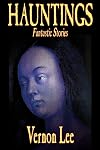
Hauntings is a collection of supernatural short-stories that remains on the threshold between the fantastic and the psychological. Perhaps ghosts and strange forces do exist here, but they’re always invited by the obsession, hatred and passion of the living.
In the first story, Amour Dure, a historian researching Medieval Italy falls in love with the portrait of a Machiavellian woman and becomes the means to carry on a centuries-old revenge. In Dionea, a mysterious little girl cast ashore show more is taken in by Catholic nuns, but her pagan ways prevent her from adjusting. The longest story, Oke of Okehurst, concerns a woman whose obsession for family history brings about a tragedy. In the final story, A Wicked Voice, a musician scoffs at an 18th century singer who may have made a deal with the Devil to receive his talent, and starts hearing his voice wherever he goes.
The role of women and the danger of the past are recurrent motifs in these stories: in Amour Dure, we read the life story of one Medea da Carpi, a schemer who tried to kill her way to power and sacrificed her lovers one by one to get it. In The Wicked Voice the protagonist takes us to the music of the 18th century; apart from the unusual idea of haunting someone through a ghost voice, this story seemed the weakest one to me.
In Dionea, the most mysterious story in the collection, a little girl, who may or may not be Venus, comes up from the sea (like in Botticelli’s painting) and declares that one day will “get back to the sea”, and infects everyone with mad love. This story reminded me a bit of Machen’s The Great God Pan, in that the modern world comes in contact with old pagan myths and forces.
My favorite, Oke of Okehurst: or the Phantom Lover, belongs in the tradition of psychological ghost stories like The Turn of the Screw. William Oke keeps seeing his wife, Alice, with a lover, although no one else can see him. Alice may be possessed by the spirit of an ancient relative, also named Alice, who had an affair with a poet before he died in mysterious circumstances. On the other hand Alice may just love her family’s history and maybe she dresses up like her ancestor just to annoy William. In this story reality isn’t as importance as its perception, and how It affects peoples’ actions.
I’d had never read Vernon Lee (pseudonym of Violet Paget) before, and her style impressed me for its clarity, ability to blur the line between reality and fantasy, and the sense of mystery her stories maintain until the end. Although her stories are couched in the Victorian/Edwardian tradition, I think she’ll be able to surprise anyone who gives her a try. show less
In the first story, Amour Dure, a historian researching Medieval Italy falls in love with the portrait of a Machiavellian woman and becomes the means to carry on a centuries-old revenge. In Dionea, a mysterious little girl cast ashore show more is taken in by Catholic nuns, but her pagan ways prevent her from adjusting. The longest story, Oke of Okehurst, concerns a woman whose obsession for family history brings about a tragedy. In the final story, A Wicked Voice, a musician scoffs at an 18th century singer who may have made a deal with the Devil to receive his talent, and starts hearing his voice wherever he goes.
The role of women and the danger of the past are recurrent motifs in these stories: in Amour Dure, we read the life story of one Medea da Carpi, a schemer who tried to kill her way to power and sacrificed her lovers one by one to get it. In The Wicked Voice the protagonist takes us to the music of the 18th century; apart from the unusual idea of haunting someone through a ghost voice, this story seemed the weakest one to me.
In Dionea, the most mysterious story in the collection, a little girl, who may or may not be Venus, comes up from the sea (like in Botticelli’s painting) and declares that one day will “get back to the sea”, and infects everyone with mad love. This story reminded me a bit of Machen’s The Great God Pan, in that the modern world comes in contact with old pagan myths and forces.
My favorite, Oke of Okehurst: or the Phantom Lover, belongs in the tradition of psychological ghost stories like The Turn of the Screw. William Oke keeps seeing his wife, Alice, with a lover, although no one else can see him. Alice may be possessed by the spirit of an ancient relative, also named Alice, who had an affair with a poet before he died in mysterious circumstances. On the other hand Alice may just love her family’s history and maybe she dresses up like her ancestor just to annoy William. In this story reality isn’t as importance as its perception, and how It affects peoples’ actions.
I’d had never read Vernon Lee (pseudonym of Violet Paget) before, and her style impressed me for its clarity, ability to blur the line between reality and fantasy, and the sense of mystery her stories maintain until the end. Although her stories are couched in the Victorian/Edwardian tradition, I think she’ll be able to surprise anyone who gives her a try. show less
Lists
You May Also Like


Associated Authors
Statistics
- Works
- 94
- Also by
- 48
- Members
- 929
- Popularity
- #27,632
- Rating
- 3.9
- Reviews
- 13
- ISBNs
- 220
- Languages
- 9
- Favorited
- 13