
Bruce Hoffman
Author of Inside Terrorism
About the Author
Bruce Hoffman is a professor in Georgetown University's Walsh School of Foreign Service and the director of the Center for Security Studies and the Security Studies Program. He is also a senior fellow at the U.S. Military Academy's Combating Terrorism Center and a visiting professor of terrorism show more studies at St. Andrews University. Hoffman is the editor of the Columbia University Press series Columbia Studies in Terrorism and Irregular Warfare, coeditor of The Evolution of the Global Terrorist Threat: From 9/11 to Osama bin Laden's Death, and author of Anonymous Soldiers: The Struggle for Israel, 1917-1947. show less
Image credit: Bruce Hoffman [credit: Georgetown University]
Works by Bruce Hoffman
Moles, defectors, and deceptions : James Angleton and his influence on US counterintelligence (2014) 4 copies
The 7/7 London Underground Bombing : A Selection from The Evolution of the Global Terrorist Threat: From 9/11 to Osama bin Laden's Death (2014) 2 copies
The victims of terrorism an assessment of their influence and growing role in policy, legislation, and the private sector (2007) 2 copies
Lessons for Contemporary Counterinsurgencies: The Rhodesian Experience/R-3998-A (Rand Report) (1991) 1 copy
Associated Works
Tagged
Common Knowledge
- Canonical name
- Hoffman, Bruce
- Other names
- Hoffman, Bruce R.
- Birthdate
- 1954-07-17
- Gender
- male
- Education
- Connecticut College (BA|Government, History)
University of Oxford (BPhil, PhD|International Relations) - Occupations
- international relations professor
security studies professor
editor - Organizations
- Georgetown University
Edmund A. Walsh School of Foreign Service
RAND Corporation
University of St Andrews
National Security Preparedness Group
Woodrow Wilson International Center for Scholars (show all 11)
U.S. Military Academy, West Point
Human Rights Watch
Jamestown Foundation
FBI Intelligence Analysts Association
Centre for the Study of Terrorism and Political Violence - Awards and honors
- Intelligence Community Seal Medallion (1994)
- Nationality
- USA
- Associated Place (for map)
- USA
Members
Reviews
God, Guns, and Sedition: Far-Right Terrorism in America (A Council on Foreign Relations Book) by Bruce Hoffman
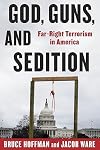
God, Guns, and Sedition is a comprehensive history of the rise of right-wing extremism over the past forty years. You should read this book if you are wondering how we got to where we are today and January 6th. The authors do an excellent job (and their notes are exhaustive) of activities, individuals, and actions that have contributed to a place where we are now wondering if our Democracy ends with this next election.
One of the main themes throughout the book is using the book The Turner show more Diaries as a playbook. If you aren't familiar with The Turner Diaries--it is a screed that describes a fictional race war in America and the use of accelerationism. Accelerationism is a Marxist strategy of revolution and is being used by white supremacists. They want to hasten the destruction of Western civilization. It is dangerous because they believe one act of mass violence perpetuated by one person can bring this about.
Timothy McVeigh is a good example of someone who bought into the plan of the Turner Diaries--he used to float around gun shows selling the book, and he used many sections in the book to plan his Oklahoma City bombing.
The book outlines incidents from Ruby Ridge to Waco to Oklahoma City and how things quieted down in the country after 9/11 because our focus was on international terrorism, which then came roaring back as the far-right groups began using social media and the Internet to recruit others. The book then outlines later lone-wolf mass shootings and terrorist incidents over the past few decades and how they play into the larger picture of accelerationism.
The scariest thing I found in this book was the recruitment of our military into white supremacy groups. Or no, maybe the scariest thing is to see how Trump has fueled and made white supremacy groups mainstream or normalized. I don't know. This book scared me, but I think I needed to be scared.
The last chapter outlines policy changes needed to combat extremism, and I hope it isn't too late. I leave you with a quote from Ronald Regan that they included at the front of the last chapter:
Freedom is a fragile thing and it's never more than one generation away from extinction. It is not ours by way of inheritance; it must be fought for and defended constantly by each generation, for it comes only once to people. And those in world history who have known freedom and then lost it have never known it again. Ronald Reagan, January 5, 1967
Other recommendations on related topics:
The Kingdom, The Power, and the Glory by Tim Alberta
American Whitelash by Wesley Lowery
Homegrown: Timothy McVeigh and the Rise of Right-Wing Extremism by Jeffrey Toobin show less
One of the main themes throughout the book is using the book The Turner show more Diaries as a playbook. If you aren't familiar with The Turner Diaries--it is a screed that describes a fictional race war in America and the use of accelerationism. Accelerationism is a Marxist strategy of revolution and is being used by white supremacists. They want to hasten the destruction of Western civilization. It is dangerous because they believe one act of mass violence perpetuated by one person can bring this about.
Timothy McVeigh is a good example of someone who bought into the plan of the Turner Diaries--he used to float around gun shows selling the book, and he used many sections in the book to plan his Oklahoma City bombing.
The book outlines incidents from Ruby Ridge to Waco to Oklahoma City and how things quieted down in the country after 9/11 because our focus was on international terrorism, which then came roaring back as the far-right groups began using social media and the Internet to recruit others. The book then outlines later lone-wolf mass shootings and terrorist incidents over the past few decades and how they play into the larger picture of accelerationism.
The scariest thing I found in this book was the recruitment of our military into white supremacy groups. Or no, maybe the scariest thing is to see how Trump has fueled and made white supremacy groups mainstream or normalized. I don't know. This book scared me, but I think I needed to be scared.
The last chapter outlines policy changes needed to combat extremism, and I hope it isn't too late. I leave you with a quote from Ronald Regan that they included at the front of the last chapter:
Freedom is a fragile thing and it's never more than one generation away from extinction. It is not ours by way of inheritance; it must be fought for and defended constantly by each generation, for it comes only once to people. And those in world history who have known freedom and then lost it have never known it again. Ronald Reagan, January 5, 1967
Other recommendations on related topics:
The Kingdom, The Power, and the Glory by Tim Alberta
American Whitelash by Wesley Lowery
Homegrown: Timothy McVeigh and the Rise of Right-Wing Extremism by Jeffrey Toobin show less
God, Guns, and Sedition: Far-Right Terrorism in America (A Council on Foreign Relations Book) by Bruce Hoffman
God, Guns, and Sedition by Bruce Hoffman and Jacob Ware is a very accessible look at the history of far-right terrorism with some difficult but very workable solutions to inhibit current and future extreme domestic terrorism no matter where on the political spectrum it comes from.
As a look back this gives the reader a better understanding that what is happening is not something that only just sprouted. This is valuable because too many of us present "solutions" that treat it as a "because of show more Trump" problem or a "reaction to Obama" problem. These two things are simply the more recent catalysts for far-right terrorism to come back into prominence. And while our current technology certainly contributes to making this a potent threat to democracy, and even just peace, social media is again just a more recent element of a long-simmering issue.
What I especially found appealing was the chapter that offered ideas on solving our current problems while laying the foundation to minimize the opportunities for future extremism to radicalize so many people to violence. I am often skeptical, both because of my support of free speech and because many proposed solutions don't seem workable, of solutions in the books I've read on the topic. Hoffman and Ware make suggestions that try to balance the very freedoms we want to keep at the core of our democracy while reigning in the blatant abuse of those rights and freedoms. They also present these ideas with enough detail to see how they would work while also admitting that coming up with specific policies and laws will take negotiation and debate. In other words, rather than present quick fixes that aren't practical they present a framework (short-, mid-, and long-range policies) within which we must get our legislators (as well as private and nonprofit groups) begin to act.
I would recommend this to anyone, no matter where you are on the political spectrum (unless, of course, you prefer authoritarianism to democracy), who wants to not only maintain but improve our democracy in the United States. The writing, while detailed and fully documented, is accessible and actually very engaging (considering the topic).
Reviewed from a copy made available by the publisher via NetGalley. show less
As a look back this gives the reader a better understanding that what is happening is not something that only just sprouted. This is valuable because too many of us present "solutions" that treat it as a "because of show more Trump" problem or a "reaction to Obama" problem. These two things are simply the more recent catalysts for far-right terrorism to come back into prominence. And while our current technology certainly contributes to making this a potent threat to democracy, and even just peace, social media is again just a more recent element of a long-simmering issue.
What I especially found appealing was the chapter that offered ideas on solving our current problems while laying the foundation to minimize the opportunities for future extremism to radicalize so many people to violence. I am often skeptical, both because of my support of free speech and because many proposed solutions don't seem workable, of solutions in the books I've read on the topic. Hoffman and Ware make suggestions that try to balance the very freedoms we want to keep at the core of our democracy while reigning in the blatant abuse of those rights and freedoms. They also present these ideas with enough detail to see how they would work while also admitting that coming up with specific policies and laws will take negotiation and debate. In other words, rather than present quick fixes that aren't practical they present a framework (short-, mid-, and long-range policies) within which we must get our legislators (as well as private and nonprofit groups) begin to act.
I would recommend this to anyone, no matter where you are on the political spectrum (unless, of course, you prefer authoritarianism to democracy), who wants to not only maintain but improve our democracy in the United States. The writing, while detailed and fully documented, is accessible and actually very engaging (considering the topic).
Reviewed from a copy made available by the publisher via NetGalley. show less

Terror today is endless. However in the period of the 1930s and 1940s, a small number of committed individuals sought to achieve a specific goal: an independent Israel and an end to British rule under its League of Nations mandate. Actual terrorists were but a fraction of the total Jewish population of Mandate Palestine but they caused so much of a threat that by the mid-1940s the UK had stationed 100,000 troops in the nation, hid behind barbed wire and concrete fortifications, and created a show more Guantanamo-style prison in Kenya and Eritrea where suspected and actual terrorists could be held indefinitely without trial or appeal. At the end of WWII, for a period of time, Britain sought to maintain its pre-war hegemony and empire. But it was too exhausted fiscally and politically and the aim of using Palestine as a base by which India could be safer was a pipe dream--given the Indian thrust for independence. In the U.S., many people sympathized with the Israeli terrorists, and full-page fundraising letters (published in leading newspapers) were written by such famous individuals as Ben Hecht. Truman sought to push the British toward partition as well by supporting the immediate entry to Israel of 100,000 Holocaust survivors caught in European displaced persons camps. Britain, like the U.S. in Vietnam, was a pitiful helpless giant and here are the cables, correspondence, and insights that powered a successful terror campaign and the failed attempts to stop it. Probably a definitive work. show less
Case study of when terrorism works by the Director of the center for Security Studies and a Fellow at the U.S. Military Academy's Combating Terrorism Center. The successful campaign that founded Israel became a model for others seeking independence from colonial rule, including Algeria.
Lists
Awards


You May Also Like


Associated Authors
Statistics
- Works
- 21
- Also by
- 1
- Members
- 674
- Popularity
- #37,467
- Rating
- 3.8
- Reviews
- 7
- ISBNs
- 58
- Languages
- 4
- Favorited
- 1
