
David Conyers
Author of Secrets of Kenya: The Mythos Roams Wild
Works by David Conyers
Undead & Unbound: Unexpected Tales From Beyond the Grave (Chaosium Fiction) (2013) — Editor; Contributor — 16 copies
Extreme Planets: A Science Fiction Anthology of Alien Worlds (Chaosium fiction) (2014) — Editor — 15 copies, 1 review
Soft Viscosity 2 copies
Aftermath 2 copies
Cthulhu Afrikus 2 copies
As Above, So Below 1 copy
The Eye of Infinity 1 copy
Red Eye of Azathoth 1 copy
Subtle Invasion 1 copy
The colony 1 copy
The Swelling 1 copy
Associated Works
Hardboiled Cthulhu: Two-Fisted Tales of Tentacled Terror (2006) — Contributor — 89 copies, 4 reviews
World War Cthulhu: A Collection of Lovecraftian War Stories (2014) — Contributor — 73 copies, 4 reviews
Eldritch Chrome: Unquiet Tales of a Mythos-Haunted Future (Chaosium Fiction) (2013) — Contributor — 22 copies, 1 review
Australian Dark Fantasy & Horror: The Year's Best Short Stories Volume Three (2009) — Contributor — 7 copies
Tagged
Common Knowledge
- Birthdate
- 1971-05-30
- Gender
- male
- Education
- University of Melbourne
- Occupations
- marketing
author
editor - Nationality
- Australia
- Birthplace
- Sydney, New South Wales, Australia
- Places of residence
- Adelaide, South Australia, Australia
Melbourne, Victoria, Australia - Associated Place (for map)
- Australia
Members
Reviews
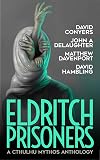
One character in this book says, “Questions are a burden, answers are a prison”.
After finishing it, making notes, skimming parts of it again, I still feel somewhat burdened and not totally imprisoned.
Whether it’s my deficiencies as a reader or because it’s a deliberately and resolutely mysterious work, I’m not sure I completely understood what happened.
However, I can unreservedly recommend three of its four stories.
Having always meant to return to David Conyers’ Harrison Peel show more series after reading “The Eye of Infinity”, I was pleased to see Peel show up in Conyers’ “Broken Singularity”. It’s the oddity here, broken up into four parts, starting and ending the book and in between the stories, and often casting some dim light on their events.
Peel awakens naked from a pod to join three other people. There’s a drill-instructor like voice yelling them to get into their spacesuits and get working or the oxygen privileges will end. The work is to explore an airless planetoid and bring back information. None of the four can remember how they got there. Peel may be the primitive one here since the rest are posthumans, but his military training kicks in, and he takes command while the rest dawdle. Not that the party lasts long after seeing the oddity of a Humvee on the surface. Approaching it, it morphs, launches weapons, and reduces two of the party to cubes of their constituent chemical components.
Debriefed on the mission, he meets a woman who seems familiar. Well, part of her: a disembodied head and arm. She hints that maybe he should check out the connections on the pod he emerged from.
Peel does and wakens again, this time with memories of his last mission. The same can not be said of the survivor of the last mission who also wakes along with two strangers. Another slaughter occurs, but Peel manages to find a strange, singularity-like object under the surface of the world, and the reason for this strange prison world begin to be revealed.
I’ve been lukewarm towards Matthew Davenport’s Andrew Dolan series, but I liked “The Prisoner from Beyond”, probably because it’s a weird western and not Indiana Jones crossed with the Cthulhu Mythos. Narrator Hiram Cartwright is a member of the Esoteric Cavalry founded in 1841 by President Martin van Buren to combat menaces “not of this world”. Cartwright fought in the American Civil War which saw both sides using magic to a limited extent which devastated the Cavalry. Now Hiram is charged with patrolling the empty lands of western America (the story is set in Nebraska Territory) and recruiting people including his older brother Buford. They are dispatched to Barrenstand to investigate the outbreak of a seemingly unearthly plague tied to a fog that appears every night.
The citizens are suffering from visions of “worms” that appear in the air. But they are real enough to bite people, and the citizens also suffer from bad dreams. Eventually, the brothers track down a wizard in town who has been making some experiments with “essential salts” and hybrid creatures. Gunplay, explosions, and magic ensue.
I liked how the brothers are marked by their war experiences and how they are surprisingly reluctant to cut loose with their revolvers.
It’s a return to David Hambling’s Stubbsverse with “The Body Snatchers” in which Harry Stubbs not only gets to show off his talents as a boxer but also as a logician and empathetic negotiator. It not only has some passing links to previous Stubbs’ stories but mentions some characters from Hambling’s The Dulwich Horror and Other Stories.
Stubbs is approached by an acquaintance, Smith, on a delicate matter. Smith is still working at the local mental asylum, a job he took up to aid Stubbs in Master of Chaos. A recent patient brought in by the police is a man who claims to be a carpenter named Edward Haywood. Their due diligence put an end to his claims. None of his roommates recognized him though there was that strange bit where he denounced someone with them as an imposter. The strange thing is that a man named Haywood was employed by Smith’s girlfriend at her pub, and the putative Haywood knows all the details of that acquaintance.
Transfers of mind are just the sort of thing that one Dr. Estelle de Vere, a psychologist with visiting privileges at the asylum, would be interested in. And you really don’t want to draw de Vere’s attention or that of her fearsome TDS organization. Determined to stamp out offworld intrusions on Earth, their operational policy is a dead-men-tell-no-tales one. All of which puts Stubbs in a rather precarious position because TDS is his real “employer” under decidedly coercive terms. So, Smith and Stubbs want this whole matter resolved before de Vere gets wind of it.
Stubbs investigation will lead him to encounter a reputed occult master and his menacing German student, an astrologer conman, and a menacing doctor and her very burly assistant and reaches a climax in the West Norwood Cemetery. It’s another winning combination of Stubbs’ simple and clear narration, occult history, and intrigue. I particularly liked Stubb’s reverie on the boxing greats buried in the cemetery.
If the archetypal Lovecraft story is somebody delving into the occult or their family genealogy, the previous three stories deviate from that. Davenport’s is a straight-up occult-tinged adventure story. Conyers’ is a military-tinged story that sees the Cthulhu “deities” in terms of forces from advanced physics. Hambling’s is an intricate mystery mixing history and the occult.
But John DeLaughter’s “Leng’s Labyrinth” does use that template – at first. Then it becomes, rather like his “The Terror Out of Time”, a corporate-military espionage story involving what you might term the Deepest State. At this point, the astute Lovecraft fan will know which of his tales other stories in this book draw from. DeLaughter’s debt is to Lovecraft’s “The Rats in the Walls” given the narrator is one Francois Luc DeLapont, a member of the same family featured in that story.
He’s a foreign exchange from Massachusetts studying in France. One Hallow’s Eve, he and a friend decide to walk the Labyrinth in Chartres Cathedral. Said friend gets ripped apart by figures emerging from the shadows, and Francois flees. A genealogical report reveals to him the sordid past of his ancestors and extended family. Weird dreams drive him to a Jungian Institute and a session in an isolation tank.
And there the plot thickens – and I had a couple of problems. The narration shifts from first person to some parts in third person. Now, this can work, but it was jarring, and I don’t think DeLaughter quite pulled it off after spending so long with Francois.
Francois finds himself kidnapped to work on a secret government project – allegedly seeking extraterrestrial life via remote viewing – in a complex near K2. And here I had my second problem with one action scene going on longer than needed to provide the tie into a bit from Conyers’ story. (Though I found the training and indoctrination for Francois’ new job a bit amusing.)
The ending was a puzzle too.
I’m not sure what to make of this story, but, despite the above problems, I still liked it.
But then I’m still not quite clear about everything in the anthology or the anthology’s overarching plot. But fans of the Mythos, especially of the more puzzling sort of story, should like this one. show less
After finishing it, making notes, skimming parts of it again, I still feel somewhat burdened and not totally imprisoned.
Whether it’s my deficiencies as a reader or because it’s a deliberately and resolutely mysterious work, I’m not sure I completely understood what happened.
However, I can unreservedly recommend three of its four stories.
Having always meant to return to David Conyers’ Harrison Peel show more series after reading “The Eye of Infinity”, I was pleased to see Peel show up in Conyers’ “Broken Singularity”. It’s the oddity here, broken up into four parts, starting and ending the book and in between the stories, and often casting some dim light on their events.
Peel awakens naked from a pod to join three other people. There’s a drill-instructor like voice yelling them to get into their spacesuits and get working or the oxygen privileges will end. The work is to explore an airless planetoid and bring back information. None of the four can remember how they got there. Peel may be the primitive one here since the rest are posthumans, but his military training kicks in, and he takes command while the rest dawdle. Not that the party lasts long after seeing the oddity of a Humvee on the surface. Approaching it, it morphs, launches weapons, and reduces two of the party to cubes of their constituent chemical components.
Debriefed on the mission, he meets a woman who seems familiar. Well, part of her: a disembodied head and arm. She hints that maybe he should check out the connections on the pod he emerged from.
Peel does and wakens again, this time with memories of his last mission. The same can not be said of the survivor of the last mission who also wakes along with two strangers. Another slaughter occurs, but Peel manages to find a strange, singularity-like object under the surface of the world, and the reason for this strange prison world begin to be revealed.
I’ve been lukewarm towards Matthew Davenport’s Andrew Dolan series, but I liked “The Prisoner from Beyond”, probably because it’s a weird western and not Indiana Jones crossed with the Cthulhu Mythos. Narrator Hiram Cartwright is a member of the Esoteric Cavalry founded in 1841 by President Martin van Buren to combat menaces “not of this world”. Cartwright fought in the American Civil War which saw both sides using magic to a limited extent which devastated the Cavalry. Now Hiram is charged with patrolling the empty lands of western America (the story is set in Nebraska Territory) and recruiting people including his older brother Buford. They are dispatched to Barrenstand to investigate the outbreak of a seemingly unearthly plague tied to a fog that appears every night.
The citizens are suffering from visions of “worms” that appear in the air. But they are real enough to bite people, and the citizens also suffer from bad dreams. Eventually, the brothers track down a wizard in town who has been making some experiments with “essential salts” and hybrid creatures. Gunplay, explosions, and magic ensue.
I liked how the brothers are marked by their war experiences and how they are surprisingly reluctant to cut loose with their revolvers.
It’s a return to David Hambling’s Stubbsverse with “The Body Snatchers” in which Harry Stubbs not only gets to show off his talents as a boxer but also as a logician and empathetic negotiator. It not only has some passing links to previous Stubbs’ stories but mentions some characters from Hambling’s The Dulwich Horror and Other Stories.
Stubbs is approached by an acquaintance, Smith, on a delicate matter. Smith is still working at the local mental asylum, a job he took up to aid Stubbs in Master of Chaos. A recent patient brought in by the police is a man who claims to be a carpenter named Edward Haywood. Their due diligence put an end to his claims. None of his roommates recognized him though there was that strange bit where he denounced someone with them as an imposter. The strange thing is that a man named Haywood was employed by Smith’s girlfriend at her pub, and the putative Haywood knows all the details of that acquaintance.
Transfers of mind are just the sort of thing that one Dr. Estelle de Vere, a psychologist with visiting privileges at the asylum, would be interested in. And you really don’t want to draw de Vere’s attention or that of her fearsome TDS organization. Determined to stamp out offworld intrusions on Earth, their operational policy is a dead-men-tell-no-tales one. All of which puts Stubbs in a rather precarious position because TDS is his real “employer” under decidedly coercive terms. So, Smith and Stubbs want this whole matter resolved before de Vere gets wind of it.
Stubbs investigation will lead him to encounter a reputed occult master and his menacing German student, an astrologer conman, and a menacing doctor and her very burly assistant and reaches a climax in the West Norwood Cemetery. It’s another winning combination of Stubbs’ simple and clear narration, occult history, and intrigue. I particularly liked Stubb’s reverie on the boxing greats buried in the cemetery.
If the archetypal Lovecraft story is somebody delving into the occult or their family genealogy, the previous three stories deviate from that. Davenport’s is a straight-up occult-tinged adventure story. Conyers’ is a military-tinged story that sees the Cthulhu “deities” in terms of forces from advanced physics. Hambling’s is an intricate mystery mixing history and the occult.
But John DeLaughter’s “Leng’s Labyrinth” does use that template – at first. Then it becomes, rather like his “The Terror Out of Time”, a corporate-military espionage story involving what you might term the Deepest State. At this point, the astute Lovecraft fan will know which of his tales other stories in this book draw from. DeLaughter’s debt is to Lovecraft’s “The Rats in the Walls” given the narrator is one Francois Luc DeLapont, a member of the same family featured in that story.
He’s a foreign exchange from Massachusetts studying in France. One Hallow’s Eve, he and a friend decide to walk the Labyrinth in Chartres Cathedral. Said friend gets ripped apart by figures emerging from the shadows, and Francois flees. A genealogical report reveals to him the sordid past of his ancestors and extended family. Weird dreams drive him to a Jungian Institute and a session in an isolation tank.
And there the plot thickens – and I had a couple of problems. The narration shifts from first person to some parts in third person. Now, this can work, but it was jarring, and I don’t think DeLaughter quite pulled it off after spending so long with Francois.
Francois finds himself kidnapped to work on a secret government project – allegedly seeking extraterrestrial life via remote viewing – in a complex near K2. And here I had my second problem with one action scene going on longer than needed to provide the tie into a bit from Conyers’ story. (Though I found the training and indoctrination for Francois’ new job a bit amusing.)
The ending was a puzzle too.
I’m not sure what to make of this story, but, despite the above problems, I still liked it.
But then I’m still not quite clear about everything in the anthology or the anthology’s overarching plot. But fans of the Mythos, especially of the more puzzling sort of story, should like this one. show less

More than most of the Chaosium "Call of Cthulhu Fiction" volumes I've read, this one is tied down to the pulp-era setting of the Call of Cthulhu role-playing game. The tales share a common emphasis on the presence of cults dedicated to the praeternatural entities of Yog-Sothothery. There is a fair amount of variety among the contributions, and some of them are genuinely disturbing.
Many of these stories use ethnicity and "race" as a distinction in order to foster fear by "othering" the show more cultists. Every central protagonist, without exception, is white (although there are a couple of darker-hued sidekicks), and villainous cults include Arabs, Chinese, tribal Africans, etc. As if uneasy with this feature himself, editor David Conyers makes an apology for it in his foreword, mentioning that it follows from the culture of the period in which the stories are set. Still, the argument falls flat with me. To recognize and illustrate the racism of the period does not mean that fantasy horror narratives need to validate it in the way that these do.
My favorite story in the book, which did not partake of this particular fault, was Penelope Love's "The Whisperer of Ancient Secrets." Conyers supplies the final story of the volume, in which he explicitly ties together most of others into a single continuity. I was impressed with how artfully he pulled that off. show less
Many of these stories use ethnicity and "race" as a distinction in order to foster fear by "othering" the show more cultists. Every central protagonist, without exception, is white (although there are a couple of darker-hued sidekicks), and villainous cults include Arabs, Chinese, tribal Africans, etc. As if uneasy with this feature himself, editor David Conyers makes an apology for it in his foreword, mentioning that it follows from the culture of the period in which the stories are set. Still, the argument falls flat with me. To recognize and illustrate the racism of the period does not mean that fantasy horror narratives need to validate it in the way that these do.
My favorite story in the book, which did not partake of this particular fault, was Penelope Love's "The Whisperer of Ancient Secrets." Conyers supplies the final story of the volume, in which he explicitly ties together most of others into a single continuity. I was impressed with how artfully he pulled that off. show less
Do we really need another anthology of Cthulhu mythos stories? Haven’t we seen all the possible permutations of Lovecraft’s ideas? The four authors of the novellas included in this new anthology would argue that there’s still room for more great stories about the Cthulhu mythos, and I would agree. Like the first two CTHULHU UNBOUND collections from Permuted Press, this third volume features “cross-genre” stories in which Lovecraftian horror is mixed with other genres to produce show more entirely new amalgams. In the case of the four novellas included here, we have Lovecraft mixed with a western, present-day psychological weirdness, a gritty prison drama, and a technothriller.
The four novellas included in this collection are:
* UNSEEN EMPIRE by Cody Goodfellow
* MIRRORRORRIM by D.L. Snell
* NEMESIS THEORY by Tim Curran
* THE R’LYEH SINGULARITY by David Conyers and Brian M. Sammons (who also serve as the collection’s editors)
Mild plot spoilers for each of the stories follow.
UNSEEN EMPIRE: Cody Goodfellow has blended the Cthulhu Mythos with a classic Western in this tale of a half-Commanche bounty hunter (who also appears in the chapbook “Black Wind” by Perilous Press) who runs afoul of something terrible as he searches for some people missing from an Indian reservation. It’s got monsters, a lost underground city from an ancient civilization, and the Oklahoma badlands. What more could you want? Goodfellow does such a good job with that one that I enjoyed it immensely, despite not even particularly liking some Western tropes.
MIRRORRORRIM: Snell has given us a story about the only male member of a therapy group for self-mutilators who soon realizes that the other members of the group – and perhaps even himself – are far more than they initially appear. The story is reminiscent of both the New Weird fiction and an old David Cronenberg movie, especially since it focuses heavily on body horror. I personally found MIRRORRORRIM to be the least successful of the four novellas – though I did enjoy it and found it satisfyingly creepy in a number of places – because I tend not to prefer stories that rely on horrifying weirdness where it’s not entirely clear exactly what’s going on. Deliberate obfuscation by an author can work, it’s just not my preferred mode of storytelling. Your mileage may vary.
NEMESIS THEORY: Tim Curran has pulled off a masterstroke with this Lovecraftian tale set inside a maximum security prison. One of the inmates, a former leader of a Jonestown-like suicide cult, manages to unsettle even these hardened criminals, then all hell truly breaks loose. Curran provides a great look at what might happen when “the stars are right.” Hint: it’s horrifying almost beyond imagination. I was initially a little skeptical of the premise of NEMESIS THEORY because I was unsure that the panoptical setting of a maximum-security prison would allow enough room for an author to tell a satisfying horror story. But then again, any tale involving something living beyond the outer reaches of our solar system described as the “Million Malignant Minds” has GOT to be good, doesn’t it? This was easily my favorite story in the collection.
THE R’LYEH SINGULARITY: Two international men of mystery who routinely deal with supernatural- and espionage-related matters for a variety of intelligence services fight to stop a global catastrophe in the making: a multinational corporation has begun a deep-sea drilling expedition that appears to be waking the sleeping dreamer Cthulhu in R’lyeh. Massive earthquakes and tsunamis affecting the entire Pacific basin have already started and things are only getting worse. One of the two men is Hamilton Peel, a former Australian military intelligence officer who also appears in the collection “The Spiraling Worm” and the chapbook “The Eye of Infinity” by David Conyers. I should note that, just as with the previous Peel tales, THE R'LYEH SINGULARITY is a tie-in with the Delta Green series of novels, stories, and role-playing game books put out by Pagan Press about confrontations between government agencies and Cthulhu set in the modern day. If you like Charles Stross’ “A Colder War” and series beginning with THE ATROCITY ARCHIVES, you’ll already have a sense of what Cthulhu mixed with modern-day techno-thrillers looks like.
All in all, I highly recommend CTHULHU UNBOUND 3: it’s a great collection of recent novellas that blend traditional Lovecraftian themes with other genres. I think that if you’re not already a fan of the larger Cthulhu Mythos you wouldn’t get quite as much out of most of these stories (MIRRORRORRIM is one exception to that, it isn’t closely tied in with Lovecraft’s work). If you like the Cthulhu Mythos – unless you’re staunchly opposed to Lovecraft’s ideas being blended with other genres – I think you’ll find a lot to like in this collection.
Review copyright © 2013 J. Andrew Byers show less
The four novellas included in this collection are:
* UNSEEN EMPIRE by Cody Goodfellow
* MIRRORRORRIM by D.L. Snell
* NEMESIS THEORY by Tim Curran
* THE R’LYEH SINGULARITY by David Conyers and Brian M. Sammons (who also serve as the collection’s editors)
Mild plot spoilers for each of the stories follow.
UNSEEN EMPIRE: Cody Goodfellow has blended the Cthulhu Mythos with a classic Western in this tale of a half-Commanche bounty hunter (who also appears in the chapbook “Black Wind” by Perilous Press) who runs afoul of something terrible as he searches for some people missing from an Indian reservation. It’s got monsters, a lost underground city from an ancient civilization, and the Oklahoma badlands. What more could you want? Goodfellow does such a good job with that one that I enjoyed it immensely, despite not even particularly liking some Western tropes.
MIRRORRORRIM: Snell has given us a story about the only male member of a therapy group for self-mutilators who soon realizes that the other members of the group – and perhaps even himself – are far more than they initially appear. The story is reminiscent of both the New Weird fiction and an old David Cronenberg movie, especially since it focuses heavily on body horror. I personally found MIRRORRORRIM to be the least successful of the four novellas – though I did enjoy it and found it satisfyingly creepy in a number of places – because I tend not to prefer stories that rely on horrifying weirdness where it’s not entirely clear exactly what’s going on. Deliberate obfuscation by an author can work, it’s just not my preferred mode of storytelling. Your mileage may vary.
NEMESIS THEORY: Tim Curran has pulled off a masterstroke with this Lovecraftian tale set inside a maximum security prison. One of the inmates, a former leader of a Jonestown-like suicide cult, manages to unsettle even these hardened criminals, then all hell truly breaks loose. Curran provides a great look at what might happen when “the stars are right.” Hint: it’s horrifying almost beyond imagination. I was initially a little skeptical of the premise of NEMESIS THEORY because I was unsure that the panoptical setting of a maximum-security prison would allow enough room for an author to tell a satisfying horror story. But then again, any tale involving something living beyond the outer reaches of our solar system described as the “Million Malignant Minds” has GOT to be good, doesn’t it? This was easily my favorite story in the collection.
THE R’LYEH SINGULARITY: Two international men of mystery who routinely deal with supernatural- and espionage-related matters for a variety of intelligence services fight to stop a global catastrophe in the making: a multinational corporation has begun a deep-sea drilling expedition that appears to be waking the sleeping dreamer Cthulhu in R’lyeh. Massive earthquakes and tsunamis affecting the entire Pacific basin have already started and things are only getting worse. One of the two men is Hamilton Peel, a former Australian military intelligence officer who also appears in the collection “The Spiraling Worm” and the chapbook “The Eye of Infinity” by David Conyers. I should note that, just as with the previous Peel tales, THE R'LYEH SINGULARITY is a tie-in with the Delta Green series of novels, stories, and role-playing game books put out by Pagan Press about confrontations between government agencies and Cthulhu set in the modern day. If you like Charles Stross’ “A Colder War” and series beginning with THE ATROCITY ARCHIVES, you’ll already have a sense of what Cthulhu mixed with modern-day techno-thrillers looks like.
All in all, I highly recommend CTHULHU UNBOUND 3: it’s a great collection of recent novellas that blend traditional Lovecraftian themes with other genres. I think that if you’re not already a fan of the larger Cthulhu Mythos you wouldn’t get quite as much out of most of these stories (MIRRORRORRIM is one exception to that, it isn’t closely tied in with Lovecraft’s work). If you like the Cthulhu Mythos – unless you’re staunchly opposed to Lovecraft’s ideas being blended with other genres – I think you’ll find a lot to like in this collection.
Review copyright © 2013 J. Andrew Byers show less
This one feels more self-indulgent and less comprehensible. Read soon after Freeze Frame, or not at all. It does very little hand-holding from the prior book (do I even remember the conspirators?) and the scenery is entirely astronomical imaginings. If Freeze Frame felt too hard sci-fi, this is the diamond sci-fi version.
https://clarkesworldmagazine.com/watts_09_14_reprint/
A truly non-spoilery example of the indulgent writing, put under spoilers for brevity:
Not this time. This time we’re just another one of Hakim’s holiday ornaments, dangling from a thread in a hurricane. According to the Chimp, that thread should hold. There are error bars, though, and not a lot of empirical observation to hang them on. The database on singularities nested inside asteroids nested inside incinerating ice giants is pretty heavy on the handwaving.
And that’s just the problem within the problem. Atmospheric docking with a world falling at two hundred kilometers a second is downright trivial next to predicting Thule’s course inside the star: the drag inflicted by a millionth of a red-hot gram per cubic centimeter, stellar winds and thermohaline mixing, the deep magnetic torque of fossil helium. It’s tough enough figuring out what “inside” even means when the gradient from vacuum to degenerate matter blurs across three million kilometers. Depending on your definition we might already be in the damn thing.
Merged review:
This one feels more self-indulgent and less comprehensible. Read soon after Freeze Frame, or not at all. It does very little hand-holding from the prior book (do I even remember the conspirators?) and the scenery is entirely astronomical imaginings. If Freeze Frame felt too hard sci-fi, this is the diamond sci-fi version.
https://clarkesworldmagazine.com/watts_09_14_reprint/
A truly non-spoilery example of the indulgent writing, put under spoilers for brevity:
Not this time. This time we’re just another one of Hakim’s holiday ornaments, dangling from a thread in a hurricane. According to the Chimp, that thread should hold. There are error bars, though, and not a lot of empirical observation to hang them on. The database on singularities nested inside asteroids nested inside incinerating ice giants is pretty heavy on the handwaving.
And that’s just the problem within the problem. Atmospheric docking with a world falling at two hundred kilometers a second is downright trivial next to predicting Thule’s course inside the star: the drag inflicted by a millionth of a red-hot gram per cubic centimeter, stellar winds and thermohaline mixing, the deep magnetic torque of fossil helium. It’s tough enough figuring out what “inside” even means when the gradient from vacuum to degenerate matter blurs across three million kilometers. Depending on your definition we might already be in the damn thing. show less
https://clarkesworldmagazine.com/watts_09_14_reprint/
A truly non-spoilery example of the indulgent writing, put under spoilers for brevity:
Not this time. This time we’re
And that’s just the problem within the problem. Atmospheric docking with a world falling at two hundred kilometers a second is downright trivial next to predicting Thule’s course inside the star: the drag inflicted by a millionth of a red-hot gram per cubic centimeter, stellar winds and thermohaline mixing, the deep magnetic torque of fossil helium. It’s tough enough figuring out what “inside” even means when the gradient from vacuum to degenerate matter blurs across three million kilometers. Depending on your definition we might already be in the damn thing.
Merged review:
This one feels more self-indulgent and less comprehensible. Read soon after Freeze Frame, or not at all. It does very little hand-holding from the prior book (do I even remember the conspirators?) and the scenery is entirely astronomical imaginings. If Freeze Frame felt too hard sci-fi, this is the diamond sci-fi version.
https://clarkesworldmagazine.com/watts_09_14_reprint/
A truly non-spoilery example of the indulgent writing, put under spoilers for brevity:
Not this time. This time we’re just another one of Hakim’s holiday ornaments, dangling from a thread in a hurricane. According to the Chimp, that thread should hold. There are error bars, though, and not a lot of empirical observation to hang them on. The database on singularities nested inside asteroids nested inside incinerating ice giants is pretty heavy on the handwaving.
And that’s just the problem within the problem. Atmospheric docking with a world falling at two hundred kilometers a second is downright trivial next to predicting Thule’s course inside the star: the drag inflicted by a millionth of a red-hot gram per cubic centimeter, stellar winds and thermohaline mixing, the deep magnetic torque of fossil helium. It’s tough enough figuring out what “inside” even means when the gradient from vacuum to degenerate matter blurs across three million kilometers. Depending on your definition we might already be in the damn thing.
Lists
Awards


You May Also Like


Associated Authors
Statistics
- Works
- 32
- Also by
- 20
- Members
- 292
- Popularity
- #80,151
- Rating
- 3.6
- Reviews
- 9
- ISBNs
- 10
- Languages
- 1
- Favorited
- 1