
Rosemary Ashton
Author of One Hot Summer: Dickens, Darwin, Disraeli, and the Great Stink of 1858
About the Author
Disambiguation Notice:
Rosemary Ashton is the author of three different books titled George Eliot: one in the Past Masters series (1983, 105 pp.), one subtitled A Life (1996, 495 pp.), and one in the Very Interesting People series (2007, 87 pp.).
Works by Rosemary Ashton
Associated Works
Tagged
Common Knowledge
- Legal name
- Ashton, Rosemary Doreen
- Other names
- Rosemary Thomson (born as)
- Birthdate
- 1947-11-04
- Gender
- female
- Occupations
- Quain Professor of English Language and Literature, University College London
- Organizations
- University College London
- Agent
- Victoria Hobbs
- Nationality
- UK
- Birthplace
- Renfrewshire, Scotland, UK
- Disambiguation notice
- Rosemary Ashton is the author of three different books titled George Eliot: one in the Past Masters series (1983, 105 pp.), one subtitled A Life (1996, 495 pp.), and one in the Very Interesting People series (2007, 87 pp.).
- Associated Place (for map)
- Scotland, UK
Members
Reviews
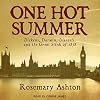
This historical work recounts the summer of 1858 in Great Britain, specifically London, during a time defined by unprecedented hot temperatures that exacerbated the foul stench of the polluted River Thames. The Great Stink, as it became known, motivated political action in Houses of Parliament and at the municipal level to clean up the river. Ashton's work also focuses on the outcomes of other legislation that year such as the legalization of divorce, new regulations for credentialing show more medical practitioners, and changes in the treatment of the mentally ill.
The core of this book though focuses on the lives of three major figures of the era with alliterative names: Charles Darwin, Charles Dickens, and Benjamin Disraeli. In 1858, Darwin became aware that another scientist, Alfred Russel Wallace, had also devised a theory of natural selection, prompting Darwin to stop dragging his feet and begin to write and publish On the Origin of Species. Dickens, meanwhile, is in the midst of nasty split with his wife due to an affair, while also falling out with fellow writer Thackery. Disraeli is in the best position to address the Great Stink and uses his power to push through the Thames Purification Act, as well as working on other legislation such as no longer requiring Jewish MPs to swear by a Christian God.
The book is a snapshot of a single period, but it feels like a jumble that lacks a coherent theme. And the stories of the three main protagonist by necessity venture far into their lives well before and after 1858. A lot of the text reads as being gossipy, yet delivered very dryly. show less
The core of this book though focuses on the lives of three major figures of the era with alliterative names: Charles Darwin, Charles Dickens, and Benjamin Disraeli. In 1858, Darwin became aware that another scientist, Alfred Russel Wallace, had also devised a theory of natural selection, prompting Darwin to stop dragging his feet and begin to write and publish On the Origin of Species. Dickens, meanwhile, is in the midst of nasty split with his wife due to an affair, while also falling out with fellow writer Thackery. Disraeli is in the best position to address the Great Stink and uses his power to push through the Thames Purification Act, as well as working on other legislation such as no longer requiring Jewish MPs to swear by a Christian God.
The book is a snapshot of a single period, but it feels like a jumble that lacks a coherent theme. And the stories of the three main protagonist by necessity venture far into their lives well before and after 1858. A lot of the text reads as being gossipy, yet delivered very dryly. show less

The opportunity for the Eliot biography industry began when Evans's young widower, John Cross, extended her strong sense of privacy to destroying some of her personal papers and bowdlerizing excerpts from her letters and journals for his respectful official life. This was not enough to stop the rumors and speculation that had begun after Evans made herself notorious by living with the married Lewes well before "George Eliot" gained fame as the author of Scenes of Clerical Life and Adam Bede. show more In the search for the real George Eliot, Ashton (English/University College, London) adds her understated version of Evans's life to the several of the last ten years, the most recent being Frederick Karl's magisterial 1995 volume. Ashton moves swiftly through Evans's life, bringing her up from Midlands provincialism to intellectual cosmopolitanism, without dwelling too long on the religious and personal crises in her life. Evans's break with her family and friends, first over her faith, then over her relations with Lewes, seem especially muted, but the novelist herself always maintained a stoic front in her personal life. Like Evans, Ashton is more at home with intellectual matters, such as her interest in Goethe (and his influence on her), her early journalism for the Westminster Review, and, of course, her novels. Ashton, editor of the Penguin Middlemarch, does her best work in drawing out Evans's perspective from her plots and characterizations.
If Gladstone called the first Eliot biography "a Reticence in three volumes," Ashton's is an Admiration in one volume-but a readable and informed one at least. show less
If Gladstone called the first Eliot biography "a Reticence in three volumes," Ashton's is an Admiration in one volume-but a readable and informed one at least. show less
The information is all in here, but not written in a way at all gripping. Unless you find lots of information and detail on this subject riveting in itself, I can't advise others to read this book. The subject matter is somewhat interesting to me, but not sufficiently so to get me very deep into this tome. Back to the library it goes!
Lists
Awards


You May Also Like


Statistics
- Works
- 15
- Also by
- 4
- Members
- 476
- Popularity
- #51,803
- Rating
- 4.1
- Reviews
- 5
- ISBNs
- 33