
Charlotte Craft
Author of King Midas and the Golden Touch
About the Author
Works by Charlotte Craft
Tagged
Common Knowledge
- Legal name
- Craft, Marie Charlotte
- Other names
- Craft, M. Charlotte
- Gender
- female
- Relationships
- Craft, Kinuko (mother)
Craft, Mahlon (father)
Members
Reviews

A retelling of the ancient Greek myth of King Midas, who foolishly believed that gold was the ultimate blessing, only to learn his lesson when Dionysus gives him the gift of the "golden touch." Unable to eat golden food, or drink golden water, Midas is miserable - but when his new-found ability transforms his beloved daughter Aurelia into a golden statue, he truly knows sorrow...
Based upon the version of this story found in Nathaniel Hawthorne's A Wonder-Book for Girls and Boys, Charlotte show more Craft's narrative is engaging, but it is the illustrations by Kinuko Craft that truly give this picture book a magical quality. One of my favorite illustrators, Craft's work is always vibrant and richly-detailed, with a lushly romantic quality, and her luminous, light-filled paintings are always a delight. Although this is a classical story, Craft chooses to locate it in a more medieval setting, making it seem like more of a fairy-tale than a myth. The scene in which Midas rushes down the stairs, a wave of golden transformation fanning out behind him, is exactly the kind of picture I would have spent hours poring over as a girl. Highly recommended to folklore and mythology lovers, and to anyone who values beautifully-illustrated picture books. show less
Based upon the version of this story found in Nathaniel Hawthorne's A Wonder-Book for Girls and Boys, Charlotte show more Craft's narrative is engaging, but it is the illustrations by Kinuko Craft that truly give this picture book a magical quality. One of my favorite illustrators, Craft's work is always vibrant and richly-detailed, with a lushly romantic quality, and her luminous, light-filled paintings are always a delight. Although this is a classical story, Craft chooses to locate it in a more medieval setting, making it seem like more of a fairy-tale than a myth. The scene in which Midas rushes down the stairs, a wave of golden transformation fanning out behind him, is exactly the kind of picture I would have spent hours poring over as a girl. Highly recommended to folklore and mythology lovers, and to anyone who values beautifully-illustrated picture books. show less

A picture-book retelling of the classic Greek myth, in which Cupid, the god of love and the son of Venus, falls in love with a mortal princess named Psyche. When Psyche is told that she will marry "a creature feared by the gods themselves" she is terrified, but soon discovers that her invisible bridegroom is gentle and loving, and she spends her days in contentment. But a visit from her envious sisters causes Psyche to doubt her new husband, and in a moment of weakness, she betrays his show more trust. Separated from all she has come to love, the mortal Psyche must accomplish three inhuman tasks, or relinquish all claim on her beloved Cupid...
The tale of Cupid and Psyche is of great antiquity, not only in various oral traditions, but in the written record as well, having first been recorded as part of Apuleius's 2nd century novel, The Golden Ass. It is an ancient variant of the more contemporary Beauty and the Beast tale, and exhibits some striking parallels to Madame le Prince de Beaumont's fairytale of that name.
I collect illustrated fairy tales and myths, and have in my collection a few other versions of this story, which I hope to eventually review here. But I thought I would start with this title, because I am a great fan of Kinuko Craft, the illustrator of this particular retelling. Her paintings are simply gorgeous - colorful, lush, and very detailed - I can look at them for hours. They are terribly romantic, but I do not find them sentimental. Her darker illustrations can be very compelling, as in the full-page depiction of Proserpine. That portrait, as well as the picture of Psyche mourning the loss of Cupid by the lily-pond, are my favorite illustrations in the book.
I also approve of M. Charlotte Craft's narrative, which I found to be a skillful adaptation of a much longer and more complex text, making this wonderful story more accessible to young readers. A note to readers: although this is indeed a Greek myth, the Roman names are used for almost every mythological figure, a function no doubt, of the identity of the first person to write the story down... show less
The tale of Cupid and Psyche is of great antiquity, not only in various oral traditions, but in the written record as well, having first been recorded as part of Apuleius's 2nd century novel, The Golden Ass. It is an ancient variant of the more contemporary Beauty and the Beast tale, and exhibits some striking parallels to Madame le Prince de Beaumont's fairytale of that name.
I collect illustrated fairy tales and myths, and have in my collection a few other versions of this story, which I hope to eventually review here. But I thought I would start with this title, because I am a great fan of Kinuko Craft, the illustrator of this particular retelling. Her paintings are simply gorgeous - colorful, lush, and very detailed - I can look at them for hours. They are terribly romantic, but I do not find them sentimental. Her darker illustrations can be very compelling, as in the full-page depiction of Proserpine. That portrait, as well as the picture of Psyche mourning the loss of Cupid by the lily-pond, are my favorite illustrations in the book.
I also approve of M. Charlotte Craft's narrative, which I found to be a skillful adaptation of a much longer and more complex text, making this wonderful story more accessible to young readers. A note to readers: although this is indeed a Greek myth, the Roman names are used for almost every mythological figure, a function no doubt, of the identity of the first person to write the story down... show less
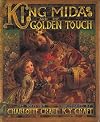
King Midas is a classic in my mind because of the effect that it had on me as a little kid. I remember being very disturbed by the idea the first time I heard the story and the illustrations were so realistically terrifying. In my older age I can really appreciate the message of this story and the incredible illustrations that accompany it, this still holds up as a great lesson.
The myth of King Midas is one of my favourite stories from the Greek tradition, but I really enjoyed Craft's change of location to a mock-War of the Roses-era England. Greed for gold is afterall a universal problem, and the contrast of the living roases that the King's daughter loves so much is a nice nod to the English themes.
Lists
Awards

You May Also Like


Associated Authors
Statistics
- Works
- 2
- Members
- 931
- Popularity
- #27,576
- Rating
- 4.4
- Reviews
- 36
- ISBNs
- 9
- Favorited
- 1