

Margaret Hodges (1911–2005)
Author of Saint George and the Dragon: A Golden Legend
About the Author
Series
Works by Margaret Hodges
Sing Out, Charley! 1 copy
Saint George And the Dragon 1 copy
Associated Works
Cricket Magazine, Vol. 3, No. 4, December 1975 — Contributor — 5 copies
Tagged
Common Knowledge
- Other names
- Moore, Sarah Margaret
- Birthdate
- 1911-07-26
- Date of death
- 2005-12-13
- Gender
- female
- Education
- Vasser College
Carnegie Institute of Technology - Occupations
- professor
librarian
children's book author
storyteller - Organizations
- University of Pittsburgh
- Relationships
- Hodges, Fletcher, Jr.
- Short biography
- Margaret Hodges, née Moore, was born in Indianapolis, Indiana. Her mother Anna Marie Moore died six months
after her birth, and an older cousin, Margaret Carlisle, moved into the household to help care for Margaret and her brother. Cousin Margaret
introduced the children to classic books, and their father often read aloud and
recited poems to them. Margaret attended Tudor Hall, a college prep school for girls. At Vassar College she majored in English, studied acting, and took part in college theater. She graduated with honors in 1932 and married Fletcher Hodges Jr., a museum curator with whom she had three children. A few years later, they moved to Pittsburgh, Pennsylvania when her husband became curator at the Stephen Foster Memorial at the University of Pittsburgh. She received a master's degree in library science from the Carnegie Institute of Technology (now Carnegie Mellon University) while volunteering as a storyteller and children's librarian at the Carnegie Library of Pittsburgh. She became a renowned children's author, producing more than 50 books that included original works such as biographies and novels, as well as retold legends, many of which were sparked by her travels in the UK, Scandinavia, and Russia. In 1953, she became the storyteller for a local radio show called "Let's Tell a Story" that grew into the nationally broadcast segment "Tell Me a Story" for Mr. Rogers' Neighborhood on WQED-TV.
She also served as a story specialist for the Pittsburgh Public Schools and was a professor of library science at the University of Pittsburgh School of Information Sciences, retiring in 1976. - Nationality
- USA
- Birthplace
- Indianapolis, Indiana, USA
- Places of residence
- Indianapolis, Indiana, USA
Pittsburgh, Pennsylvania, USA - Place of death
- Verona, Pennsylvania, USA
- Associated Place (for map)
- Pennsylvania, USA
Members
Discussions
Children's book--boy goes into city to have lunch at a special hotel/restaurant in Name that Book (March 2014)
Reviews

Author Margaret Hodges and illustrator Tim Ladwig join forces in this picture-book history of one of the world's most beloved Christmas carols. Written by Austrian priest Joseph Mohr on Christmas Eve, 1818, when his church's organ broke down, thereby threatening the music that made such an integral part of their congregation's Christmas Eve mass, the words of the song were paired with a tune composed by church organist Franz Gruber. The origin of the song was forgotten for a time, but it was show more popularized by an Austrian family who sang it at a fair in Leipzig, leading to its inclusion in a small book entitled Four Songs of the Tyrol... Sung by the Strasser Family of the Ziller Valley. It eventually caught the attention of King Frederick William IV of Prussia, who had it sung every Christmas by his Cathedral Choir, and whose curiosity about its origins led to its true authorship being revealed. It was brought to America by another singing family of the Ziller Valley, and first translated into English in 1863, by John Freeman Young. It went on to be translated into many languages, to be sung at key moments in various conflicts, including the 1914 Christmas Truce during World War I, and remains a most popular Christmas carol today...
I found Silent Night: The Song and Its Story both informative and moving, and appreciated the history it provided of the carol after it was initially created by Mohr and Gruber. That part of the story - the creation of the song - was the only part I already knew, so the rest of it - how it spread and became popular, how its singing has bridged many divides, even in the midst of war - was new to me. There were moments, during my reading, that I found myself tearing up, particularly when Hodges described how the song was sung across the trenches of World War I, or how a Korean Army unit sang it as they moved along during the Korean War. I do wish that the author had included her sources however, as I cannot find any information on that second anecdote, or on the one set in a Russian prisoner-of-war camp (also during WWI). Given that this is meant to be an informational book, I found the lack of afterword or source notes truly disappointing. Leaving that flaw aside, I did greatly appreciate this one, both for its text and for its gorgeous illustrations. I had encountered Tim Ladwig's work before, in the version of Good King Wenceslas that he illustrated, but it was good to see more of it. With the caveat that they be aware of the lack of back matter, this is one I would recommend to those children interested in the history of Silent Night, or in the history of music transmission in general. show less
I found Silent Night: The Song and Its Story both informative and moving, and appreciated the history it provided of the carol after it was initially created by Mohr and Gruber. That part of the story - the creation of the song - was the only part I already knew, so the rest of it - how it spread and became popular, how its singing has bridged many divides, even in the midst of war - was new to me. There were moments, during my reading, that I found myself tearing up, particularly when Hodges described how the song was sung across the trenches of World War I, or how a Korean Army unit sang it as they moved along during the Korean War. I do wish that the author had included her sources however, as I cannot find any information on that second anecdote, or on the one set in a Russian prisoner-of-war camp (also during WWI). Given that this is meant to be an informational book, I found the lack of afterword or source notes truly disappointing. Leaving that flaw aside, I did greatly appreciate this one, both for its text and for its gorgeous illustrations. I had encountered Tim Ladwig's work before, in the version of Good King Wenceslas that he illustrated, but it was good to see more of it. With the caveat that they be aware of the lack of back matter, this is one I would recommend to those children interested in the history of Silent Night, or in the history of music transmission in general. show less

Based upon Ruth Sawyer's classic holiday tale, The Wee Christmas Cabin of Carn-na-ween, first published in 1941 as part of her collection, The Long Christmas, this lovely picture-book follows the story of Oona, a "tinker's child" who is left on the doorstep of an Irish farm couple, late one night. Raised as the couple's own child, Oona grows into a beautiful, kindhearted young woman. But despite her many virtues, none of the lads will marry her - being a "tinker's child" - and so Oona begins show more a long life of service to others, moving from house to house, as the need arises, caring for the sick, the young, and the elderly. Then the Great Famine strikes, and Oona finds that, in this time of terrible hunger, there is no room in any home for another mouth to feed. Worn out, and grown old, she wanders off one snowy Christmas Eve night, settling under a blackthorn bush, and preparing to die. But the fairies, having long observed her blameless life of kindness, have other plans...
A poignant holiday tale, set during a very dark time in Irish history, The Wee Christmas Cabin emphasizes one of the most important aspects of Christmas - the spirit of giving - and has the feeling almost of a saint's tale. It's not clear to me, from reading Hodges' adaptation, whether Sawyer's 1941 story was an original selection, or was taken from folklore, but I am eager to track it down, read "the whole thing," and see how it compares to this more modern version. Leaving aside issues of adaptation, I would say that the narrative here is very effective, communicating Oona's longing for her own wee cabin, and the enchantment of her wish's fulfillment. The watercolor illustrations, by Kimberly Bulcken Root, complement the tale perfectly - I particularly liked the two-page spread in which Oona sleeps under the blackthorn bush! All in all, a lovely holiday book, recommended to young readers who enjoy magical holiday stories, or tales set in Ireland. show less
A poignant holiday tale, set during a very dark time in Irish history, The Wee Christmas Cabin emphasizes one of the most important aspects of Christmas - the spirit of giving - and has the feeling almost of a saint's tale. It's not clear to me, from reading Hodges' adaptation, whether Sawyer's 1941 story was an original selection, or was taken from folklore, but I am eager to track it down, read "the whole thing," and see how it compares to this more modern version. Leaving aside issues of adaptation, I would say that the narrative here is very effective, communicating Oona's longing for her own wee cabin, and the enchantment of her wish's fulfillment. The watercolor illustrations, by Kimberly Bulcken Root, complement the tale perfectly - I particularly liked the two-page spread in which Oona sleeps under the blackthorn bush! All in all, a lovely holiday book, recommended to young readers who enjoy magical holiday stories, or tales set in Ireland. show less
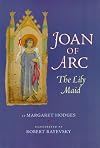
As far as Joan of Arc books go, and there is an overwhelming abundance of them, this is one that seems pretty kid friendly. I'm not going to call it the definitive Joan of Arc work, but it's good enough that a kid would get what was important about her and who she was without being bored to tears.

A poor peddler of Ballymena, a small village in County Antrim, Ireland (currently Northern Ireland), treats everyone who comes to his door with kindness and generosity in this Irish adaptation of a traditional English folktale. When the Great Famine strikes, the entire countryside is reduced to poverty, and the peddler to starvation. For three night Saint Patrick comes to the peddler in a dream, instructing him to travel to Dublin, and to stand on the bridge across the Liffey, for there he show more will hear something of benefit to him. Eventually giving in, the peddler does as he is told, and learns that he has had a fortune all along, buried underneath his old cauldron ...
According to author Margaret Hodges' afterword, the story in Saint Patrick and the Peddler is actually taken from Joseph Jacobs' 1893 collection, More English Fairy Tales, where it was entitled The Pedlar of Swaffam. Hodges decided to transplant the story from England to Ireland, setting it in Ballymena because that is where some of her ancestors hail from, and combining it with the lore of Saint Patrick. Leaving aside the question of origins, the story itself is engaging, with a worthy and generous hero and a happy ending. The artwork from illustrator Paul Brett Johnson, done in acrylic paint, has a lovely impressionistic feeling to it, and beautifully captures the Irish countryside, and the play of light on the land. Recommended to young folklore enthusiasts, and to picture-book readers looking for stories for St. Patrick's Day. show less
According to author Margaret Hodges' afterword, the story in Saint Patrick and the Peddler is actually taken from Joseph Jacobs' 1893 collection, More English Fairy Tales, where it was entitled The Pedlar of Swaffam. Hodges decided to transplant the story from England to Ireland, setting it in Ballymena because that is where some of her ancestors hail from, and combining it with the lore of Saint Patrick. Leaving aside the question of origins, the story itself is engaging, with a worthy and generous hero and a happy ending. The artwork from illustrator Paul Brett Johnson, done in acrylic paint, has a lovely impressionistic feeling to it, and beautifully captures the Irish countryside, and the play of light on the land. Recommended to young folklore enthusiasts, and to picture-book readers looking for stories for St. Patrick's Day. show less
Lists
Awards


You May Also Like


Associated Authors
Statistics
- Works
- 52
- Also by
- 4
- Members
- 7,609
- Popularity
- #3,210
- Rating
- 4.1
- Reviews
- 148
- ISBNs
- 108
- Languages
- 1