
Wayne D. Dosick
Author of Living Judaism: The Complete Guide to Jewish Belief, Tradition, and Practice
About the Author
Rabbi Wayne Dosick is the spiritual guide of The Elijah Minyan and adjunct professor of Jewish Studies at the University of San Diego.
Works by Wayne D. Dosick
Living Judaism: The Complete Guide to Jewish Belief, Tradition, and Practice (1995) 399 copies, 4 reviews
Golden Rules: The Ten Ethical Values Parents Need to Teach Their Children (1995) 94 copies, 1 review
Spiritually Healing the Indigo Children (and Adult Indigos, Too!): The Practical Guide and Handbook (2004) 5 copies
20 Minute Kabbalah: The Daily Personal Spiritual Practice That Brings You To God, Your Soul-Knowing, and Your Heart's Desires (2008) 3 copies
Living Judaism 1 copy
Tagged
Common Knowledge
- Canonical name
- Dosick, Wayne D.
- Gender
- male
- Occupations
- rabbi
Members
Reviews

Dosick believes that he has divined the true name of God (pp. 27-31): Anochi (אנכי), pronounced Ah-no-CHEE.
Where does he get this? He starts at Exodus 20:2, the beginning of the Ten Commandments. He takes "I am the YHWH your Elohim...," which is "Anochi YHWH elohecha..." in transliterated Hebrew, and makes it into: "Anochi, I-Source appointed YHWH to hold the office of Elohim [God on Earth]...."
What?
Dosick, like a bunch of progressive people, can't stand YHWH because He is patriarchical, show more monarchical, and wants you to follow a rigid morality. Dosick can't stand the traditional notion of YHWH because He is "...rigid, militaristic, hierarchical, male authoritarian. It is a God who brings plagues, and kills firstborn; throws temper tantrums, and metes out harsh punishments; opens the ground to swallow up opponents, and makes war to obliterate enemy nations. It is a God who gets angry, is jealous and vengeful, makes outrageous demands, and—frankly—behaves very badly. [...] ...the image of an old man with a long white beard, sitting on a Heavenly throne exacting judgment..." (pp. 4-5). Dosick even concludes (p. 153): "I can no longer be a YHWH-ist." Instead, he says, "I am an Anochi-ist."
So instead, Dosick concocts a theology where YHWH was just a personality of his true Anochi God, holding the "office of Elohim" on earth temporarily (I guess when God needs to be a mean badass and kill some Egyptians or Philistines, He projects His YHWH-Self). Sometimes, says Dosick, Anochi is El Shaddai, sometimes Yah, sometime El Elyon, whatever. Dosick claims, innumerable times in the book (starting at pp. 8-9) that each aspect of God, each name, is like the panel of a beach ball: each panel is an aspect/name of God, but the full God is all the panels, the full ball is his Anochi.
Doscik then spends chapter 4, "Torah Tells," attempting to exegete his Anochi out of Scripture. By the way, anochi (אנכי) is just a word for "I" in Hebrew; there is another popular Hebrew word for "I" in the text, ani (אני). Anyway, Dosick searches for spots where the Bible uses Anochi for "I" and translates them to "Anochi" or "Anochi, I-Source" (the latter Dosick's way to show God is transcendent) as he sees fit. He then mistranslates a whole slew of verses. Thus, from Deuteronomy 6:6 Dosick takes the "...which I command thee this day..." bit and makes it "..which Anochi, I-Source command you this day..." (p. 34). Numerous other examples are given, like Exodus 3:6, which he turns into "Anochi, I-Source Am the God of your fathers..." (p. 35). Basically, whenever God says "I" and Dosick can make it "Anochi," he does so.
This is poor grammar, however, turning a pronoun into a proper noun.
Because guess what? Mere mortal human beings also say "anochi." In chapter 5 Dosick posits that sometimes when humans say "anochi" for "I" they are in-tune or connected somehow to his hypothetical Anochi-God. Abraham and Joseph, for example, sometimes say "anochi" and are really channeling Anochi-God. I guess. For example, Joseph says, Genesis 37:16: "Anochi-I Am looking for my brothers..." Dosick states (p. 63): "...the use of Anochi-I surely indicates Joseph is aware of his Anochi-I, Anochi-Within, his GodSelf, and intends it to influence his behavior.... Being aware of his GodWithin means that Joseph is already being Divinely guided." Dosick even says that the Pharaoh of Exodus somehow channels Anochi-God (see pp. 64-65)!
The main problem with all this is that Dosick is cherry-picking when to say the mere common word "anochi" really means "Anochi-I Source" or "Anochi-I, God Within" (or what have you) and when it just means "I" as a human being. That is bad scholarship and bad grammar. And it is bad theology. Later, Dosick is going to tell people to get in touch, in-tune, with their inner Anochi-I-ness. Of course, what if some fellow's "Anochi-I" tells him 2+2=5? And another fellow's "Anochi-I" tells him 2+2=3? And another fellow's "Anochi-I" tells him 2+2=4? Now replace the math with moral actions or beliefs. You see the problem? If everybody's "Anochi-I, God Within" is right we have moral and physical chaos. Mankind is not God.
But I digress too early.
Dosick is just wrong on the Biblical text. When God says in Exodus 20:2 that "I am the LORD your God" the text actually should be the more emphatic "I, YHWH, am your God." (The NET Bible has, properly: "I, the LORD, am your God....") This is a definitive statement where God tells us his name is YHWH. The verse is not saying "Anochi-I" is the real name of God. Dosick has to torture the Hebrew of the verse to get his preferred: "Anochi, I-Source appointed YHWH to hold the office of Elohim [God on Earth]." Of course, Dosick has added "appointed" and "to hold the office of" and "[God on Earth]" to make his ideas fit. That is bad Hebrew, bad translation, bad grammar, and bad theology.
In fact, when God has the opportunity to provide His real name, He explicitly does not use "Anochi." Here is Exodus 3:13-14 (ESV):
Then Moses said to God, "If I come to the people of Israel and say to them, 'The God of your fathers has sent me to you,' and they ask me, 'What is his name?' what shall I say to them?" God said to Moses, "I AM WHO I AM," And he said, "Say this to the people of Israel: 'I AM has sent me to you.'"
Now the bit translated "I AM WHO I AM" (or, alternatively, "I AM WHO I AM," "I AM THAT I AM," "I AM WHAT I AM," "I WILL BE WHAT I WILL BE," etc.) is "Ehyeh Asher Ehyeh" (אֶהְיֶה אֲשֶׁר אֶהְיֶה). Later God says "I AM (Ehyeh, אֶהְיֶה) has sent me to you."
Neither of these bits are "Anochi." And, by the way, Ehyeh is probably related to YHWH.
God again notes that His name is YHWH, not Anochi, in Exodus 6:2-3 (Names of God translation):
Elohim spoke to Moses, “I am Yahweh. I appeared to Abraham, Isaac, and Jacob as El Shadday, but I didn’t make myself known to them by my name, Yahweh."
Now, Dosick (pp. 26-27) says this verse is about the "offices" of God, various parts of the "beach ball" metaphor, but the plain Hebrew text has God telling us what His name is. And it is not Anochi.
Dosick has to make many such merry mistranslations of the Bible in order to force it into his Anochi-I mold. For instance, he takes Psalms 46:11, "Be still and know that I Am God..." and makes it "Be still and know that Anochi is [in the office of] Elohim..." (p. 86). Better yet, Dosick says it should read, "Be still and know that Anochi is God" (p. 87). Dosick then expounds (p. 87), putting words into God's mouth and God's Bible: "Anochi says to us: 'To know Me, you cannot know just an aspect, a part, of Me. You must know the Whole Me. So, right now, I place My Anochi-Self into the office of Elohim, so that... if you really, really want to know Me, you can."
In other places, Dosick blatantly changes Scripture to meet his needs. He "adapted" Psalms 16:8a ("I have set the LORD [YHWH] always before me" in the KJV) to read "I place Anochi All-Ways before me" (p. 88). Here Dosick has straight up replaced YHWH with Anochi to suit him. This is, again, bad Hebrew, bad translation, bad grammar, and bad theology.
In the second half of the book, from chapter 6 on, the book goes off the rails. It turns from a wrong, but interesting enough, interpretation and exegesis of texts into a New Age, self help, feelgood, hippie mish-mash of a book.
Dosick now has the genderless, "God is love" god he has asked for in the introduction. Dosick gushes, "...we no longer have to settle for the male, hierarchical image of god, and the predominately masculine language and names of God" (p. 81). "Knowing Anochi," Dosick says, "means knowing that God is all around you, and within you, and gives you life" (p. 81). What is God? Dosick answers (p. 82): "Anochi loves every child of the universe.... We are all One, and Anochi loves us all.... ...knowing Anochi means knowing that God is Love—pure, total, unequivocal, unconditional, absolute, eternal Love." In other places, Dosick expands on this. This is a God that permits but does not limit. This is the hippie-god of "if it feels good do it." God is a poor Father if he has no rules or boundaries, just as if a poor earthly father has no rules or boundaries and let his kids run amok. I'm sorry hippies, you have to have moral rules and strictures. Opposite of God's permissive love is God's punishing love. On that score, Dosick mentions the Kabbalah and the Tree of Life several times, but he apparently doesn't comprehend why the sefirah Gevurah ("Discipline") is opposite the sefirah Chesed ("Kindness") on the right and left pillars. (The universe is balanced by God's discipline and his permissive kindness.) But, then again, Dosick doesn't like traditional Kabbalah or the traditional layout of sefirot, as he creates his own spiral Tree of Life (pp. 107-110) that doesn't have all those pesky hierarchies and strictures.
Instead, Dosick (pp. 89ff.) changes God to fit his own ideas and feelings. "I am uncomfortable," notice (p. 90) it is his, Dosick's, personal discomfort that is the sticking point, "with the image of a male God who commands, and whose means of making us holy is through the strict observance of directives and injunctions." Dosick asks, "[W]here is the God of love, the God of compassion, the God of gentle guidance?" Dosick answers, creating his own hippie-god Anochi.
Creating your own god reminds me of Genesis 3:4-5 (KJ21): "And the serpent said unto the woman, 'Ye shall not surely die; for God doth know that in the day ye eat thereof, then your eyes shall be opened, and ye shall be as gods, knowing good and evil.'"
The whole book reeks of Dosick being uncomfortable with a God who isn't all love, permissiveness, and sweetness. So, Dosick has constructed the genderless, permissive, hippie god Anochi. Dosick assures us "that the God we meet in much of the Bible is not the real God" (p. 14). (Dosick, however, does not seems to realize that all the times in the Bible when mean ol' male YHWH brings punishment and destruction—like, say, Noah's Flood or the Ten Plagues of Egypt—that it is still his loving, peaceful, Anochi at the back of it. The whole beach ball is still liable for the actions of each beach ball panel, right?)
Dosick's Anochi, when it comes down to it, is a god of his own making. "Anochi" is not the name of the God of the Bible. "Anochi" is not the name of God. To say so is bad Hebrew, bad translation, bad grammar, and bad theology.
(I have placed this book on my occult shelf, not my Biblical commentary shelf.) show less
Where does he get this? He starts at Exodus 20:2, the beginning of the Ten Commandments. He takes "I am the YHWH your Elohim...," which is "Anochi YHWH elohecha..." in transliterated Hebrew, and makes it into: "Anochi, I-Source appointed YHWH to hold the office of Elohim [God on Earth]...."
What?
Dosick, like a bunch of progressive people, can't stand YHWH because He is patriarchical, show more monarchical, and wants you to follow a rigid morality. Dosick can't stand the traditional notion of YHWH because He is "...rigid, militaristic, hierarchical, male authoritarian. It is a God who brings plagues, and kills firstborn; throws temper tantrums, and metes out harsh punishments; opens the ground to swallow up opponents, and makes war to obliterate enemy nations. It is a God who gets angry, is jealous and vengeful, makes outrageous demands, and—frankly—behaves very badly. [...] ...the image of an old man with a long white beard, sitting on a Heavenly throne exacting judgment..." (pp. 4-5). Dosick even concludes (p. 153): "I can no longer be a YHWH-ist." Instead, he says, "I am an Anochi-ist."
So instead, Dosick concocts a theology where YHWH was just a personality of his true Anochi God, holding the "office of Elohim" on earth temporarily (I guess when God needs to be a mean badass and kill some Egyptians or Philistines, He projects His YHWH-Self). Sometimes, says Dosick, Anochi is El Shaddai, sometimes Yah, sometime El Elyon, whatever. Dosick claims, innumerable times in the book (starting at pp. 8-9) that each aspect of God, each name, is like the panel of a beach ball: each panel is an aspect/name of God, but the full God is all the panels, the full ball is his Anochi.
Doscik then spends chapter 4, "Torah Tells," attempting to exegete his Anochi out of Scripture. By the way, anochi (אנכי) is just a word for "I" in Hebrew; there is another popular Hebrew word for "I" in the text, ani (אני). Anyway, Dosick searches for spots where the Bible uses Anochi for "I" and translates them to "Anochi" or "Anochi, I-Source" (the latter Dosick's way to show God is transcendent) as he sees fit. He then mistranslates a whole slew of verses. Thus, from Deuteronomy 6:6 Dosick takes the "...which I command thee this day..." bit and makes it "..which Anochi, I-Source command you this day..." (p. 34). Numerous other examples are given, like Exodus 3:6, which he turns into "Anochi, I-Source Am the God of your fathers..." (p. 35). Basically, whenever God says "I" and Dosick can make it "Anochi," he does so.
This is poor grammar, however, turning a pronoun into a proper noun.
Because guess what? Mere mortal human beings also say "anochi." In chapter 5 Dosick posits that sometimes when humans say "anochi" for "I" they are in-tune or connected somehow to his hypothetical Anochi-God. Abraham and Joseph, for example, sometimes say "anochi" and are really channeling Anochi-God. I guess. For example, Joseph says, Genesis 37:16: "Anochi-I Am looking for my brothers..." Dosick states (p. 63): "...the use of Anochi-I surely indicates Joseph is aware of his Anochi-I, Anochi-Within, his GodSelf, and intends it to influence his behavior.... Being aware of his GodWithin means that Joseph is already being Divinely guided." Dosick even says that the Pharaoh of Exodus somehow channels Anochi-God (see pp. 64-65)!
The main problem with all this is that Dosick is cherry-picking when to say the mere common word "anochi" really means "Anochi-I Source" or "Anochi-I, God Within" (or what have you) and when it just means "I" as a human being. That is bad scholarship and bad grammar. And it is bad theology. Later, Dosick is going to tell people to get in touch, in-tune, with their inner Anochi-I-ness. Of course, what if some fellow's "Anochi-I" tells him 2+2=5? And another fellow's "Anochi-I" tells him 2+2=3? And another fellow's "Anochi-I" tells him 2+2=4? Now replace the math with moral actions or beliefs. You see the problem? If everybody's "Anochi-I, God Within" is right we have moral and physical chaos. Mankind is not God.
But I digress too early.
Dosick is just wrong on the Biblical text. When God says in Exodus 20:2 that "I am the LORD your God" the text actually should be the more emphatic "I, YHWH, am your God." (The NET Bible has, properly: "I, the LORD, am your God....") This is a definitive statement where God tells us his name is YHWH. The verse is not saying "Anochi-I" is the real name of God. Dosick has to torture the Hebrew of the verse to get his preferred: "Anochi, I-Source appointed YHWH to hold the office of Elohim [God on Earth]." Of course, Dosick has added "appointed" and "to hold the office of" and "[God on Earth]" to make his ideas fit. That is bad Hebrew, bad translation, bad grammar, and bad theology.
In fact, when God has the opportunity to provide His real name, He explicitly does not use "Anochi." Here is Exodus 3:13-14 (ESV):
Then Moses said to God, "If I come to the people of Israel and say to them, 'The God of your fathers has sent me to you,' and they ask me, 'What is his name?' what shall I say to them?" God said to Moses, "I AM WHO I AM," And he said, "Say this to the people of Israel: 'I AM has sent me to you.'"
Now the bit translated "I AM WHO I AM" (or, alternatively, "I AM WHO I AM," "I AM THAT I AM," "I AM WHAT I AM," "I WILL BE WHAT I WILL BE," etc.) is "Ehyeh Asher Ehyeh" (אֶהְיֶה אֲשֶׁר אֶהְיֶה). Later God says "I AM (Ehyeh, אֶהְיֶה) has sent me to you."
Neither of these bits are "Anochi." And, by the way, Ehyeh is probably related to YHWH.
God again notes that His name is YHWH, not Anochi, in Exodus 6:2-3 (Names of God translation):
Elohim spoke to Moses, “I am Yahweh. I appeared to Abraham, Isaac, and Jacob as El Shadday, but I didn’t make myself known to them by my name, Yahweh."
Now, Dosick (pp. 26-27) says this verse is about the "offices" of God, various parts of the "beach ball" metaphor, but the plain Hebrew text has God telling us what His name is. And it is not Anochi.
Dosick has to make many such merry mistranslations of the Bible in order to force it into his Anochi-I mold. For instance, he takes Psalms 46:11, "Be still and know that I Am God..." and makes it "Be still and know that Anochi is [in the office of] Elohim..." (p. 86). Better yet, Dosick says it should read, "Be still and know that Anochi is God" (p. 87). Dosick then expounds (p. 87), putting words into God's mouth and God's Bible: "Anochi says to us: 'To know Me, you cannot know just an aspect, a part, of Me. You must know the Whole Me. So, right now, I place My Anochi-Self into the office of Elohim, so that... if you really, really want to know Me, you can."
In other places, Dosick blatantly changes Scripture to meet his needs. He "adapted" Psalms 16:8a ("I have set the LORD [YHWH] always before me" in the KJV) to read "I place Anochi All-Ways before me" (p. 88). Here Dosick has straight up replaced YHWH with Anochi to suit him. This is, again, bad Hebrew, bad translation, bad grammar, and bad theology.
In the second half of the book, from chapter 6 on, the book goes off the rails. It turns from a wrong, but interesting enough, interpretation and exegesis of texts into a New Age, self help, feelgood, hippie mish-mash of a book.
Dosick now has the genderless, "God is love" god he has asked for in the introduction. Dosick gushes, "...we no longer have to settle for the male, hierarchical image of god, and the predominately masculine language and names of God" (p. 81). "Knowing Anochi," Dosick says, "means knowing that God is all around you, and within you, and gives you life" (p. 81). What is God? Dosick answers (p. 82): "Anochi loves every child of the universe.... We are all One, and Anochi loves us all.... ...knowing Anochi means knowing that God is Love—pure, total, unequivocal, unconditional, absolute, eternal Love." In other places, Dosick expands on this. This is a God that permits but does not limit. This is the hippie-god of "if it feels good do it." God is a poor Father if he has no rules or boundaries, just as if a poor earthly father has no rules or boundaries and let his kids run amok. I'm sorry hippies, you have to have moral rules and strictures. Opposite of God's permissive love is God's punishing love. On that score, Dosick mentions the Kabbalah and the Tree of Life several times, but he apparently doesn't comprehend why the sefirah Gevurah ("Discipline") is opposite the sefirah Chesed ("Kindness") on the right and left pillars. (The universe is balanced by God's discipline and his permissive kindness.) But, then again, Dosick doesn't like traditional Kabbalah or the traditional layout of sefirot, as he creates his own spiral Tree of Life (pp. 107-110) that doesn't have all those pesky hierarchies and strictures.
Instead, Dosick (pp. 89ff.) changes God to fit his own ideas and feelings. "I am uncomfortable," notice (p. 90) it is his, Dosick's, personal discomfort that is the sticking point, "with the image of a male God who commands, and whose means of making us holy is through the strict observance of directives and injunctions." Dosick asks, "[W]here is the God of love, the God of compassion, the God of gentle guidance?" Dosick answers, creating his own hippie-god Anochi.
Creating your own god reminds me of Genesis 3:4-5 (KJ21): "And the serpent said unto the woman, 'Ye shall not surely die; for God doth know that in the day ye eat thereof, then your eyes shall be opened, and ye shall be as gods, knowing good and evil.'"
The whole book reeks of Dosick being uncomfortable with a God who isn't all love, permissiveness, and sweetness. So, Dosick has constructed the genderless, permissive, hippie god Anochi. Dosick assures us "that the God we meet in much of the Bible is not the real God" (p. 14). (Dosick, however, does not seems to realize that all the times in the Bible when mean ol' male YHWH brings punishment and destruction—like, say, Noah's Flood or the Ten Plagues of Egypt—that it is still his loving, peaceful, Anochi at the back of it. The whole beach ball is still liable for the actions of each beach ball panel, right?)
Dosick's Anochi, when it comes down to it, is a god of his own making. "Anochi" is not the name of the God of the Bible. "Anochi" is not the name of God. To say so is bad Hebrew, bad translation, bad grammar, and bad theology.
(I have placed this book on my occult shelf, not my Biblical commentary shelf.) show less
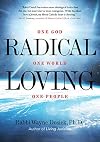
This book wasn't what I expected. When I think of radical loving, I suppose I think of it from an ecumenical point of view. As an agnostic with an appreciation for spiritual leaders from a number of different faith traditions, I suppose I'm used to a more universal, less particular view of the divine. This book was more faith-centered than I expected, and for that reason I had trouble appreciating it for what it was. I don't mean this as a judgement against the book -- just a statement of my show more perception of it. show less
 This review was written for LibraryThing Early Reviewers.
"Radical Loving" presents a different approach to faith, religion and believing in a deity. Rabbi Dosick, while discussing the tenants of Judaism, refers often to culturally held beliefs of many of the world's religions and wonders why people on earth find themselves morally and ethically distressed and confused and why there is so much increased hate. He mulls over the inability of humans to feel comfortable with the "other". He questions why we cannot easily accept others who appear or act show more differently than we do and why we cannot treasure God's gift of the natural world and take better care of our planet. He questions how long it will take for humans to put love and kindness before power and greed.
One cannot help but acknowledge and agree with Dosick's analysis of the human condition. He points out that we often blame each other and find fault with the behavior of others. It is much more difficult to search our own souls for the answers. He emphasizes how we are all connected no matter what faith we follow. We are all dependent on each other for our welfare and well being. He asks why our different spiritual traditions cannot be acknowledged and respected and why humans cannot act with tolerance toward each other. His references to different bible stories and his understanding of other faiths and traditions besides Judaism make this book so interesting.
Dosick attempts to explain man's relationship toward religion from God's point of view... "Even though they may seem so different, each religion that you invented as your pathway to Me is nothing more than a reflection of the time, place, culture, politics, and social circumstances in which a particular religion was born and began to develop. In their purest form, your organized religions can be enlightening, embracing, sweet, uplifting, and inspiring. Yet, perversely, organized religion can be rigidly fundamental, confining, stifling, and punishing."
Dosick views God as the maker of all humans whose wish is to have all his creatures love one another.
This is definitely a book worth reading and it will surely help every reader understand how important it is to respect all faiths and to choose the path of righteousness, kindness and compassion no matter what religion you embrace. show less
One cannot help but acknowledge and agree with Dosick's analysis of the human condition. He points out that we often blame each other and find fault with the behavior of others. It is much more difficult to search our own souls for the answers. He emphasizes how we are all connected no matter what faith we follow. We are all dependent on each other for our welfare and well being. He asks why our different spiritual traditions cannot be acknowledged and respected and why humans cannot act with tolerance toward each other. His references to different bible stories and his understanding of other faiths and traditions besides Judaism make this book so interesting.
Dosick attempts to explain man's relationship toward religion from God's point of view... "Even though they may seem so different, each religion that you invented as your pathway to Me is nothing more than a reflection of the time, place, culture, politics, and social circumstances in which a particular religion was born and began to develop. In their purest form, your organized religions can be enlightening, embracing, sweet, uplifting, and inspiring. Yet, perversely, organized religion can be rigidly fundamental, confining, stifling, and punishing."
Dosick views God as the maker of all humans whose wish is to have all his creatures love one another.
This is definitely a book worth reading and it will surely help every reader understand how important it is to respect all faiths and to choose the path of righteousness, kindness and compassion no matter what religion you embrace. show less
This review was written for LibraryThing Early Reviewers.
An interesting read, and a sincere desire from this Rabbi for working together towards world peace centered on working together with our similarities, rather than perpetual religious war based on differences.
This review was written for LibraryThing Early Reviewers.Lists
Judaism & Israel (1)
You May Also Like


Statistics
- Works
- 15
- Members
- 712
- Popularity
- #35,610
- Rating
- 4.0
- Reviews
- 15
- ISBNs
- 27
- Languages
- 2
