

Zoë Heller
Author of Notes on a Scandal
About the Author
Zoe Heller has been a contributing editor of Vanity Fair and a staff member of the London Sunday Times, the Times Supplement, Esquire, Vogue, the London Review of Books and The New York Times. Her 2003 novel, What Was She Thinking?: Notes on a Scandal, earned tremendous acclaim, including a spot on show more the short list for the prestigious Man Booker Prize. The audio release coincided with the 2007 film adaptation, Notes on a Scandal, starring Cate Blanchett and Judi Dench. She was born and educated in Britain and now divides her time between Brooklyn, NY and Bucks County, PA. (Bowker Author Biography) show less
Image credit: Photo by David Shankbone (Cropped/Wikimedia Commons)
Works by Zoë Heller
Associated Works
Tagged
Common Knowledge
- Canonical name
- Heller, Zoë
- Birthdate
- 1965-07-07
- Gender
- female
- Education
- University of Oxford (English)
Columbia University - Occupations
- journalist
writer - Agent
- Gill Coleridge (Rogers, Coleridge & White)
- Relationships
- Heller, Hermann (grandfather)
Heller, Lukas (father)
Heller, Bruno (brother) - Nationality
- UK
- Birthplace
- London, England, UK
- Places of residence
- London, England, UK (birth)
New York, New York, USA - Associated Place (for map)
- UK
Members
Reviews
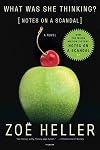
The slow decline into obsession is like a slow growing cancer. The sickness of the heart soon controls the soul. Barbara Covett's long teaching career at St. Georges School affords her a critical opinion of her colleagues, old and new. With barely any friends, scarce family ties, and no love life to speak of, Barbara is an aging spinster alone with an ailing cat. Such bitter loneliness entitles Barbara to scoff at any relationship until she meets Sheba Hart. Sheba brings out a strange show more possessiveness in Barbara. As a pottery teacher Sheba is new to St. Georges and it's politics. Barbara takes Sheba under her wing and desires to be her only friend. Except Sheba is capable of making a variety of relationships which fuel Barbara's jealousies. Barbara reminded me of the manipulative Iago in the way that she slyly pushed Sue, another St. Georges colleague, out of the friendship with Sheba. Three is definitely a crowd.
As mentioned before, Sheba is capable of making connections quickly. When she starts a physical relationship with a sixteen year old student in her pottery class, Barbara seizes the opportunity to be Sheba's only nonjudgmental confident, further pulling Sheba into a sick dependency. However, Barbara's immature need to be on the high horse of morality gets the better of her and she risks Sheba's friendship by keeping a journal. The more obsessed Sheba gets with the schoolboy, the more reckless she becomes. How long before the house of cards come crashing down? show less
As mentioned before, Sheba is capable of making connections quickly. When she starts a physical relationship with a sixteen year old student in her pottery class, Barbara seizes the opportunity to be Sheba's only nonjudgmental confident, further pulling Sheba into a sick dependency. However, Barbara's immature need to be on the high horse of morality gets the better of her and she risks Sheba's friendship by keeping a journal. The more obsessed Sheba gets with the schoolboy, the more reckless she becomes. How long before the house of cards come crashing down? show less

Why do we raise our eyebrows at relationships between two people of markedly different ages? Why are we in such a hurry to classify certain romantic entanglements as being "exploitative", and can we ever be clear exactly who is exploiting whom anyway? These are just some of the questions you're likely to ask yourself while reading Notes on a Scandal.
On paper, this looks like a pretty cut-and-dried case: a 42-year-old married female teacher pursues a sexual relationship with a 15/16-year-old show more schoolboy. It's criminal behaviour, it draws forth both scorn and condemnation from the media, it ruins lives and taints reputations - but it's testament to Heller's writing skills that by the end of the novel you may well find yourself sympathising with the "criminal" Sheba Hart rather than the "victim" Steven Connolly. After all, the novel suggests, Connolly basically just has a rather enjoyable sexual experience and then gets on with his life; it is Sheba who suffers as a result, Sheba who must endure not only the pangs of lost love but the pain of a broken marriage, a destroyed reputation and an impending jail sentence.
The "notes on a scandal" of the title refers to the account of the affair written by Barbara Covett. Barbara is a fellow schoolteacher, a spinster who is atrociously lonely, and who is also - apparently - Sheba's most loyal friend. Barbara is the kind of woman - snide, snippy, and a self-righteous old gossip - who you'd avoid like the plague in real life, but actually as a narrator she's rather delightful company, digging right into the salacious heart of the scandal on behalf of the reader. She's curiously self-deluding on occasion, but at other times she manages to nail the people around her with such brilliant precision that you can't help but be impressed. She's wickedly funny, and at other times is heartrending as she constantly confronts the haunting fact of her own crushing loneliness. This, is turns out, is why she is so loyal to Sheba: she needs Sheba, she has to feel that she has someone giving meaning to her life, and she'll do just about anything to keep her. Sheba hands this extraordinary power to Barbara when she tells her about her affair with Connolly, and her confession proves to be something of an incendiary. Barbara can, depending on her mood, either put it quietly and safely to one side or light the fuse, put her fingers in her ears and stand well back ...
There are some faults with the novel, certainly: the character of Barbara comes perilously close to being a cliché (she even has a pet cat that she dotes on, just as stereotypical lonely old spinsters everywhere are said to have). Also, Steven is made to sound rather repulsive - he has no obvious attractions, either physically, mentally or personality-wise - so it's rather hard to understand why Sheba is even attracted to him, let alone so obsessed that she'll risk everything for his sake.
Still, those faults are more like minor niggles than fatal flaws. This is a compelling, quick read - I got through it in about three evenings, and couldn't wait to get home and pick it up again. By turns funny and grim, it will draw you in and make you question some of your assumptions. I don't think Heller expects you to draw any profound moral from it; it's more of a dissection of the dynamics and power-struggles of personal and sexual relations, and an examination of societal and personal responses to sexual scandals. Read and enjoy. show less
On paper, this looks like a pretty cut-and-dried case: a 42-year-old married female teacher pursues a sexual relationship with a 15/16-year-old show more schoolboy. It's criminal behaviour, it draws forth both scorn and condemnation from the media, it ruins lives and taints reputations - but it's testament to Heller's writing skills that by the end of the novel you may well find yourself sympathising with the "criminal" Sheba Hart rather than the "victim" Steven Connolly. After all, the novel suggests, Connolly basically just has a rather enjoyable sexual experience and then gets on with his life; it is Sheba who suffers as a result, Sheba who must endure not only the pangs of lost love but the pain of a broken marriage, a destroyed reputation and an impending jail sentence.
The "notes on a scandal" of the title refers to the account of the affair written by Barbara Covett. Barbara is a fellow schoolteacher, a spinster who is atrociously lonely, and who is also - apparently - Sheba's most loyal friend. Barbara is the kind of woman - snide, snippy, and a self-righteous old gossip - who you'd avoid like the plague in real life, but actually as a narrator she's rather delightful company, digging right into the salacious heart of the scandal on behalf of the reader. She's curiously self-deluding on occasion, but at other times she manages to nail the people around her with such brilliant precision that you can't help but be impressed. She's wickedly funny, and at other times is heartrending as she constantly confronts the haunting fact of her own crushing loneliness. This, is turns out, is why she is so loyal to Sheba: she needs Sheba, she has to feel that she has someone giving meaning to her life, and she'll do just about anything to keep her. Sheba hands this extraordinary power to Barbara when she tells her about her affair with Connolly, and her confession proves to be something of an incendiary. Barbara can, depending on her mood, either put it quietly and safely to one side or light the fuse, put her fingers in her ears and stand well back ...
There are some faults with the novel, certainly: the character of Barbara comes perilously close to being a cliché (she even has a pet cat that she dotes on, just as stereotypical lonely old spinsters everywhere are said to have). Also, Steven is made to sound rather repulsive - he has no obvious attractions, either physically, mentally or personality-wise - so it's rather hard to understand why Sheba is even attracted to him, let alone so obsessed that she'll risk everything for his sake.
Still, those faults are more like minor niggles than fatal flaws. This is a compelling, quick read - I got through it in about three evenings, and couldn't wait to get home and pick it up again. By turns funny and grim, it will draw you in and make you question some of your assumptions. I don't think Heller expects you to draw any profound moral from it; it's more of a dissection of the dynamics and power-struggles of personal and sexual relations, and an examination of societal and personal responses to sexual scandals. Read and enjoy. show less

This is a novel about a dysfunctional family, and it's also, perhaps, a satire. Lots of people don't like it because almost all the characters are unlikeable--some in fact are hugely unlikeable. The novel centers on the family of Joel Litvinoff, an womanizing activist lawyer who makes his living defending terrorists--present-day Muslims and Black Panther-like individuals in the past. As the novel opens, Joel suffers a stroke, and he lies in a coma for most of the rest of the book.
Joel's wife show more Audrey appears to live to support Joel, entirely burying her own wants and desires to the needs of Joel. In fact, as Heller cleverly shows us, Audrey is one of the most self-centered and mean characters to appear in the pages of a contemporary novel. Joel and Audrey have three children. Rosa has just returned from a Marxist fling in Cuba and is flirting with becoming a Hasidic Jew, much to the dismay of her atheist parents. Karla, an overweight "marshmallow" of a social worker married to a union organizer, bears the brunt of Audrey's snide remarks. Adopted son Lenny, a drug addict unable to hold a job, is adored by Audrey.
I think the fact that the characters are so unlikeable is what makes this book likeable. Here's a quote:
"{Audrey} was always congratulating herself on her audacious honesty, her willingness to express what everyone else was thinking. But no one...actually shared Audrey's ugly view of the world. It was not the truth of her observations that made people laugh, but their unfairness, their surreal cruelty."
3 stars show less
Joel's wife show more Audrey appears to live to support Joel, entirely burying her own wants and desires to the needs of Joel. In fact, as Heller cleverly shows us, Audrey is one of the most self-centered and mean characters to appear in the pages of a contemporary novel. Joel and Audrey have three children. Rosa has just returned from a Marxist fling in Cuba and is flirting with becoming a Hasidic Jew, much to the dismay of her atheist parents. Karla, an overweight "marshmallow" of a social worker married to a union organizer, bears the brunt of Audrey's snide remarks. Adopted son Lenny, a drug addict unable to hold a job, is adored by Audrey.
I think the fact that the characters are so unlikeable is what makes this book likeable. Here's a quote:
"{Audrey} was always congratulating herself on her audacious honesty, her willingness to express what everyone else was thinking. But no one...actually shared Audrey's ugly view of the world. It was not the truth of her observations that made people laugh, but their unfairness, their surreal cruelty."
3 stars show less

‘The Believers’ by Zoe Heller is the story of a New York family and how serious illness challenges each person to consider in what they believe. The Litvinoffs are a Jewish family used by Heller as a prism to question our beliefs, not just religious but also motherhood, fidelity and politics.
The story starts with the meeting of English student Audrey and American lawyer Joel, at a party in London in the Sixties. The action then shifts swiftly to 2002. Audrey and Joel live in New York, show more he is a prominent and outspoken radical lawyer, she does good works. They have two daughters, Rose and Karla, and adopted son Lenny. On the day he is due to appear in court representing a controversial defendant, Joel has a stroke. As he lays in a coma, Heller shows each of the family confronting the situation, its impact on their own lives, or not as the case may be. None of the characters are particularly likeable, and the storyline can be difficult in places, but I found the pages turned quickly as I wanted to know the ending. Of course, like life, there is no neat finale only more life to follow as the stories of the family continue.
Audrey is a deliciously outspoken and brutal mother to her daughters, though she mollycoddles her son to a ridiculous degree. Rosa is re-discovering her Jewish roots, having been raised in a non-observant Jewish family. We follow her exploration of the oddities of Orthodoxy, as she wrestles with the concept of accepting things she doesn’t understand. Karla, unhappily married and trying for a baby, is the recipient most frequently of Audrey’s caustic tongue. Not looking for an affair, she nevertheless stumbles into one, and has difficulty believing and accepting her suitor could possibly be attracted to her. Lenny is a drug addict who believes in nothing except his next hit. Meanwhile, Joel in his hospital bed is the cog of the wheel around which they all move.
I was left loving Heller’s writing, she has a wonderful turn of phrase. ‘Depression, in Karla’s experience, was a dull, inert thing – a toad that squatted wetly on your head until it finally gathered the energy to slither off. The unhappiness she had been living with for the last ten days was quite a different creature. It was frantic and aggressive. It had fists and fangs and hobnailed boots. It didn’t sit, it assailed. It hurt her.’
But, I finished the book dissatisfied with the story. Audrey’s Englishness did not come into play, except in the first chapter which feels unrelated to the rest of the book, and she seems unnecessarily harsh and unfair without real justification. What made her so bitter? Something which happened between the Prologue in 1962, and the main story in 2002? The big surprise, when it comes, is perhaps predictable to everyone except Audrey.
Read more of my book reviews at http://www.sandradanby.com/book-reviews-a-z/ show less
The story starts with the meeting of English student Audrey and American lawyer Joel, at a party in London in the Sixties. The action then shifts swiftly to 2002. Audrey and Joel live in New York, show more he is a prominent and outspoken radical lawyer, she does good works. They have two daughters, Rose and Karla, and adopted son Lenny. On the day he is due to appear in court representing a controversial defendant, Joel has a stroke. As he lays in a coma, Heller shows each of the family confronting the situation, its impact on their own lives, or not as the case may be. None of the characters are particularly likeable, and the storyline can be difficult in places, but I found the pages turned quickly as I wanted to know the ending. Of course, like life, there is no neat finale only more life to follow as the stories of the family continue.
Audrey is a deliciously outspoken and brutal mother to her daughters, though she mollycoddles her son to a ridiculous degree. Rosa is re-discovering her Jewish roots, having been raised in a non-observant Jewish family. We follow her exploration of the oddities of Orthodoxy, as she wrestles with the concept of accepting things she doesn’t understand. Karla, unhappily married and trying for a baby, is the recipient most frequently of Audrey’s caustic tongue. Not looking for an affair, she nevertheless stumbles into one, and has difficulty believing and accepting her suitor could possibly be attracted to her. Lenny is a drug addict who believes in nothing except his next hit. Meanwhile, Joel in his hospital bed is the cog of the wheel around which they all move.
I was left loving Heller’s writing, she has a wonderful turn of phrase. ‘Depression, in Karla’s experience, was a dull, inert thing – a toad that squatted wetly on your head until it finally gathered the energy to slither off. The unhappiness she had been living with for the last ten days was quite a different creature. It was frantic and aggressive. It had fists and fangs and hobnailed boots. It didn’t sit, it assailed. It hurt her.’
But, I finished the book dissatisfied with the story. Audrey’s Englishness did not come into play, except in the first chapter which feels unrelated to the rest of the book, and she seems unnecessarily harsh and unfair without real justification. What made her so bitter? Something which happened between the Prologue in 1962, and the main story in 2002? The big surprise, when it comes, is perhaps predictable to everyone except Audrey.
Read more of my book reviews at http://www.sandradanby.com/book-reviews-a-z/ show less
Lists
Booker Prize (1)
Reading list (1)
Awards


You May Also Like


Associated Authors
Statistics
- Works
- 7
- Also by
- 5
- Members
- 4,679
- Popularity
- #5,392
- Rating
- 3.7
- Reviews
- 199
- ISBNs
- 107
- Languages
- 13
- Favorited
- 14