
Marguerite de Angeli (1889–1987)
Author of The Door in the Wall
About the Author
Image credit: via Pennsylvania Center for the Book
Series
Works by Marguerite de Angeli
Newbery Winner Set: The Door in the Wall; Call It Courage; Roll of Thunder, Hear My Cry (1990) 2 copies
A door in the wall 1 copy
Hannah Learns a Lesson 1 copy
Associated Works
The Little Duke; or Richard the Fearless (1854) — Illustrator, some editions — 1,084 copies, 6 reviews
The Illustrated Treasury of Children's Literature, Volumes 1-2 (1955) — Contributor — 523 copies, 4 reviews
The Young Folks' Shelf of Books, Volume 01: A B C Go! (1962) — Illustrator, some editions — 213 copies, 2 reviews
A Season of Joy: Favorite Stories and Poems for Christmas (1987) — Contributor — 55 copies, 1 review
The Prince and the Page: A Story of the Last Crusade (1891) — Illustrator, some editions — 31 copies, 1 review
Red Coats and Blue: A Story of a British Girl in the American Revolution (1930) — Illustrator — 5 copies
Tagged
Common Knowledge
- Canonical name
- de Angeli, Marguerite
- Birthdate
- 1889-03-14
- Date of death
- 1987-06-16
- Gender
- female
- Occupations
- children's book author
autobiographer
singer
children's book illustrator - Awards and honors
- Regina Medal (1968)
Distinguished Daughter of Pennsylvania (1958) - Short biography
- http://en.wikipedia.org/wiki/Margueri...
Marguerite de Angeli, née Lofft, was born in Lapeer, Michigan, and grew up in Philadelphia. At age 15, she began to sing professionally and left high school for more musical training. In 1910, she married John Dailey de Angeli, a violinist, with whom she had six children. In 1921, she began studying drawing and soon went on to illustrate first a Sunday school paper and then national magazines such as The Ladies' Home Journal. She illustrated books for authors including Dorothy Canfield Fisher. She published her own first book, Ted and Nina Go to the Grocery Store, in 1935. Over her 50-year career, she became one of the best-known and most highly-acclaimed author/illustrators in American children's literature. She won the Newbery Medal in 1950 for her most famous book, The Door in the Wall. She published her autobiography, Butter at the Old Price, in 1971. - Nationality
- USA
- Birthplace
- Lapeer, Michigan, USA
- Places of residence
- Collingswood, New Jersey, USA
- Place of death
- Philadelphia, Pennsylvania, USA
Toms River, New Jersey, USA - Map Location
- USA
Members
Reviews
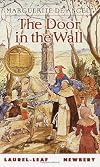
The kids and I read this very slowly over several months as part of one of our homeschool co-ops group read-alouds. Yes, I'll admit it, I cried at the end and the kids all laughed at me! BUT---I did see one of my boys wiping away some tears too!
Written in 1949, this sweet story tells the tale of Robin, son of nobleman Sir John de Bureford. From Amazon: "Ever since he can remember, has been told what is expected of him as the son of a nobleman. He must learn the ways of knighthood. But show more Robin's destiny is changed in one stroke: He falls ill and loses the use of his legs. Fearing a plague, his servants abandon him and Robin is left alone. A monk named Brother Luke rescues Robin and takes him to the hospice of St. Mark's where he is taught woodcarving and--much harder--patience and strength. Says Brother Luke, 'Thou hast only to follow the wall far enough and there will be a door in it.'"
We had several great discussions about this book---mainly what "the door in the wall" really means. We decided it referred to an opportunity---the chance to change one's course, simply by walking through an available door.
Some of the kids are already asking to reread it, so I'm thinking a second copy is in order. I know our family will cherish this story for years to come! show less
Written in 1949, this sweet story tells the tale of Robin, son of nobleman Sir John de Bureford. From Amazon: "Ever since he can remember, has been told what is expected of him as the son of a nobleman. He must learn the ways of knighthood. But show more Robin's destiny is changed in one stroke: He falls ill and loses the use of his legs. Fearing a plague, his servants abandon him and Robin is left alone. A monk named Brother Luke rescues Robin and takes him to the hospice of St. Mark's where he is taught woodcarving and--much harder--patience and strength. Says Brother Luke, 'Thou hast only to follow the wall far enough and there will be a door in it.'"
We had several great discussions about this book---mainly what "the door in the wall" really means. We decided it referred to an opportunity---the chance to change one's course, simply by walking through an available door.
Some of the kids are already asking to reread it, so I'm thinking a second copy is in order. I know our family will cherish this story for years to come! show less

Too much, too twee, and too dated. I suppose that it was nice, back in the day, to only have to buy one book to get a "treasury" of rhymes and pictures, but I can't imagine many families today being interested. I'm not, and I *am* the target audience.
One of the biggest problems is that there is no organization. No titles, no page breaks, much less any sort of chapter breaks to sort theme or subject. A new verse might be a new poem, or a continuation of a longer poem, but there's no way to show more tell. Related issue: the answers to the riddles are typed immediately below, right side up, so no chance to guess them.
Amateur scholars might like it - it's interesting to learn, for example, how many verses some rhymes have, when we know them only by their first verse. And there's a story I love about the man & wife trading chores for the day, that here is represented in rhyme... the prose adaptations I've read are more successful, but the poem does have it's own charm.
Unfortunately, the illustrations, imo, don't succeed. They look, to me, as if someone took de Angeli's pieces, artificially distressed them, and then printed them for the book. (I don't know anything about bookmaking technology though, so I have no idea.... I'm just saying.)
In order to avoid having to choose a star rating, I chose to skip many of the verses. But I did turn every page and skim the entire book. show less
One of the biggest problems is that there is no organization. No titles, no page breaks, much less any sort of chapter breaks to sort theme or subject. A new verse might be a new poem, or a continuation of a longer poem, but there's no way to show more tell. Related issue: the answers to the riddles are typed immediately below, right side up, so no chance to guess them.
Amateur scholars might like it - it's interesting to learn, for example, how many verses some rhymes have, when we know them only by their first verse. And there's a story I love about the man & wife trading chores for the day, that here is represented in rhyme... the prose adaptations I've read are more successful, but the poem does have it's own charm.
Unfortunately, the illustrations, imo, don't succeed. They look, to me, as if someone took de Angeli's pieces, artificially distressed them, and then printed them for the book. (I don't know anything about bookmaking technology though, so I have no idea.... I'm just saying.)
In order to avoid having to choose a star rating, I chose to skip many of the verses. But I did turn every page and skim the entire book. show less
After not really liking Adam of the Road by Elizabeth Janet Gray, I was a bit hesitant with this one as I saw similar plot areas in a similar setting. However, this was its own story and offered a few areas of enjoyment when looking over the whole scope of the story. This was a family read for us which I always have a soft spot for stories we do together as a family and it's interesting to see how a story from 1949 can resonate with younger kids (9 and 7 year old girls) and us big kids. The show more style and pacing is not something you'd have today. There's no anachronistic language or politics or behaviors. De Angeli does a great job of keeping some of the "ye ol'" language in while still allowing it to be readable and her naming of time period accurate items made the story seem a lot older than I thought it was - in a good way.
What impressed me the most was de Angeli's main character Robin going through the character growth arc that he did. There are small moments which the character chooses to make choices that either allows him the possibility to grow and get outside of his own head or to stay festering in self-loathing and frustration. And like any normal boy youth, he succeeds and fails and often times without even realizing it. And as the reader this was true for me too. Other than one really big set piece that shows his arc leading up to this moment these small shifts in characters ring true the meaning of the book's title of having a simple door in the wall he's facing to either go through or not. In fact, I really wasn't sure I was going to be overly poisitive with the story until the ending where you got to see his more mature choices that he would have never made in the beginning. And the final chapter is really a stand out one to pause and added to the bulk of our family reading discussion. This isn't a story like The Three Musketeers where it's swashbuckling and intrigue. It's a simple story that lends to the discussion about virtue when learning, how to tackle adversity, and how youth is not an excuse for sentimental immorality.
Brother Luke and minstrel John Go-in-the-Wynd join Robin on his journey. Brother Luke is a regular, pious friar who encourages Robin without brow beating him but pushes him where he needs to be encouraged. The minstrel also offers assitance as a friend without being condescending to Robin. There's no liar-revealed-trop here or friends-to-enemies-to-friends-again. In fact, the only diservice that I think is done is from the cover of my copy that makes all three seem silly looking and a bungling comedy is about to take place.
I think this book for us moderns is a sleeper that might stay with you a bit longer if you let it. If your nihilism and sarcasm can be staved off for a bit, you'll be able to enjoy this book of virtue living in the small moments that drive our big character moments. Final Grade - B show less
What impressed me the most was de Angeli's main character Robin going through the character growth arc that he did. There are small moments which the character chooses to make choices that either allows him the possibility to grow and get outside of his own head or to stay festering in self-loathing and frustration. And like any normal boy youth, he succeeds and fails and often times without even realizing it. And as the reader this was true for me too. Other than one really big set piece that shows his arc leading up to this moment these small shifts in characters ring true the meaning of the book's title of having a simple door in the wall he's facing to either go through or not. In fact, I really wasn't sure I was going to be overly poisitive with the story until the ending where you got to see his more mature choices that he would have never made in the beginning. And the final chapter is really a stand out one to pause and added to the bulk of our family reading discussion. This isn't a story like The Three Musketeers where it's swashbuckling and intrigue. It's a simple story that lends to the discussion about virtue when learning, how to tackle adversity, and how youth is not an excuse for sentimental immorality.
Brother Luke and minstrel John Go-in-the-Wynd join Robin on his journey. Brother Luke is a regular, pious friar who encourages Robin without brow beating him but pushes him where he needs to be encouraged. The minstrel also offers assitance as a friend without being condescending to Robin. There's no liar-revealed-trop here or friends-to-enemies-to-friends-again. In fact, the only diservice that I think is done is from the cover of my copy that makes all three seem silly looking and a bungling comedy is about to take place.
I think this book for us moderns is a sleeper that might stay with you a bit longer if you let it. If your nihilism and sarcasm can be staved off for a bit, you'll be able to enjoy this book of virtue living in the small moments that drive our big character moments. Final Grade - B show less
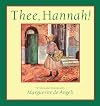
First sentence: Hannah stopped talking for a moment to listen to the night watch cry out the time. She heard the cry again, going on down the block, "Nine o'clock," and went on talking.
My thoughts, part one: Thee, Hannah may have the dimensions of a picture book, but it is not a picture book. It is not an early chapter book. Yes, it has illustrations--occasionally--but consider it more a novel in a very odd format.
Premise/plot: Hannah, our heroine, is a Quaker. Hannah spends most of the show more novel feeling out of sorts about that. Why can't she dress like others? Why can't she talk like others? Why can't she be more like others? She isn't necessarily questioning faith--just how that faith is lived out. And not questioning in a twentieth-century or twenty-first century way. Hannah is not deconstructing. She's just wanting to wear a different kind of bonnet, a bonnet more like her friends wear. She dreams about owning a red dress, for example. Or having a sash like her friend has. The book doesn't have much of a plot--not really. It's just Hannah being Hannah day after day, week after week, month after month. It does offer a glimpse of the Quaker way of life in the nineteenth century. But is that a plot? Maybe. Maybe not. The most eventful event of the novel is when Hannah helps a runaway slave. (Her family--like many Quakers--were part of the underground railroad).
My thoughts: I like historical fiction, generally. I like classics, mostly. I wasn't expecting this to be so text-heavy because of the [deceptive] picture book format. Maybe this was not an unusual format or layout in 1940. The novel is definitely a quiet, simple book. Definitely character driven and not plot-driven. Will the novel be easy to sell to children in 2023? I doubt it. I think the book could still be enjoyed by readers of various ages, but it will be a special reader that will be the best match.
I do think that religion and spirituality are rarely tackled in modern writing and publishing. So it was nice that faith was so matter-of-fact in this story. show less
My thoughts, part one: Thee, Hannah may have the dimensions of a picture book, but it is not a picture book. It is not an early chapter book. Yes, it has illustrations--occasionally--but consider it more a novel in a very odd format.
Premise/plot: Hannah, our heroine, is a Quaker. Hannah spends most of the show more novel feeling out of sorts about that. Why can't she dress like others? Why can't she talk like others? Why can't she be more like others? She isn't necessarily questioning faith--just how that faith is lived out. And not questioning in a twentieth-century or twenty-first century way. Hannah is not deconstructing. She's just wanting to wear a different kind of bonnet, a bonnet more like her friends wear. She dreams about owning a red dress, for example. Or having a sash like her friend has. The book doesn't have much of a plot--not really. It's just Hannah being Hannah day after day, week after week, month after month. It does offer a glimpse of the Quaker way of life in the nineteenth century. But is that a plot? Maybe. Maybe not. The most eventful event of the novel is when Hannah helps a runaway slave. (Her family--like many Quakers--were part of the underground railroad).
My thoughts: I like historical fiction, generally. I like classics, mostly. I wasn't expecting this to be so text-heavy because of the [deceptive] picture book format. Maybe this was not an unusual format or layout in 1940. The novel is definitely a quiet, simple book. Definitely character driven and not plot-driven. Will the novel be easy to sell to children in 2023? I doubt it. I think the book could still be enjoyed by readers of various ages, but it will be a special reader that will be the best match.
I do think that religion and spirituality are rarely tackled in modern writing and publishing. So it was nice that faith was so matter-of-fact in this story. show less
Lists
Best Young Adult (1)
1970s (1)
Ambleside Y2 (1)
Ambleside Books (1)
Sonlight Books (3)
Newbery Adjacent (2)
4th Grade Books (1)
Precious People (1)
Elevenses (1)
Books About Boys (1)
Favorite Books (1)
Awards


You May Also Like


Associated Authors
Statistics
- Works
- 40
- Also by
- 33
- Members
- 12,504
- Popularity
- #1,876
- Rating
- 3.8
- Reviews
- 124
- ISBNs
- 108
- Languages
- 5
- Favorited
- 11