

John Lukacs (1924–2019)
Author of Five Days in London: May 1940
About the Author
John Lukacs was born Janos Adalbert Lukacs in Budapest, Hungry on January 31, 1924. His father was Catholic and his mother was Jewish. He received an advanced degree in history from the University of Budapest. Although he was a practicing Catholic, he was considered Jewish enough to be conscripted show more into an army labor battalion when the Nazis occupied Hungary. He deserted in late 1944. When things did not improve under Soviet occupation and a Communist government, he fled illegally to the United States in July 1946. He was hired as a part-time lecturer in history at Columbia University to accommodate an influx of returning veterans. In 1947, he was hired by Chestnut Hill College in Philadelphia to teach full time. He taught there for 47 years, retiring in 1994. He wrote numerous books including The Last European War; Confessions of an Original Sinner; The Duel: The Eighty-Day Struggle Between Churchill and Hitler; The Hitler of History; A Student's Guide to the Study of History; Churchill: Visionary. Statesman. Historian.; At the End of an Age; George Kennan: A Study of Character; and A Short History of the Twentieth Century. He died from heart failure on May 6, 2019 at the age of 95. (Bowker Author Biography) show less
Image credit: via Goodreads
Works by John Lukacs
Blood, Toil, Tears and Sweat: Winston Churchill and the Speech That Saved Civilization (2007) 115 copies, 5 reviews
A Student's Guide to European History 45 copies
George F. Kennan and the Origins of Containment, 1944-1946: The Kennan-Lukacs Correspondence (1997) 16 copies
Through the History of the Cold War: The Correspondence of George F. Kennan and John Lukacs (2010) 16 copies
Booknotes: Hitler of History 2 copies
Associated Works
The Old Regime and the French Revolution (1856) — Translator, some editions — 1,525 copies, 9 reviews
What If? 2: Eminent Historians Imagine What Might Have Been (2001) — Contributor — 1,088 copies, 11 reviews
A World of Ideas : Conversations With Thoughtful Men and Women About American Life Today and the Ideas Shaping Our Future (1989) — Interviewee — 603 copies, 1 review
What Ifs? of American History : Eminent Historians Imagine What Might Have Been (2003) — Contributor — 537 copies, 7 reviews
A Sense of History: The Best Writing from the Pages of American Heritage (1985) — Contributor — 491 copies, 4 reviews
Novel History: Historians and Novelists Confront America's Past and Each Other (2001) — Contributor — 139 copies, 1 review
The European Revolution & Correspondence with Gobineau (1959) — Editor, some editions; Translator, some editions — 28 copies, 1 review
Tagged
Common Knowledge
- Legal name
- Lukacs, John Adalbert
- Birthdate
- 1924-01-31
- Date of death
- 2019-05-06
- Gender
- male
- Education
- University of Budapest
- Occupations
- historian
author - Organizations
- Chestnut Hill College
- Nationality
- Hungary (birth)
USA - Birthplace
- Budapest, Hungary
- Places of residence
- New York, New York, USA
- Place of death
- Phoenixville, Pennsylvania, USA
- Map Location
- Hungary
Members
Discussions
Folio Archives 384: Five Days in London, May 1940 by John Lukacs - 2011 in Folio Society Devotees (July 2024)
Reviews

A nice piece of micro-history by a Czech historian with a crush on WSC. Redolent of "the Day Lincoln Was Shot", it's a lively look at the British decision to fight on after the fall of France in 1940. Lukacs jokes that his next book will be entitled "The Forty-five Minutes", a look at just the portion of the Cabinet Meeting at which the decision was made, but I think he could stop here! Just the right amount of detail for this type of thing. Read it!

Lukacs opens this book with the claim that: “There is no serious history of the twentieth century, that I know of.” He thus manages to be both arrogant and wrong before he’s even finished the first sentence. There are, in fact, at least a half-dozen– by historians like Eric Hobsbawm, Jeremy Black, Martin Gilbert, and Paul Johnson – nearly all of which would make a better introduction to the humankind’s last, most tumultuous hundred years.
The history offered here is, indeed, short show more at 228 pages. It’s also incomplete – Lukacs’ twentieth century runs from 1914 to 1989, and thus clocks in at a tidy 75 years – and riddled with factual errors ranging from the trivial (Warren Harding’s campaign slogan) to the jaw-dropping (getting the location of Pakistan wrong by 1000 miles; erasing three major wars from the history of 19C South America). It is also aggressively Eurocentric: spending chapters on that continent’s internal politics (particularly between 1920 and 1945) while glossing over the internal affairs of Asia, Latin America, and Africa in the broadest and vaguest of terms. The handling of post-colonial Africa is broad, dismissive, and dark enough that it dances up to the very edge of being racist caricature.
Readers already familiar with the history of the last century may well enjoy Lukacs’ take on it. He is fiercely opinionated and, as a self-proclaimed “reactionary,” perpetually and intensely cranky about this most modern (and modernizing) of centuries . . . all of which makes him fun to argue with. This should not, however, be anybody’s first (or second) book on the subject: Too much is left out, too much is gotten wrong, and too much is distorted.
(The views expressed here are developed at greater length, backed up by examples, at: http://www.popmatters.com/review/175997-a-brief-history-of-the-twentieth-century... ) show less
The history offered here is, indeed, short show more at 228 pages. It’s also incomplete – Lukacs’ twentieth century runs from 1914 to 1989, and thus clocks in at a tidy 75 years – and riddled with factual errors ranging from the trivial (Warren Harding’s campaign slogan) to the jaw-dropping (getting the location of Pakistan wrong by 1000 miles; erasing three major wars from the history of 19C South America). It is also aggressively Eurocentric: spending chapters on that continent’s internal politics (particularly between 1920 and 1945) while glossing over the internal affairs of Asia, Latin America, and Africa in the broadest and vaguest of terms. The handling of post-colonial Africa is broad, dismissive, and dark enough that it dances up to the very edge of being racist caricature.
Readers already familiar with the history of the last century may well enjoy Lukacs’ take on it. He is fiercely opinionated and, as a self-proclaimed “reactionary,” perpetually and intensely cranky about this most modern (and modernizing) of centuries . . . all of which makes him fun to argue with. This should not, however, be anybody’s first (or second) book on the subject: Too much is left out, too much is gotten wrong, and too much is distorted.
(The views expressed here are developed at greater length, backed up by examples, at: http://www.popmatters.com/review/175997-a-brief-history-of-the-twentieth-century... ) show less

The late John Lukacs (d. 2019) was an opinionated cuss, so he rubs some folks the wrong way. But, I respect immensely his depth of knowledge on the Second World War, Churchill, and Hitler in particular. (Aside from maybe Ian Kershaw, Richard Evans, or Richard Overy, nobody could touch him on the historiography of Hitler.) Reaching back a bit and forward a bit, Lukacs details the events of May 24 to May 28, five days, in London.
His thesis is that it was in those days that Churchill, through show more his steadfastness and gumption, won the Second World War, or, rather did not lose it. (Lukacs says only the USA and USSR won the war, but the UK could have lost it. Lukacs also said that Hitler could have come out with a win or draw if he, perhaps, took Moscow and collapsed the USSR or defeated the Western allies at D-Day. But, (p. 189), Hitler could have won HIS war, Lukacs states, if Churchill had capitulated or Halifax had taken over and capitulated. (Dubious, perhaps, as Hitler, even with a defeated UK, probably would have rushed headlong into Russia. Perhaps without US and UK help the Soviet Union may have been defeated. But that's a big if. Ask Napoleon.)
I disagree with Lukacs, though, and wholeheartedly when he says this (p. 217): "The greatest threat to Western civilization was not Communism. It was National Socialism." First, I consider National Socialism and Communist Socialism to be step-brothers, and equally evil. I see not a spit-worth of difference between Hitler controlling Europe and Stalin controlling Europe. Both are totalitarian, statist, and purveyors of executions galore. Both are evil, none more evil than the other. He continues a theme he picks up in The Hitler of History, that (pp. 217-218) Hitler was "the greatest revolutionary of the twentieth century... merging nationalism and socialism into one tremendous force...." On that he may have a point.
But, kudos to Churchill, who was resolute, determined, dogged, and an instrument of Providence. "At best," Lukacs sums up, "civilization may survive, at least in some small part due to Churchill in 1940" (p. 219).
Photos, extensive footnotes (many discursive), bibliography, index. show less
His thesis is that it was in those days that Churchill, through show more his steadfastness and gumption, won the Second World War, or, rather did not lose it. (Lukacs says only the USA and USSR won the war, but the UK could have lost it. Lukacs also said that Hitler could have come out with a win or draw if he, perhaps, took Moscow and collapsed the USSR or defeated the Western allies at D-Day. But, (p. 189), Hitler could have won HIS war, Lukacs states, if Churchill had capitulated or Halifax had taken over and capitulated. (Dubious, perhaps, as Hitler, even with a defeated UK, probably would have rushed headlong into Russia. Perhaps without US and UK help the Soviet Union may have been defeated. But that's a big if. Ask Napoleon.)
I disagree with Lukacs, though, and wholeheartedly when he says this (p. 217): "The greatest threat to Western civilization was not Communism. It was National Socialism." First, I consider National Socialism and Communist Socialism to be step-brothers, and equally evil. I see not a spit-worth of difference between Hitler controlling Europe and Stalin controlling Europe. Both are totalitarian, statist, and purveyors of executions galore. Both are evil, none more evil than the other. He continues a theme he picks up in The Hitler of History, that (pp. 217-218) Hitler was "the greatest revolutionary of the twentieth century... merging nationalism and socialism into one tremendous force...." On that he may have a point.
But, kudos to Churchill, who was resolute, determined, dogged, and an instrument of Providence. "At best," Lukacs sums up, "civilization may survive, at least in some small part due to Churchill in 1940" (p. 219).
Photos, extensive footnotes (many discursive), bibliography, index. show less
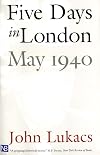
An interesting examination of what Lukacs contends as being a period of time when Hitler was never closer to winning his war in Europe. In May 1940, a number of key factors were at play: Hitler’s driving forces had France on the verge of defeat; Belgium surrender to Germany and the British Expeditionary Forces found themselves holed up on the coast of Dunkirk with no allied assistance to back them up. Compounding the situation was the fact that the current majority in the British show more Parliament, was currently tolerating Hitler’s growing presence on the continent. Lukacs arrives at his conclusion through a myriad of information gleaned from the memoirs and public/private papers of various key players such as Lord Halifax and Neville Chamberlain. The fact that Churchill was still new in his role as Prime Minister (he was appointed by King George V to the role only on May 10th) is of note, as is the criticism (unknown to Churchill at the time) American President Franklin D. Roosevelt held of Churchill’s abilities. The fact that Churchill remained resolute that any accommodation with Hitler would lead to the eventual demise of Britain and Europe, shows a strength of character deserving of praise. While there is a fair bit of focus on the debate going on in the British War Cabinet of how best to proceed, this is important as Lukacs is able to demonstrate how Churchill used personal diplomacy and moral persuasion to bring the War Cabinet to his line of thinking and to overcome Lord Halifax and the distrust Churchill faced from a number of his colleagues. Lukacs also provides the reader with interesting public opinion barometric pressure readings gleaned from various newspaper polls, giving the book a more “point in time” of the British feelings at the time, and how calm British stoicism was at play, even during those uncertain days.
Whether Lukacs is correct in his premise – that those last days in May of 1940 were the closest Hitler ever came to winning his war against Europe – is anyone’s personal opinion. Either way, Lukacs writes in an informative manner. As a fond observer of human behaviour, I really enjoyed the inclusion of the personal opinions of various key players as they really helped shape the developments for me. On a possible downside, I listened to the audiobook version and found that some of the footnotes tended to interrupt the rhythmic flow of Lukacs’ writing.
A solid read for anyone interested in Churchill, the early period of WWII or political diplomacy in general. show less
Whether Lukacs is correct in his premise – that those last days in May of 1940 were the closest Hitler ever came to winning his war against Europe – is anyone’s personal opinion. Either way, Lukacs writes in an informative manner. As a fond observer of human behaviour, I really enjoyed the inclusion of the personal opinions of various key players as they really helped shape the developments for me. On a possible downside, I listened to the audiobook version and found that some of the footnotes tended to interrupt the rhythmic flow of Lukacs’ writing.
A solid read for anyone interested in Churchill, the early period of WWII or political diplomacy in general. show less
Lists
Awards


You May Also Like


Associated Authors
Statistics
- Works
- 52
- Also by
- 10
- Members
- 4,117
- Popularity
- #6,113
- Rating
- 3.7
- Reviews
- 66
- ISBNs
- 236
- Languages
- 17
- Favorited
- 8