

Aranka Siegal
Author of Upon the Head of the Goat: A Childhood in Hungary 1939-1944
About the Author
Works by Aranka Siegal
All’inferno e ritorno. 1 copy
Tagged
Common Knowledge
- Other names
- Davidowitz, Aranka
- Birthdate
- 1930-06-10
- Gender
- female
- Education
- New York University (BS|Social Anthropology)
- Occupations
- writer
Holocaust survivor
teacher
autobiographer
public speaker - Short biography
- Aranka Siegal, née Meizlik, was born to a large Jewish family in Beregszász, Czechoslovakia (present-day Berehove, Ukraine). Her parents were Rise Rosner and her first husband Meyer Meizlik, who died when Aranka was a baby. Her mother changed their surname to Davidowitz after her second marriage to Ignac Davidowitz. During World War II, some of Aranka's siblings and other relatives were taken away by the Nazis. In 1944, when she was 13, Aranka, her mother, and her siblings Iboya, Sándor, and Joli were forced into the Beregszász ghetto, before being deported to the Nazi death camp at Auschwitz. There Aranka and her older sister Iboya were separated from the rest of the family and never saw them again. They were later sent to Bergen-Belsen. In April 1945, the two girls were liberated by British troops and taken to Sweden by the Swedish Red Cross to recover. They emigrated to the USA in 1948. In 1951, at age 21, Aranka married Gilbert Siegal, a lawyer who had served as an officer in the U.S. Air Force during the war. They lived in the suburbs of New York City, where they raised their two children. In her mid-forties, Aranka went back to school and earned a bachelor's degree in social anthropology from New York University in 1977. That same year, she began hosting a radio show on which she talked about her experiences during the Holocaust. She also became a substitute teacher and lecturer in schools and colleges. In 1981, she published the first of her three autobiographical books, Upon the Head of the Goat: A Childhood in Hungary, 1930-1944, which won the Newbery Honor and Boston Globe-Horn Book Award in 1982. Subsequent volumes in the series were Grace in the Wilderness: After the Liberation 1945-1948 (2003), and Memories of Babi (2008), a series of stories based on her childhood visits to her maternal grandmother on her farm in the Carpathian Mountains. Her books have been translated into many different languages including French, Hungarian, Italian, Japanese, Dutch, and German.
- Nationality
- USA
Czechoslovakia (birth) - Birthplace
- Berehove, Ukraine
Beregszász, Czechoslovakia - Places of residence
- Hungary
Sweden
USA
Aventura, Florida, USA
Members
Reviews
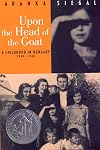
Aranka Siegal’s memoir Upon the Head of the Goat: A Childhood in Hungary 1939-1944 is a depiction of her life as a young girl during the World War II era. Known as Piri, Siegal introduces the audience to her experiences of being a Jew living in Europe and having to face the ravages of the Holocaust.
She enlightens the reader by providing a full context of the increasing perils which climaxed into the mass killing of Jews during this period. Siegal begins with her time spent with her show more grandmother and leads in to the beginning processes of war. At this point, few of life’s daily activities were disturb, but such events as the bodies floating down river foreshadowed the coming perils not realized by her and her family at the time. This keeps the reader engaged and wondering if the family will be out of the reach of the German forces. Siegal transitions more and more into the dangers of the time and struggles many felt as a consequence of war. In a brilliant way, the context of this work builds the reader a vivid image of living life in an atmosphere of the unknown and unexpected. It infers that no one could have known or anticipated the severe totality of destruction which would befall upon them.
As a resource to teach about the Holocaust, this memoir would be ideal for the reasons stated above. Students would be engaged and enjoy how Siegal narrative would help provide a fully developed perspective of events. One shortcoming would be that the book does not offer leads to other resources that would further expand upon her work and other events of the Holocaust. show less
She enlightens the reader by providing a full context of the increasing perils which climaxed into the mass killing of Jews during this period. Siegal begins with her time spent with her show more grandmother and leads in to the beginning processes of war. At this point, few of life’s daily activities were disturb, but such events as the bodies floating down river foreshadowed the coming perils not realized by her and her family at the time. This keeps the reader engaged and wondering if the family will be out of the reach of the German forces. Siegal transitions more and more into the dangers of the time and struggles many felt as a consequence of war. In a brilliant way, the context of this work builds the reader a vivid image of living life in an atmosphere of the unknown and unexpected. It infers that no one could have known or anticipated the severe totality of destruction which would befall upon them.
As a resource to teach about the Holocaust, this memoir would be ideal for the reasons stated above. Students would be engaged and enjoy how Siegal narrative would help provide a fully developed perspective of events. One shortcoming would be that the book does not offer leads to other resources that would further expand upon her work and other events of the Holocaust. show less

This memoir follows Piri, a young girl in a mid-to-lower class Jewish family living in Hungary during WWII, through hearing rumors of mistreatment of Jews in other areas, to being evacuated from their home and moved into a ghetto, and ends with them being packed into the train headed for Auschwitz. It's sad and moving and terrifying, and, I think, one of the more mature picks for the Newbery Honor list I've read (which are generally books aimed at middle grade readers - I'd put this one show more firmly in the YA category). Guardedly recommended - it's certainly not a happy read, but fairly well done for what it is. show less
A heartwrenching Holocaust memoir, this text stands apart from other books on the topic. Told by Holocaust survivor Aranka ("Piri") Seagal, "Upon the Head of the Goat" vividly details the hardships of the Jewish community in Hungary during World War II. Seagal's unflinching on her family, their hardships, tales of bravery, and their network of friends and neighbors in Beregszasz compells readers to form a deep connection with the characters. Seagal tells the story as objectively as possible, show more allowing readers to form their own emotions and repsonses. While I believe this text would be very challenging for a middle or high school audience, I think it would be extremely worthwhile. I highly recommend this book as an alternative to reading Elie Wiesel's "Night." I hope to see it on the shelves of every middle and high school library. show less
Upon the Head of the Goat is the memoir of a young Hungarian girl who grew up during the beginning of World War II. The story chronicles her life in three locations, which underscore the events in history. She begins in the Ukrainian countryside, where she is open and free with her grandmother, then moves with her mother to the more closed in city in Hungary as events and atrocities begin to intensify, and finally to the ghetto where all of the Jewish families are thrown into close quarters show more and squalor to await an unknown fate.
This book differs from many holocaust era memoirs in that it transpires entirely during the buildup of events, and does not describe the authors experiences in a concentration camp or similar situations. Because of this, it provides a more relatable story for the average reader who can never truly empathize with holocaust suffering.
This book does not standout as the most memorable of book I have read of the genre. Perhaps because the author does not seem concerned with time passing as a frame of reference, which makes it sometimes hard to keep in mind exactly how old the author is, or the other characters are in relation to her.
The reading level is not too advanced, and it does not aim to deliberately shock the sensibilities, making it an appropriate read for a younger, perhaps middle school level, audience. show less
This book differs from many holocaust era memoirs in that it transpires entirely during the buildup of events, and does not describe the authors experiences in a concentration camp or similar situations. Because of this, it provides a more relatable story for the average reader who can never truly empathize with holocaust suffering.
This book does not standout as the most memorable of book I have read of the genre. Perhaps because the author does not seem concerned with time passing as a frame of reference, which makes it sometimes hard to keep in mind exactly how old the author is, or the other characters are in relation to her.
The reading level is not too advanced, and it does not aim to deliberately shock the sensibilities, making it an appropriate read for a younger, perhaps middle school level, audience. show less
Lists
Awards


You May Also Like


Statistics
- Works
- 4
- Members
- 764
- Popularity
- #33,304
- Rating
- 3.8
- Reviews
- 34
- ISBNs
- 42
- Languages
- 4
- Favorited
- 1