
Timothy Zahn
Author of Heir to the Empire
About the Author
Timothy Zahn was born in Chicago, Illinois on September 1, 1951. He received a B.S. degree in physics from Michigan State University in East Lansing in 1973 and a M.S. degree in physics from the University of Illinois in Champaign-Urbana in 1975. In 1975, Zahn began writing science fiction as a show more hobby. When his thesis advisor died in 1979, effectively wiping out three years of work, he decided to try making a living at writing. Since then, Zahn has published short stories, novelettes, novels, and short fiction collections. He is best known for writing the Star Wars the Thrawn Trilogy: Heir to the Empire, Dark Force Rising, and The Last Command. The novella, Cascade Point (1984) won a Hugo Award. He also writes numerous series including Cobra, Blackcollar, Dragonback, and Conquerors' Trilogy. Zahn co-authored with David Weber A Call To Duty, the first book in the Manticore Ascendant Series, which made the New York Times bestseller list in October 2014. (Bowker Author Biography) show less
Image credit: Timothy Zahn en 2017
Series
Works by Timothy Zahn
The Dragonback Series Books 1–3: Dragon and Thief, Dragon and Soldier, and Dragon and Slave (2018) 68 copies, 1 review
Winner Lose All--A Lando Calrissian Tale: Star Wars Legends (Novella) (Star Wars - Legends) (2012) 67 copies, 1 review
The Dragonback Series Books 4–6: Dragon and Herdsman, Dragon and Judge, Dragon and Liberator (2018) 39 copies
Blackcollar: 3 Romane in einem Band: Die Blackcollar-Elite. Die Backlash-Mission. Die Judas-Variante (2008) 14 copies
Cascade Point [novella] 12 copies
Star Wars: Judge's Call 8 copies
Star Wars Short Story Collection — Contributor — 2 copies
A Matter of Trust 2 copies
Side Trip [novella] 2 copies
Return To The Fold 2 copies
The Art of War [short story] 2 copies
Hitmen—See Murderers 2 copies
An act of war 2 copies
Raison d'Etre 2 copies
℗L'℗orbita di metallo 1 copy
Del Rey 2017 Sampler 1 copy
Star Song [short story] 1 copy
The Giftie Gie Us 1 copy
Tree of Life (Wayward Pines) 1 copy
The Dreamsender 1 copy
Duel 1 copy
Banshee 1 copy
Válaszutak 1 copy
For the Love of Amanda 1 copy
Point Man 1 copy
The Play's the Thing 1 copy
Ernie 1 copy
Houseguest 1 copy
Star Wars Special #5 1 copy
Jade Solitaire 1 copy
Side Trip Part 04 1 copy
The President's Doll 1 copy
Side Trip Part 01 1 copy
Heist 1 copy
Buyer's Market 1 copy
The Energy Crisis Of 2215 1 copy
The Shadows Of Evening 1 copy
Time Bomb [short story] 1 copy
The Ring 1 copy
Trollbridge [novelette] 1 copy
Hero of Cart: Hero's Call 1 copy
Hero of Cart: Hero's End 1 copy
Pawn to King Four 1 copy
Justice Machine {novelette} 1 copy
A Call to Arms [novella] 1 copy
I Figli Del Potere 1 copy
Condon Sanitaire [novella] 1 copy
Cordon Santaire 1 copy
Analog Science Fiction 1 copy
The Peacemakers 1 copy
Not Always To The Strong 1 copy
Black Thoughts At Midnight 1 copy
Handoff 1 copy
The Challenge 1 copy
The Cassandra 1 copy
Dragon Pax 1 copy
Job Inaction 1 copy
Teamwork 1 copy
Dark Thoughts At Noon 1 copy
L'ORBITA DI METALLO 1 copy
The Peaceful Man 1 copy
The Outbreak Paradox 1 copy
Guardian Angel 1 copy
Expanded Charter 1 copy
Final Solution 1 copy
Associated Works
Twilight Zone: 19 Original Stories on the 50th Anniversary (2009) — Contributor — 145 copies, 3 reviews
Isaac Asimov's Wonderful Worlds of Science Fiction, Volume 7: Space Shuttles (1987) — Author — 90 copies, 1 review
Analog Science Fiction/Science Fact: Vol. CII, No. 1 (January 1982) (1982) — Contributor — 20 copies
Analog Science Fiction/Science Fact: Vol. CI, No. 4 (March 30, 1981) (1981) — Contributor — 16 copies
Analog Science Fiction/Science Fact: Vol. CIII, No. 13 (December 1983) (1983) — Contributor — 14 copies
Isaac Asimov's Science Fiction Magazine: Vol. 6, No. 2 [February 1982] (1982) — Contributor — 11 copies
FenCon XI: The University of FenCon — Contributor — 1 copy
Tagged
Common Knowledge
- Birthdate
- 1951-09-01
- Gender
- male
- Education
- Michigan State University (BS|Physics, 1973)
University of Illinois, Urbana-Champaign (MS|Physics, 1975) - Organizations
- Science Fiction and Fantasy Writers of America
- Awards and honors
- Scribe Award (Grandmaster, Faust Award, 2016)
- Nationality
- USA
- Birthplace
- Chicago, Illinois, USA
- Places of residence
- Bandon, Oregon, USA
Chicago, Illinois, USA (birth) - Associated Place (for map)
- USA
Members
Discussions
Cobra in Good Show Sir! — bad science fiction and fantasy covers (May 9)
Sci Fi - Humans kind under attack from mysterious aliens in Name that Book (July 2010)
Reviews
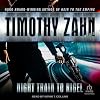
Timothy Zahn is a journeyman author who knows how to play with the tropes of several genres. He knows, for example, that trains are more fun than starships as settings for espionage thrillers. So how about a starship that is a train? In Night Train to Rigel, a not-quite-former covert agent travels on a spacefaring train catering to a whole Star Wars cantina of alien races and run by sentient spiders. The story makes direct and appropriate allusions to Alfred Hitchcock’s The Lady Vanishes show more and North by Northwest. There is even a scene where our hero crawls out on the roof to travel between cars. And here is a future spy-craft tip: never touch the Modhran coral. show less
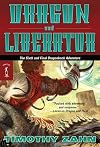
The time has come for Jack and Draycos to fulfill their destiny, or die trying. The K’da/Shontine refugee fleet has nearly completed its two years of faster-than-light travel, fleeing across the void between adjacent spiral arms of the galaxy. Despite all of their efforts, their enemies have assembled an attack force at the rendezvous point for the refugee fleet.
The time has also come for answers. Who are the K’da, and where did they come from? Why are their enemies willing to pursue show more them beyond the edge of the world? Who is Alison Kayna, and whom does she work for? What exactly is the connection between Jack and Draycos, and and why do they ‘nick’?
By now, we also have many answers. We learned in the last volume that Jack’s parents were Judge-Paladins, the circuit judges of the Orion Arm, empowered to hear cases and dispense justice anywhere they might find themselves. While we don’t learn precisely what the limits of their power or jurisdiction are, we do know that are granted ships of unusual power, speed, and armament, such as the one Virgil Morgan stole from Jack’s parents.
I found Zahn’s description of the badges of authority of a Judge-Paladin fascinating: their distinctive hats were a combination of a biretta and a tricorn hat. As a Catholic convert, and a reader of First Things magazine, that seems like a not entirely accidental combination. If someone were to boldly create a symbol of the late twentieth century project to marry orthodox Catholicism to the American Dream, this would be it.
While I’ve had some doubts about Zahn, I have absolutely nothing to make me think that Zahn is a secret disciple of Fr. Neuhaus. Nonetheless, this is a striking example of cultural convergence. I might dismiss it as a coincidence if it weren’t for the uncanny resemblance of Draycos’ ethics of war to the police model of the Catechism of the Catholic Church.
An interesting wrinkle in this theory is that book 6 is where the gloves come off. Up til now, Draycos has avoided intentional killing, except for book 1, where he executed a man who had killed a random passerby in an attempt to coerce Jack into helping with Arthur Neverlin’s grand conspiracy. Now that time is short, and the fate of his people hangs upon a precipice, Draycos is quicker to kill, and he even resorts to the use of the Death, the dreaded weapon of the Valahgua, smuggled into the Orion Arm to finish the fleeing refugees.
I saw a comment in another review that seems pertinent here. I hadn’t particularly noticed, but book 1 was a bit of a departure from Zahn’s usual style, and even a bit over the top in how the story and even the terminology was simplified. Now that we are down to book 6, I feel like Zahn has gotten more comfortable with the juvenile novel thing, and relaxed back into something that feels more normal for him.
Which is a good thing, insofar as Zahn skillfully wraps up all of his plot threads and hints from the previous five volumes into a hell of a conclusion. This is an excellent series, with some interesting ideas and especially well done character development. I encourage you to pick these books up. show less
The time has also come for answers. Who are the K’da, and where did they come from? Why are their enemies willing to pursue show more them beyond the edge of the world? Who is Alison Kayna, and whom does she work for? What exactly is the connection between Jack and Draycos, and and why do they ‘nick’?
By now, we also have many answers. We learned in the last volume that Jack’s parents were Judge-Paladins, the circuit judges of the Orion Arm, empowered to hear cases and dispense justice anywhere they might find themselves. While we don’t learn precisely what the limits of their power or jurisdiction are, we do know that are granted ships of unusual power, speed, and armament, such as the one Virgil Morgan stole from Jack’s parents.
I found Zahn’s description of the badges of authority of a Judge-Paladin fascinating: their distinctive hats were a combination of a biretta and a tricorn hat. As a Catholic convert, and a reader of First Things magazine, that seems like a not entirely accidental combination. If someone were to boldly create a symbol of the late twentieth century project to marry orthodox Catholicism to the American Dream, this would be it.
While I’ve had some doubts about Zahn, I have absolutely nothing to make me think that Zahn is a secret disciple of Fr. Neuhaus. Nonetheless, this is a striking example of cultural convergence. I might dismiss it as a coincidence if it weren’t for the uncanny resemblance of Draycos’ ethics of war to the police model of the Catechism of the Catholic Church.
An interesting wrinkle in this theory is that book 6 is where the gloves come off. Up til now, Draycos has avoided intentional killing, except for book 1, where he executed a man who had killed a random passerby in an attempt to coerce Jack into helping with Arthur Neverlin’s grand conspiracy. Now that time is short, and the fate of his people hangs upon a precipice, Draycos is quicker to kill, and he even resorts to the use of the Death, the dreaded weapon of the Valahgua, smuggled into the Orion Arm to finish the fleeing refugees.
I saw a comment in another review that seems pertinent here. I hadn’t particularly noticed, but book 1 was a bit of a departure from Zahn’s usual style, and even a bit over the top in how the story and even the terminology was simplified. Now that we are down to book 6, I feel like Zahn has gotten more comfortable with the juvenile novel thing, and relaxed back into something that feels more normal for him.
Which is a good thing, insofar as Zahn skillfully wraps up all of his plot threads and hints from the previous five volumes into a hell of a conclusion. This is an excellent series, with some interesting ideas and especially well done character development. I encourage you to pick these books up. show less
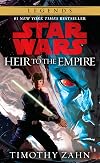
The story is as engaging as I remember it. Zahn deftly extrapolates the actions, concerns, relationships, and experiences of the familiar Star Wars characters from the original trilogy, while giving them new situations – threats and otherwise – to adapt to, managing to fill out even more of their stories through, for example, a visit to Chewie's home planet and yet another return trip to Dagobah for Luke. That the primary protagonists seem to keep ending up together in the places where show more the main action seems to be occurring is not more or less providential than in the original movies.
However, Zahn's genius has always been the introduction of his new antagonists: most importantly the alien Imperial strategist, Grand Admiral Thrawn (for whom the trilogy has been post hoc named), and the hate-filled Emperor's Hand, Mara Jade. Expertly crafted characters in their own rights, both are given plausible backstories as to how, despite being marginalized by the Empire (and the Emperor himself), they yet remain loyal to it (and him) in ways that exceed the rote conditioning of the average officer and stormtrooper in the Imperial Navy.
Perhaps more subtly inspired, and something that I had not picked up on with previous reads, is the use of Capt. Pallaeon and Talon Karrde to explicate the more fascinating personalities of Thrawn and Jade, respectively. Zahn uses these two characters in much the same way that Tolkien uses the hobbit characters (mostly) in [b:The Lord of the Rings|33|The Lord of the Rings (The Lord of the Rings, #1-3)|J.R.R. Tolkien|https://d.gr-assets.com/books/1411114164s/33.jpg|3462456] – what Michael Drout has called the "epistemic regime." The reader wonders and learns alongside Pallaeon and Karrde about the motives and insights of Thrawn and Jade, respectively, and while it's not quite as expertly done as in Tolkien, the effect is much the same, with our seeing through the eyes of those who have less information.
The only chagrin I have with re-reading this is, of course, that the last time I read the book, I had not even seen the "new" movies, let alone learned that the Expanded Universe was no longer canonical in any way. I still enjoyed the story very much, but knowing that these aren't the events that "actually" happened post-Return is, as the kids say, booty. Given that the Thrawn trilogy was my own introduction to the EU, at a time when it was supposedly curated by Lucas Films, it's disappointing to know that this is not the direction which Disney, Abrams, et al, will be taking the new stories. That said, it is blessedly free of midi-chlorians. (For more thoughts on how I think the jettisoning of the EU from canon is a terrible idea, please listen to the 100th episode of my podcast, Kat & Curt's TV Re-View.)
Nonetheless, I still really enjoyed the story and have the second book in the series sitting here beside me waiting to be cracked as soon as I hit save on this review.... show less
However, Zahn's genius has always been the introduction of his new antagonists: most importantly the alien Imperial strategist, Grand Admiral Thrawn (for whom the trilogy has been post hoc named), and the hate-filled Emperor's Hand, Mara Jade. Expertly crafted characters in their own rights, both are given plausible backstories as to how, despite being marginalized by the Empire (and the Emperor himself), they yet remain loyal to it (and him) in ways that exceed the rote conditioning of the average officer and stormtrooper in the Imperial Navy.
Perhaps more subtly inspired, and something that I had not picked up on with previous reads, is the use of Capt. Pallaeon and Talon Karrde to explicate the more fascinating personalities of Thrawn and Jade, respectively. Zahn uses these two characters in much the same way that Tolkien uses the hobbit characters (mostly) in [b:The Lord of the Rings|33|The Lord of the Rings (The Lord of the Rings, #1-3)|J.R.R. Tolkien|https://d.gr-assets.com/books/1411114164s/33.jpg|3462456] – what Michael Drout has called the "epistemic regime." The reader wonders and learns alongside Pallaeon and Karrde about the motives and insights of Thrawn and Jade, respectively, and while it's not quite as expertly done as in Tolkien, the effect is much the same, with our seeing through the eyes of those who have less information.
The only chagrin I have with re-reading this is, of course, that the last time I read the book, I had not even seen the "new" movies, let alone learned that the Expanded Universe was no longer canonical in any way. I still enjoyed the story very much, but knowing that these aren't the events that "actually" happened post-Return is, as the kids say, booty. Given that the Thrawn trilogy was my own introduction to the EU, at a time when it was supposedly curated by Lucas Films, it's disappointing to know that this is not the direction which Disney, Abrams, et al, will be taking the new stories. That said, it is blessedly free of midi-chlorians. (For more thoughts on how I think the jettisoning of the EU from canon is a terrible idea, please listen to the 100th episode of my podcast, Kat & Curt's TV Re-View.)
Nonetheless, I still really enjoyed the story and have the second book in the series sitting here beside me waiting to be cracked as soon as I hit save on this review.... show less
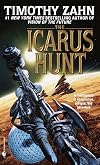
A brother of mine turned me on to SF writer Timothy Zahn (the author of a number of Star Wars novels as well as the Conquerors' Trilogy and Dragonback series). My introduction to Zahn came via The Icarus Hunt - a fun and fast-paced space opera jaunt through the galaxy. I thoroughly enjoyed the engaging characters, witty dialog and repartee, as well as the adventure laden plot (that reads like an Agatha Christie in space along with the requisite locked room mystery and Poirot-like show more denouement). Good, clean fun (with a few minor swear words and PG situations) - a solid book in which to introduce the genre to your junior higher! Don't let the 450 pages deter you either, quest/adventure novels have come a long way since Don Quixote.
Zahn is a talented writer with an imagination that spices up the standard space opera trope with just the right amount (imo) of hard SF detail. The Icarus is a spaceship that is carrying an unknown cargo that could break the economic stranglehold of the Patth, an alien civilization that controls a majority of the commercial space lanes. Enter Captain Jordan McKell who is hired to pilot the Icarus to Earth - and along the way unravels a number of mysteries that spring up regarding this special cargo. The book is a page-turner as McKell jumps through space from one crisis to the next.
I enjoy Zahn's first person narrative voice (via a Han Solo-esque protagonist); he nicely integrates dialog and action, weaving in the world-building and background information through POV reflection and conversation. If there is a quibble, it would be that his characters "grimace" too often. It's a descriptive word, but is almost as frequently used as "said" for a dialog marker. (I've noticed in the two other books I've read by Zahn that grimacing must be one of his writerly peccadillos.) Still, I can live with that since it doesn't take away from the story, and eventually one just ignores those markers.
That said, if you're looking for an escape while hiking in the mountains or at the beach this summer, grab The Icarus Hunt and strap yourself in for a wild ride. (8 out of 10) show less
Zahn is a talented writer with an imagination that spices up the standard space opera trope with just the right amount (imo) of hard SF detail. The Icarus is a spaceship that is carrying an unknown cargo that could break the economic stranglehold of the Patth, an alien civilization that controls a majority of the commercial space lanes. Enter Captain Jordan McKell who is hired to pilot the Icarus to Earth - and along the way unravels a number of mysteries that spring up regarding this special cargo. The book is a page-turner as McKell jumps through space from one crisis to the next.
I enjoy Zahn's first person narrative voice (via a Han Solo-esque protagonist); he nicely integrates dialog and action, weaving in the world-building and background information through POV reflection and conversation. If there is a quibble, it would be that his characters "grimace" too often. It's a descriptive word, but is almost as frequently used as "said" for a dialog marker. (I've noticed in the two other books I've read by Zahn that grimacing must be one of his writerly peccadillos.) Still, I can live with that since it doesn't take away from the story, and eventually one just ignores those markers.
That said, if you're looking for an escape while hiking in the mountains or at the beach this summer, grab The Icarus Hunt and strap yourself in for a wild ride. (8 out of 10) show less
Lists
Star Wars Legends (10)
Book club books (1)
Best Young Adult (1)
Awards


You May Also Like


Associated Authors
Statistics
- Works
- 268
- Also by
- 45
- Members
- 53,554
- Popularity
- #282
- Rating
- 3.8
- Reviews
- 813
- ISBNs
- 852
- Languages
- 19
- Favorited
- 99


