
Dan Jacobson (1929–2014)
Author of All for Love
About the Author
Dan Jacobson was born in Johannesburg, South Africa on March 7, 1929. He received a degree in English from the University of Witwatersrand in 1949 and became a professor at University College London. He became a novelist and critic. His works include The Beginners, The Rape of Tamar, The Wonder show more Worker, The Confessions of Josef Baisz, The Story of the Stories: The Chosen People and Its God, and Heshel's Kingdom. He died on June 12, 2014 at the age of 85. (Bowker Author Biography) show less
Works by Dan Jacobson
Timbuktu, Timbuktu : a selection of works from the Caine Prize for African wriiting 2001 (2003) — Introduction — 5 copies
Time of Arrival, and Other Essays 4 copies
Associated Works
Literary Genius: 25 Classic Writers Who Define English & American Literature (2007) — Contributor — 95 copies, 2 reviews
Tagged
Common Knowledge
- Canonical name
- Jacobson, Dan
- Birthdate
- 1929-03-07
- Date of death
- 2014-06-12
- Gender
- male
- Education
- Kimberley Boys' High School
University of Witwatersrand - Occupations
- novelist
essayist
short story writer
university teacher (Britain|South Africa|Australia|USA) - Relationships
- Jacobson, Jessica (daughter)
- Nationality
- South Africa (birth)
UK (naturalised) - Birthplace
- Johannesburg, South Africa
- Places of residence
- Johannesburg, South Africa
Israel
England
Kimberley, South Africa - Place of death
- Hampstead, London, England, UK
- Associated Place (for map)
- Hampstead, London, England, UK
Members
Reviews

The Confessions of Josef Baisz is presented as the posthumous memoir of one Josef Baisz, a minor official in the government of the fictional Republic of Sarmeda. The geographical specifics of Sarmeda are not provided, but the country has a North and a South. Baisz hails from the rural, backward North and, when he joins the Republican Guard, is relieved to escape his home town of Vliss and a family with a checkered past of which he is ashamed. While suffering through basic training in the show more company of bullies and dolts, he makes a lightning-quick decision that marks him as a hero. It is also a deliberate act of petty revenge that ruins the life of an ignorant and guileless fellow cadet, but this outcome troubles Baisz not at all. As a result of his quick thinking, Baisz is recruited to serve as personal bodyguard for the Deputy Minister of National Guidance, and the course of his career is set. Over the years, Baisz serves many masters, all of whom trust him implicitly, all of whom he holds in contempt and betrays in a variety of ways. It is by means of these betrayals and a combination of luck, cagey opportunism, and heartless scheming that he is able to steer his career in a mostly upward direction. By serving those in positions of power, the wily and observant Baisz finds himself uniquely situated to witness the rampant corruption and capricious brutalities of a totalitarian state that keeps its citizens subservient to an inflexible ideology and in thrall to the politically resilient Heerser, the Sarmedian see-all, know-all supreme leader. But when the ultimate reckoning comes in response to a betrayal more contemptible than any he has previously committed, one that even he can’t justify or condone, Baisz finds himself stricken by an unaccustomed fit of conscience and retreats from public life to compose his tattle-tale autobiography. Dan Jacobson’s novel is a triumph: an expert blending of style with substance. In Josef Baisz, Jacobson has created a loathsome and dangerous amoral creature: a man with no qualms about destroying others in order to gain an advantage or achieve advancement, but who also, like an insect or parasite, has no sense of purpose. Throughout the book, Baisz speaks to us in the confident and sardonic voice of someone who knows that his conduct is repugnant, that he lacks redeeming qualities, that he is undeserving of the success that comes his way, but doesn’t care because ruthlessness and sheer cunning will ensure his survival. What is unexpected is how funny the novel often is, as Baisz comments on the shortcomings of his superiors and informs us in gleeful fashion what he’s up to behind their backs. The Confessions of Josef Baisz is a wry commentary on human civilization in the late 20th century, with specific reference to the type of person who is likely to flourish in a society built on absolute control and the suppression of individual will. It is also an enormously entertaining and supremely intelligent work of fiction by an unjustly neglected author who, when it was published in 1977, was clearly at the top of his game. show less

A strange book. When he eventually gets into 'Her Story' the writing is luminous, passionate and compelling, an allegory on the supposed life of either Mary, mother of Jesus, or of the mother of one of the criminals crucified alongside him. But almost the first third (43 of 141 pages in my Flamingo paperback) is taken up with an unconvincing sci-fi introduction by an archivist / historian in 22nd century England, now apparently an Islamic (or possibly post-Islamic) state. Given that the show more novel was published in 1987, this shows remarkable prescience of more modern (2015) issues, but for me it adds little to either the value or the meaning of the main story. If time permitted I would search for serious critical reviews that might explain the relevance of the sci-fi element. None-the-less a good read, but don't hesitate to skip if you get bored with the sci-fi bit waiting to find out why you're reading it - I never did! show less
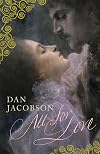
In All for Love, Dan Jacobson takes a true story, documented in two autobiographies by the participants, and invents his own fictional account of the tale.
Princess Louise was the daughter of King Leopold II of Belgium , and a cousin to Queen Victoria of England . She was indulged and spoiled, and unsurprisingly, when she grew older and married, soon grew bored and restless with her husband, whom she dubbed, “Fatso.”
When Louise met Geza Mettanich, it was instant and magnetic, their show more attraction. She soon began an audacious affair with him, going so far as to install him as a member of her household, demanding enormous favors of “Fatso,” and risking proper decorum by allowing herself to be seen going into a hotel room alone with her lover.
The King reached the limits of his royal patience, and summoned Louise to hear his verdict – she was to be banished from her home and from royal life. Louise seemed to think that this was a huge joke, and with Mettanich swept restlessly across the continent, setting up glamorous residences in Paris and Vienna , shopping exorbitantly and expecting “Fatso” to pick up the tab. This story is the thoughtless and scandalous remains of Louise and Geza's tattered love affair.
Dan Jacobson was reading a non-fiction book when he heard of this story, and wondered what it might be like to fictionalize the tale of two real-life people, especially ones who had written their own autobiographies. He embarked on the project.
While the writing in All for Love is exceptional, and at times transcendent, the reader becomes all too aware of how the lines between fiction and non-fiction blur. Jacobson's writing, in fact, suggests that he is merely reporting the facts, rather than imagining a long-past story. The novel is laden with footnotes, attributing quotes to various books that Jacobson used in his research, contributing to the impression that this, in fact, is a work of non-fiction. Jacobson veers back and forth between narrating a historical tale and addressing the reader in a conscious aside that references such modern technology as laser-guided missiles, television, and modern-day supermarkets. The effect is disjointed, often detracting from the narrative flow of the novel. show less
Princess Louise was the daughter of King Leopold II of Belgium , and a cousin to Queen Victoria of England . She was indulged and spoiled, and unsurprisingly, when she grew older and married, soon grew bored and restless with her husband, whom she dubbed, “Fatso.”
When Louise met Geza Mettanich, it was instant and magnetic, their show more attraction. She soon began an audacious affair with him, going so far as to install him as a member of her household, demanding enormous favors of “Fatso,” and risking proper decorum by allowing herself to be seen going into a hotel room alone with her lover.
The King reached the limits of his royal patience, and summoned Louise to hear his verdict – she was to be banished from her home and from royal life. Louise seemed to think that this was a huge joke, and with Mettanich swept restlessly across the continent, setting up glamorous residences in Paris and Vienna , shopping exorbitantly and expecting “Fatso” to pick up the tab. This story is the thoughtless and scandalous remains of Louise and Geza's tattered love affair.
Dan Jacobson was reading a non-fiction book when he heard of this story, and wondered what it might be like to fictionalize the tale of two real-life people, especially ones who had written their own autobiographies. He embarked on the project.
While the writing in All for Love is exceptional, and at times transcendent, the reader becomes all too aware of how the lines between fiction and non-fiction blur. Jacobson's writing, in fact, suggests that he is merely reporting the facts, rather than imagining a long-past story. The novel is laden with footnotes, attributing quotes to various books that Jacobson used in his research, contributing to the impression that this, in fact, is a work of non-fiction. Jacobson veers back and forth between narrating a historical tale and addressing the reader in a conscious aside that references such modern technology as laser-guided missiles, television, and modern-day supermarkets. The effect is disjointed, often detracting from the narrative flow of the novel. show less

In "All for Love" Dan Jacobson fleshes out the illicit affair carried on by Princess Louise of the Saxe-Coburgs (daughter of ghastly King Leopold of Belgium and married to a secondary prince of Austria-Hungary) and a jumped-up Croatian cavalryman who claimed a spurious nobility. The torrid affair elicited royal and societal disapproval, with all the weight such disapproval carries.
The story Jacobson weaves happened to real people, in turbulent late-19th and early- 20th century Europe. show more Jacobson uses primary sources - stories written by the lovers themselves - and adds his own reasoning and imagination to present the tale in novel form. Or he says he does. This construct doesn't really work for me. It never rises above the documentary form, in my opinion, and Jacobson is never very far from the surface, and often breaks through the narrative to address the reader directly.
The strong points here: we get knowing and compassionate protraits of flawed, spoiled, self-centered people, and follow their exploits to their logical ends: scandal, bankruptcy, fugitive flight, still more bankruptcy. At length we must take Louise and the cavalryman (Geza Mattachich by name) and their devotion at face value. Through desparate flight, imprisonment on both sides, his dalliances with other women, and all the notoriety attending, they never become estranged, never stop to wonder why they got together in the first place.
This is a diverting romp with two flawed and self-important lovers who remain true to each other. show less
The story Jacobson weaves happened to real people, in turbulent late-19th and early- 20th century Europe. show more Jacobson uses primary sources - stories written by the lovers themselves - and adds his own reasoning and imagination to present the tale in novel form. Or he says he does. This construct doesn't really work for me. It never rises above the documentary form, in my opinion, and Jacobson is never very far from the surface, and often breaks through the narrative to address the reader directly.
The strong points here: we get knowing and compassionate protraits of flawed, spoiled, self-centered people, and follow their exploits to their logical ends: scandal, bankruptcy, fugitive flight, still more bankruptcy. At length we must take Louise and the cavalryman (Geza Mattachich by name) and their devotion at face value. Through desparate flight, imprisonment on both sides, his dalliances with other women, and all the notoriety attending, they never become estranged, never stop to wonder why they got together in the first place.
This is a diverting romp with two flawed and self-important lovers who remain true to each other. show less
Lists
Awards


You May Also Like


Associated Authors
Statistics
- Works
- 32
- Also by
- 16
- Members
- 509
- Popularity
- #48,720
- Rating
- 3.4
- Reviews
- 12
- ISBNs
- 70
- Languages
- 4
- Favorited
- 1