
About the Author
Lawrence Weschler is regarded as one of the leading practitioners of literary nonfiction. His essays have appeared in The New Yorker for over twenty years, and his series of "Convergences" is a regular feature in McSweeney's Quarterly. The recepient of a Lannan Literary Award and the National Book show more Critics Circle Award for Criticism, he currently teaches at New York University. show less
Image credit: David Shankbone, August 2007
Works by Lawrence Weschler
Mr. Wilson's Cabinet Of Wonder: Pronged Ants, Horned Humans, Mice on Toast, and Other Marvels of Jurassic Technology (1995) 1,295 copies, 19 reviews
Seeing Is Forgetting the Name of the Thing One Sees: A Life of Contemporary Artist Robert Irwin (1982) 426 copies, 3 reviews
And How Are You, Dr. Sacks?: A Biographical Memoir of Oliver Sacks (2019) — Author — 144 copies, 2 reviews
Associated Works
McSweeney's 14: McSweeney's at War for the Foreseeable Future and He's Never Been So Scared (2004) — Contributor — 412 copies, 5 reviews
McSweeney's 05: Sometimes Not Believing How Great This All Is (2012) — Contributor — 189 copies, 2 reviews
David Hockney : a retrospective [cat. exp., Los Angeles County Museum of Art, Feb 4-April 24, 1988; Metropolitan Museum of Art, June 11-Aug14, 1988; Tate Gallery, Oct 26, 1988-Jan… (1988) — Contributor — 188 copies, 4 reviews
The Shaping Forces in Music: An Inquiry into the Nature of Harmony, Melody, Counterpoint and Form (1948) — Introduction, some editions — 74 copies, 1 review
Konspira: Solidarity Underground (Society and Culture in East-Central Europe) (1989) — Afterword, some editions — 9 copies
Tagged
Common Knowledge
- Birthdate
- 1952
- Gender
- male
- Education
- University of California, Santa Cruz
- Occupations
- writer
- Organizations
- The New Yorker
New York Institute for the Humanities
Chicago Humanities Festival - Awards and honors
- Lannan Literary Award (Nonfiction, 1998)
- Relationships
- Weschler, Toni (sister)
Toch, Ernst (grandfather) - Nationality
- USA
- Birthplace
- Van Nuys, California, USA
- Associated Place (for map)
- California, USA
Members
Reviews
Seeing is forgetting the name of the thing one sees : a life of contemporary artist Robert Irwin by Lawrence Weschler

Title adapted from Paul Valery, as noted in the 1982 edition (last page): "To see is to forget the name of the thing one sees."
A spare, artfully structured account of Robert Irwin's career. It reads like an offhand front porch conversation, but Weschler introduces ideas with satisfying heft every few pages. The overall effect is a serious examination of art history and purveyors of art in a deceptively light framework. Were I drafting a syllabus for an Introduction to Phenomenology, I'd be show more tempted to use this as the first book we read, then address in depth the various themes it raises at later points in the course.
Weschler weaves in references to ontology and epistemology when appropriate, and never obtrusively. Irwin's examinations of perception and presence (which Weschler sometimes refers to as Irwin's research) build on themselves and raise these metaphysical questions naturally, so Weschler mostly stands back and lets Irwin do the talking.
At the same time, their conversation provides a nice summary of Western art since the Renaissance, and a somewhat more nuanced overview of modern art, with sketches of the East and West Coast art scenes along the way. I'm not well versed in art, but have heard of various artists, schools, styles, and historic periods enough to confuse me. Weschler manages to fit these stray pieces into a comfortable frame without seeming to make overly strong claims about any of them.
Irwin's maturation is equally interesting, evolving from a preternatural "technician" to someone challenging himself at each step, finally reinventing himself as an artist when he decides to leave the studio and its emphasis upon making "art objects" rather than art. To a certain degree, Irwin's post-Whitney career path seems to be something of a cop-out. Except that by that point in the book, I'm persuaded that Irwin is driven by integrity more than anything else, certainly not being safe or staying in a comfort zone. I'm interested to read some of Irwin's essays on his artistic and philosophical perspective.
"What I'm really trying to do with these things is draw their attention to, my attention to looking at and seeing all of those things that have been going on all along but which previously have been too incidental or too meaningless to really seriously enter into our visual structure, our picture of the world." (183, quoting Irwin)
"It was as if Irwin were saying, 'I can paint this square here at Fifth Avenue and Forty-second Street, and doing so creates a remarkable perceptual space, but why bother? There are hundreds of shadow squares just as remarkable all up and down the block. The point is to attend to *them*.'" (186) show less
A spare, artfully structured account of Robert Irwin's career. It reads like an offhand front porch conversation, but Weschler introduces ideas with satisfying heft every few pages. The overall effect is a serious examination of art history and purveyors of art in a deceptively light framework. Were I drafting a syllabus for an Introduction to Phenomenology, I'd be show more tempted to use this as the first book we read, then address in depth the various themes it raises at later points in the course.
Weschler weaves in references to ontology and epistemology when appropriate, and never obtrusively. Irwin's examinations of perception and presence (which Weschler sometimes refers to as Irwin's research) build on themselves and raise these metaphysical questions naturally, so Weschler mostly stands back and lets Irwin do the talking.
At the same time, their conversation provides a nice summary of Western art since the Renaissance, and a somewhat more nuanced overview of modern art, with sketches of the East and West Coast art scenes along the way. I'm not well versed in art, but have heard of various artists, schools, styles, and historic periods enough to confuse me. Weschler manages to fit these stray pieces into a comfortable frame without seeming to make overly strong claims about any of them.
Irwin's maturation is equally interesting, evolving from a preternatural "technician" to someone challenging himself at each step, finally reinventing himself as an artist when he decides to leave the studio and its emphasis upon making "art objects" rather than art. To a certain degree, Irwin's post-Whitney career path seems to be something of a cop-out. Except that by that point in the book, I'm persuaded that Irwin is driven by integrity more than anything else, certainly not being safe or staying in a comfort zone. I'm interested to read some of Irwin's essays on his artistic and philosophical perspective.
"What I'm really trying to do with these things is draw their attention to, my attention to looking at and seeing all of those things that have been going on all along but which previously have been too incidental or too meaningless to really seriously enter into our visual structure, our picture of the world." (183, quoting Irwin)
"It was as if Irwin were saying, 'I can paint this square here at Fifth Avenue and Forty-second Street, and doing so creates a remarkable perceptual space, but why bother? There are hundreds of shadow squares just as remarkable all up and down the block. The point is to attend to *them*.'" (186) show less
Mr. Wilson's Cabinet Of Wonder: Pronged Ants, Horned Humans, Mice on Toast, and Other Marvels of Jurassic Techno logy by Lawrence Weschler
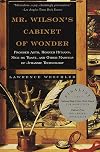
Mr. Wilson’s Cabinet of Wonder: Pronged Ants, Horned Humans, Mice on Toast, and Other Marvels of Jurassic Technology, by Lawrence Weschler
Vintage Books (1995)
“[A] small nondescript storefront operation located along the main commercial drag of downtown Culver City in the middle of West Los Angeles’s endless pseudo-urban sprawl: the Museum of Jurassic Technology, according to the fading blue banner facing the street.” Lawrence Weschler, a staff writer for The New Yorker, describes the show more otherwise anonymous location for one of the oddest museums on the American landscape. He details the exhibits of the Museum and the life of its creator, David Wilson, in Mr. Wilson’s Cabinet of Wonder: Pronged Ants, Horned Humans, Mice on Toast, and Other Marvels of Jurassic Technology.
After reading this book, I had to ask, “Where has this book been all my life?” Despite majoring in Public History, the intellectual adjunct to academic history focusing on museums, historical societies, and the like, I had never encountered this book. Even with my Museum Studies classes taken at the Milwaukee Public Museum this was never on the mandatory reading list. It should be.
For an otherwise short book – the paperback text is only 108 pages, albeit with a lengthy section of endnotes – there is a lot to unpack. Weschler divides the book into two sections. The first, “Inhaling the Spore,” is a lengthy narrative tour through the Museum of Jurassic Technology. The second, “Cerebral Growth,” is a combination biography of David Wilson and the history of modern museums. The second sections explores the digressive route Wilson took to eventually become head of his own idiosyncratic museum. This digression is combined with a digressive exploration of the kunst- and wunderkammern (German for “art- and wonder cabinets”).
Wonder cabinets became popular around the sixteenth and seventeenth century. During this time (early modern Europe in academic parlance) Europe experienced an extended period of culture shock due to the discoveries made through contact and exploration with North America. The culture shock was coupled with a revival of classical learning and a fascinating with esoteric and occult knowledge. Curiosity cabinets reflected this simultaneous combination of global exploration and interior contemplation. Prior to the time, Europe was dominated by a medieval mindset. The curiosity cabinet fell out of favor when the Enlightenment popularized a more scientific and rational mentality.
Granted, the statement above is a broad-brush generalization. Weschler also concedes that despite the new people, places, and things discovered during early modern times, it was also a period of cruelty and barbarism.
All this is a roundabout introduction to what David Wilson is attempting with his Museum of Jurassic Technology. In his own way, he has created a modern curiosity cabinet. A tiny jewel box museum mixing fantasy and fact. Wilson’s brilliance comes from the Museum’s admixing of parody, homage, and critique of modern museum practice. A visitor can’t readily distinguish between a factual exhibit or one created by Wilson’s imagination. He has mimicked to the voice of Institutional Authority with incredible precision. In his interactions with visitors and at museum conferences, he never “breaks character.” Everything is done with a straight face and with the utmost serious. (Contrast this with The Church of the SubGenius, which is a parody religion, except when it isn’t.)
After reading the book, I realized it was one of my top favorite non-fiction works. Unlike fiction, non-fiction is so broad and varied, it is hard to label something an all-time favorite. Like the House on the Rock and the Salt Lake City Temple, the Museum of Jurassic Technology will go on my list for an American Odd Pilgrimage.
The Museum of Jurassic Technology is yet another example of California as American laboratory of weirdness and idiosyncrasy.
https://driftlessareareview.com/2021/04/09/american-odd-mr-wilsons-cabinet-of-wo... show less
Vintage Books (1995)
“[A] small nondescript storefront operation located along the main commercial drag of downtown Culver City in the middle of West Los Angeles’s endless pseudo-urban sprawl: the Museum of Jurassic Technology, according to the fading blue banner facing the street.” Lawrence Weschler, a staff writer for The New Yorker, describes the show more otherwise anonymous location for one of the oddest museums on the American landscape. He details the exhibits of the Museum and the life of its creator, David Wilson, in Mr. Wilson’s Cabinet of Wonder: Pronged Ants, Horned Humans, Mice on Toast, and Other Marvels of Jurassic Technology.
After reading this book, I had to ask, “Where has this book been all my life?” Despite majoring in Public History, the intellectual adjunct to academic history focusing on museums, historical societies, and the like, I had never encountered this book. Even with my Museum Studies classes taken at the Milwaukee Public Museum this was never on the mandatory reading list. It should be.
For an otherwise short book – the paperback text is only 108 pages, albeit with a lengthy section of endnotes – there is a lot to unpack. Weschler divides the book into two sections. The first, “Inhaling the Spore,” is a lengthy narrative tour through the Museum of Jurassic Technology. The second, “Cerebral Growth,” is a combination biography of David Wilson and the history of modern museums. The second sections explores the digressive route Wilson took to eventually become head of his own idiosyncratic museum. This digression is combined with a digressive exploration of the kunst- and wunderkammern (German for “art- and wonder cabinets”).
Wonder cabinets became popular around the sixteenth and seventeenth century. During this time (early modern Europe in academic parlance) Europe experienced an extended period of culture shock due to the discoveries made through contact and exploration with North America. The culture shock was coupled with a revival of classical learning and a fascinating with esoteric and occult knowledge. Curiosity cabinets reflected this simultaneous combination of global exploration and interior contemplation. Prior to the time, Europe was dominated by a medieval mindset. The curiosity cabinet fell out of favor when the Enlightenment popularized a more scientific and rational mentality.
Granted, the statement above is a broad-brush generalization. Weschler also concedes that despite the new people, places, and things discovered during early modern times, it was also a period of cruelty and barbarism.
All this is a roundabout introduction to what David Wilson is attempting with his Museum of Jurassic Technology. In his own way, he has created a modern curiosity cabinet. A tiny jewel box museum mixing fantasy and fact. Wilson’s brilliance comes from the Museum’s admixing of parody, homage, and critique of modern museum practice. A visitor can’t readily distinguish between a factual exhibit or one created by Wilson’s imagination. He has mimicked to the voice of Institutional Authority with incredible precision. In his interactions with visitors and at museum conferences, he never “breaks character.” Everything is done with a straight face and with the utmost serious. (Contrast this with The Church of the SubGenius, which is a parody religion, except when it isn’t.)
After reading the book, I realized it was one of my top favorite non-fiction works. Unlike fiction, non-fiction is so broad and varied, it is hard to label something an all-time favorite. Like the House on the Rock and the Salt Lake City Temple, the Museum of Jurassic Technology will go on my list for an American Odd Pilgrimage.
The Museum of Jurassic Technology is yet another example of California as American laboratory of weirdness and idiosyncrasy.
https://driftlessareareview.com/2021/04/09/american-odd-mr-wilsons-cabinet-of-wo... show less
Mr. Wilson's Cabinet of Wonder: Pronged Ants, Horned Humans, Mice on Toast, and Other Marvels of Jurassic Technology by Lawrence Weschler

The first half of this book describes the author's explorations and investigations of Los Angeles's Museum of Jurassic technology and encounters with its proprietor, David Wilson. And a weird, weird place this is. Weird enough that I felt compelled to look it up and make sure it was actually a real establishment, and not some sort of elaborate prank or fantasy. Turns out, it is real, and despite the fact that this book was published in 1995, it's still there, and still doing... whatever the show more heck it is that it's doing.
Because, the way Weschler describes it, it's hard to tell to what extent this place qualifies as a museum and to what extent it's some kind of bizarre art project. It contains exhibits and information that are strange, and strangely presented, but perfectly real, and others that are completely made up. Or partly made up. Or completely crackpotty. Or something. It can be very hard to tell the difference, and very hard to tell when Wilson is being serious and when he's being ironic.
Weschler clearly falls down quite a rabbit hole here, and the main effect is to leave one blinking and going, "What the heck did I just read?" Which seems entirely appropriate to the subject matter.
The second half mostly consists of a little historical exploration of the wunderkammer, or cabinet of wonder, a tradition in whose footsteps the Wilson's odd collection certainly follows. The subject matter here is interesting, but the disjointed writing style which did such a good job capturing the feel of the Museum works less well here, and the rambling footnotes are more than a little distracting. show less
Because, the way Weschler describes it, it's hard to tell to what extent this place qualifies as a museum and to what extent it's some kind of bizarre art project. It contains exhibits and information that are strange, and strangely presented, but perfectly real, and others that are completely made up. Or partly made up. Or completely crackpotty. Or something. It can be very hard to tell the difference, and very hard to tell when Wilson is being serious and when he's being ironic.
Weschler clearly falls down quite a rabbit hole here, and the main effect is to leave one blinking and going, "What the heck did I just read?" Which seems entirely appropriate to the subject matter.
The second half mostly consists of a little historical exploration of the wunderkammer, or cabinet of wonder, a tradition in whose footsteps the Wilson's odd collection certainly follows. The subject matter here is interesting, but the disjointed writing style which did such a good job capturing the feel of the Museum works less well here, and the rambling footnotes are more than a little distracting. show less
Mr. Wilson's Cabinet Of Wonder: Pronged Ants, Horned Humans, Mice on Toast, and Other Marvels of Jurassic Techno logy by Lawrence Weschler

The books begins when Lawrence Weschler wanders into the Museum of Jurassic Technology in Culver City, California, where he encounters an oddly fascinating collection of exhibits. Beginning with the Cameroonian stink ant and the spores of a fungus, which when inhaled, cause the ant to climb upward, eventually grabbing onto the vine or trunk with his mandible, where he dies. The fungus then sprouts from the ant's forehead, raining spores down on the unsuspecting ants below. Other exhibits show more include a theory of memory, a very small bat and a collection of antlers, which includes the horn of Mary Davis of Saughall.
Weschler is understandably intrigued, and speaking with David Wilson, the museum's owner and curator, adds to his curiosity. Professionally presented, the museum nonetheless awakens seeds of doubt in his mind, which sprout when he researches the exhibits. Mr. Wilson's Cabinet of Wonder looks at our ideas about museums and looks at how museums came to be; originating from the wunderkammern of the early enlightenment, where wealthy men collected interesting items and grouped them together in a room or cabinet for the wonderment of his guests. Classification was optional and certainly different, with one collection including
two huge ribs from a whale (out in the courtyard); "a goose which has grown in Scotland in a tree"; "a number of things changed into stone" (in other words, fossils); the hand of a mermaid; the hand of a mummy; a small piece of wood from the cross of Christ"; "pictures from the church of S. Sofia in Constantinople copies by a Jew into a book"; "a bat as large as a pigeon"...
There is a lot packed into this slender book, from the nature of wonder itself to the history of those fascinating and eclectic cabinets of curiosity, which sprang up when explorers to the far east and the Americas began returning with things never before seen and as superstition gave way to reason. show less
Weschler is understandably intrigued, and speaking with David Wilson, the museum's owner and curator, adds to his curiosity. Professionally presented, the museum nonetheless awakens seeds of doubt in his mind, which sprout when he researches the exhibits. Mr. Wilson's Cabinet of Wonder looks at our ideas about museums and looks at how museums came to be; originating from the wunderkammern of the early enlightenment, where wealthy men collected interesting items and grouped them together in a room or cabinet for the wonderment of his guests. Classification was optional and certainly different, with one collection including
two huge ribs from a whale (out in the courtyard); "a goose which has grown in Scotland in a tree"; "a number of things changed into stone" (in other words, fossils); the hand of a mermaid; the hand of a mummy; a small piece of wood from the cross of Christ"; "pictures from the church of S. Sofia in Constantinople copies by a Jew into a book"; "a bat as large as a pigeon"...
There is a lot packed into this slender book, from the nature of wonder itself to the history of those fascinating and eclectic cabinets of curiosity, which sprang up when explorers to the far east and the Americas began returning with things never before seen and as superstition gave way to reason. show less
Lists
Awards


You May Also Like


Associated Authors
Statistics
- Works
- 35
- Also by
- 14
- Members
- 3,326
- Popularity
- #7,689
- Rating
- 4.0
- Reviews
- 43
- ISBNs
- 69
- Languages
- 6
- Favorited
- 4