

John Dos Passos (1896–1970)
Author of Manhattan Transfer
About the Author
John Dos Passos, 1896 - 1970 John Passos was born January 14,1896 to John Randolph Dos Passos and Lucy Addison Sprigg Madison. He attended Harvard University from 1912-1916. He was in the ambulance service units in France and Italy and in 1918, enlisted in the U.S. Army Medical Corps. From 1926-29, show more he directed New Playwrights' Theatre in New York City. In 1929, Passos married Katharine Smith and in 1947, they were in an automobile accident that killed his wife and left him blind in one eye. He married Elizabeth Holdridge in 1949 and a year later, Lucy Hamlin Dos Passos was born. Passos' many novels include "One Man's Initiation" (1917), "Three Soldiers" (1921), which has met with wide acclaim, "Streets of Night" (1923), "Facing the Chair" (1927), which defends the immigrants Sacco and Vanzetti, "Orient Express" (1927), "The Ground We Stand On" (1949), and "Prospects of a Golden Age" (1959). He received the Gold Medal for fiction from the National Institute of Arts and Letters in 1957, the Feltrinelli Prize for Fiction in 1967 and was elected to the American Academy of Arts and Letters in 1947. On September 28, 1970, Passos died of heart failure in Baltimore, Maryland. (Bowker Author Biography) show less
Image credit: Mondadori Portfolio/Getty Images, from Library of America website
Series
Works by John Dos Passos
Novels, 1920-1925: One Man's Initiation: 1917, Three Soldiers, Manhattan Transfer (2003) 307 copies, 1 review
Mr. Wilson's War: From the Assassination of McKinley to the Defeat of the League of Nations (1962) 155 copies, 1 review
Davanti alla sedia elettrica: come Sacco e Vanzetti furono americanizzati (1970) 32 copies, 1 review
Das Land des Fragebogens 1945: Reportagen aus dem besiegten Deutschland. Gesamttitel: rororo; 60600 : Sachbuch (1997) 11 copies
Viajes de entreguerras: Una visión del mundo entre la Primera Guerra Mundial y la Guerra Civil española (ODISEAS) (Spanish Edition) (2005) 9 copies
Novelas 9 copies
Prospects of a Golden Age 5 copies
Manhattan Transfer vol. II 4 copies
John Dos Passos' correspondence with Arthur K. McComb, or, "Learn to sing the Carmagnole" (1991) 3 copies
La grosse galette, tome 1 2 copies
Airways, inc., 2 copies
Manhattan Transfer vol. I 2 copies
La grosse galette, t. 2 2 copies
The Body Of An American 2 copies
Trzej żołnierze 1 copy
PRIMER ENCUENTRO 1 copy
CALLES DE LA NOCHE 1 copy
Devetnajststo devetnajst 1 copy
Bilan d'une nation 1 copy
ÖNEMLİ ADAM (BİR NUMARA) 1 copy
Un monde plus grand... 1 copy
Vol. 1: La lunga attesa 1 copy
Builders for a golden age 1 copy
Il mondo fuori casa: romanzo 1 copy
USA 2 1 copy
HIl Igrande paese 1 copy
A metà secolo 1 copy
Argus Bookshop Business Reply Card (Postmarked Jul? 1950) Autograph From John Dos Passos to Argus 1 copy
Art And Isadora 1 copy
Tin Lizzie [from "USA"] 1 copy
Meester Veelson [from "USA"] 1 copy
La primera catástrofe 1 copy
In All Countries 1 copy
Servizio Speciale 1 copy
Novelas. Tomo II : Un Lugar en la Tierra . Podria Salir Bien. Tres Soldados. Primer Encuentro. Calles de Noche (1970) 1 copy
Le vie della liberta 1 copy
Veliki denar 1 copy
2005 1 copy
Ciężkie pieniądze 1 copy
Il 42o Parallelo 1 copy
Associated Works
American Poetry: The Twentieth Century, Volume Two: E. E. Cummings to May Swenson (2000) — Contributor — 442 copies, 1 review
World War I and America: Told by the Americans Who Lived It (1918) — Contributor — 225 copies, 1 review
This is My Best: American Greatest Living Authors Present and Give Their Reasons Why (1942) — Contributor — 213 copies
The Lincoln Anthology: Great Writers on His Life and Legacy from 1860 to Now (2008) — Contributor — 172 copies, 1 review
An American Album: One Hundred and Fifty Years of Harper's Magazine (2000) — Contributor — 145 copies, 1 review
The Norton Anthology of American Literature, Volume 2: 1865 to Present (1979) — Contributor, some editions — 136 copies
The Heath Anthology of American Literature, Concise Edition (2003) — Contributor — 73 copies, 1 review
The Signet Classic Book of Contemporary American Short Stories (1985) — Contributor — 47 copies, 1 review
Years of Protest: A Collection of American Writings of the 1930's (1967) — Contributor — 44 copies, 1 review
John Dos Passos Presents the Living Thoughts of Tom Paine (A Premier Book) (1940) — Editor — 41 copies
Oogst Der Tijden. keur uit de werken van schrijvers en dichters aller volken en eeuwen (1940) — Contributor — 12 copies
Washington: a reader; the National Capital as seen through the eyes of Thomas Jefferson (1967) 3 copies
The Ethnic Image in Modern American Literature, 1900-1950, Volumes 1-2 (1984) — Contributor — 1 copy
Tagged
Common Knowledge
- Canonical name
- Dos Passos, John
- Legal name
- Dos Passos, John Roderigo
- Birthdate
- 1896-01-14
- Date of death
- 1970-09-28
- Gender
- male
- Education
- Harvard University (BA|1916)
Choate School - Occupations
- novelist
poet
playwright
painter - Organizations
- American Volunteer Motor Ambulance Corps (WWI)
United States Army Medical Corps (WWI) - Awards and honors
- American Academy of Arts and Letters (1947)
Antonio Feltrinelli Prize (1967)
National Institute of Arts and Letters Gold Medal for Fiction (1957) - Cause of death
- heart failure
- Nationality
- USA
- Birthplace
- Chicago, Illinois, USA
- Places of residence
- Westmoreland, Virginia, USA
- Place of death
- Baltimore, Maryland, USA
- Burial location
- Yeocomico Churchyard Cemetery, Cople Parish, Virginia, USA
- Map Location
- USA
Members
Discussions
April-June Theme Read: War and Regions in Conflict in Reading Globally (February 2024)
AMERICAN AUTHORS CHALLENGE--JUNE 2022--JOHN DOS PASSOS in 75 Books Challenge for 2022 (July 2022)
Reviews
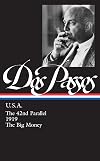
My what a splendid book this is. Vast in its scope and magnanimous in its treatment of the varied strata that made up a nation coming to terms with the 20th century. I defy you to enjoy this, despite it being well over 1,000 pages long, a trilogy that follows 12 characters some related and others not. Not only is it written in a style that is incredibly accessible for such a long novel, it’s written in four styles that are incredibly accessible. Even the stream of consciousness episodes show more are so well crafted and (ahem) so short, that they fly by.
While I enjoyed the characters and what they got up to, what I most enjoyed was how I saw the nation of the US through their eyes and experiences. It was a promising time for the US and various ideals are put to the test including the spectral opposites of capitalism and socialism. Neither of them come off well, but I kind of felt, a bit like in Sinclair’s masterpiece The Jungle, that it was the ones who espoused a more societal basis for life that were painted with more touches of heroism. Certainly, you sympathised a lot more with those who fell victims to mass industry and the drive to industrialise at the sake of the common man.
Certainly Dos Passos here composed a classic but not just for his storytelling skills. It’s a nation analysed and put to the test of history. Interestingly, it shows how weak the ideals are, ideals that, even today are either praised or vilified in equal measure depending on which facet of US citizenry you talk to. I’m not sure that the US has really grown much more mature in its pursuit of an identity than it is portrayed in this novel. I wonder what the USAnians among you would respond to that.
For outsiders who want to know more of why the US is as it is, this is a good novel to reflect on. There’s such a vast amount here to consider there’s no way to do it justice. Even just one of the 12 character threads would provide book clubs with hours of discussion. For those of you on the inside, I think this is a good one to have under your belt to say you know where US literature is coming from and to provide food for thought as you continue to build on what those 12 characters built before you. show less
While I enjoyed the characters and what they got up to, what I most enjoyed was how I saw the nation of the US through their eyes and experiences. It was a promising time for the US and various ideals are put to the test including the spectral opposites of capitalism and socialism. Neither of them come off well, but I kind of felt, a bit like in Sinclair’s masterpiece The Jungle, that it was the ones who espoused a more societal basis for life that were painted with more touches of heroism. Certainly, you sympathised a lot more with those who fell victims to mass industry and the drive to industrialise at the sake of the common man.
Certainly Dos Passos here composed a classic but not just for his storytelling skills. It’s a nation analysed and put to the test of history. Interestingly, it shows how weak the ideals are, ideals that, even today are either praised or vilified in equal measure depending on which facet of US citizenry you talk to. I’m not sure that the US has really grown much more mature in its pursuit of an identity than it is portrayed in this novel. I wonder what the USAnians among you would respond to that.
For outsiders who want to know more of why the US is as it is, this is a good novel to reflect on. There’s such a vast amount here to consider there’s no way to do it justice. Even just one of the 12 character threads would provide book clubs with hours of discussion. For those of you on the inside, I think this is a good one to have under your belt to say you know where US literature is coming from and to provide food for thought as you continue to build on what those 12 characters built before you. show less
Not many things make me feel patriotic about the United States. Anyone who knows me will tell you that I am about as far from flag-waving as a person can be; not only do I deplore current policies and past atrocities in this country, but I usually don't feel very connected to the huge entity that is "The United States." I feel very connected to Portland, and even Oregon, since I have lived here my whole life and feel I am a product, for better or worse, of this culture. Even the whole West show more Coast can sometimes conjure up feelings of fondness or belonging in me. But the entirety of this huge, unwieldly nation? Not a chance. There are so many distinct subcultures here with which I have never even had any contact: I have never been to the Deep South, or Appalachia, or the Midwest, or Texas. Even if I had been to one or the other, I would be as much of a tourist there as if I were visiting a totally different country. And yet, John Dos Passos' USA trilogy somehow accesses a deeply - but DEEPLY - buried patriotism in me, and I think for a moment that it's kind of appealing to imagine myself part of a long national narrative, even if most of said narrative is something I wish I could rewrite from beginning to end.
It's almost as if USA is specifically structured to get under my skin, making use of the modernist experimentalism I'm such a sucker for in other works, and using it to express a uniquely American perspective. Dos Passos's trilogy features many different types of narratives: third-person stories about regular American men and women, told in a succinct, newspaper-influenced voice; long, prose-like poems about the larger-than-life Americans of the time, from Rockefeller and Eugene Debs in the early years to Isadora Duncan and Henry Ford in the later; snippets of newspaper headlines and popular songs cobbled together into looser, "newsreel" poems; and the Camera Eye sections, told in a stream-of-consciousness style, from Dos Passos's own perspective. Together this variety of the large and small, journalistic objectivity and intensely subjective snapshots, regular people and giants of art and industry, lets me relate to America-as-vast-experiential-panorama, in a way I usually can't. And the way that the ridiculousness of newspaper headlines and semi-articulateness of a poignant song lyric interact with the complicated and compromised lives of real people rings true almost a century later.
USA also offers a leftist slice of history in a way that's very personal: witnessing a brutal anti-labor attack in rural Washington state in the 1910's, or the ins and outs of a strike in Goldfield, Nevada in 1905, really makes the history of those familiar places come alive for me, and become part of the larger patterns of pro- and anti-labor movements happening all over the country. (Unfortunately, the activists who undermine themselves through in-fighting and excessive drinking are eerily familiar as well.) There is a Kerouac-like love of the small towns and big cities of America, but Dos Passos writes about people who are actually invested in them one way or another, rather than people who are just passing through - an approach I find much more emotionally rewarding. For me personally, writing about the wide spectrum of American experience using a wide spectrum of (American) voices is very powerful, and I've never really seen it done as effectively as Dos Passos does it here. If there are any other lovers of experimental prose out there trying to connect with their American roots (or not), I highly recommend USA. show less
It's almost as if USA is specifically structured to get under my skin, making use of the modernist experimentalism I'm such a sucker for in other works, and using it to express a uniquely American perspective. Dos Passos's trilogy features many different types of narratives: third-person stories about regular American men and women, told in a succinct, newspaper-influenced voice; long, prose-like poems about the larger-than-life Americans of the time, from Rockefeller and Eugene Debs in the early years to Isadora Duncan and Henry Ford in the later; snippets of newspaper headlines and popular songs cobbled together into looser, "newsreel" poems; and the Camera Eye sections, told in a stream-of-consciousness style, from Dos Passos's own perspective. Together this variety of the large and small, journalistic objectivity and intensely subjective snapshots, regular people and giants of art and industry, lets me relate to America-as-vast-experiential-panorama, in a way I usually can't. And the way that the ridiculousness of newspaper headlines and semi-articulateness of a poignant song lyric interact with the complicated and compromised lives of real people rings true almost a century later.
USA also offers a leftist slice of history in a way that's very personal: witnessing a brutal anti-labor attack in rural Washington state in the 1910's, or the ins and outs of a strike in Goldfield, Nevada in 1905, really makes the history of those familiar places come alive for me, and become part of the larger patterns of pro- and anti-labor movements happening all over the country. (Unfortunately, the activists who undermine themselves through in-fighting and excessive drinking are eerily familiar as well.) There is a Kerouac-like love of the small towns and big cities of America, but Dos Passos writes about people who are actually invested in them one way or another, rather than people who are just passing through - an approach I find much more emotionally rewarding. For me personally, writing about the wide spectrum of American experience using a wide spectrum of (American) voices is very powerful, and I've never really seen it done as effectively as Dos Passos does it here. If there are any other lovers of experimental prose out there trying to connect with their American roots (or not), I highly recommend USA. show less

“Limon was one of the worst pestholes on the Caribbean, even the Indians died there of malaria, yellow jack, dysentery.
Keith went back up to New Orleans on the steamer 𝘑𝘰𝘩𝘯 𝘎. 𝘔𝘦𝘪𝘨𝘨𝘴 to hire workers to build the railroad. He offered a dollar a day and grub and hired seven hundred men. Some of them had been down before in the filibustering days of William Walker.
Of that bunch about twentyfive came out alive.
The rest left their whiskyscalded carcases to rot show more in the swamps.
On another load he shipped down fifteen hundred; they all died to prove that only Jamaica Negroes could live in Limon.
Minor Keith didn’t die.”
This quote from Wikipedia: “As many as four thousand people, including Keith's three brothers, died during the construction of the first 25 miles of track. Having subsequent trouble recruiting Costa Rican laborers, Keith eventually brought in blacks from the Caribbean islands (mainly Jamaica), Chinese, and even Italians, to complete the project.”
The 𝘜.𝘚.𝘈. trilogy was published in 1930. The events from the opening passage to this post occurred in the late 1800s. American imperialism then. American imperialism now? This book was recommended by a friend since it fit into the research I was doing for an upcoming short story. Anytime, however, I put spade to the unturned earth of American history I’m left agape and ashamed at the old bones of brutal conquest. And we’re no exception, even if American exceptionalism is an ideology applied to that equally flattering and unsightly image in a mirror of our own fashioning, held at selfie-snapping distance.
Oh, America. Out of 180 degrees of latitude, surely there’s more than enough room to share. I did enjoy this novel, for its depictions of the average and not-so-average American as well as for its experimentation in style. However, I can’t find myself going back over this again. Maybe I’ll read the other two installments. I’m sure they’re worth it. But, man, I really don’t like most of what I’m seeing. Maybe it’s in the writing, but this mirror has got an awful lot of blemishes, nicks from hasty shaving, and sun-damage caught in the reflection.
This is what I read during the power outage of Hurricane Florence. I probably should’ve selected something more humorous or uplifting. However, the outpouring of community, fellowship, charity, and selflessness after the storm was the perfect antithesis to the conceit of most of the characters in this book.
Maybe there’s hope for America, after all. show less
Keith went back up to New Orleans on the steamer 𝘑𝘰𝘩𝘯 𝘎. 𝘔𝘦𝘪𝘨𝘨𝘴 to hire workers to build the railroad. He offered a dollar a day and grub and hired seven hundred men. Some of them had been down before in the filibustering days of William Walker.
Of that bunch about twentyfive came out alive.
The rest left their whiskyscalded carcases to rot show more in the swamps.
On another load he shipped down fifteen hundred; they all died to prove that only Jamaica Negroes could live in Limon.
Minor Keith didn’t die.”
This quote from Wikipedia: “As many as four thousand people, including Keith's three brothers, died during the construction of the first 25 miles of track. Having subsequent trouble recruiting Costa Rican laborers, Keith eventually brought in blacks from the Caribbean islands (mainly Jamaica), Chinese, and even Italians, to complete the project.”
The 𝘜.𝘚.𝘈. trilogy was published in 1930. The events from the opening passage to this post occurred in the late 1800s. American imperialism then. American imperialism now? This book was recommended by a friend since it fit into the research I was doing for an upcoming short story. Anytime, however, I put spade to the unturned earth of American history I’m left agape and ashamed at the old bones of brutal conquest. And we’re no exception, even if American exceptionalism is an ideology applied to that equally flattering and unsightly image in a mirror of our own fashioning, held at selfie-snapping distance.
Oh, America. Out of 180 degrees of latitude, surely there’s more than enough room to share. I did enjoy this novel, for its depictions of the average and not-so-average American as well as for its experimentation in style. However, I can’t find myself going back over this again. Maybe I’ll read the other two installments. I’m sure they’re worth it. But, man, I really don’t like most of what I’m seeing. Maybe it’s in the writing, but this mirror has got an awful lot of blemishes, nicks from hasty shaving, and sun-damage caught in the reflection.
This is what I read during the power outage of Hurricane Florence. I probably should’ve selected something more humorous or uplifting. However, the outpouring of community, fellowship, charity, and selflessness after the storm was the perfect antithesis to the conceit of most of the characters in this book.
Maybe there’s hope for America, after all. show less
This is a pessimistic book about people coming of age in a nation that is, in its own way, also coming of age.
Dos Passos uses a patchwork method of inserting news headlines (Newsreel) and small biographical pieces about prominent news makers (Camera Eye) into more conventional narratives to create an impressionistic view of the USA at the turn of the 20th century. As a whole, the stories show the prevailing concerns, moods, and desires of the nation as it was coming out of Reconstruction show more and moving into the 20th century. The majority of the book is presented through the lives of five main characters in separate but sometimes intersecting storylines. With only one exception (J. Ward Moorehouse) the characters are coming of age in a world that is systemically unequal, disinterested, and sometimes actually hostile.
The characters are looking for routes to self-fulfillment and finding the routes blocked because of wide gaps between haves and have nots. Class struggle, racial discrimination, gender inequality, and labor unrest all contribute to a grim overall outlook, but it is one that the characters either do not recognize, are fatalistically resigned to, or that they push against in ineffectual and disorganized ways that more often inspire pity than pride. Pathways that may open up for real becoming and change either fizzle out, trail off, get sidetracked, or are sometime violently squashed. The grim presence of WWI then opens up what appears to some characters to be the only viable avenue for purpose: patriotic self-sacrifice.
This grim spiral is not the arc for all characters, however. J. Ward Moorehouse is one who manages to break out of the gravitational pull of his socio-economic status to succeed as a public relations man, but this success highlights the haves/have-nots divide. A quote from Eugene Debs (a labor organizer of the time) that shows up multiple times in the book articulates a central point of this conflict. Debs is recorded as saying, in part, “I would be ashamed to admit that I had risen from the ranks. When I rise it will be with the ranks, and not from the ranks.” Moorehouse, is one who has risen but from the ranks rather than with the ranks. Although his life does intersect with some of the other characters, he advances his position foremost. He helps these characters, but only in so far as he employs them and has vaguely Platonic (but not really) relationships with them.
Reading this book today, in this political and economic climate, definitely deepened the shadows that Dos Passos presented. It was not the tonic I needed to lighten my spirits, but I did enjoy it. show less
Dos Passos uses a patchwork method of inserting news headlines (Newsreel) and small biographical pieces about prominent news makers (Camera Eye) into more conventional narratives to create an impressionistic view of the USA at the turn of the 20th century. As a whole, the stories show the prevailing concerns, moods, and desires of the nation as it was coming out of Reconstruction show more and moving into the 20th century. The majority of the book is presented through the lives of five main characters in separate but sometimes intersecting storylines. With only one exception (J. Ward Moorehouse) the characters are coming of age in a world that is systemically unequal, disinterested, and sometimes actually hostile.
The characters are looking for routes to self-fulfillment and finding the routes blocked because of wide gaps between haves and have nots. Class struggle, racial discrimination, gender inequality, and labor unrest all contribute to a grim overall outlook, but it is one that the characters either do not recognize, are fatalistically resigned to, or that they push against in ineffectual and disorganized ways that more often inspire pity than pride. Pathways that may open up for real becoming and change either fizzle out, trail off, get sidetracked, or are sometime violently squashed. The grim presence of WWI then opens up what appears to some characters to be the only viable avenue for purpose: patriotic self-sacrifice.
This grim spiral is not the arc for all characters, however. J. Ward Moorehouse is one who manages to break out of the gravitational pull of his socio-economic status to succeed as a public relations man, but this success highlights the haves/have-nots divide. A quote from Eugene Debs (a labor organizer of the time) that shows up multiple times in the book articulates a central point of this conflict. Debs is recorded as saying, in part, “I would be ashamed to admit that I had risen from the ranks. When I rise it will be with the ranks, and not from the ranks.” Moorehouse, is one who has risen but from the ranks rather than with the ranks. Although his life does intersect with some of the other characters, he advances his position foremost. He helps these characters, but only in so far as he employs them and has vaguely Platonic (but not really) relationships with them.
Reading this book today, in this political and economic climate, definitely deepened the shadows that Dos Passos presented. It was not the tonic I needed to lighten my spirits, but I did enjoy it. show less
Lists
Awards


You May Also Like


Associated Authors
Statistics
- Works
- 116
- Also by
- 31
- Members
- 11,630
- Popularity
- #2,023
- Rating
- 3.8
- Reviews
- 146
- ISBNs
- 483
- Languages
- 15
- Favorited
- 3
