

John O'Hara (1) (1905–1970)
Author of Appointment in Samarra
For other authors named John O'Hara, see the disambiguation page.
About the Author
John Henry O'Hara was born in Pottsville, Pennsylvania on January 31, 1905. Many of his novels and short stories were set in fictionally named Pennsylvania towns with the main themes centering on class conflict and status. He began writing for the New Yorker in 1928; and during his life, sold 225 show more stories to the magazine. His first collection, The Doctor's Son and Other Stories (1935) was followed by twelve more. Pal Joey (1940) was made into a Broadway musical by Richard Rodgers and Lorenz Hart and later was adapted into a film starring Frank Sinatra and Rita Hayworth. Some of his published novels include Appointment in Samarra (1934), A Rage to Live (1949), The Lockwood Concern (1965), and The Good Samaritan and Other Stories (published posthumously in 1974). Ten North Frederick (1955) won the National Book Award and Butterfield 8 (1935) and From the Terrace (1958) were adapted into movies in 1960. He died from cardiovascular disease on April 11, 1970. (Bowker Author Biography) show less
Works by John O'Hara
Collected Stories of John O'Hara: Selected and With an Introduction by Frank MacShane (1985) 235 copies, 3 reviews
Four Novels of the 1930s: Appointment in Samarra / Butterfield 8 / Hope of Heaven / Pal Joey (2019) 88 copies
Short Stories 2 copies
Andrea 2 copies
Over the River and Through the Woods 2 copies
Popołudniowy walc 2 copies
Stories of Venial Sin 2 copies
One for the road 2 copies
Flight 2 copies
The Kids 1 copy
The Big Gleaming Coach 1 copy
Grief 1 copy
All I've Tried To Be 1 copy
This Time 1 copy
The Busybody 1 copy
Last Respects 1 copy
The Frozen Face 1 copy
Requiescat 1 copy
For Help And Pity 1 copy
THE SECOND EWINGS 1 copy
The Favor 1 copy
That First Husband 1 copy
Straight Pool {short story} 1 copy
The Time Element 1 copy
A Cub Tells His Story 1 copy
Complete Works 1 copy
Στα παράνομα της Νέας Υόρκης 1 copy
Family Evening 1 copy
The War 1 copy
Nil Nisi 1 copy
All the Girls he Wanted 1 copy
The Tackle 1 copy
The Skeletons 1 copy
The Portly Gentleman 1 copy
The Pomeranian 1 copy
The Neighborhood 1 copy
Leonard 1 copy
James Francis And The Star 1 copy
The Weakling 1 copy
The Jama 1 copy
A Good Location 1 copy
The General 1 copy
The Gambler 1 copy
Fatimas And Kisses 1 copy
The Assistant 1 copy
Price's Always Open 1 copy
The Way To Majorca 1 copy
Yostie 1 copy
The Sun-Dodgers 1 copy
The Last Of Haley 1 copy
Eileen 1 copy
The Dry Murders 1 copy
He Thinks He Owns Me 1 copy
The Brothers 1 copy
The Heart Of Lee W. Lee 1 copy
Memorial Fund 1 copy
At The Cothurnos Club 1 copy
Encounter: 1943 1 copy
Interior With Figures 1 copy
The Lady Takes An Interest 1 copy
No Justice 1 copy
Not Always 1 copy
The Skipper 1 copy
Pilgrimage 1 copy
Conversation At Lunch 1 copy
Late, Late Show 1 copy
Associated Works
The World of the Short Story: A 20th Century Collection (1986) — Contributor — 511 copies, 4 reviews
Points of View: An Anthology of Short Stories, Revised & Updated Edition (1995) — Contributor — 443 copies, 7 reviews
In Another Part of the Forest: An Anthology of Gay Short Fiction (1994) — Contributor — 191 copies, 2 reviews
Reader's Digest Condensed Books 1957 v01: Bon Voyage / The Tribe That Lost Its Head / The Philadelphian / A Family Party / Stopover: Tokyo (1957) — Contributor — 46 copies, 1 review
Published and Perished: Memoria, Eulogies, and Remembrances of American Writers (2002) — Contributor — 41 copies, 1 review
More Murder on Cue: Stage, Screen & Radio Favorites: Stories from Ellery Queen's Mystery Magazine (1990) — Contributor — 9 copies
Contemporary Short Stories: Representative Selections, Volume 3 — Contributor — 6 copies
The Ethnic Image in Modern American Literature, 1900-1950, Volumes 1-2 (1984) — Contributor — 1 copy
Tagged
Common Knowledge
- Legal name
- O'Hara, John Henry
- Other names
- Delaney, Franey
- Birthdate
- 1905-01-31
- Date of death
- 1970-04-11
- Gender
- male
- Education
- Niagara Prep School, Lewiston, New York
- Occupations
- novelist
short story writer
playwright
screenwriter
reporter
movie critic (show all 8)
radio broadcaster
press agent - Organizations
- Collier's
Newsday
Authors Guild
Dramatists Guild
Authors League of America
Screen Writers Guild (show all 23)
National Press Club
Silurians
Nassau Club
Field Club
Century Association
Raquet Club
Beach Club
Loyal Legion
National Golf Links of America
Kew-Teddington Observatory Society
Hessian Relief Society
Sigma Delta Chi
Pottsville Journal
Pennsylvania Railroad
Time magazine
Pittsburgh Bulletin-Index
Warner Bros. - Awards and honors
- Gold Medal of the Academy of Arts and Letters (1964)
American Academy of Arts and Letters
Honorary citizen of Philadelphia (1961)
John O'Hara House on National Register of Historic Places - Relationships
- Bryan, C. D. B. (stepson)
- Nationality
- USA
- Birthplace
- Pottsville, Pennsylvania, USA
- Places of residence
- New York, New York, USA
- Place of death
- Princeton, New Jersey, USA
- Burial location
- Princeton Cemetery, Princeton, New Jersey, USA
- Associated Place (for map)
- USA
Members
Reviews

Rating: 3.5* of five
"Imagine Kissing Pete" is a novella told to us, the slightly shell-shocked audience, by Jim Malloy. He's one of the Gibbsville, Pennsylvania, Lost Generation youths whose adulthoods commenced with the Great Depression of 1929-1938. It's not about him, not really anyway; it's about his way of life that morphed before it began properly, about the people who, like him, were still forming their identities when the whole world changed. The lens we see them through is Jim. He's show more a writer.
In fact, he's John O'Hara, part of him anyway, and Gibbsville stands for O'Hara's native Pennsylvania coal town. The people in Gibbsville, in this novella, are the people O'Hara knew and screwed. A lot of what made O'Hara's writing readable was the frankness of it, the unvarnished truths he told about hearts and minds. This novella's got the requisite amount of sex and drinking, though none of it is particularly meaty: No descriptions of Tab A into Slot B, no falling-down puking-up binges, but no shying away from the facts either. He was neither prudish nor prurient in writing about women and their sexual desire. That he knew women experienced sexual desire utterly unconnected to men and their desire impresses me as it isn't ordinary today. O'Hara was born in 1905. What a lot of time was wasted when men read his voluminous ouevre and took no hints from it as to what those female persons they cohabited with were thinking about.
Anyway. This novella. Jim elides a huge chunk of his own life in favor of telling us about Bobbie and Pete McCrea's disaster of a marriage. Bobbie, beautiful and spoiled, throws over her affianced yacht-owning fool of a boyfriend for marriage to their social set's least desirable, most weird outlier, Pete. Things don't go all that well as the Depression bites, money evaporates, and the two end up on the last street before the black folks while he and his Princeton degree run a pool hall. Bobbie has two kids, seems not to care a whole lot about them...claims to love them, once, to Jim when she's just been awful about them...Pete rapes a few girls, or tries ineptly to, I can't tell which; so the McCreas don't get invited to the parties their set gives anymore.
Jim's career as a writer has spooled up nicely, he offers Bobbie money for nothing (what's $200 to him? to her it's freedom), tells her to look him up when she comes to New York City, but never sees her. Or any of his other friends from Gibbsville, after the trip where he offers Bobbie the cash. They're stuffy small-town big shots. Reduced in circumstances for a while, they're back on the up as members of the upper middle class have always been able to do, and they go right back to being their insular, tedious selves.
Wartime floats the McCreas' boat a lot higher than the pool hall, but not up to their former lifestyle. They do what they've always done and, for a wonder, see it for what it is at last: Coping. They've each coped without the other, simply existing in the same space and apparently being tolerably good parents. Jim and his wife visit, Bobbie tells Jim everything, and I was genuinely and completely stunned when Bobbie's fortieth birthday present from her unloved, unlovable spouse was freedom...if she wanted to marry someone, if she fell in love with him and wanted to spend whatever was left to her with him, Pete would bow out quietly. He knows about Bobbie's other men, she knows about his other women, neither one was ever foolish enough to complain so long as lines weren't crossed. But Pete's been changing since the War lifted him back up. He knows Bobbie didn't marry him for love but out of spite for the boy she left. He didn't love her, either, but she was beautiful and sex is pretty amazing when you're first introduced to it. Now? They're not getting younger and Pete thinks Bobbie's a pretty nifty lady now that he's actually looked at her and listened to her.
Amazing. Just amazing. He's behaving somewhat decently?! What?!? He was a rapist...or maybe not, the actual crime isn't presented, but a serious perv and a man you didn't leave your womenfolk alone with. It's not much of a conversion experience, but it's something.
O'Hara's fiction was made into some films I liked (Ten North Frederick, BUtterfield 8) and a few I didn't, but there was no smallest doubt of why the filmmakers chose O'Hara's novels to adapt: The drama was there, the stories were well-crafted, and people loved the books. So why is Updike's wet, squooddgy Rabbit Angstrom still discussed and O'Hara's Gibbsville guys and dolls ignored? Because O'Hara was so much like his characters, I suppose; he wasn't a pleasant person. He left behind a mammoth body of work, he was clearly talented, he had no flaws not common to the men of his place and time. Give him a whirl. I doubt you'll like him less than Steinbeck or Hemingway. show less
"Imagine Kissing Pete" is a novella told to us, the slightly shell-shocked audience, by Jim Malloy. He's one of the Gibbsville, Pennsylvania, Lost Generation youths whose adulthoods commenced with the Great Depression of 1929-1938. It's not about him, not really anyway; it's about his way of life that morphed before it began properly, about the people who, like him, were still forming their identities when the whole world changed. The lens we see them through is Jim. He's show more a writer.
In fact, he's John O'Hara, part of him anyway, and Gibbsville stands for O'Hara's native Pennsylvania coal town. The people in Gibbsville, in this novella, are the people O'Hara knew and screwed. A lot of what made O'Hara's writing readable was the frankness of it, the unvarnished truths he told about hearts and minds. This novella's got the requisite amount of sex and drinking, though none of it is particularly meaty: No descriptions of Tab A into Slot B, no falling-down puking-up binges, but no shying away from the facts either. He was neither prudish nor prurient in writing about women and their sexual desire. That he knew women experienced sexual desire utterly unconnected to men and their desire impresses me as it isn't ordinary today. O'Hara was born in 1905. What a lot of time was wasted when men read his voluminous ouevre and took no hints from it as to what those female persons they cohabited with were thinking about.
Anyway. This novella. Jim elides a huge chunk of his own life in favor of telling us about Bobbie and Pete McCrea's disaster of a marriage. Bobbie, beautiful and spoiled, throws over her affianced yacht-owning fool of a boyfriend for marriage to their social set's least desirable, most weird outlier, Pete. Things don't go all that well as the Depression bites, money evaporates, and the two end up on the last street before the black folks while he and his Princeton degree run a pool hall. Bobbie has two kids, seems not to care a whole lot about them...claims to love them, once, to Jim when she's just been awful about them...Pete rapes a few girls, or tries ineptly to, I can't tell which; so the McCreas don't get invited to the parties their set gives anymore.
Jim's career as a writer has spooled up nicely, he offers Bobbie money for nothing (what's $200 to him? to her it's freedom), tells her to look him up when she comes to New York City, but never sees her. Or any of his other friends from Gibbsville, after the trip where he offers Bobbie the cash. They're stuffy small-town big shots. Reduced in circumstances for a while, they're back on the up as members of the upper middle class have always been able to do, and they go right back to being their insular, tedious selves.
Wartime floats the McCreas' boat a lot higher than the pool hall, but not up to their former lifestyle. They do what they've always done and, for a wonder, see it for what it is at last: Coping. They've each coped without the other, simply existing in the same space and apparently being tolerably good parents. Jim and his wife visit, Bobbie tells Jim everything, and I was genuinely and completely stunned when Bobbie's fortieth birthday present from her unloved, unlovable spouse was freedom...if she wanted to marry someone, if she fell in love with him and wanted to spend whatever was left to her with him, Pete would bow out quietly. He knows about Bobbie's other men, she knows about his other women, neither one was ever foolish enough to complain so long as lines weren't crossed. But Pete's been changing since the War lifted him back up. He knows Bobbie didn't marry him for love but out of spite for the boy she left. He didn't love her, either, but she was beautiful and sex is pretty amazing when you're first introduced to it. Now? They're not getting younger and Pete thinks Bobbie's a pretty nifty lady now that he's actually looked at her and listened to her.
Amazing. Just amazing. He's behaving somewhat decently?! What?!? He was a rapist...or maybe not, the actual crime isn't presented, but a serious perv and a man you didn't leave your womenfolk alone with. It's not much of a conversion experience, but it's something.
O'Hara's fiction was made into some films I liked (Ten North Frederick, BUtterfield 8) and a few I didn't, but there was no smallest doubt of why the filmmakers chose O'Hara's novels to adapt: The drama was there, the stories were well-crafted, and people loved the books. So why is Updike's wet, squooddgy Rabbit Angstrom still discussed and O'Hara's Gibbsville guys and dolls ignored? Because O'Hara was so much like his characters, I suppose; he wasn't a pleasant person. He left behind a mammoth body of work, he was clearly talented, he had no flaws not common to the men of his place and time. Give him a whirl. I doubt you'll like him less than Steinbeck or Hemingway. show less
O'Hara's roman à clef follows a handful of New Yorkers and their lives, all of whom have some connection to 20-something slightly-scandalous gal-about-town, Gloria Wandrous, and it culminates in the affair she has with the older, married Weston Liggett and the aftermath of that affair.
I usually don't like this kind of novel very well; the characters are a too ordinary-everyday kind of flawed (I generally need my characters to be flawed in a more supernatural or flashy or epic kind of way, I show more guess) and the plot spends too much time inside their heads, and I usually get impatient with that sort of thing. But O'Hara writing is good enough that I don't mind it, I suppose, because I kind of loved this book (and I kind of loved Appointment in Samarra, too). I'm not sure that I'm supposed to like these characters - they're not exactly made up of loveable actions and motives - but I do, and maybe that's the point? Maybe that's O'Hara's special talent? Anyway, I loved it and I am beginning to think that I love him, too. show less
I usually don't like this kind of novel very well; the characters are a too ordinary-everyday kind of flawed (I generally need my characters to be flawed in a more supernatural or flashy or epic kind of way, I show more guess) and the plot spends too much time inside their heads, and I usually get impatient with that sort of thing. But O'Hara writing is good enough that I don't mind it, I suppose, because I kind of loved this book (and I kind of loved Appointment in Samarra, too). I'm not sure that I'm supposed to like these characters - they're not exactly made up of loveable actions and motives - but I do, and maybe that's the point? Maybe that's O'Hara's special talent? Anyway, I loved it and I am beginning to think that I love him, too. show less

A sort of inverted The Scarlet Letter peopled by dreary snobs, John O'Hara's Appointment in Samarra is a decent – though limited – idea let down by the author's indulgence and ennui; a long-winded joke that I was tired of long before the punchline.
Set in Christmas 1930 amongst the well-to-do WASPs of a Pennsylvania milieu, O'Hara's novel begins with an epigraph quoting W. Somerset Maugham's 'Appointment in Samarra' fable, about a man who flees to the town of Samarra after seeing the Grim show more Reaper in a Baghdad marketplace. When questioned on this, the Grim Reaper expresses bemusement, because he had not expected to see him in Baghdad: they had an appointment in Samarra. O'Hara's novel is pretty much a mechanism reiterating this tale, but whereas Maugham told it succinctly and evocatively in a single paragraph, O'Hara drags it out to novel length and to lesser effect.
In O'Hara's version, a slight, vain, upper-class wet named Julian English has a moment of pique at a dinner party, and throws his drink in the face of one of his peers, Harry Reilly. Julian then suffers the banal fallout of this act – amounting to some mild and ineffectual disapproval from his social circle – but, tying himself in knots over this nonsense and fearing retaliation from the well-connected Harry, Julian begins a downward spiral. Fulfilling the twist of the 'Appointment in Samarra' fable, there's a rewarding moment of bathos at the end as it turns out a bemused Harry has not been plotting any revenge at all, and still thinks relatively highly of Julian – on the rare occasions he thinks of him at all.
It's a cute idea, but O'Hara is painfully serious about the whole thing. If you read a biography of the author, he comes across as an inveterate and insufferable snob, and this also comes across in Appointment in Samarra. The depiction of Julian's social scene – with the town of Gibbsville being a fictional carbon-copy of the town O'Hara himself was raised in – would only really be tolerable if there was an element of satire to it, whether black or comic, but there is none. Instead, there is an indulgent morass of WASP frippery, some inconsequential writerly tangents that any merciful editor would have excised, and scarce few characters who transcend the cardboard cutouts O'Hara has designated for them. The book is quite well-written but the indulgence spoils it, and the ending is anti-climactic. Appointment in Samarra might be respectable enough, but it is disappointing and doesn't reward the amount of effort one must put into it. A largely shallow tale about some shallow people. show less
Set in Christmas 1930 amongst the well-to-do WASPs of a Pennsylvania milieu, O'Hara's novel begins with an epigraph quoting W. Somerset Maugham's 'Appointment in Samarra' fable, about a man who flees to the town of Samarra after seeing the Grim show more Reaper in a Baghdad marketplace. When questioned on this, the Grim Reaper expresses bemusement, because he had not expected to see him in Baghdad: they had an appointment in Samarra. O'Hara's novel is pretty much a mechanism reiterating this tale, but whereas Maugham told it succinctly and evocatively in a single paragraph, O'Hara drags it out to novel length and to lesser effect.
In O'Hara's version, a slight, vain, upper-class wet named Julian English has a moment of pique at a dinner party, and throws his drink in the face of one of his peers, Harry Reilly. Julian then suffers the banal fallout of this act – amounting to some mild and ineffectual disapproval from his social circle – but, tying himself in knots over this nonsense and fearing retaliation from the well-connected Harry, Julian begins a downward spiral. Fulfilling the twist of the 'Appointment in Samarra' fable, there's a rewarding moment of bathos at the end as it turns out a bemused Harry has not been plotting any revenge at all, and still thinks relatively highly of Julian – on the rare occasions he thinks of him at all.
It's a cute idea, but O'Hara is painfully serious about the whole thing. If you read a biography of the author, he comes across as an inveterate and insufferable snob, and this also comes across in Appointment in Samarra. The depiction of Julian's social scene – with the town of Gibbsville being a fictional carbon-copy of the town O'Hara himself was raised in – would only really be tolerable if there was an element of satire to it, whether black or comic, but there is none. Instead, there is an indulgent morass of WASP frippery, some inconsequential writerly tangents that any merciful editor would have excised, and scarce few characters who transcend the cardboard cutouts O'Hara has designated for them. The book is quite well-written but the indulgence spoils it, and the ending is anti-climactic. Appointment in Samarra might be respectable enough, but it is disappointing and doesn't reward the amount of effort one must put into it. A largely shallow tale about some shallow people. show less
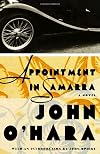
Julian English seems to have everything: a gorgeous (and smart) wife, a good job, wealth and glamour. But his actions at a party one night cause his near-perfect life to begin unraveling, and readers soon see that his reality is quite far from perfect.
O'Hara was a contemporary of and often compared to F. Scott Fitzgerald, and truthfully I was often comparing this story in my head with The Great Gatsby. Oddly enough, I may even have liked it better. Maybe because their glitzy country club show more life was a little more small-town than New York, maybe because I felt like the characters had foibles that I could forgive a little more than Gatsby's. Certainly no one is on a pedestal in this story, which is introduced by the short story "Appointment in Samarra" by W. Somerset Maugham and addresses the inevitability of fate. Though the essential action takes place over three days of Christmas 1930, many times we get a glimpse of past events in several characters' lives, helping us see how everything came together in just this way. I didn't always like what happened but couldn't imagine things ending up any other way, and that's about the highest compliment I can give a writer. show less
O'Hara was a contemporary of and often compared to F. Scott Fitzgerald, and truthfully I was often comparing this story in my head with The Great Gatsby. Oddly enough, I may even have liked it better. Maybe because their glitzy country club show more life was a little more small-town than New York, maybe because I felt like the characters had foibles that I could forgive a little more than Gatsby's. Certainly no one is on a pedestal in this story, which is introduced by the short story "Appointment in Samarra" by W. Somerset Maugham and addresses the inevitability of fate. Though the essential action takes place over three days of Christmas 1930, many times we get a glimpse of past events in several characters' lives, helping us see how everything came together in just this way. I didn't always like what happened but couldn't imagine things ending up any other way, and that's about the highest compliment I can give a writer. show less
Lists
Awards


You May Also Like


Associated Authors
Statistics
- Works
- 134
- Also by
- 48
- Members
- 6,787
- Popularity
- #3,601
- Rating
- 3.7
- Reviews
- 119
- ISBNs
- 246
- Languages
- 9
- Favorited
- 11