
John P. Marquand (1893–1960)
Author of The Late George Apley
About the Author
Image credit: by Louis Fabian Bachrach: Library of Congress Prints and Photographs Division (REPRODUCTION NUMBER: LC-USZ62-116936)
Series
Works by John P. Marquand
North of Grand Central;: Three novels of New England: The late George Apley, Wickford Point, H.M. Pulham, Esquire (1956) 9 copies
Lord Timothy Dexter of Newburyport, Massachusetts, first in the East, first in the West, and the greatest philosopher in the western world (1925) 8 copies, 1 review
Black Cargo (The Labor Movement in Fiction and Non-Fiction An Ams Reprint Series) (1976) 7 copies, 2 reviews
The Late George Apley: A Play 3 copies
Don't ask questions 2 copies
Ingen vei tilbake. B2 2 copies
Ingen vei tilbake. B1 1 copy
The second happiest day 1 copy
Pull, Pull Together 1 copy
Poor Pan 1 copy
Iwo Jima Before H-Hour 1 copy
Golden Lads 1 copy
Letter To Dr. Huntington 1 copy
Ascension Island 1 copy
Good Morning, Major 1 copy
Lunch at Honolulu 1 copy
The End Game 1 copy
King of the Sea 1 copy
Rainbow 1 copy
Fourth Down 1 copy
Just Break The News 1 copy
Beginning Now-- 1 copy
Merry Christmas, All 1 copy
High Tide 1 copy
Where Are You, Prince? 1 copy
The Summing Up 1 copy
Associated Works
Reporting World War II Part Two : American Journalism 1944-1946 (1995) — Contributor — 435 copies, 3 reviews
An American Album: One Hundred and Fifty Years of Harper's Magazine (2000) — Contributor — 145 copies, 1 review
Reader's Digest Condensed Books 1957 v01: Bon Voyage / The Tribe That Lost Its Head / The Philadelphian / A Family Party / Stopover: Tokyo (1957) — Contributor — 45 copies, 1 review
The Dick Francis Complete Treasury of Great Racing Stories (1991) — Contributor — 36 copies, 1 review
Contemporary Short Stories: Representative Selections, Volume 3 — Contributor — 6 copies
Reader's Digest Condensed Books: Old Yeller • The Tribe that Lost its Head • The Philadelphian • Stopover: Tokyo (1956) — Contributor — 4 copies
Best-in-Books: Treasure of Pleasant Valley / Best of H.T. Webster / Bridge of San Luis Rey / Think Fast Mr. Moto / Hawaii / H.R.H. / Story of Philip / Answer / Sea Fights and… (1956) — Contributor — 4 copies
The Best from Cosmopolitan — Contributor — 4 copies
The Best Short Stories of 1927 and the Yearbook of the American Short Story (1927) — Contributor — 3 copies
Reader's Digest Condensed Books: Women and Thomas Harrow, The Northern Light, In My Father's House, Cone of Silence (1955) — Contributor — 3 copies
Best-in-Books: Beyond This Place / Gallant Mrs. Stonewall / U.S.A. in Color / Life at Happy Knoll / Land of Stones and Saints / Dreamers of the American Dream (1957) — Contributor — 3 copies
Om weer te leven; De laatste reis van de Andrea Doria; Vaarwel, lady; Komplot in Tokio 2 copies, 1 review
5 Book LOT: International Collectors Library. History of Tom Jones / Late George Apley / Winesburg, Ohio / Short Stories / The Robe (1960) — Contributor — 1 copy
Capolavori del brivido e del mistero — Contributor — 1 copy
The Ethnic Image in Modern American Literature, 1900-1950, Volumes 1-2 (1984) — Contributor — 1 copy
Tagged
Common Knowledge
- Legal name
- Marquand, John Phillips
- Birthdate
- 1893-11-10
- Date of death
- 1960-07-16
- Gender
- male
- Education
- Harvard College (AB)
- Occupations
- novelist
- Organizations
- U.S. Army
Bread Loaf School of English - Awards and honors
- American Academy of Arts and Letters (1940)
- Relationships
- Phillips, John (son) (7)
- Nationality
- USA
- Birthplace
- Wilmington, Delaware, USA
- Places of residence
- Cambridge, Massachusetts, USA
Middlebury, Vermont, USA
Newburyport, Massachusetts, USA - Place of death
- Newburyport, Massachusetts, USA
- Burial location
- Sawyer Hill Burying Ground, Newburyport, Massachusetts, USA
- Associated Place (for map)
- Massachusetts, USA
Members
Reviews
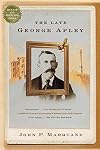
I cannot believe that I have lived in Boston for almost half my life and not read this dellightful book. It is a wonderfully nuanced satire on the Boston Brahmin culture. What is sad is that George Apley, having resisted his father's attempts to immerse him in this culture of privilege, noblesse oblige, and prejudice against the Irish, nonetheless, imposes exactly these same strictures on his own son, all in the name of family and community responsibility as well as one's duty to one's show more ancestors. Like his own father,George Apley resists change, despairs of the wildness of the youth, and lives a life of privilege and conformity: clubs (mostly of the dry, intellectual sort), summer camps (on distant islands),, family dinners, and numerous board meetings. Saddest of all is his sense that he has accomplished nothing in his lifetime and the fact that he had stifled the one impulse that might have led to genuine happiness--falling in love with a girl from a lower socioeconomic class while in college. His one friend who seems to have found happiness left Boston and married a showgirl but is regarded as a pariah to all but George Apley. One learns of his life through letters, his own and those of his parents to him as well as those of his to his son. These letters and reminiscences have been collected by one of his most pompous and conservative friends who comments on them, always missing the point. The narrator is both unable and unwilling to see either George Apley or his son's restiveness and minor rebellions, but it is this voice that creates the satire of the novel. I was reminded while reading the novel of my beloved Bostonian father-in-law who was a gentler version of George Apley as well as my own Virginian father who epitomized WASP culture, though not the Boston Brahmin variety. As a result, I kept up a running dialogue with the novel, one of the first to so affect me. show less

This second book in the Mr. Moto series is a solid step up over the first one. Here is a much more intense story and more psychologically developed main characters. As with the first book, No Hero, Mr. Moto is a secondary figure to the main protagonist, Tom Nelson, and Eleanor Joyce, an art dealer who has beguiled Nelson and leads him into a nest of spies.
But Moto, too, is much more fully fleshed out than in No Hero. In fact, the entire issue of Japan's occupation of China becomes much more show more complex and hard to define. Marquand actually expresses some degree of understanding for Japan's "manifest destiny" to rule over at least parts of China and the Asian mainland. The only issue is whether that colonialization will be done at the hands of radicals or more moderate Japanese figures. Mr. Moto is made to represent the more moderate and even friendly face of Japan, although once again, as in No Hero, Moto is also depicted as a ruthless killer, if need be.
The scope of the story takes place over only a couple of days in Peking. But Tom Nelson is changed forever during this time. From being an expatriate satisfied with his easy life in China, he reacquires his loyalty to his country. He also comes to see that there will always be a divide, racially, culturally, and spiritually, between the West and the East. show less
But Moto, too, is much more fully fleshed out than in No Hero. In fact, the entire issue of Japan's occupation of China becomes much more show more complex and hard to define. Marquand actually expresses some degree of understanding for Japan's "manifest destiny" to rule over at least parts of China and the Asian mainland. The only issue is whether that colonialization will be done at the hands of radicals or more moderate Japanese figures. Mr. Moto is made to represent the more moderate and even friendly face of Japan, although once again, as in No Hero, Moto is also depicted as a ruthless killer, if need be.
The scope of the story takes place over only a couple of days in Peking. But Tom Nelson is changed forever during this time. From being an expatriate satisfied with his easy life in China, he reacquires his loyalty to his country. He also comes to see that there will always be a divide, racially, culturally, and spiritually, between the West and the East. show less

John P. Marquand won the Pulitzer Prize in 1938 for his brilliant work of social satire, *The Late George Apley*. Through the life of its title character, George Apley, the book provides a complex and frequently humorous look into the inflexible world of Boston Brahmin society in the late 19th and early 20th centuries. The novel's unique narrative structure is one of its most notable features. After George Apley passed away, a rather haughty and well-meaning family friend named Horatio show more Willing put together what is presented as a fictional biography. Using a variety of letters, diaries, and other private records, it seeks to paint a respectable and admiring picture of Apley. Willing's well-meaning but frequently misguided remarks are masterfully used by Marquand to subtly expose a more nuanced and occasionally tragic reality beneath the surface. The very limitations and setbacks of Apley's life are frequently brought to light by Willing's attempts to cleanse or justify Apley's early defiances or moments of true emotion. This semi-epistolary approach allows for layers of irony and subtle critique.
Marquand's genius lies in his ability to be both gently satirical and deeply sympathetic towards his characters. While he pokes fun at the pretensions and absurdities of Boston's elite, he also allows the reader to feel a profound sense of understanding and even pity for George Apley. Apley is not a villain but rather a man trapped by the very circumstances of his birth and the rigid expectations he inherited.
The Late George Apley is a witty, incisive, and ultimately poignant character study. It offers a fascinating glimpse into a specific time and place while also exploring universal themes of identity, legacy, and the complex interplay between individual desires and societal pressures. It remains a relevant and highly regarded work of American literature for its sharp observations and its blend of humor and pathos. show less
Marquand's genius lies in his ability to be both gently satirical and deeply sympathetic towards his characters. While he pokes fun at the pretensions and absurdities of Boston's elite, he also allows the reader to feel a profound sense of understanding and even pity for George Apley. Apley is not a villain but rather a man trapped by the very circumstances of his birth and the rigid expectations he inherited.
The Late George Apley is a witty, incisive, and ultimately poignant character study. It offers a fascinating glimpse into a specific time and place while also exploring universal themes of identity, legacy, and the complex interplay between individual desires and societal pressures. It remains a relevant and highly regarded work of American literature for its sharp observations and its blend of humor and pathos. show less

A thumping good read. I felt like I was reading a combination of "The Great Gatsby" and Downton Abbey and Anthony Trollope.
I hadn't read John Marquand before, hadn't even heard of him; now, I want everything he's written. I bought this book from the dollar cart at a used-books shop, probably based on its cover and maybe after reading the opening lines and bits from pages farther in.
I couldn't have gotten luckier.
There are irritatingly self-centered characters and eccentric stately characters show more and an honest open-eyed narrator who knows that it would be best if all these lackadaisical young adults, including him, left Wickford Point to establish lives of their own. Some do - for a while - but they end up being drawn back to Wickford Point - there's nothing they can do about it, it seems.
Good humor, good writing, good story, and thought-provoking slices of life. What more could you want from a novel?
I lucked into a gem. show less
I hadn't read John Marquand before, hadn't even heard of him; now, I want everything he's written. I bought this book from the dollar cart at a used-books shop, probably based on its cover and maybe after reading the opening lines and bits from pages farther in.
I couldn't have gotten luckier.
There are irritatingly self-centered characters and eccentric stately characters show more and an honest open-eyed narrator who knows that it would be best if all these lackadaisical young adults, including him, left Wickford Point to establish lives of their own. Some do - for a while - but they end up being drawn back to Wickford Point - there's nothing they can do about it, it seems.
Good humor, good writing, good story, and thought-provoking slices of life. What more could you want from a novel?
I lucked into a gem. show less
Lists
Epistolary Books (1)
Awards


You May Also Like


Associated Authors
Statistics
- Works
- 67
- Also by
- 43
- Members
- 2,887
- Popularity
- #8,874
- Rating
- 3.8
- Reviews
- 80
- ISBNs
- 114
- Languages
- 3
- Favorited
- 5

