
Louis Auchincloss (1917–2010)
Author of The Rector of Justin
About the Author
Louis Auchincloss was born on September 27, 1917 in New York. He attended Groton College and Yale University and received a law degree from the University of Virginia. He served in the U.S. Navy for four years during World War ll. A practicing attorney, Auchincloss wrote his first novel, "The show more Indifferent Children," in 1947 under the pseudonym Andrew Lee, establishing a dual career as a successful lawyer and writer. Born into a socially prominent family, Auchincloss generally writes about society's upper class. Strong family connections, well-bred manners, and corporate boardrooms are subject matter in such novels as "Portrait in Brownstone" and "I Come As a Thief." He has also written several biographical and critical works on such notable writers as Edith Wharton and Henry James. Auchincloss was President of the Museum of the City of New York. (Bowker Author Biography) show less
Image credit: photo by Tom Cogill from Cullen Couch's 2005 article at UVA Lawyer
Works by Louis Auchincloss
Family Fortunes: The Rector of Justin/the House of Five Talents/Portrait in Brownstone (1993) 32 copies
Ellen Glasgow - American Writers 33: University of Minnesota Pamphlets on American Writers (1964) 3 copies
Pa's Darling 1 copy
The Warden 1 copy
2006 1 copy
The Rector of St. Justin 1 copy
Associated Works
A Sense of History: The Best Writing from the Pages of American Heritage (1985) — Contributor — 490 copies, 4 reviews
Yankee from Olympus: Justice Holmes and His Family (1944) — Introduction, some editions — 418 copies, 3 reviews
A Truth Universally Acknowledged: 33 Great Writers on Why We Read Jane Austen (2009) — Contributor — 411 copies, 18 reviews
The Blithedale Romance [Norton Critical Edition, 1st ed.] (1978) — Contributor — 193 copies, 2 reviews
On the Firing Line: The Public Life of Our Public Figures (1989) — Contributor — 126 copies, 1 review
Writing New York: A Literary Anthology (Expanded 10th-Anniversary Edition) (2008) — Contributor — 101 copies, 1 review
The World of Law, Volumes I-II: The Law in Literature, The Law as Literature (1960) — Contributor — 54 copies
New World Writing: Third Mentor Selection - Poetry, Fiction, Drama, Criticism (1953) — Contributor — 8 copies
American Experience: Woodrow Wilson [2002 TV episode] — Actor — 5 copies
Best In Books: Mandate For Change, A Man Named John, Happy New Year Herbie, Renoir, My Father, The Mirror Crack'd, By Quintin Reynolds, The Dillinger Days, Power Of Attorney,… (1963) — Contributor — 2 copies
The Golden Bowl | The Portrait of a Lady | The Spoils of Poynton and Other Stories (1971) — Introduction — 2 copies
Tagged
Common Knowledge
- Canonical name
- Auchincloss, Louis
- Legal name
- Auchincloss, Louis Stanton
- Birthdate
- 1917-09-27
- Date of death
- 2010-01-26
- Gender
- male
- Education
- University of Virginia (LL.B.|1941)
Yale University
Groton School - Occupations
- lawyer
novelist
historian
essayist - Organizations
- Sullivan & Cromwell
Hawkins, Delafield & Wood
Association of the Bar of the City of New York
American Bar Association
New York State Bar Association (1941)
Century Association (show all 7)
United States Navy Reserve - Awards and honors
- National Medal of Arts (2005)
Phi Beta Kappa
Fellow, American Academy of Arts and Sciences (1997)
American Academy of Arts and Letters (1965) - Relationships
- Lawrence, Adele (wife)
Rives, Amelie (friend) - Cause of death
- complications of a stroke
- Nationality
- USA
- Birthplace
- Lawrence, New York, USA
- Places of residence
- New York, New York, USA
- Place of death
- New York, New York, USA
- Associated Place (for map)
- New York, USA
Members
Reviews
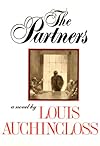
This is the second Auchincloss novel I’ve read. Diary of a Yuppie (1986) read like a hyper-polished Henry Jamesian version of American Psycho (1991). The Partners (1974) proceeds like a season of Mad Men (AMC, 2007—2015), but taking place in a white shoe corporate law firm on Wall Street instead of Don Draper’s Sixties ad firm.
At Shepard, Putney and Cox, Beekman “Beeky” Ehninger, a senior partner, navigates the crucible of corporate law, a challenging marriage, and upholding his show more personal moral code. The novel moves forward stately and staid, but never boring, each chapter like a long short story. Beeky is less the main character than the lodestar around which other minor bodies revolve. Administrative reorganization, merger threats, and ethical lapses harry the firm across stories tragical, comical, comical-tragical, and so forth. After setting the scene in the Nixon-era Big Apple, Auchincloss sets several chapters decades earlier when Beeky was a green college graduate. A couple chapters recount his early career as an aspiring clerk in the firm of Shepard & Howland. As with Diary of a Yuppie, Auchincloss pilots the course between the interconnected world of high finance and high society, each populated by peacocks and thugs.
Throughout his career Auchincloss has been compared to The Master, Henry James. Don’t let that praise intimidate you, because Auchincloss writes in a style at once smoothly polished yet highly accessible. His high society types will make pepper their dinner conversations with references to personalities of Imperial Rome or seventeenth century Spanish playwrights. This might have proven a high wall to scale, but today there’s Google. An infinite encyclopedia at your fingertips.
That said, it would be churlish to write an entire review on an Auchincloss novel without a sample of the writing. While the later writings of Henry James are baroque labyrinths of indirection, Auchincloss can capture a character in a few short lines. In the first chapter, “A Kingly Crown,” Beeky seeks to reorganize Shepard, Putney and Cox, recruiting help among the senior partners. In order to create a firm within a firm, he must convince Dan Purdy. Describing Purdy becomes an exercise in the comical grotesque, more Addams Family than Henry Adams:
"Dan Purdy, as Mrs. Bing said, looked like a monk. Austerity seemed to emanate from his tall spare frame like dry air from a desert. He was not, perhaps, a bad-looking man: his regular features and long, strong face might have been almost attractive but for an air of juicelessness that hung about him, a hard-baked clay quality that made one see his short stiff curly hair as a tonsure. Dan moved rapidly, abruptly, awkwardly. His voice was harsh and loud, and his laugh sounded like gravel on tin. But there was a tough humorousness in his cynicism, a trenchancy to his observations, a naked strength in his observations and actions that made him a leader, if not of men, at least of cliques."
If you are looking for a short novel – the hardcover barely cracks 250 pages – to scratch that Mad Men itch, The Partners is the novel for you. Auchincloss simultaneously reveals himself as a master of modern prose and in his ability to capture the zeitgeist of the era. In this case, through the character of Beeky and the partners of Shepard, Putney and Cox, the post-Sixties anxieties and frustrations at the fading morality of an older era. Memories of robber barons clash with a nascent feminism and concerns for pollution. The Partners is less about aging gracefully than the tragicomic attempts to pull off such a feat.
https://driftlessareareview.com/2020/04/12/espresso-shots-the-partners-by-louis-... show less
At Shepard, Putney and Cox, Beekman “Beeky” Ehninger, a senior partner, navigates the crucible of corporate law, a challenging marriage, and upholding his show more personal moral code. The novel moves forward stately and staid, but never boring, each chapter like a long short story. Beeky is less the main character than the lodestar around which other minor bodies revolve. Administrative reorganization, merger threats, and ethical lapses harry the firm across stories tragical, comical, comical-tragical, and so forth. After setting the scene in the Nixon-era Big Apple, Auchincloss sets several chapters decades earlier when Beeky was a green college graduate. A couple chapters recount his early career as an aspiring clerk in the firm of Shepard & Howland. As with Diary of a Yuppie, Auchincloss pilots the course between the interconnected world of high finance and high society, each populated by peacocks and thugs.
Throughout his career Auchincloss has been compared to The Master, Henry James. Don’t let that praise intimidate you, because Auchincloss writes in a style at once smoothly polished yet highly accessible. His high society types will make pepper their dinner conversations with references to personalities of Imperial Rome or seventeenth century Spanish playwrights. This might have proven a high wall to scale, but today there’s Google. An infinite encyclopedia at your fingertips.
That said, it would be churlish to write an entire review on an Auchincloss novel without a sample of the writing. While the later writings of Henry James are baroque labyrinths of indirection, Auchincloss can capture a character in a few short lines. In the first chapter, “A Kingly Crown,” Beeky seeks to reorganize Shepard, Putney and Cox, recruiting help among the senior partners. In order to create a firm within a firm, he must convince Dan Purdy. Describing Purdy becomes an exercise in the comical grotesque, more Addams Family than Henry Adams:
"Dan Purdy, as Mrs. Bing said, looked like a monk. Austerity seemed to emanate from his tall spare frame like dry air from a desert. He was not, perhaps, a bad-looking man: his regular features and long, strong face might have been almost attractive but for an air of juicelessness that hung about him, a hard-baked clay quality that made one see his short stiff curly hair as a tonsure. Dan moved rapidly, abruptly, awkwardly. His voice was harsh and loud, and his laugh sounded like gravel on tin. But there was a tough humorousness in his cynicism, a trenchancy to his observations, a naked strength in his observations and actions that made him a leader, if not of men, at least of cliques."
If you are looking for a short novel – the hardcover barely cracks 250 pages – to scratch that Mad Men itch, The Partners is the novel for you. Auchincloss simultaneously reveals himself as a master of modern prose and in his ability to capture the zeitgeist of the era. In this case, through the character of Beeky and the partners of Shepard, Putney and Cox, the post-Sixties anxieties and frustrations at the fading morality of an older era. Memories of robber barons clash with a nascent feminism and concerns for pollution. The Partners is less about aging gracefully than the tragicomic attempts to pull off such a feat.
https://driftlessareareview.com/2020/04/12/espresso-shots-the-partners-by-louis-... show less
Sometimes Auchincloss uses tightly-linked short stories, or lengthy character studies, to construct a sort of novel. He successfully does that here.
The first, and one of the best, stories takes place when Oscar is at a tony prep school and slowly learns that his idealized favorite teacher isn’t precisely what he seems to be.
The stories are told in chronological order, and strictly from Oscar’s point of view. Over and over he realizes that what he thinks about a person doesn’t include show more the deeper parts of the character’s psyche. He’s often surprised, and not in a particularly good way. In one story, however, Oscar sees what others have missed or deliberately ignored. He helps this man to change his life, and derives quiet satisfaction from doing so.
One note: people often criticize this author for focusing on a rather narrow milieu of the northeastern upper-crust society. But authors are continually told to “write what they know.” And this is what Auchincloss knows: it’s precisely where he was born, grew up, and lived his entire life. He casts a very clear eye at the stupidity, the bigotry, and the privilege of this world. If he attempted to write about a different milieu, no doubt he would be pilloried for his lack of knowledge and understanding. He’s an expert at dissecting the world of the moderately rich—and he does it with beautiful, restrained writing that is truly elegant.
This isn’t an author , style, or subject for everyone, so YMMV. But if you love Edith Wharton, you’ll feel very much at home in Auchincloss’s books. show less
The first, and one of the best, stories takes place when Oscar is at a tony prep school and slowly learns that his idealized favorite teacher isn’t precisely what he seems to be.
The stories are told in chronological order, and strictly from Oscar’s point of view. Over and over he realizes that what he thinks about a person doesn’t include show more the deeper parts of the character’s psyche. He’s often surprised, and not in a particularly good way. In one story, however, Oscar sees what others have missed or deliberately ignored. He helps this man to change his life, and derives quiet satisfaction from doing so.
One note: people often criticize this author for focusing on a rather narrow milieu of the northeastern upper-crust society. But authors are continually told to “write what they know.” And this is what Auchincloss knows: it’s precisely where he was born, grew up, and lived his entire life. He casts a very clear eye at the stupidity, the bigotry, and the privilege of this world. If he attempted to write about a different milieu, no doubt he would be pilloried for his lack of knowledge and understanding. He’s an expert at dissecting the world of the moderately rich—and he does it with beautiful, restrained writing that is truly elegant.
This isn’t an author , style, or subject for everyone, so YMMV. But if you love Edith Wharton, you’ll feel very much at home in Auchincloss’s books. show less

The story is told in chapters that deal with members of a family during different points in history, from American colonial time to the Vietnam War era. Auchincloss, for me, is a fabulous writer. What I liked most about this particular book was the moral dilemma presented in each story: If a person truly believes that what he or she is doing is the right thing to do, but it isn't right or results in harmful consequences, how guilty is that person, is guilt or responsibility mitigated by the show more person's sincere motives. In other words, does sincere belief make a difference in actual or moral guilt for what happens as a result of your actions. A fascinating discussion, whether you're talking about pointing the finger at "witches" in the 1600s or about the many issues of our day. show less

This is a series of connected stories that do not exactly make a novel, but which together present a comprehensive portrait of the partners and staff of a somewhat stodgy Wall Street law firm in the middle of the twentieth century. Many of them were published individually in magazines like Scribner's, The New Yorker, and The Saturday Evening Post, back when magazines published decent fiction. I was pleasantly surprised to find myself enjoying the heck out of all of them. Perceptive as show more Wharton, more readable than Henry James, Auchincloss belongs in just such company. I'm going to try to find more of his output.
Review written May 2016 show less
Review written May 2016 show less
Lists
Awards


You May Also Like


Associated Authors
Statistics
- Works
- 86
- Also by
- 33
- Members
- 4,725
- Popularity
- #5,329
- Rating
- 4.1
- Reviews
- 100
- ISBNs
- 274
- Languages
- 8
- Favorited
- 18
