
Beryl Markham (1902–1986)
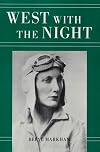
Author of West with the Night
About the Author
Image credit: Beryl Markham circa 1930. Unknown author
Works by Beryl Markham
Associated Works
The Dick Francis Complete Treasury of Great Racing Stories (1991) — Contributor — 35 copies, 1 review
Tagged
Common Knowledge
- Canonical name
- Markham, Beryl
- Legal name
- Clutterbuck, Beryl (born)
- Birthdate
- 1902-10-26
- Date of death
- 1986-08-03
- Gender
- female
- Occupations
- horse trainer
pilot
short story writer
memoirist - Relationships
- Dinesen, Isak (friend)
- Short biography
- Beryl Markham was a British-born Kenyan who had several careers in her life, all of them adventurous. She was a record-breaking pilot in the pioneer days of aviation, and is best remembered today as the author of the memoir "West with the Night."
- Nationality
- UK
- Birthplace
- Ashwell, Rutland, England, UK
- Places of residence
- Ashwell, England, UK
Njoro, Kenya
Nairobi, Kenya
Hollywood, California, USA - Place of death
- Nairobi, Kenya
Members
Reviews

I'm sorry to say I haven't heard of Beryl Markham until I read this memoir written in 1936, first published in 1942 and reprinted in the 1980s. Markham was born in 1902 and went to what is now Kenya with her father in 1906. Like her father she was a racehorse trainer but she fell in love with flying and became a bush pilot eventually scouting for elephant from the air and working with people like Baron von Blixen. In 1936 she was the first woman to fly solo east-to-west across the Atlantic. show more
She was the most adventurous woman I can imagine, afraid of nothing. And to top it all produced this fantastic memoir using the most poetic, beautiful prose that even Hemingway envied. This mesmerizing book goes back on the shelf because it will definitely be read again. Now I plan to read Mary S. Lovell's biography West with the Night and Circling the Sun a fictional story of her life by Paula McLain. There has been some controversy about whether or not Markham wrote the book, but Lovell is said to have been in no doubt about the authorship after meeting Markham. show less
She was the most adventurous woman I can imagine, afraid of nothing. And to top it all produced this fantastic memoir using the most poetic, beautiful prose that even Hemingway envied. This mesmerizing book goes back on the shelf because it will definitely be read again. Now I plan to read Mary S. Lovell's biography West with the Night and Circling the Sun a fictional story of her life by Paula McLain. There has been some controversy about whether or not Markham wrote the book, but Lovell is said to have been in no doubt about the authorship after meeting Markham. show less
"I stumble out of the plane and sink to my knees in muck and stand there foolishly staring, not at the lifeless land, but at my watch. Twenty-one hours and twenty-five minutes. Atlantic flight. Abingdon, England, to a nameless swamp – nonstop."
It is probably sacrilege to have read West with the Night and not to have loved it more.
To be fair, when I read the book I could hardly put it down. It was a charmingly written memoir of what must have been an extraordinarily interesting person. show more Beryl Markham was funny, witty, daring, confident, dashing...in short all one would associate with an adventurer. Most strikingly, she was not at all what I would have expected from someone growing up in colonial Africa, where expats are said to have formed an exclusive society about whom history books and literature seem to like reporting in terms of stereotypes and cliches.
Markham was not like that. She grew up in the remote wilderness of Kenya as an equal to the local Nandi and Masai and it seems from her writing that she saw herself as African.
"Competitors in conquest have overlooked the vital soul of Africa herself, from which emanates the true resistance to conquest. The soul is not dead, but silent, the wisdom not lacking, but of such simplicity as to be counted non-existent in the tinker’s mind of modern civilization. Africa is of an ancient age and the blood of many of her peoples is as venerable and as chaste as truth. What upstart race, sprung from some recent, callow century to arm itself with steel and boastfulness, can match in purity the blood of a single Masai Murani whose heritage may have stemmed not far from Eden?"
The book is full of passages that show her reverence for Africa in a way that is neither sentimental nor frightened by the unknown. Africa is Africa - what may seem as drama to European society is just a fact of life. To some extent, Markham even makes fun of the attitudes that seem to long for the theatrical:
"I do not suggest that the lion of the Serengetti have become so blasé about the modern explorer’s motion-picture camera that their posing has already become a kind of Hollywoodian habit. But many of them have so often been bribed with fresh-killed zebra or other delicacies that it is sometimes possible to advance with photographic equipment to within thirty or forty yards of them if the approach is made in an automobile. To venture that close on foot, however, would mean the sudden shattering of any kindly belief that the similarity of the lion and the pussy cat goes much beyond their whiskers. But then, since men still live by the sword, it is a little optimistic to expect the lion to withdraw his claws, handicapped as he is by his inability to read our better effusions about the immorality of bloodshed."
However, on finishing the book, I realised that even though I enjoy reading about her exploits - nearly being mauled by a lion, becoming a racehorse trainer, taking up flying, and organising safaris with Bror Blixen - there was something amiss with the recollection of stories. There was a guarded hesitation about the way she told the stories.
Markham, of course, is known for being a famous aviatrix but she is more famous for being one of the cornerstones of the love triangle described in the oh-so-famous Out of Africa - except that Karen Blixen does not mention her. Markham in return writes much about Denys Finch-Hatton and Bror Blixen, but does not mention Blixen's wife.
So, despite the humorous eloquence of Markham's book, I was left wondering what other relevant details were left out. Not that it is necessary for West with the Night to be a truthful, tell-all memoir. Not at all. It was just that the book seemed to suffer from a lack of credibility once I read more about the characters involved in her life. show less
It is probably sacrilege to have read West with the Night and not to have loved it more.
To be fair, when I read the book I could hardly put it down. It was a charmingly written memoir of what must have been an extraordinarily interesting person. show more Beryl Markham was funny, witty, daring, confident, dashing...in short all one would associate with an adventurer. Most strikingly, she was not at all what I would have expected from someone growing up in colonial Africa, where expats are said to have formed an exclusive society about whom history books and literature seem to like reporting in terms of stereotypes and cliches.
Markham was not like that. She grew up in the remote wilderness of Kenya as an equal to the local Nandi and Masai and it seems from her writing that she saw herself as African.
"Competitors in conquest have overlooked the vital soul of Africa herself, from which emanates the true resistance to conquest. The soul is not dead, but silent, the wisdom not lacking, but of such simplicity as to be counted non-existent in the tinker’s mind of modern civilization. Africa is of an ancient age and the blood of many of her peoples is as venerable and as chaste as truth. What upstart race, sprung from some recent, callow century to arm itself with steel and boastfulness, can match in purity the blood of a single Masai Murani whose heritage may have stemmed not far from Eden?"
The book is full of passages that show her reverence for Africa in a way that is neither sentimental nor frightened by the unknown. Africa is Africa - what may seem as drama to European society is just a fact of life. To some extent, Markham even makes fun of the attitudes that seem to long for the theatrical:
"I do not suggest that the lion of the Serengetti have become so blasé about the modern explorer’s motion-picture camera that their posing has already become a kind of Hollywoodian habit. But many of them have so often been bribed with fresh-killed zebra or other delicacies that it is sometimes possible to advance with photographic equipment to within thirty or forty yards of them if the approach is made in an automobile. To venture that close on foot, however, would mean the sudden shattering of any kindly belief that the similarity of the lion and the pussy cat goes much beyond their whiskers. But then, since men still live by the sword, it is a little optimistic to expect the lion to withdraw his claws, handicapped as he is by his inability to read our better effusions about the immorality of bloodshed."
However, on finishing the book, I realised that even though I enjoy reading about her exploits - nearly being mauled by a lion, becoming a racehorse trainer, taking up flying, and organising safaris with Bror Blixen - there was something amiss with the recollection of stories. There was a guarded hesitation about the way she told the stories.
Markham, of course, is known for being a famous aviatrix but she is more famous for being one of the cornerstones of the love triangle described in the oh-so-famous Out of Africa - except that Karen Blixen does not mention her. Markham in return writes much about Denys Finch-Hatton and Bror Blixen, but does not mention Blixen's wife.
So, despite the humorous eloquence of Markham's book, I was left wondering what other relevant details were left out. Not that it is necessary for West with the Night to be a truthful, tell-all memoir. Not at all. It was just that the book seemed to suffer from a lack of credibility once I read more about the characters involved in her life. show less

Beryl Markham (1902-1986) certainly led an adventurous life. Born in England, she moved to Kenya (then British East Africa) at age four. Her life included “up close and personal” experiences with African wildlife, training racehorses, and flying aircraft. She flew the African bush, bringing medical supplies to remote locations, spotting wildlife, and searching for downed pilots. She flew from Nairobi to London. She was the first woman to fly solo east to west over the Atlantic, from show more England to Nova Scotia.
Published in 1942, the majority of the book is focused on her life in Africa. She encounters lions, elephants, warthogs, zebras, and more. The final two chapters describe her solo flight. She keeps her private life private, sticking to career, colleagues, friends, and family.
What a wonderful memoir. Markham definitely had a way with words. Her writing is descriptive, eloquent, and artistic. Her love for Africa is unmistakable. I felt a sense of accompanying her on her flights. If you are looking for well-written non-fiction about a strong woman that led the life of a non-conformist, pick this one up. As an added bonus, Anna Fields does a first-rate job of voice acting in the audio book. show less
Published in 1942, the majority of the book is focused on her life in Africa. She encounters lions, elephants, warthogs, zebras, and more. The final two chapters describe her solo flight. She keeps her private life private, sticking to career, colleagues, friends, and family.
What a wonderful memoir. Markham definitely had a way with words. Her writing is descriptive, eloquent, and artistic. Her love for Africa is unmistakable. I felt a sense of accompanying her on her flights. If you are looking for well-written non-fiction about a strong woman that led the life of a non-conformist, pick this one up. As an added bonus, Anna Fields does a first-rate job of voice acting in the audio book. show less
On the back cover of [West with the Night] is an encomium from Ernest Hemingway:
I knew her [Beryl Markham] in Africa and never would have suspected that she could and would put pen to paper except to write in her flyer's log book. As it is, she has written so well, and marvelously well, that I was completely ashamed of myself as a writer...But [she] can write rings around all of us who consider ourselves as writers....[R]ead it because it is really a bloody wonderful book.
I do agree with Hem show more on this. I give West with the Night both thumbs up. It is a wonderful book.
Markham's memoir begins with a tale of rescue. She's awakened by a messenger bringing a request from a remote encampment to fly in with a tank of oxygen to save a desperately sick gold miner. Oxygen strapped into the passenger seat of her biplane, she flies in the dark to the spot where a few torches delineate a very rough landing strip. She's confident she can land her plane, but questions whether she'll be able to take off from so short a strip. She needs to get airborne by daylight to continue a search for a fellow aviator who is presumed down. It's the life of a pioneering flier in a vast and largely unexplored, unmapped country.
Africa is mystic; it is wild; it is a sweltering inferno; it is a photographer's paradise, a hunter's Valhalla, an escapist's Utopia. It is what you will, and it withstands all interpretations. It is the last vestige of a dead world or a cradle of a shiny new one. To a lot of people, as to myself, it is just "home." It is all these things but one thing—it is never dull.
Born in England, Beryl moves at the age of 4 with her father, an accomplished thoroughbred trainer, to what was then (in the early 1900s) British East Africa, now Kenya. There's no farmhouse on the farm he establishes, only individual huts for himself and his daughter. While her father tends to business, Beryl learns about her new homeland from the children of the native workers. She follows two boys along their path to manhood, which will be completed when the two are circumcised. As part of their maturation, the three, along with Beryl's dog Buller, venture into the bush to hunt warthogs, armed only with spears and bush knives. Lions are confronted.
From her father she learns about horses and how to train them. A drought destroys her father's farm, he heads to Peru, and at age 17, Beryl is on her own, running a training stable, a venture that peaks in a race expected to be dominated by a stallion named Wrack, a horse she trained until its owner succumbed to a fear-mongering rival trainer. No 17-year-old girl could successfully prepare a winner. She preps a different horse, a filly named Wise Child. The race is thrilling, as is Markham's narration. "Wrack is a picture of driving power—Wise Child a study in coordination of muscle and bone and nerve. She's fast, she's smooth. She's smooth as a blade. She cuts the daylight between Wrack and herself to a hand's breadth—to a hair's breath—to nothing."
Sometime later she turns to flying, inspired by a pioneering flier named Tom Black who glides into Nairobi carrying "a message of enterprise, a cargo of pain, and a vessel of death." A pair of hunters cornered a lion and shot it, the pilot tells Beryl, and Beryl tells us.
He was an old lion, prepared from birth to lose his life rather than leave it. But he had the dignity of all free creatures, and so he was allowed his moment. It was hardly a glorious moment…[The hunters] shot him without killing him, and then turned the unconscionable eye of a camera upon his agony. It was a small, a stupid, but a callous crime.
When Tom Black...landed...at the camp site near Muscoma, one man lay dead and a second, mangled and helpless, was alive only by the caprice of chance.
Black educates Markham as a pilot. She buys a plane and begins a career as a free-lance aviator, ferrying machine parts, critical supplies, and other cargo to isolated towns and encampments. She shared flying and hunting adventures with a variety of men, particularly Denys Hatton-Finch and Baron von Blixen. These two were introduced in 1938 in the pages of the novel [Out of Africa], written by Baron von Blixen's wife Karen, better known to the literary world as Isak Dinesen. Eventually tiring of her African business and drawn to England, she flies north. In England, Markham finds a new venture, flying east from England to America, and a financial backer who has a plane built for the flight. And she does make it to Nova Scotia before fuel-system icing ends the flight.
A wonderful book it is. show less
I knew her [Beryl Markham] in Africa and never would have suspected that she could and would put pen to paper except to write in her flyer's log book. As it is, she has written so well, and marvelously well, that I was completely ashamed of myself as a writer...But [she] can write rings around all of us who consider ourselves as writers....[R]ead it because it is really a bloody wonderful book.
I do agree with Hem show more on this. I give West with the Night both thumbs up. It is a wonderful book.
Markham's memoir begins with a tale of rescue. She's awakened by a messenger bringing a request from a remote encampment to fly in with a tank of oxygen to save a desperately sick gold miner. Oxygen strapped into the passenger seat of her biplane, she flies in the dark to the spot where a few torches delineate a very rough landing strip. She's confident she can land her plane, but questions whether she'll be able to take off from so short a strip. She needs to get airborne by daylight to continue a search for a fellow aviator who is presumed down. It's the life of a pioneering flier in a vast and largely unexplored, unmapped country.
Africa is mystic; it is wild; it is a sweltering inferno; it is a photographer's paradise, a hunter's Valhalla, an escapist's Utopia. It is what you will, and it withstands all interpretations. It is the last vestige of a dead world or a cradle of a shiny new one. To a lot of people, as to myself, it is just "home." It is all these things but one thing—it is never dull.
Born in England, Beryl moves at the age of 4 with her father, an accomplished thoroughbred trainer, to what was then (in the early 1900s) British East Africa, now Kenya. There's no farmhouse on the farm he establishes, only individual huts for himself and his daughter. While her father tends to business, Beryl learns about her new homeland from the children of the native workers. She follows two boys along their path to manhood, which will be completed when the two are circumcised. As part of their maturation, the three, along with Beryl's dog Buller, venture into the bush to hunt warthogs, armed only with spears and bush knives. Lions are confronted.
From her father she learns about horses and how to train them. A drought destroys her father's farm, he heads to Peru, and at age 17, Beryl is on her own, running a training stable, a venture that peaks in a race expected to be dominated by a stallion named Wrack, a horse she trained until its owner succumbed to a fear-mongering rival trainer. No 17-year-old girl could successfully prepare a winner. She preps a different horse, a filly named Wise Child. The race is thrilling, as is Markham's narration. "Wrack is a picture of driving power—Wise Child a study in coordination of muscle and bone and nerve. She's fast, she's smooth. She's smooth as a blade. She cuts the daylight between Wrack and herself to a hand's breadth—to a hair's breath—to nothing."
Sometime later she turns to flying, inspired by a pioneering flier named Tom Black who glides into Nairobi carrying "a message of enterprise, a cargo of pain, and a vessel of death." A pair of hunters cornered a lion and shot it, the pilot tells Beryl, and Beryl tells us.
He was an old lion, prepared from birth to lose his life rather than leave it. But he had the dignity of all free creatures, and so he was allowed his moment. It was hardly a glorious moment…[The hunters] shot him without killing him, and then turned the unconscionable eye of a camera upon his agony. It was a small, a stupid, but a callous crime.
When Tom Black...landed...at the camp site near Muscoma, one man lay dead and a second, mangled and helpless, was alive only by the caprice of chance.
Black educates Markham as a pilot. She buys a plane and begins a career as a free-lance aviator, ferrying machine parts, critical supplies, and other cargo to isolated towns and encampments. She shared flying and hunting adventures with a variety of men, particularly Denys Hatton-Finch and Baron von Blixen. These two were introduced in 1938 in the pages of the novel [Out of Africa], written by Baron von Blixen's wife Karen, better known to the literary world as Isak Dinesen. Eventually tiring of her African business and drawn to England, she flies north. In England, Markham finds a new venture, flying east from England to America, and a financial backer who has a plane built for the flight. And she does make it to Nova Scotia before fuel-system icing ends the flight.
A wonderful book it is. show less
Lists
Carole's List (1)
Allie's Wishlist (1)
Awards


You May Also Like


Associated Authors
Statistics
- Works
- 2
- Also by
- 9
- Members
- 4,273
- Popularity
- #5,881
- Rating
- 4.1
- Reviews
- 151
- ISBNs
- 90
- Languages
- 10
- Favorited
- 9
