
Edward Bellamy (1850–1898)
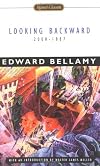
Author of Looking Backward, 2000-1887
About the Author
It is as a romantric Utopian rather than a novelist or profound thinker that Edward Bellamy is remembered and read today. While working as a journalist in Springfield, Massachusetts, he began to write novels and later short stories but did not achieve much success until the publication of Looking show more Backward (1888). The hero of this fantasy falls asleep in 1887 and awakens in the year 2000 to find himself in a humane scientific and socialistic utopia. After selling fewer than 10,000 copies in its first year, Looking Backward became enormously popular. Clubs were formed to promote Bellamy's social ideas, and he became a leader of a nationalist movement, crusading for economic equality, brotherhood, and the progressive nationalization of industry. Americans as diverse as Thorstein Veblen and John Dewey have been influenced by Bellamy's suggestion that the products of industrial energy, intelligently organized, could be used to obtain a nobler future. His The Religion of Solidarity (1940), long out of print, is again available. (Bowker Author Biography) show less
Image credit: Courtesy of the NYPL Digital Gallery (image use requires permission from the New York Public Library)
Series
Works by Edward Bellamy
Associated Works
Isaac Asimov Presents : The Best Science Fiction of the 19th Century (1981) — Contributor — 155 copies, 2 reviews
Short Science Fiction Collection 047 — Contributor — 2 copies
Tagged
Common Knowledge
- Canonical name
- Bellamy, Edward
- Legal name
- Bellamy, Edward
- Other names
- Bellamy, Eduardo
- Birthdate
- 1850-03-26
- Date of death
- 1898-05-22
- Gender
- male
- Education
- Union College
- Occupations
- journalist
- Organizations
- New York Post
Springfield Union
The New Nation - Awards and honors
- Edward Bellamy House (Chicopee Falls, Massachusetts, USA)
Bellamy Road (Toronto, Ontario, Canada)
Bellamy Loop (The Bronx, New York City, New York, USA) - Relationships
- Bellamy, Joseph (g-g-grandfather)
Bellamy, Francis (cousin) - Nationality
- USA
- Birthplace
- Chicopee Falls, Massachusetts, USA
- Places of residence
- Chicopee Falls, Massachusetts, USA (Birth)
- Place of death
- Boston, Massachusetts, USA
- Associated Place (for map)
- Massachusetts, USA
Members
Reviews

A Book About the Gilded Age*
If a good book should engage a reader in a debate about its themes, Looking Backward is a good book. Edward Bellamy sends his protagonist, Julian West, forward in time to the year 2000 to witness the social transformation America has undergone in the 113 years since Julian's unusual hypnotic session propels him into the future. The novel is full of criticisms of Julian's original time, the Gilded Age, detailed through the contrasting organization of business and show more society in the future.
If a good book has a basis in the reality of human nature, Looking Backward fails to qualify. The America of the future is a utopia of social equality where there is no need for money, or armies. Where the citizens of the country have voluntarily migrated to this new arrangement in which the government owns all means of production and distribution, even decides what should be imported from foreign countries. Where all citizens, even children, receive an equal share of the national wealth annually to spend as they see fit (although they are so satisfied with their condition that they are incapable of spending it all). In other words, America has been overrun by non-humans who fervently believe the needs of the many outweigh the needs of the one (regards, Mr. Spock) and act in accordance.
Looking Backward is an interesting read which I recommend with caveats. I laughed at Bellamy's thoughts on freedom and equality, because the patriarchy of his day is still in effect in the future. The equivalent of noblesse oblige has been transferred from the wealthy and their obligations to the less-fortunate to men and their treatment of women. If you take offense at patronizing attitudes about the delicacy of women you might skip this book. Even if you can accept travel across time, the novel also contains a fantastic coincidence, which I won't spoil, which overwhelms even the most ludicrous of Bellamy's visions of an enlightened future. If you read and enjoy 18th and 19th century fiction, this twist will be in keeping with those of greater works such as Les Miserables and Jane Eyre. If you need a plot grounded in the semblance of the possible, this book isn't for you. But overall it's an enjoyable book, if for no other reason than to see what Marx might have done as a novelist.
* - I've had to set my themed reading list aside for now, as I'm taking a couple literature classes this summer through a state program that provides free tuition for Texas residents over 55. This novel is assigned for my 19th Century American Literature class focused on the Gilded Age. show less
If a good book should engage a reader in a debate about its themes, Looking Backward is a good book. Edward Bellamy sends his protagonist, Julian West, forward in time to the year 2000 to witness the social transformation America has undergone in the 113 years since Julian's unusual hypnotic session propels him into the future. The novel is full of criticisms of Julian's original time, the Gilded Age, detailed through the contrasting organization of business and show more society in the future.
If a good book has a basis in the reality of human nature, Looking Backward fails to qualify. The America of the future is a utopia of social equality where there is no need for money, or armies. Where the citizens of the country have voluntarily migrated to this new arrangement in which the government owns all means of production and distribution, even decides what should be imported from foreign countries. Where all citizens, even children, receive an equal share of the national wealth annually to spend as they see fit (although they are so satisfied with their condition that they are incapable of spending it all). In other words, America has been overrun by non-humans who fervently believe the needs of the many outweigh the needs of the one (regards, Mr. Spock) and act in accordance.
Looking Backward is an interesting read which I recommend with caveats. I laughed at Bellamy's thoughts on freedom and equality, because the patriarchy of his day is still in effect in the future. The equivalent of noblesse oblige has been transferred from the wealthy and their obligations to the less-fortunate to men and their treatment of women. If you take offense at patronizing attitudes about the delicacy of women you might skip this book. Even if you can accept travel across time, the novel also contains a fantastic coincidence, which I won't spoil, which overwhelms even the most ludicrous of Bellamy's visions of an enlightened future. If you read and enjoy 18th and 19th century fiction, this twist will be in keeping with those of greater works such as Les Miserables and Jane Eyre. If you need a plot grounded in the semblance of the possible, this book isn't for you. But overall it's an enjoyable book, if for no other reason than to see what Marx might have done as a novelist.
* - I've had to set my themed reading list aside for now, as I'm taking a couple literature classes this summer through a state program that provides free tuition for Texas residents over 55. This novel is assigned for my 19th Century American Literature class focused on the Gilded Age. show less

In Looking Backward: 2000-1887, Edward Bellamy tells the story of Julian West, who goes to sleep in a hermetic chamber and finds himself waking “exactly one hundred and thirteen years, three months, and eleven days” after he retired for the night, now in the year 2000 (pg. 31). In the future, Dr. Leete explains to him how the United States and the world became a socialist utopia, with people working jobs that bring them satisfaction and knowing that they are bettering society. Further, show more without money, people receive what goods they want free of charge. These same goods are instantaneously delivered without the chaos and pressures of commercialism.
Bellamy discusses the transformation of the future in generalized terms, focused as he is on the larger ideas of human improvement and the betterment of society, but this works to his advantage as advances in technology would normally lead to the novel feeling too dated. Some of his few examples include a predecessor to debit cards and the use of electronic music. Interestingly, though he does not give much detail about fashion, West’s reaction to modern clothing reflects the general stability in men’s wear since the mid-1800s: “It did not appear that any very startling revolution in men’s attire had been among the great changes my host had spoken of, for, barring a few details, my new habiliments did not puzzle me at all” (pg. 40).
The popularity of Looking Backward – second only to Uncle Tom’s Cabin and Ben-Hur in its own time – led to the creation of Bellamy Clubs which arose to discuss and promote Bellamy’s socialist utopian ideas and fostered several utopian communities. In many ways, the ideas Bellamy describes closely align with those Gene Roddenberry discussed in his Star Trek franchise. As a work of science fiction focused on time travel, Bellamy’s book predates H.G. Wells’s The Time Machine by seven years, though it lacks a time machine and instead relies on the protagonist sleeping through the passage of time, like Louis-Sébastien Mercier’s L’An 2440, rêve s’il en fût jamais from 1770, Washington Irving’s Rip Van Winkle from 1819, and Wells’s other time travel story, When the Sleeper Awakes from 1899. Though Irving and Wells remain familiar to modern audiences, Bellamy’s work speaks to ideas that seem all the more relevant in the early twenty-first century amid the actions of oligarchs and the effects of late-stage capitalism. show less
Bellamy discusses the transformation of the future in generalized terms, focused as he is on the larger ideas of human improvement and the betterment of society, but this works to his advantage as advances in technology would normally lead to the novel feeling too dated. Some of his few examples include a predecessor to debit cards and the use of electronic music. Interestingly, though he does not give much detail about fashion, West’s reaction to modern clothing reflects the general stability in men’s wear since the mid-1800s: “It did not appear that any very startling revolution in men’s attire had been among the great changes my host had spoken of, for, barring a few details, my new habiliments did not puzzle me at all” (pg. 40).
The popularity of Looking Backward – second only to Uncle Tom’s Cabin and Ben-Hur in its own time – led to the creation of Bellamy Clubs which arose to discuss and promote Bellamy’s socialist utopian ideas and fostered several utopian communities. In many ways, the ideas Bellamy describes closely align with those Gene Roddenberry discussed in his Star Trek franchise. As a work of science fiction focused on time travel, Bellamy’s book predates H.G. Wells’s The Time Machine by seven years, though it lacks a time machine and instead relies on the protagonist sleeping through the passage of time, like Louis-Sébastien Mercier’s L’An 2440, rêve s’il en fût jamais from 1770, Washington Irving’s Rip Van Winkle from 1819, and Wells’s other time travel story, When the Sleeper Awakes from 1899. Though Irving and Wells remain familiar to modern audiences, Bellamy’s work speaks to ideas that seem all the more relevant in the early twenty-first century amid the actions of oligarchs and the effects of late-stage capitalism. show less

A book I've intended to read for a long time, ever since learning that Edward Bellamy briefly attended Union College (my alma mater) in the late 1860s. Bellamy's book, which attained great popularity (and also significant ridicule) at the time of its publication, is a utopian manifesto wrapped lightly in the threads of a thinly-plotted Victorian romance novel. Bellamy goes to sleep in 1887 and wakes up in 2000 to a Boston much changed, and a bulk of the book is spent in dialogue with his show more interlocutor about how society has been reformed in the intervening century. Heavy-handed? Yes. A bit clunky? Yes. But also thoroughly interesting to see what a utopia might have looked like to a resident of the 1880s (covered sidewalks, radio broadcasts, centralized production eliminating the need for strikes, &c.).
Worth a read as an example of historical utopianism, if nothing else. show less
Worth a read as an example of historical utopianism, if nothing else. show less
A truly terrible book. It's an extremely naive, optimistic, earnest political treatise masquerading as a novel. Most if not all of the political content comes off as repugnant to modern ears as well. Especially the frankly terrifying national industrial army, where citizens do their best for the glory of the "fatherland." It brings up scary WW2 echoes, but is packaged in an annoyingly earnest, naive "utopian" novel. The novel also suffers from a distinct lack of imagination. Bellamy's future show more society is basically exactly the same 19th century society in which he lived, only improved. Just a terrible, terrible book. show less
Lists
Awards


You May Also Like


Associated Authors
Statistics
- Works
- 43
- Also by
- 12
- Members
- 3,668
- Popularity
- #6,900
- Rating
- 3.4
- Reviews
- 70
- ISBNs
- 360
- Languages
- 10
- Favorited
- 4

