
Adam Nicolson
Author of God's Secretaries: The Making of the King James Bible
About the Author
Adam Nicolson has been both a publisher and a travel writer, and is the author of many award-winning books. He lives on a farm with his family near Burwash, England
Image credit: Robert Birnbaum
The Morning News/Identitytheory
Works by Adam Nicolson
Associated Works
Tagged
Common Knowledge
- Canonical name
- Nicolson, Adam
- Legal name
- Carnock, Adam Nicolson, 5th Baron
- Birthdate
- 1957-09-12
- Gender
- male
- Education
- Eton College
University of Cambridge (Magdalene College)
Summer Fields School, Oxford - Occupations
- non-fiction writer
journalist - Awards and honors
- Royal Society of Literature (Fellow)
Society of Antiquaries of Scotland (Fellow) - Relationships
- Nicolson, Nigel (father)
Raven, Sarah (wife)
Nicolson, Harold (grandfather)
Sackville-West, Vita (grandmother)
Nicolson, Juliet (sister)
Nicolson, Benedict (uncle) - Short biography
- Adam Nicolson is the son of writer Nigel Nicolson and grandson of the writers Vita Sackville-West and Sir Harold Nicolson. He was educated at Eton College and Magdalene College, Cambridge and has worked as a journalist and columnist on the Sunday Times, the Sunday Telegraph and the Daily Telegraph. He is a Fellow of the Royal Society of Literature, the Society of Antiquaries and the Society of Antiquaries of Scotland.Nicolson was married to Olivia Fane from 1982 to 1992. They have three sons, Thomas (born in 1984), William (born 1986) and Ben (born 1988).Since 1992 Nicolson has been married to Sarah Raven. He and his wife have two daughters, Rosie (born 1993) and Molly (born 1996). They live at Perch Hill Farm in Sussex and at Sissinghurst Castle in Kent.Between 2005 and 2009, in partnership with the National Trust, he led a project which transformed the 260 acres (110 ha) surrounding the house and garden at Sissinghurst into a productive mixed farm, growing meat, fruit, cereals and vegetables for the National Trust restaurant.In December 2008 he succeeded his cousin David Nicolson, 4th Baron Carnock as 5th Baron Carnock, a title he does not use.
Wiki-Extract - Nationality
- UK
- Birthplace
- Bransgore, England, UK
- Places of residence
- Sissinghurst, Kent, England, UK
Sussex, England, UK - Map Location
- England, UK
Members
Reviews
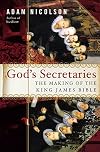
I must confess: A saint in church loaned this book to me months ago; it has been sitting on my shelf ignored. Until today when, on the most random of impulses (mainly guilt that I had kept the book so long), I picked it up to thumb through it as I'd done a couple times before. That was 10 am; I finished it just after 11 pm. Let me be clear: I. Could. Not. Stop. I can't tell you the last time that I completely ignored my "to-do" list and finished an ENTIRE book in a day.
Here's what I think show more was most amazing about Nicolson's achievement: He manages to tell the story of Jacobean England through the lens of the King James Bible while simultaneously telling the story of the King James Bible through the lens of Jacobean England. (If that sentence sounds like a tautology, read the section where he compares Hatfield House with the KJV and you'll see what I mean.)
Perhaps most intriguing to me is that I didn't find out until the very final pages of the very last chapter Nicholson's religious leanings which were quite cleverly summarized: " I'm no atheist, but I'm no churchgoer either." I suspected as much; however, that makes this work even more intriguing because of his very evident awe of this translation. This book is a testament to the KJV's cultural power as a shaper of English language and as an expression of English (e.g. British & American) culture.
I think the book's greatest strength is found in Nicholson's comparisons of the KJV with other translations (especially Tyndale's and the NEB). Though he only looks at snippets of text (at most 4-5 verses each), he has chosen well; the passage demonstrate that, in many important ways, the KJV could still claim to be a "superior" translation. In fact, Nicholson's distaste for modern translations I think plays no small part in his "non-churchgoer" status.
I am by no means a "KJV-only" radical...but neither have I ever desired to be seen as one who despises it. Nicholson's approach to the KJV mirrors my own; stunned admiration at its monumental achievement for its time dosed with the reality of its antiquarian nature. And, underneath it all, the yearning that, someday, perhaps we will reach another cultural nexus that will produce a work of the spiritual and cultural magnitude achieved in 1611. show less
Here's what I think show more was most amazing about Nicolson's achievement: He manages to tell the story of Jacobean England through the lens of the King James Bible while simultaneously telling the story of the King James Bible through the lens of Jacobean England. (If that sentence sounds like a tautology, read the section where he compares Hatfield House with the KJV and you'll see what I mean.)
Perhaps most intriguing to me is that I didn't find out until the very final pages of the very last chapter Nicholson's religious leanings which were quite cleverly summarized: " I'm no atheist, but I'm no churchgoer either." I suspected as much; however, that makes this work even more intriguing because of his very evident awe of this translation. This book is a testament to the KJV's cultural power as a shaper of English language and as an expression of English (e.g. British & American) culture.
I think the book's greatest strength is found in Nicholson's comparisons of the KJV with other translations (especially Tyndale's and the NEB). Though he only looks at snippets of text (at most 4-5 verses each), he has chosen well; the passage demonstrate that, in many important ways, the KJV could still claim to be a "superior" translation. In fact, Nicholson's distaste for modern translations I think plays no small part in his "non-churchgoer" status.
I am by no means a "KJV-only" radical...but neither have I ever desired to be seen as one who despises it. Nicholson's approach to the KJV mirrors my own; stunned admiration at its monumental achievement for its time dosed with the reality of its antiquarian nature. And, underneath it all, the yearning that, someday, perhaps we will reach another cultural nexus that will produce a work of the spiritual and cultural magnitude achieved in 1611. show less
Jacobean England was the England of Shakespeare, Jonson, and Bacon. Jacobean England was both more godly and less godly than the country had ever been, and the entire culture was drawn taut between these polarities. This was the world that created the King James Bible. It is no coincidence that the translation was made at the moment "Englishness." The English language had come into its first passionate maturity. The English of Jacobean England has a more encompassing idea of its scope than show more any form of the language before or since. It drips with potency and sensitivity. show less

Adam Nicolson owns the Shiants islands, off Lewis. He clearly loves these islands and is about to hand them over to his son. He writes about the wildlife, natural history, geology and social history of the islands. He also writes about getting his own boat to get to and from the islands and some of the practicalities of spending time on the Shiants. He has a curious mind and is interested in a range of subjects and people. His love of these islands comes across and he is observant of the show more features on the islands. His writing is rambling and sometimes repetitive and he is very clear about his opinions. He feels a right to private ownership and that he is the best person to care for these islands and he tells the reader that he has no time for the RSPB and Nature Scot and ecology experts. He gives a sense of these islands as someone who spends time there in the summer for leisure. show less

The compilation of the Authorised Version must have been one of the few thoroughly succesful government-sponsored IT projects ever. Completed on time and within budget, despite the fact that all the developers involved were clergymen and/or academics (unfortunately the project sponsor had spent the money on something else in the meantime...), run according to strict project-management principles that sound like PRINCE2 avant la lettre, and resulting in a product that became an industry show more standard internationally, with no serious competitor for over 350 years. Admittedly, initial acceptance of the product was slow, and some of the early versions did have serious bugs (the celebrated missing "not" in the 10 commandments), but that sort of thing is inevitable.
Nicolson gives us a very readable, if slightly gossipy account of the project and its background. He's rather limited in what he can do because most of the official documentation has been lost, and he obviously doesn't think his readers would be interested in technical discussions of Greek and Hebrew texts, so he tends to fall back a great deal on character sketches of the people involved, which can get a little wearing after a while. There's surprisingly little about the actual English of the translation, but the chapters where he does get into comparing the text of the AV with Tyndale and its other predecessors are some of the most rewarding parts of the book, and also the parts where Nicolson is most willing to intrude himself and give an opinion. show less
Nicolson gives us a very readable, if slightly gossipy account of the project and its background. He's rather limited in what he can do because most of the official documentation has been lost, and he obviously doesn't think his readers would be interested in technical discussions of Greek and Hebrew texts, so he tends to fall back a great deal on character sketches of the people involved, which can get a little wearing after a while. There's surprisingly little about the actual English of the translation, but the chapters where he does get into comparing the text of the AV with Tyndale and its other predecessors are some of the most rewarding parts of the book, and also the parts where Nicolson is most willing to intrude himself and give an opinion. show less
Lists
Awards


You May Also Like


Associated Authors
Statistics
- Works
- 33
- Also by
- 4
- Members
- 5,746
- Popularity
- #4,292
- Rating
- 3.8
- Reviews
- 121
- ISBNs
- 159
- Languages
- 4
- Favorited
- 2
