
Jean Bottéro (1914–2007)
Author of Mesopotamia : writing, reasoning, and the gods
About the Author
Jean Bottero has held a chair in Assyriology in the Department of Philology and History at the Ecole pratique des Hautes Etudes since 1958.
Works by Jean Bottéro
Fischer Weltgeschichte, Bd.2, Die Altorientalischen Reiche I - Vom Paläolithikum bis zur Mitte des 2. Jahrtausends (1966) 101 copies
Ancestor of the West : Writing, Reasoning, and Religion in Mesopotamia, Elam, and Greece (2000) 47 copies
Textes économique et administratifs 3 copies
Le antiche divinità semitiche 2 copies
Associated Works
Fischer Weltgeschichte, Bd.3, Die Altorientalischen Reiche II, Das Ende des 2. Jahrtausends (1972) — Editor — 71 copies
Tagged
Common Knowledge
- Canonical name
- Bottéro, Jean
- Legal name
- Bottéro, Jean-Baptiste Marius Joachim
- Other names
- Bottéro, Pierre (En religion)
- Birthdate
- 1914-08-30
- Date of death
- 2007-12-15
- Gender
- male
- Education
- Ecole Pratique des Hauts Etudes (Doctorat, Thèse'Le problème de la rétribution individuelle dans la religion d'Israël, au travers de l'Ecclésiaste', 1940)
Prieuré de Saint-Maximin, Var (Dominicain, 1932l1950)
Couvent dominicain de Biarritz (Noviciat, 1931l1932)
Petit Séminaire de Nice, Alpes-Maritimes (Bacalauréat, 1925l1931) - Occupations
- assyriologist
historian - Organizations
- Ecole Pratique des Hauts Etudes (Chargé de cours ∙ [1953] ∙ [1958, 1982])
Ecole du Louvre (Chargé de cours ∙ [1953])
Centre National de la Recherche Scientifique ( [1947, 1958])
Couvent dominicain Saint Jacques, Paris (1946l1950)
Prieuré de Saint-Maximin, Var (Professeur ∙ [1932, 1946])
Couvent dominicain de Biarritz (Noviciat ∙ [1931, 1932]) - Awards and honors
- Chevalier dans l'Ordre de la Légion d'honneur
- Relationships
- Labat, René (Professeur)
Durand, Jean-Marie (Thésard)
Lagrange, Marie-Joseph (Condisciple)
Gauchet, Marcel (Condisciple)
Lenzen, Heinrich (Condisciple)
Cassin, Elena (Amie) (show all 8)
Vernant, Jacques (Ami)
Vernant, Jean-Pierre (Ami) - Nationality
- France
- Birthplace
- Vallauris, France
- Places of residence
- Vallauris, France
Gif-sur-Yvette, France - Place of death
- Gif-sur-Yvette, France
- Map Location
- France
- Associated Place (for map)
- Gif-sur-Yvette, France
Members
Reviews
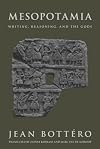
This book is a collection of articles written by the author (a respected French Assyriologist) from 1966 to 1982, along with an introduction and some helps and aids. This is not an introduction to ancient Mesopotamia. What Bottéro tries to do is figure out how the ancient Mesopotamians thought, what made their brain tick. He is especially fascinated by:
• the utility of investigating long lost cultures,
• how the development of writing changed the way that educated Mesopotamians looked show more at the world,
• the links between concrete reality and concepts, and the written word,
• how the world was investigated and understood,
• how ancient Mesopotamians thought about the gods, sex, and death.
Bottéro is disarming in his mixed attitude to the Mesopotamians: they both repulse and intrigue him. Although his writing does not require technical knowledge of ancient Mesoptamian history, writing or language, a basic familiarity is assumed. Following his reasoning can be hard work (at least for those like me for whom philosophy and logic hold no special attraction) but it is worthwhile persisting. Windows open up, not only on long past cultures, but on how humans view and construct culture. Perhaps it can lend some perspective to our own? That, I think, is one of Bottéro’s hopes. show less
• the utility of investigating long lost cultures,
• how the development of writing changed the way that educated Mesopotamians looked show more at the world,
• the links between concrete reality and concepts, and the written word,
• how the world was investigated and understood,
• how ancient Mesopotamians thought about the gods, sex, and death.
Bottéro is disarming in his mixed attitude to the Mesopotamians: they both repulse and intrigue him. Although his writing does not require technical knowledge of ancient Mesoptamian history, writing or language, a basic familiarity is assumed. Following his reasoning can be hard work (at least for those like me for whom philosophy and logic hold no special attraction) but it is worthwhile persisting. Windows open up, not only on long past cultures, but on how humans view and construct culture. Perhaps it can lend some perspective to our own? That, I think, is one of Bottéro’s hopes. show less
One of the author's goals in this book is to defend the utility of studying ancient civilizations. He does this by presenting the ways of thought of the ancient Mesopotamians as recorded in their tablets. The presentation is of course limited by the scarcity of the evidence and the tenuousness of interpretations, but nevertheless it persuaded me. Excellent books like this are the best justification for the pursuit of understanding in ancient history.
Bottero is an excellent writer, always worth reading. This book is the best one I've read on the historical context of the Old Testament, where these ideas came from and why they were fixed in a written canon.
This is as close to the original as a non-expert is ever going to get
Lists
Awards

You May Also Like


Associated Authors
Statistics
- Works
- 38
- Also by
- 3
- Members
- 1,162
- Popularity
- #22,116
- Rating
- 4.0
- Reviews
- 14
- ISBNs
- 90
- Languages
- 8
- Favorited
- 1


