
About the Author
Arthur Herman, PhD, is the author of the New York Times bestseller How the Scots Invented the Modern World, which has sold a half million copies worldwide, and Gandhi and Churchill, which was a finalist for the Pulitzer Prize. He is the author of six previous books and a senior fellow at the Hudson show more Institute in Washington, DC. show less
Works by Arthur Herman
How the Scots Invented the Modern World: The True Story of How Western Europe's Poorest Nation Created Our World & Everything in It (2001) 2,904 copies, 39 reviews
The Cave and the Light: Plato Versus Aristotle, and the Struggle for the Soul of Western Civilization (2013) 598 copies, 9 reviews
Gandhi & Churchill: The Epic Rivalry that Destroyed an Empire and Forged Our Age (2008) 486 copies, 6 reviews
Freedom's Forge: How American Business Produced Victory in World War II (2012) 374 copies, 9 reviews
Joseph McCarthy: Reexamining the Life and Legacy of America's Most Hated Senator (1999) 101 copies, 2 reviews
TheCaveandtheLight 1 copy
Associated Works
The History of Black Americans (A Study Guide and Curriculum Outline) (1972) — some editions — 6 copies
Tagged
Common Knowledge
- Legal name
- Herman, Arthur L.
- Birthdate
- 1956-11-23
- Gender
- male
- Education
- Johns Hopkins University (MA|Ph.D|1984)
University of Minnesota (BA)
University of Edinburgh - Occupations
- historian
- Organizations
- American Enterprise Institute
Hudson Institute - Relationships
- Herman, Alfred L. (father)
- Nationality
- USA
- Places of residence
- Stevens Point, Wisconsin, USA
Edinburgh, Midlothian, Scotland, UK
Washington, D.C., USA - Associated Place (for map)
- USA
Members
Reviews
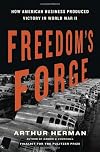
In World War II, the Allies buried the Axis under a torrent of technological products. This is the story of that production miracle, as seen through the biographies of two key leaders. Bill Knudsen was a Danish immigrant who at General Motors pioneered flexible mass production and annual models of automobiles. Henry Kaiser was an entrepreneur who made his fortune on the West Coast, first building roads and then leading mega-scale projects like the Hoover and Grand Coulee Dams.
In 1940, show more America was one of the most productive countries in the world, but industry had been hit hard by the Great Depression, and almost none of that capacity was geared towards military ends. The Army was without tanks, the Air Force was third tier at best, and while the Navy had capital ships, it was deficient in escorts and transports. In the last war, American soldiers had fought with French and British equipment. While Wilson had ordered a mass mobilization, production hang-ups and logistical snafus meant that very little of what was ordered ever saw a battlefield. If that happened again, there would be no way to defeat the Axis.
Knudsen was appointed Chairman of the Office of Production Management, and in the time between the invasion of Poland and Pearl Harbor, when American involvement in the war was distinctly unpopular, began the tricky work of converting commercial production over to military use. Knudsen used his immense standing in industry and his detailed knowledge of production to begin producing machine tools and setting up new factories. From fitful beginnings, Knudsen unleashed an avalanche of material: hundreds of thousands of tanks and aircraft, along with billions of shells and all the other necessary components of war.
Kaiser turned his mega-project style to building transports, churning out hundreds of Liberty cargo ships, along with oilers and escort carriers. Applying mass production to ships cut the build time down from 200 days to 25 at full swing. As part of a contest, one yard turned out a complete ship in 4 days! But Kaiser's publicity seeking style made him enemies, including Bill Knudsen. And when Liberty ships began cracking up, Kaiser's reputation took the blame, even though the fault was a combination of design and steel quality, rather than manufacturing defects.
Herman is a conservative intellectual, with longtime associations with the American Enterprise Institute and the Hudson Institute, and this book is a paean to big business. Celebrating industry is a fair frame, but Herman can't help himself from taking swipes at FDR, the New Deal, or organized labor whenever he can. My politics are basically entirely opposed to Herman's, but the story that he tells is engaging enough that I can give his obligatory right wing gruntings a pass. Wages of Destruction is worth reading, but Freedom's Forge is fun reading. It's just important to keep in mind that contrary to Herman's great man focused vision, the American people paid for the war, where the big contractors got a cost+8% contract and useful capital installations afterwards; workers milled, stamped, riveted, and welded the ships, planes, tanks, and guns; and ultimately an army of citizen-soldiers used these weapons to win the war. show less
In 1940, show more America was one of the most productive countries in the world, but industry had been hit hard by the Great Depression, and almost none of that capacity was geared towards military ends. The Army was without tanks, the Air Force was third tier at best, and while the Navy had capital ships, it was deficient in escorts and transports. In the last war, American soldiers had fought with French and British equipment. While Wilson had ordered a mass mobilization, production hang-ups and logistical snafus meant that very little of what was ordered ever saw a battlefield. If that happened again, there would be no way to defeat the Axis.
Knudsen was appointed Chairman of the Office of Production Management, and in the time between the invasion of Poland and Pearl Harbor, when American involvement in the war was distinctly unpopular, began the tricky work of converting commercial production over to military use. Knudsen used his immense standing in industry and his detailed knowledge of production to begin producing machine tools and setting up new factories. From fitful beginnings, Knudsen unleashed an avalanche of material: hundreds of thousands of tanks and aircraft, along with billions of shells and all the other necessary components of war.
Kaiser turned his mega-project style to building transports, churning out hundreds of Liberty cargo ships, along with oilers and escort carriers. Applying mass production to ships cut the build time down from 200 days to 25 at full swing. As part of a contest, one yard turned out a complete ship in 4 days! But Kaiser's publicity seeking style made him enemies, including Bill Knudsen. And when Liberty ships began cracking up, Kaiser's reputation took the blame, even though the fault was a combination of design and steel quality, rather than manufacturing defects.
Herman is a conservative intellectual, with longtime associations with the American Enterprise Institute and the Hudson Institute, and this book is a paean to big business. Celebrating industry is a fair frame, but Herman can't help himself from taking swipes at FDR, the New Deal, or organized labor whenever he can. My politics are basically entirely opposed to Herman's, but the story that he tells is engaging enough that I can give his obligatory right wing gruntings a pass. Wages of Destruction is worth reading, but Freedom's Forge is fun reading. It's just important to keep in mind that contrary to Herman's great man focused vision, the American people paid for the war, where the big contractors got a cost+8% contract and useful capital installations afterwards; workers milled, stamped, riveted, and welded the ships, planes, tanks, and guns; and ultimately an army of citizen-soldiers used these weapons to win the war. show less

Arthur Herman’s 1917 was published this year in observation of the 100th anniversary of the Russian Revolution and of significant developments in World War I. The unifying theme of the book is to contrast the actions and characters of the two most influential persons on the world stage that year—Woodrow Wilson, president of the U.S. from March, 1913 to March, 1921, and Vladimir Lenin, who served as head of government of Soviet Russia from 1917 to 1924 and of the Soviet Union from 1922 to show more 1924.
The author states that one mission of the book is to show how “these two intellectuals and dreamers” managed to overthrow traditional geopolitics and alter the distribution of world power. For Wilson’s part, he got Congress to declare war on Germany in spite of his campaign promises to keep the country out of war. After the war was over, Wilson’s words stimulated nationalist quests around the world, much to the Allies’ chagrin, and to the benefit of Lenin, as will be explained below.
Lenin successfully established the world’s first one party state dictatorship which he imposed on a vast and diverse country on the basis of an ideology some historians have, to account for its success, likened to a religious cult. Certainly the Soviets adapted some of the tropes of religion (Lenin loves the little children!) to push their agenda.
Perhaps more importantly, Herman avers, the age was “shaped as much by what Lenin and Wilson aimed and failed to do as by what they succeeded in doing.” Both worked for a new world order, and both the U.S. and the U.S.S.R. were indeed changed radically, but not in the directions either of them intended or foresaw.
Two (only somewhat) lesser players in Herman’s drama are Senator Henry Cabot Lodge and Alexander Kerensky, the principal rivals of, respectively, Wilson and Lenin. Herman contrasts the hard headed, realistic approaches of Lodge and Kerensky with the more theoretical and utopian approaches of Wilson and Lenin. But while Lodge, through his influence in Congress, prevailed in curtailing Wilson’s agenda, Kerensky was pushed aside by Lenin, who succeeded in overthrowing Kerensky and his democratic government.
Ironically, Wilson was on the winning side of the war, yet he failed to achieve his long term goals of setting up an effective multinational agency to maintain the peace. Lenin, on the other hand, not only overturned a long ruling monarchy, but successfully set in motion the entrenchment of a completely new kind of state. Herman attributes Lenin’s relative (compared to Wilson’s) success to his extreme ruthlessness and willingness to use “revolutionary violence” to achieve his ends. Herman might also have mentioned the very different natures of the polities each man strove to direct. Lenin, in a way, had more “freedom” to exercise his will in his non-free society than Wilson did in his democracy with the shared power of different branches of government.
It is also relevant to Herman’s theme to note the observations of historian David Reynolds, the author of in The Long Shadow: The Legacies of the Great War in the Twentieth Century. Reynolds points out that after the war, Wilson not only did not make himself any friends abroad, but unwittingly aided the cause of Lenin and communism. By lecturing Europe on the need for “self-determination” of minorities, Wilson roiled up anti-colonial agitators and alienated most of the other world leaders. They scoffed at Wilson for his hypocrisy and excoriated him for not understanding the effects “his seductive words would set in motion.” In response to the hostility of the Allied leadership against Wilson for stirring up trouble without knowing what he was talking about, Wilson not only backed down, stating that he had spoken “without the knowledge that nationalities existed….” but acquiesced in the imperialist policies of his allies. That precipitated a backlash against Wilson throughout the world outside America by the people as well as their leaders, with disillusioned nationalists turning to communism. Reynolds argues, “Right across the colonial world, in fact, Leninism gained from Wilson’s shattered credibility.”
Evaluation: 1917 was certainly a pivotal year in history, with the legacy of both Wilson and Lenin affecting the political climate long after they left the world scene. Herman’s account provides an interesting way to frame some of the most important events that shaped the 20th century.
(JAB) show less
The author states that one mission of the book is to show how “these two intellectuals and dreamers” managed to overthrow traditional geopolitics and alter the distribution of world power. For Wilson’s part, he got Congress to declare war on Germany in spite of his campaign promises to keep the country out of war. After the war was over, Wilson’s words stimulated nationalist quests around the world, much to the Allies’ chagrin, and to the benefit of Lenin, as will be explained below.
Lenin successfully established the world’s first one party state dictatorship which he imposed on a vast and diverse country on the basis of an ideology some historians have, to account for its success, likened to a religious cult. Certainly the Soviets adapted some of the tropes of religion (Lenin loves the little children!) to push their agenda.
Perhaps more importantly, Herman avers, the age was “shaped as much by what Lenin and Wilson aimed and failed to do as by what they succeeded in doing.” Both worked for a new world order, and both the U.S. and the U.S.S.R. were indeed changed radically, but not in the directions either of them intended or foresaw.
Two (only somewhat) lesser players in Herman’s drama are Senator Henry Cabot Lodge and Alexander Kerensky, the principal rivals of, respectively, Wilson and Lenin. Herman contrasts the hard headed, realistic approaches of Lodge and Kerensky with the more theoretical and utopian approaches of Wilson and Lenin. But while Lodge, through his influence in Congress, prevailed in curtailing Wilson’s agenda, Kerensky was pushed aside by Lenin, who succeeded in overthrowing Kerensky and his democratic government.
Ironically, Wilson was on the winning side of the war, yet he failed to achieve his long term goals of setting up an effective multinational agency to maintain the peace. Lenin, on the other hand, not only overturned a long ruling monarchy, but successfully set in motion the entrenchment of a completely new kind of state. Herman attributes Lenin’s relative (compared to Wilson’s) success to his extreme ruthlessness and willingness to use “revolutionary violence” to achieve his ends. Herman might also have mentioned the very different natures of the polities each man strove to direct. Lenin, in a way, had more “freedom” to exercise his will in his non-free society than Wilson did in his democracy with the shared power of different branches of government.
It is also relevant to Herman’s theme to note the observations of historian David Reynolds, the author of in The Long Shadow: The Legacies of the Great War in the Twentieth Century. Reynolds points out that after the war, Wilson not only did not make himself any friends abroad, but unwittingly aided the cause of Lenin and communism. By lecturing Europe on the need for “self-determination” of minorities, Wilson roiled up anti-colonial agitators and alienated most of the other world leaders. They scoffed at Wilson for his hypocrisy and excoriated him for not understanding the effects “his seductive words would set in motion.” In response to the hostility of the Allied leadership against Wilson for stirring up trouble without knowing what he was talking about, Wilson not only backed down, stating that he had spoken “without the knowledge that nationalities existed….” but acquiesced in the imperialist policies of his allies. That precipitated a backlash against Wilson throughout the world outside America by the people as well as their leaders, with disillusioned nationalists turning to communism. Reynolds argues, “Right across the colonial world, in fact, Leninism gained from Wilson’s shattered credibility.”
Evaluation: 1917 was certainly a pivotal year in history, with the legacy of both Wilson and Lenin affecting the political climate long after they left the world scene. Herman’s account provides an interesting way to frame some of the most important events that shaped the 20th century.
(JAB) show less

As someone who has always been fascinated by history, “The Scottish Enlightenment: The Scots’ Invention of the Modern World” by Arthur Herman was an absolute delight to read. Herman masterfully weaves together the stories of Scotland’s greatest minds, from Adam Smith to David Hume, showcasing how their revolutionary ideas shaped the modern world.
What truly captivated me was Herman’s ability to make complex philosophical and economic concepts accessible and engaging. His writing is show more both scholarly and approachable, making it easy to understand how the Scottish Enlightenment laid the groundwork for many aspects of contemporary society.
The book is a treasure trove of insights, revealing how a small nation with a tumultuous history managed to produce such a remarkable intellectual legacy. It’s inspiring to see how the Scots’ emphasis on education, critical thinking, and innovation led to advancements that still resonate today.
In short, this book is a must-read for anyone interested in history, philosophy, or the origins of modern thought. It’s a brilliant reminder of the power of ideas and the enduring impact of a few determined individuals. I couldn’t recommend it more highly show less
What truly captivated me was Herman’s ability to make complex philosophical and economic concepts accessible and engaging. His writing is show more both scholarly and approachable, making it easy to understand how the Scottish Enlightenment laid the groundwork for many aspects of contemporary society.
The book is a treasure trove of insights, revealing how a small nation with a tumultuous history managed to produce such a remarkable intellectual legacy. It’s inspiring to see how the Scots’ emphasis on education, critical thinking, and innovation led to advancements that still resonate today.
In short, this book is a must-read for anyone interested in history, philosophy, or the origins of modern thought. It’s a brilliant reminder of the power of ideas and the enduring impact of a few determined individuals. I couldn’t recommend it more highly show less
How the Scots invented the modern world : the true story of how western europe's poorest nation created our world & everything in it by Arthur Herman

I have a Scottish friend who is always quick to point out how the Scots are behind all the great advances in history, so it was little surprise that he recommended "How the Scots invented the modern world".
The author makes some interesting points about Scotland and its role in influencing European history but, as other reviewers have pointed out, Herman seems to stretch the idea of "Scottishness" to support his thesis so much I was fully expecting him to claim Tesla as Scottish. Still, I show more thought it a worthwhile read, and the fact I was in South Korea when I read this was an interesting experience in itself as one would struggle to find a more diametrically opposed nation to Scotland than the Republic of Korea. show less
The author makes some interesting points about Scotland and its role in influencing European history but, as other reviewers have pointed out, Herman seems to stretch the idea of "Scottishness" to support his thesis so much I was fully expecting him to claim Tesla as Scottish. Still, I show more thought it a worthwhile read, and the fact I was in South Korea when I read this was an interesting experience in itself as one would struggle to find a more diametrically opposed nation to Scotland than the Republic of Korea. show less
Lists
Awards


You May Also Like


Associated Authors
Statistics
- Works
- 16
- Also by
- 1
- Members
- 6,297
- Popularity
- #3,897
- Rating
- 3.9
- Reviews
- 85
- ISBNs
- 81
- Languages
- 3
- Favorited
- 2