
John Dalmas (1926–2017)
Author of The Regiment
About the Author
Disambiguation Notice:
John Dalmas (1926-2017), American science fiction author; legal name is John Robert Jones
Image credit: courtesy of the author John Dalmas website
Series
Works by John Dalmas
Picture Man 3 copies
Most Singular Murder 2 copies
About The Author 1 copy
The Lion of Farside Volume 2 1 copy
The Stoor's Map 1 copy
The Ides Of September 1 copy
Tiger Hunt 1 copy
The Railroad 1 copy
Out Of The North A Giant 1 copy
Moonlight Nocturne 1 copy
Short Fiction Collection 1 copy
Associated Works
Analog Science Fiction/Science Fact: Vol. LXXXVI, No. 2 (October 1970) (1970) — Contributor — 20 copies
Tagged
Common Knowledge
- Legal name
- Jones, John Robert
- Birthdate
- 1926-09-03
- Date of death
- 2017-06-15
- Gender
- male
- Education
- Michigan State University
- Occupations
- longshoreman
logger
construction worker
smokejumper - Nationality
- USA
- Birthplace
- Chicago, Illinois, USA
- Places of residence
- Minnesota, USA
Michigan, USA
Spokane, Washington, USA
Ohio, USA - Place of death
- Ohio, USA
- Disambiguation notice
- John Dalmas (1926-2017), American science fiction author; legal name is John Robert Jones
- Associated Place (for map)
- USA
Members
Discussions
Reality Matrix in Good Show Sir! — bad science fiction and fantasy covers (October 2025)
Reviews
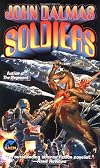
In John Dalmas’s Soldiers, 14,000 alien warships appear from nowhere in the human Commonwealth and start attacking entire planets, exterminating all of the humans, and resettling and terraforming these worlds for themselves – kind of six limbed, powerful mini-dinosaurs with brains and guns. Typically all humans die. The Commonwealth doesn’t even find out about this until this has happened to several planets and warning is gotten away secretly.
The Commonwealth is unprepared for this, as show more it hasn’t had war in centuries, and it has virtually no fleet nor army to speak of. In order to get the time to build up both, more worlds will fall and more people will die.
A lot happens in this book as we follow one particular group of recruits from a religious-based (as in zealots) planet as they train, as well as following the build up of the fleet and the tactics used in an effort to gain intelligence and to “annoy” the enemy. Additionally, there are peaceniks at home who think this is all a hoax, "peaceniks" who want peace so badly, they are willing to kill to get it. It all makes for good drama and a pretty good book. The ultimate land and orbital battles are tactically gripping and are well written. You can draw certain conclusions from this book, philosophically, although I wouldn’t put it in the same category as Ender’s Game or its sequels. Still, if you want to think about things, you can. If you don’t want to, just enjoy the explosions. It’s typical Dalmas – a four star book and recommended. show less
The Commonwealth is unprepared for this, as show more it hasn’t had war in centuries, and it has virtually no fleet nor army to speak of. In order to get the time to build up both, more worlds will fall and more people will die.
A lot happens in this book as we follow one particular group of recruits from a religious-based (as in zealots) planet as they train, as well as following the build up of the fleet and the tactics used in an effort to gain intelligence and to “annoy” the enemy. Additionally, there are peaceniks at home who think this is all a hoax, "peaceniks" who want peace so badly, they are willing to kill to get it. It all makes for good drama and a pretty good book. The ultimate land and orbital battles are tactically gripping and are well written. You can draw certain conclusions from this book, philosophically, although I wouldn’t put it in the same category as Ender’s Game or its sequels. Still, if you want to think about things, you can. If you don’t want to, just enjoy the explosions. It’s typical Dalmas – a four star book and recommended. show less
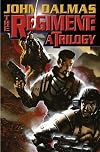
A heavily philosophical military science fiction novel, the first in a trilogy, I believe. I thought it was quite good, although I found the ending somewhat unsatisfying and a little disappointing. But perhaps it was fitting for the philosophical viewpoints the author was trying to get across regarding society, war, and other roles for people/beings in cultures, etc.
A rebellion takes place on a planet where some important mining is done by slaves, essentially. The slaves are physically show more superior to their intellectually “superior” masters, but they have some help and training, as well as weapons, and soon it turns into a real battle. So, a different race of warriors from another planet is hired as mercenaries to come in and fight them for the human masters. The protagonist, a journalist, joins the mercenaries to get their stories, and becomes one of them, essentially, living and training with them, even going out on missions with them. He discovers and finally understands their cultural philosophy regarding “play” and war, etc, and that changes everything.
I won’t say more because I don’t want to give away the plot or the critical ending, but it’s a good, action packed book with a lot of tension and emotion, intrigue and politics. And the aforementioned philosophical thoughts and ideas. Almost a five star book, but I’m giving it four stars due to the problematic and moderately disappointing ending. Nonetheless, definitely recommended and I intend to read the other books in the series. show less
A rebellion takes place on a planet where some important mining is done by slaves, essentially. The slaves are physically show more superior to their intellectually “superior” masters, but they have some help and training, as well as weapons, and soon it turns into a real battle. So, a different race of warriors from another planet is hired as mercenaries to come in and fight them for the human masters. The protagonist, a journalist, joins the mercenaries to get their stories, and becomes one of them, essentially, living and training with them, even going out on missions with them. He discovers and finally understands their cultural philosophy regarding “play” and war, etc, and that changes everything.
I won’t say more because I don’t want to give away the plot or the critical ending, but it’s a good, action packed book with a lot of tension and emotion, intrigue and politics. And the aforementioned philosophical thoughts and ideas. Almost a five star book, but I’m giving it four stars due to the problematic and moderately disappointing ending. Nonetheless, definitely recommended and I intend to read the other books in the series. show less

A mediocre take on low tech military scifi.
The Regiment follows a reporter embedded with a regiment of mysterious mercenaries as they fight an insurrection on a jungle planet. Has the setup of a pretty decent action book but quickly gets sidetracked into dune-like philosophy but without the depth
The Regiment follows a reporter embedded with a regiment of mysterious mercenaries as they fight an insurrection on a jungle planet. Has the setup of a pretty decent action book but quickly gets sidetracked into dune-like philosophy but without the depth

Not wonderful, not bad. I like Haugen, and the situation is interesting, but it's more than a little wishful thinking. It's actually somewhat disconcerting how the situation in the book resembles...not the current economic situation, but how the situation today could have been (was, by some people) forecast six months ago. Written in 1988, set in 1994.
Problems - the aforementioned wishful thinking - if the right guy could get real power, he could reform! Everything! Foreign policy, the legal show more system (and the law), education, tax reform (that one's easy in comparison), healthcare, etc, etc. 'All' it needs is one guy who thinks 'sensibly' to have power (effectively unlimited power, too - there's a thin rationalization of that, but it wouldn't really work that way). Yeah. No. Not gonna happen.
The other thing that looked familiar was that this reminded me a lot of Ringo's Last Centurion - the story is not even a little borrowed, but the wishful thinking is similar. Though the Centurion is working from the bottom up, not the top down.
The new science thing is an interesting deus ex machina, though it hasn't really come into full play by the end of the book. The oddest thing is - well, two things. Published in 1988, but his tech is way behind in a few spots - the sort of stuff that was in common use in offices (like fax machines or copiers) don't get mentioned, while he talks about mimeograph machines. They were still around in '88, I guess, but I was working by then and never saw one in any of the offices I worked in. Ever. The other oddity is how much worse shape the world was in in his forecast than in reality - the Soviet Union was still going strong, the price of oil was way up (to $67/barrel! Well, it's been higher now...), apartheid was still in full force in South Africa, and so on. A lot of those things were still active in '88 - now we look back and see the cracks, but the changes didn't seem serious then - so I can see why he'd think so, but looking at what the world really did look like in 1994 his forecast is amusing. And it really is a conspiracy theory - which seems totally unnecessary.
Overall, not a bad story but not one that catches me. Too much wishful thinking and too much cognitive dissonance. Glad I read it, won't re-read.
Oh, BTW - the person who wrote the back cover matter (and chose the title) didn't read the book, or even a good outline of it. The fact that he was chosen to be President by the Chairman of the Joint Chiefs of Staff is...basically irrelevant to the story (it even gets brought up as a media question only once). Silly. Though the alternate title might have been 'Try Common Sense, America!'. Which I don't think would have sold very well. show less
Problems - the aforementioned wishful thinking - if the right guy could get real power, he could reform! Everything! Foreign policy, the legal show more system (and the law), education, tax reform (that one's easy in comparison), healthcare, etc, etc. 'All' it needs is one guy who thinks 'sensibly' to have power (effectively unlimited power, too - there's a thin rationalization of that, but it wouldn't really work that way). Yeah. No. Not gonna happen.
The other thing that looked familiar was that this reminded me a lot of Ringo's Last Centurion - the story is not even a little borrowed, but the wishful thinking is similar. Though the Centurion is working from the bottom up, not the top down.
The new science thing is an interesting deus ex machina, though it hasn't really come into full play by the end of the book. The oddest thing is - well, two things. Published in 1988, but his tech is way behind in a few spots - the sort of stuff that was in common use in offices (like fax machines or copiers) don't get mentioned, while he talks about mimeograph machines. They were still around in '88, I guess, but I was working by then and never saw one in any of the offices I worked in. Ever. The other oddity is how much worse shape the world was in in his forecast than in reality - the Soviet Union was still going strong, the price of oil was way up (to $67/barrel! Well, it's been higher now...), apartheid was still in full force in South Africa, and so on. A lot of those things were still active in '88 - now we look back and see the cracks, but the changes didn't seem serious then - so I can see why he'd think so, but looking at what the world really did look like in 1994 his forecast is amusing. And it really is a conspiracy theory - which seems totally unnecessary.
Overall, not a bad story but not one that catches me. Too much wishful thinking and too much cognitive dissonance. Glad I read it, won't re-read.
Oh, BTW - the person who wrote the back cover matter (and chose the title) didn't read the book, or even a good outline of it. The fact that he was chosen to be President by the Chairman of the Joint Chiefs of Staff is...basically irrelevant to the story (it even gets brought up as a media question only once). Silly. Though the alternate title might have been 'Try Common Sense, America!'. Which I don't think would have sold very well. show less
You May Also Like


Associated Authors
Statistics
- Works
- 45
- Also by
- 9
- Members
- 3,149
- Popularity
- #8,110
- Rating
- 3.5
- Reviews
- 37
- ISBNs
- 43
- Favorited
- 2