

Ken Kesey (1935–2001)
Author of One Flew Over the Cuckoo's Nest
About the Author
Ken Kesey, September 17, 1935 - November 10, 2001 Kenneth Elton "Ken" Kesey was born in Colorado on September 17, 1935. He graduated from the University of Oregon, and published two full-length novels that helped to give him a cult following. "One Flew over the Cuckoo's Nest" (1962) owes much to show more Kesey's own experience as a ward attendant at the Menlo Park Veterans' Hospital. This exciting first novel was told from the point of view of a half-Indian man who thinks of himself as the Big Chief pictured on the writing tablets of everybody's school days looking out at the other inmates in a Disneylike world. Its portrayal of the doomed but heroic rebel McMurphy stood for a particular kind of American individualism. The book was adapted into a successful stage play by Dale Wasserman, and in 1975, Milos Forman directed a screen adaptation, which won the "Big Five" Academy Awards: Best Picture, Best Actor (Jack Nicholson), Best Actress (Louise Fletcher), Best Director (Forman) and Best Adapted Screenplay (Lawrence Hauben, Bo Goldman). Kesey's Sometimes a Great Notion (1964) is a long, complex novel that troubled many of his earlier readers. Kesey's most recent novel was Demon Box (1987); although it was somewhat well received, it was still compared unfavorably to his earlier works. His last major work was an essay for Rolling Stone magazine calling for peace in the aftermath of the September 11 attacks. On October 25, 2001, Kesey had surgery on his liver to remove a tumor. He died of complications from the surgery on November 10, 2001. He was 66. (Bowker Author Biography) show less
Works by Ken Kesey
Associated Works
The Rolling Stone Book of the Beats: The Beat Generation and American Culture (1999) — Contributor — 181 copies, 2 reviews
The Graphic Canon, Vol. 3: From Heart of Darkness to Hemingway to Infinite Jest (2013) — Contributor — 162 copies, 1 review
The Dylan Companion: A Collection of Essential Writing About Bob Dylan (1990) — Contributor, some editions — 103 copies
Take My Advice: Letters to the Next Generation from People Who Know a Thing or Two (2002) — Contributor — 50 copies
West Coast Fiction: Modern Writing from California, Oregon, and Washington (1979) — Contributor — 8 copies, 1 review
Northwest Review: Fall, 1957 — Contributor — 2 copies
Tagged
Common Knowledge
- Legal name
- Kesey, Kenneth Elton
- Birthdate
- 1935-09-17
- Date of death
- 2001-11-10
- Gender
- male
- Education
- University of Oregon
Stanford University - Occupations
- novelist
hospital orderly - Organizations
- U.S. Veterans Administration
- Awards and honors
- Robert Kirsch Award (1991)
Western Literature Association's Distinguished Achievement Award (1988) - Short biography
- Kenneth Elton Kesey (September 17, 1935 – November 10, 2001) was an American novelist, essayist, and countercultural figure. He considered himself a link between the Beat Generation of the 1950s and the hippies of the 1960s.
Kesey was born in La Junta, Colorado, and grew up in Springfield, Oregon, graduating from the University of Oregon in 1957. He began writing One Flew Over the Cuckoo's Nest in 1960 following the completion of a graduate fellowship in creative writing at Stanford University; the novel was an immediate commercial and critical success when published two years later. During this period, Kesey participated in government studies involving hallucinogenic drugs (including mescaline and LSD) to supplement his income.
Following the publication of One Flew Over the Cuckoo's Nest, he moved to nearby La Honda, California, and began hosting happenings with former colleagues from Stanford, miscellaneous bohemian and literary figures (most notably Neal Cassady), and other friends collectively known as the Merry Pranksters; these parties, known as Acid Tests, integrated the consumption of LSD with multimedia performances. He mentored the Grateful Dead (the de facto "house band" of the Acid Tests) throughout their incipience and continued to exert a profound influence upon the group throughout their long career. - Nationality
- USA
- Birthplace
- La Junta, Colorado, USA
- Places of residence
- Springfield, Oregon, USA
Pleasant Hill, Oregon, USA - Place of death
- Pleasant Hill, Oregon, USA
- Burial location
- Kesey family farm, Eugene, Oregon, USA
- Map Location
- USA
Members
Discussions
Group Read, March 2020: Sometimes a Great Notion in 1001 Books to read before you die (March 2020)
Reviews
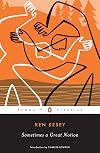
This feels like Kesey’s “Great American Novel” and he considered it his masterpiece, but while I liked it, I think “One Flew Over the Cuckoo’s Nest” should hold that honor. It’s remarkable to me that the subject of the novel was a labor dispute between loggers in the rugged forest of Oregon, gritty and not the kind of stuff that generally takes one’s breath away, considering the author would soon be leading his “Merry Pranksters” across the country in a bus, and would show more become a leading figure in the psychedelic movement. While I admire Kesey taking the road less travelled in his life, it’s a shame that he didn’t write more books, as his talent is certainly on display here.
At over 700 dense pages, this book is quite a tome, and if its style throws you off early on, stick with it. Kesey experiments with a technique of switching between perspectives rapidly, sometimes within a sentence, which can be a little disorienting, particularly as the story is being filled in. Ironically, in contrast to this style and the fluidity with which he wields it, he’s at his best with the level of realism in his dialogue, which invariably seems natural and unforced, and the level of detail in his description of the surroundings.
There are two central conflicts in the story, the primary of which is a logging family’s stubborn refusal to join others in a strike, and their attempt to go it alone amidst the rancor of their community. Interestingly, Kesey doesn’t choose sides in describing this struggle, satirizing both union leaders as well as the rugged individuals who disregard the strike, which may have been a part of why initial reactions to the book were mixed. The other conflict is within the family, with the younger son returning from college harboring a secret grudge against his brother, and plotting to have an affair with his wife.
There are topical references scattered in here, such as an allusion to the threat of nuclear war, the love the hip had for jazz music, or popular figures like Alan Watts, but this story mostly feels timeless, and intentionally so. There is something primal in the emotions in play, and it builds to moments of fantastic tension towards the end.
At the same, the book probably could have done with some editing, as it gets rather elongated (bizarrely, including 60 pages between 602 and 662 where a main character goes missing entirely). Worse yet, the female characters are terribly under-developed across the board, which was a serious detractor. As a warning, there are also bits of mild racism, such as the use of N-word between white workers, comments like “what other Caucasian ever moved with that slack-limbed indolence?” and the minor character of “Indian Jenny,” a prostitute who is more of a stereotype than anything else. Aside from the ridiculously terse updates for her throughout the novel, Kesey writes of her expression that it never changes, and is “somewhere between blunt ferocity and brute pathos.” (ugh)
All in all, however, it’s certainly a good book, and one that feels like it should be better known. show less
At over 700 dense pages, this book is quite a tome, and if its style throws you off early on, stick with it. Kesey experiments with a technique of switching between perspectives rapidly, sometimes within a sentence, which can be a little disorienting, particularly as the story is being filled in. Ironically, in contrast to this style and the fluidity with which he wields it, he’s at his best with the level of realism in his dialogue, which invariably seems natural and unforced, and the level of detail in his description of the surroundings.
There are two central conflicts in the story, the primary of which is a logging family’s stubborn refusal to join others in a strike, and their attempt to go it alone amidst the rancor of their community. Interestingly, Kesey doesn’t choose sides in describing this struggle, satirizing both union leaders as well as the rugged individuals who disregard the strike, which may have been a part of why initial reactions to the book were mixed. The other conflict is within the family, with the younger son returning from college harboring a secret grudge against his brother, and plotting to have an affair with his wife.
There are topical references scattered in here, such as an allusion to the threat of nuclear war, the love the hip had for jazz music, or popular figures like Alan Watts, but this story mostly feels timeless, and intentionally so. There is something primal in the emotions in play, and it builds to moments of fantastic tension towards the end.
At the same, the book probably could have done with some editing, as it gets rather elongated (bizarrely, including 60 pages between 602 and 662 where a main character goes missing entirely). Worse yet, the female characters are terribly under-developed across the board, which was a serious detractor. As a warning, there are also bits of mild racism, such as the use of N-word between white workers, comments like “what other Caucasian ever moved with that slack-limbed indolence?” and the minor character of “Indian Jenny,” a prostitute who is more of a stereotype than anything else. Aside from the ridiculously terse updates for her throughout the novel, Kesey writes of her expression that it never changes, and is “somewhere between blunt ferocity and brute pathos.” (ugh)
All in all, however, it’s certainly a good book, and one that feels like it should be better known. show less
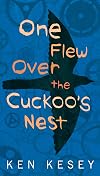
If you can read this novel without squirming, you are a stalwart soul. It is so realistically horrific that it made me shudder. Kesey begins his story with an almost lighthearted humorous view of McMurphy, the fly in Big Nurse's ointment, who can stir up the quiet of the men's ward at the state insane asylum. But, he rapidly takes us beyond that to a realization that McMurphy is treading a dangerous road and playing a game in which he doesn't truly understand the rules or recognize the show more stakes.
Kesey makes a serious statement about abusive authority, and I felt a tightness form around my heart as I thought about the control Big Nurse has and how devoid of compassion she is. The men on the ward receive more of what they need from McMurphy than they do from any of the staff, and while none of the men on the ward improve at the hands of the doctor or nurse, McMurphy gives many of them the will to live. He surely breaths life back into Chief.
Finally, Chief as narrator is inspired. He should be a very unreliable narrator, being an inmate of the asylum. He tells us himself of his hallucinations, but we come to realize that he is the perfect silent observer and understands more of what lies beneath events than one would expect. He hears and sees everything and he foreshadows the ultimate outcome, even as he frees himself from the "fog" that the institution imposes upon him.
This novel has earned its reputation as a modern classic. While the movie was very well done, I think the book has even more impact. Despite having some rough edges and being set in an environment we would hope does not any longer exist in this guise, its message is not dated at all. The Nurse Rached's of the world are still out there. It will continue to be a meaningful read well into the future. show less
Kesey makes a serious statement about abusive authority, and I felt a tightness form around my heart as I thought about the control Big Nurse has and how devoid of compassion she is. The men on the ward receive more of what they need from McMurphy than they do from any of the staff, and while none of the men on the ward improve at the hands of the doctor or nurse, McMurphy gives many of them the will to live. He surely breaths life back into Chief.
Finally, Chief as narrator is inspired. He should be a very unreliable narrator, being an inmate of the asylum. He tells us himself of his hallucinations, but we come to realize that he is the perfect silent observer and understands more of what lies beneath events than one would expect. He hears and sees everything and he foreshadows the ultimate outcome, even as he frees himself from the "fog" that the institution imposes upon him.
This novel has earned its reputation as a modern classic. While the movie was very well done, I think the book has even more impact. Despite having some rough edges and being set in an environment we would hope does not any longer exist in this guise, its message is not dated at all. The Nurse Rached's of the world are still out there. It will continue to be a meaningful read well into the future. show less
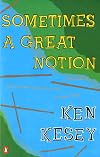
Absolutely stunning. Kesey takes a subject I normally wouldn't care about and a group of characters I normally wouldn't like and makes me really care about their outcome. The writing in this is amazing: scenes are written from several points of view simultaneously, so you get an amazing understanding of the characters and their actions. The landscape of Oregon is as active and strong a character as any of the people in the book. It's not the kind of story I generally enjoy, but the writing show more is just so phenomenal that this ranks among the best books I have ever read. show less
Lists
Catalog (2)
Best Satire (1)
Read (1)
Put a Bird On It (1)
1980s (1)
USA Road Trip (1)
Five star books (1)
1960s (1)
Forced Exposure (1)
A Novel Cure (1)
. (1)
Unread books (1)
BitLife (1)
Overdue Podcast (1)
Pageturners (1)
Allie's Wishlist (1)
Fiction For Men (1)
Books (1)
Gen X Library (1)
Fave Books (1)
hopes (1)
1970s (1)
Books I've Read (1)
. (1)
Favourite Books (2)
Daria (1)
BBC Big Read (1)
First Novels (1)
Read These Too (1)
AP Lit (1)
Classics (1)
Awards


You May Also Like


Associated Authors
Statistics
- Works
- 37
- Also by
- 16
- Members
- 33,280
- Popularity
- #579
- Rating
- 4.1
- Reviews
- 401
- ISBNs
- 314
- Languages
- 24
- Favorited
- 87

