
Jon Fosse
Author of Septology
About the Author
Series
Works by Jon Fosse
Fosse: Plays One: Someone is Going to Come Home; The Name; The Guitar Man; The Child (Oberon Modern Playwrights) (2002) 15 copies
Vai vir alguém e outras peças 4 copies
Drugie imię 3 copies
Vaim Hotel 3 copies
Gespräche mit einem Schweiger: Jon Fosse, befragt von Martina Läubli und Linus Schöpfer (2024) 2 copies
Et nyt navn: Septologien VII 2 copies
Jeg er en anden: Septologien V 2 copies
Et nyt navn - Septologien VI 2 copies
Jeg er en anden: Septologien III 2 copies
Pas i anđeo 1 copy
Melanholija 1 copy
The Child (in Plays One) 1 copy
Vaim (2025) 1 copy
Die Nacht singt ihre Lieder: und andere Stücke | Nobelpreis für Literatur 2023 (German Edition) (2016) 1 copy
Ja sam vetar 1 copy
El otro nombre 2019 1 copy
Soc el vent 1 copy
To jest Ales 1 copy
Låst guitar 1 copy
Ja to ktoś inny 1 copy
Un día en el verano 1 copy
El hijo 1 copy
El nombre 1 copy
Todesvariationen 1 copy
Schlaf 1 copy
Raud strikkeluve 1 copy
Ich bin der Wind 1 copy
Trilogía 1 copy
TRIOLOGJI 1 copy
Associated Works
Freedom: Stories Celebrating the Universal Declaration of Human Rights (2009) — Contributor — 88 copies, 2 reviews
Tagged
Common Knowledge
- Legal name
- Fosse, Jon Olav
- Birthdate
- 1959-09-29
- Gender
- male
- Education
- University of Bergen (BA|MA|1987)
- Occupations
- playwright
writer
author
poet
essayist
translator - Awards and honors
- Nobel Prize (Literature, 2023)
Chevalier, Ordre national du Mérite (2007)
Royal Norwegian Order of St. Olav (Commander, 2005)
Willy Brandt Prize (2016)
Nordic Council's Literature Prize (2015)
European Prize for Literature (2014) (show all 22)
Target Prize (2012)
International Ibsen Award (2010)
Deutscher Jugendliteraturpreis (2007)
Swedish Academy Nordic Prize (2007)
Anders Jahres Culture Prize (2006)
Brage Prize (2005, 2021)
Diktartavla Prize (2004)
Nynorsk Literature Prize (2003, 2019)
Norsk kulturråds ærespris (2003)
Nordic Playwright Prize (2000)
Nestroy Theatre Prize (2000)
Dobloug Prize (1999)
Søren Gyldendal Prize (1999)
Aschehoug Prize (1997)
Norwegian Ibsen Prize (1996)
Nynorsk Literature Prize (1992) - Nationality
- Norway
- Birthplace
- Haugesund, Norway
- Places of residence
- Haugesund, Norway (birth)
Bergen, Norway - Associated Place (for map)
- Norway
Members
Reviews

Like a lava lamp...
This story is a hypnotic, continually fluid tale of light and dark. The narrator, a rather unremarkable man, is caught in predicament of his own making. To navigate it, he embarks on an endless and narrow logic in his unfolding surreal experience.
Meanwhile the reader is mesmerized, thoughts forming like floating globules rising and falling within an ombré of light and dark, joining and breaking up repeatedly.
I understand there are those that give this work a strong show more religious interpretation, and that seems entirely valid. Me, I'm not religious but discovered it rich with speculations entirely outside of religion. That flexibility speaks to its beauty; that it will feel personally tailored to whatever the reader brings to it.
Without a doubt, this will be the strangest, and among the strongest, works that I've read this year. During its mere hour and a half narration, the slow moving story showered me with a blessed antidote to the dark, seemingly inescapable entrapment of 2025. Yet, it wasn't escapism; rather it was a reminder of the other forms of reality that exist within the vast human experience.
This, my friends, is what petty book banners don't understand. Our minds, our experiences are not ban-able.
I needed this exact book at this moment.
The last thoughts in the novella are sublime, “everything is without meaning . . . everything just sort of is . . . everything is meaning.” show less
This story is a hypnotic, continually fluid tale of light and dark. The narrator, a rather unremarkable man, is caught in predicament of his own making. To navigate it, he embarks on an endless and narrow logic in his unfolding surreal experience.
Meanwhile the reader is mesmerized, thoughts forming like floating globules rising and falling within an ombré of light and dark, joining and breaking up repeatedly.
I understand there are those that give this work a strong show more religious interpretation, and that seems entirely valid. Me, I'm not religious but discovered it rich with speculations entirely outside of religion. That flexibility speaks to its beauty; that it will feel personally tailored to whatever the reader brings to it.
Without a doubt, this will be the strangest, and among the strongest, works that I've read this year. During its mere hour and a half narration, the slow moving story showered me with a blessed antidote to the dark, seemingly inescapable entrapment of 2025. Yet, it wasn't escapism; rather it was a reminder of the other forms of reality that exist within the vast human experience.
This, my friends, is what petty book banners don't understand. Our minds, our experiences are not ban-able.
I needed this exact book at this moment.
The last thoughts in the novella are sublime, “everything is without meaning . . . everything just sort of is . . . everything is meaning.” show less

— "but there is meaning in everything that happens, the pastor said, and he said that God writes straight on crooked lines,"
— "it's also always much nicer and safer to have two people in a boat than just one,"
I don't think I can say anything about this book other than I spent seven months reading it really slowly. There is a divine totality in the way our losses relentlessly accumulate but still generate new moments of beauty amidst unspeakable sorrow. After ten years of loneliness, you show more find yourself finally agreeing to a Christmas invitation from someone who doesn't want you to be alone, or putting slices of less burnt bacon on a friend's plate even though you don't want him in your house. These are ordinary events, and their beauty is hard to comprehend in the moment, but they happen, all the time, everywhere, a kind of straightness/wholeness that exists precisely because everything else has fallen apart. All the possibilities of our lives (what has happened, what could be, what could have been) will eventually meet in death, but before that, we tend to all of them as they come.
Reminds me of this one passage from Marilynne Robinson's Housekeeping:
"Cain, the image of God, gave the simple earth of the field a voice and a sorrow, and God himself heard the voice, and grieved for the sorrow, so Cain was a creator, in the image of his Creator." show less
— "it's also always much nicer and safer to have two people in a boat than just one,"
I don't think I can say anything about this book other than I spent seven months reading it really slowly. There is a divine totality in the way our losses relentlessly accumulate but still generate new moments of beauty amidst unspeakable sorrow. After ten years of loneliness, you show more find yourself finally agreeing to a Christmas invitation from someone who doesn't want you to be alone, or putting slices of less burnt bacon on a friend's plate even though you don't want him in your house. These are ordinary events, and their beauty is hard to comprehend in the moment, but they happen, all the time, everywhere, a kind of straightness/wholeness that exists precisely because everything else has fallen apart. All the possibilities of our lives (what has happened, what could be, what could have been) will eventually meet in death, but before that, we tend to all of them as they come.
Reminds me of this one passage from Marilynne Robinson's Housekeeping:
"Cain, the image of God, gave the simple earth of the field a voice and a sorrow, and God himself heard the voice, and grieved for the sorrow, so Cain was a creator, in the image of his Creator." show less
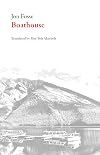
Imagine if Knausgaard had spent a few years trimming down his bloated novel to the essence, and then tried to do something interesting with language, and then became genuinely self-critical, instead of being self-critical for show. Voila. All the gold, none of the dross.

Jon Fosse has one stylistic approach in his prose writing. It’s based on rhythm and repetition. The reader, once they get the rhythm is lulled into a continuous reading stream experience. I don’t know how else to describe it. A sentence can have an endless variation yet be different, ever so slightly from the previous one, or the sentence with slight variation expresses the same thing over and over. Like a period of restlessness.
At first, I thought these to be a simulation of the show more internal world. I mean no one thinks in complete sentences, paragraphs, grammatical correctness and each new thought is not novel. We tend to repeat in our heads our own conscious concerns. So, I kind of admired this glimpse into another consciousness approach. Though, I don’t know if that is what he’s doing, can’t be sure.
So, I’m drawn along on a current of words about a narrator, around 30yo, his old school friend Knut and Knut’s wife when the family visits the old town. Knut has left, become educated, got a job as a music teacher, had two kids. The family plan to spend the summer on holiday in his home town, he hasn’t been back in ten years, or at least hasn’t spoken to the narrator in ten years. They were close, did everything together as kids, had a band together, hung out. Then Knut leaves. The return is tense, something happens, the narrator then remains restless, uneasy, he stops going out and writes. He writes to keep the restlessness at bay. There are strange goings on in the marriage and our narrator is caught up in them. The restlessness is about some tension unspoken.
Few things happen. There is a fishing expedition to an island on the fjord. A folk dance where our narrator plays guitar in a two-piece band. He stops playing after that night and writes. Something happens, it unnerves him enough to spend all his time indoors writing from then on. The narrator is caught up in the couple’s whirlwind state. The couple aren’t happy and it’s kind of weird. As a result he writes the thing we are reading (it seems).
Thing is, none of this is a spoiler. I’m left with images from a poetic quality of writing. The events are etched in my head now. I could write another stream of events in another paragraph like the one above and you’d know all the action: though there isn’t much.
As I was reading, enjoying the rhythm, I wondered how short the work would be if all the repetitions were removed. Call it quantitative reviewing, using words as data. I’d say only 10 per cent would remain, a short story, told simply. And it kind of annoys me but I don’t know why it annoys me. I’m familiar with the style. It’s not even a novelty.
The boathouse features as the pace where the two men played as children. A place where the two friends spent much time: used it for band practice, tidied it up, know its peculiarities. You enter through a hatch door and open the boat gates only from the inside. The boathouse is still there when they are men in their early thirties. A little decrepit. It feels as though not much has changed in their town, except events happen to its inhabitants that cannot be repaired.
Reading this book was a kind of accident. I finally went into town to my favourite bookshop looking for a different book they didn't have. A book no one seems to have. I saw this and a Javier Marias novel I hadn't read and bought both. I started reading the Fosse on the way home on the tram and kept reading. I hadn't intended to, it kind of happened. show less
Lists
Awards


You May Also Like


Associated Authors
Statistics
- Works
- 220
- Also by
- 5
- Members
- 4,074
- Popularity
- #6,177
- Rating
- 4.2
- Reviews
- 102
- ISBNs
- 497
- Languages
- 22
- Favorited
- 16
