

Perry Nodelman
Author of Of Two Minds
About the Author
Image credit: scholastic.ca
Series
Works by Perry Nodelman
Tagged
Common Knowledge
- Birthdate
- 1942-08-18
- Gender
- male
- Occupations
- children's book author
literary critic - Organizations
- University of Winnipeg
- Nationality
- Canada
- Birthplace
- Toronto, Ontario, Canada
- Places of residence
- Toronto, Ontario, Canada
Winnipeg, Manitoba, Canada - Associated Place (for map)
- Canada
Members
Reviews

Having re-read this favorite from age 12, now at age 40, I'm pleased by how well it holds up. I would happily offer it to any tween today.
It's a Point Fantasy, which means it's exactly 200 pages, not high literature or anything, but it's a fun adventure and I can see why it appealed to me so much. Of the two main characters, Lenora gets more screen time at first, and she's nearly a caricature of ego-centric, angsty teen moods. She feels smothered by her parents, who are boring and don't let show more her do anything fun. Meanwhile, Coren is an opposite character, but equally adolescent: he feels awkward, is constantly embarrassed by his parents, and just wants them to leave him alone. One is daring, wild, the other hyper-aware of others' gazes and overly cautious.
The main arc of the plot is about these two teens growing a little. Lenora learns to consider people other than herself, and that having her way all the time would be boring, never thrilling for long. Coren gains confidence in himself and stops worrying so much about what everyone else thinks, and to stand up for himself and what is right.
I noticed a lot of similarities with classic children's stories: there's IT and the city it controls in A Wrinkle in Time, the invisible little Monopods from Voyage of the Dawn Treader, and much of the Emerald City and the Great and Wonderful Wizard from the Wizard of Oz. These are all fairly common story tropes, I suppose, and I never noticed in my many re-reads as a teen.
The pacing is a bit wonky, and in the first half, the back-and-forth between the two povs was a bit annoying, because they kept repeating bits I'd already seen in the other pov. But, again, as a teen I didn't notice this, and the 2 povs do emphasize how the same events can look different according to the teller. It picks up in the second half, once the adventure in Grag really gets started, with less time in any one pov before switching, and fewer repeats.
The first half establishes who Lenora and Coren are and sets out the rules for their respective countries of people who can imagine things into reality or people whose imaginations are so strong they can effectively ignore reality and live in their own minds—including visiting and eavesdropping on others' thoughts. Lenora's parents (understandably!) want to get her to stop being so headstrong and wild, so they decide to marry her off at 16, and effectively exile her to a distant island until she grows up a bit. The responsibilities of a husband and children should surely get her to settle down, yes? Coren is the arranged husband, as his family could use the match politically and perhaps monetarily. Neither teen is happy about being forced to marry someone they have never met.
In the second half, Lenora responds to a magic call and is transported to another reality, where everything and everyone is beautiful and happy, and ruled by the most handsome, gracious, wonderful Hevak. Unfortunately, she accidentally brings Coren with her. She's thrilled to be somewhere so great, ready for adventure. He isn't. But when they meet Hevak, this wonderful place starts to show an ugly side, and they must find out how to save themselves and the country of Grag from a despot. Along the way, they realize they actually like each other and share a few kisses. (But it's not a romance, not really. More like another aspect of adolescence.)
So, no, not high literature or anything. But it's a nice enough fantasy story that I, at least, found highly relatable as a teen, re-read many times, and would still offer a tween today. show less
It's a Point Fantasy, which means it's exactly 200 pages, not high literature or anything, but it's a fun adventure and I can see why it appealed to me so much. Of the two main characters, Lenora gets more screen time at first, and she's nearly a caricature of ego-centric, angsty teen moods. She feels smothered by her parents, who are boring and don't let show more her do anything fun. Meanwhile, Coren is an opposite character, but equally adolescent: he feels awkward, is constantly embarrassed by his parents, and just wants them to leave him alone. One is daring, wild, the other hyper-aware of others' gazes and overly cautious.
The main arc of the plot is about these two teens growing a little. Lenora learns to consider people other than herself, and that having her way all the time would be boring, never thrilling for long. Coren gains confidence in himself and stops worrying so much about what everyone else thinks, and to stand up for himself and what is right.
I noticed a lot of similarities with classic children's stories: there's IT and the city it controls in A Wrinkle in Time, the invisible little Monopods from Voyage of the Dawn Treader, and much of the Emerald City and the Great and Wonderful Wizard from the Wizard of Oz. These are all fairly common story tropes, I suppose, and I never noticed in my many re-reads as a teen.
The pacing is a bit wonky, and in the first half, the back-and-forth between the two povs was a bit annoying, because they kept repeating bits I'd already seen in the other pov. But, again, as a teen I didn't notice this, and the 2 povs do emphasize how the same events can look different according to the teller. It picks up in the second half, once the adventure in Grag really gets started, with less time in any one pov before switching, and fewer repeats.
The first half establishes who Lenora and Coren are and sets out the rules for their respective countries of people who can imagine things into reality or people whose imaginations are so strong they can effectively ignore reality and live in their own minds—including visiting and eavesdropping on others' thoughts. Lenora's parents (understandably!) want to get her to stop being so headstrong and wild, so they decide to marry her off at 16, and effectively exile her to a distant island until she grows up a bit. The responsibilities of a husband and children should surely get her to settle down, yes? Coren is the arranged husband, as his family could use the match politically and perhaps monetarily. Neither teen is happy about being forced to marry someone they have never met.
In the second half, Lenora responds to a magic call and is transported to another reality, where everything and everyone is beautiful and happy, and ruled by the most handsome, gracious, wonderful Hevak. Unfortunately, she accidentally brings Coren with her. She's thrilled to be somewhere so great, ready for adventure. He isn't. But when they meet Hevak, this wonderful place starts to show an ugly side, and they must find out how to save themselves and the country of Grag from a despot. Along the way, they realize they actually like each other and share a few kisses. (But it's not a romance, not really. More like another aspect of adolescence.)
So, no, not high literature or anything. But it's a nice enough fantasy story that I, at least, found highly relatable as a teen, re-read many times, and would still offer a tween today. show less
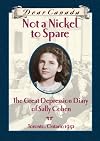
This book was eye opening. I had no idea of the depths of antisemitism in bygone Toronto. Or maybe I should have; when we first moved to Parkdale in the 1970s we had Nazi leaflets and human waste left on our doorstep once or twice, but I digress. The author based the events on the recollections of his parents and it is very sincere, convincing and authentic. I have to compare it to the Booky trilogy by Bernice Thurman Hunter, who was born in 1922 and actually lived through those years at show more about the same age as the fictional Sally Cohen. The Cohen family had a surprisingly settled life, unlike Booky's family they never had to flit to stay ahead of the rent collector, but in general it's recognizably the same city and similar struggles. The last third of the book gets extremely tedious, however, because we get step by step accounts of marches and demonstrations and blow by blow accounts of clashes between police and demonstrators, between gentiles and Jews, culminating in the Christie Pit riots. Riots are just boring to read about in first-person narrative. People mill around, dodge blows, run away, end up on the edge of the melee, and wade back in. The author could manage to get Sally to some of the marches and demonstrations by dint of her boy cousin loaning her his trousers and cap and dragging her along, but he absolutely couldn't justify placing her in the thick of the riots so it's all "and then Benny said he did this and then he did that". It lacks immediacy. And that's the note it ends on. A book worth giving children to read, especially Jewish children in Canada, but not every child will be able to get to the end of it and that's okay.
As in all the Dear Canada series, the extra material at the end is superb. Glossary of Yiddish terms, photographs, maps, and more.
Now I want to reread Fredelle Maynard's memoir, Raisins and Almonds, about growing up Jewish in Saskatchewan at the exact same time (the only Jewish family in town) and see how that compares as a book for young adult readers. show less
As in all the Dear Canada series, the extra material at the end is superb. Glossary of Yiddish terms, photographs, maps, and more.
Now I want to reread Fredelle Maynard's memoir, Raisins and Almonds, about growing up Jewish in Saskatchewan at the exact same time (the only Jewish family in town) and see how that compares as a book for young adult readers. show less
Not a Nickel to Spare Sally Cohen: The Great Depression Diary of Sally Cohen, Toronto, 1932 by Perry Nodelman
This was an interesting look at something I know next to nothing about - Canadian history. It never occurred to me they had prohibition too! And they were racist? But...but they're so polite!!! That can't be!!! Everything I know is a lie!
In all seriousness though, it was a strange but good tale. The major event of the story wasn't as Earth-shattering as many of the events that different "My Story" series focus on (wars, immigration movements, political turnover, etc). But it kind of goes to show more show that lives (and history) are made up of many smaller events that are big to only a few people. show less
In all seriousness though, it was a strange but good tale. The major event of the story wasn't as Earth-shattering as many of the events that different "My Story" series focus on (wars, immigration movements, political turnover, etc). But it kind of goes to show more show that lives (and history) are made up of many smaller events that are big to only a few people. show less
This entire series is a wonderful way to learn history or teach it to adolescents. I find today's generations seem to recall more when they learn through other people (pop songs, celebrity gossip, etc.), so what better way to teach history than through someone else's perspective? Yes, "authentic" diaries would be "better", but would the language really hold the modern student's attention? Did the diary writer know what WOULD be important in the context of history? Probably not.
Lists
Awards


You May Also Like


Associated Authors
Statistics
- Works
- 24
- Members
- 1,396
- Popularity
- #18,408
- Rating
- 3.7
- Reviews
- 10
- ISBNs
- 64
- Languages
- 1