

Terence Robertson (1921–1970)
Author of Escort Commander, Originally Published as Walker R.N.
About the Author
Terence Robertson served in the war and subsequently worked as a journalist. His other books include Escort Commander and Dieppe: The Shame and the Glory.
Works by Terence Robertson
Kultainen hevosenkenkä 2 copies
Underwater Taxi 1 copy
Sous-marin d'attaque 1 copy
Sous-marin-droit devant ! 1 copy
Associated Works
Tagged
Common Knowledge
- Birthdate
- 1921
- Date of death
- 1970-01-31
- Gender
- male
Members
Reviews
Walker, R.N.: The Greatest U-Boat Hunter of the Battle of the Atlantic (Submarine Warfare in World War Two) by Terence Robertson
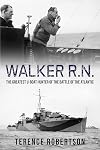
Walker, R.N. is punchy first-round WW2 history, focusing on Captain Frederic John "Johnny" Walker, the most decorated and successful anti-submarine warfare commander of the Second World War. The book glides over his early life and pre-war career as a successful misfit in the Royal Navy, a natural leader who clashed with his superiors and who's career seemed to have stalled when war broke out.
The Battle of the Atlantic was one of the critical points of the war. Without convoys from the show more Americas, Britain would have starved, Russia would not have received important lend-lease aid, and the Normandy landings might never have occurred. This was a campaign without fronts or decisive moments, a grinding war of attrition between escorts and U-boats.
In this war, Walker made a name for himself as an aggressive and preternaturally gifted hunter. In command of the Second Support Group, consisting of a core of Black Swan-class sloops, Walker sought out U-boats wherever they were most active, either in the Bay of Biscay or attacking allied convoys. He pioneered several tactics, specializing in a directed quiet kill, where he would stand off maintaining Asdic (the British term for Sonar) contact, while directing another ship to creep in and nail the target with depth charges. The descriptions of combat are plenty exciting, if a little repetitive, while the rest of the book is standard hagiography. show less
The Battle of the Atlantic was one of the critical points of the war. Without convoys from the show more Americas, Britain would have starved, Russia would not have received important lend-lease aid, and the Normandy landings might never have occurred. This was a campaign without fronts or decisive moments, a grinding war of attrition between escorts and U-boats.
In this war, Walker made a name for himself as an aggressive and preternaturally gifted hunter. In command of the Second Support Group, consisting of a core of Black Swan-class sloops, Walker sought out U-boats wherever they were most active, either in the Bay of Biscay or attacking allied convoys. He pioneered several tactics, specializing in a directed quiet kill, where he would stand off maintaining Asdic (the British term for Sonar) contact, while directing another ship to creep in and nail the target with depth charges. The descriptions of combat are plenty exciting, if a little repetitive, while the rest of the book is standard hagiography. show less

This is the most famous battle fought by Canadians in WWII, and Mr. Robertson has produced an account that justly remains in print. Though an experiment that went about as badly as could be expected, the lessons of the day were valuable in all following amphibious attacks by the western powers. There was plenty of blame to go around, but several bright and shiny exploits to be publicized.
Walker, R. N.; the story of Captain Frederic John Walker, C. B., D. S. O. and three bars, R. N by Terence Robertson

Commander Walker was doing quite nicely at the end of WWI, but budget cuts and the power of the Battle-line quite eclipsed the need for consistent development in anti-Submarine warfare. Walker had to give up the bright lights and toil in obscurity trying to keep HMS Osprey, the AS warfare school open. It wasn't easy. The Germans would never be able to launch another U-Boat war, everyone knew it. Johnny Walker knew that wasn't true, and had a good idea how close the Germans had come in the show more winter of 1917-18.
In 1939, the war started up again and Walker was sent to a staff post, but after Dunkirk, he was back in the Atlantic. Max Horton gave Walker a vital convoy back from Gibraltar, containing the first of the RN's CVEs. Walker lost about half the convoy, including the Escort Carrier...and produced a 200 page report as to why. Horton read it, and moved Walker to the command of the first Hunter-killer ASW group. Together, with Horton letting Walker innovate anything in the interests of the service, they killed a lot of U-Boats. Walker was a wonderful leader, but he worked himself to death by July 7th 1944. In spite of only three days notice, and the fact that Overlord was in progress, over one thousand people attended his funeral. He was one of the top three Royal Navy Heroes of WWII. The book is thin...but adequate. show less
In 1939, the war started up again and Walker was sent to a staff post, but after Dunkirk, he was back in the Atlantic. Max Horton gave Walker a vital convoy back from Gibraltar, containing the first of the RN's CVEs. Walker lost about half the convoy, including the Escort Carrier...and produced a 200 page report as to why. Horton read it, and moved Walker to the command of the first Hunter-killer ASW group. Together, with Horton letting Walker innovate anything in the interests of the service, they killed a lot of U-Boats. Walker was a wonderful leader, but he worked himself to death by July 7th 1944. In spite of only three days notice, and the fact that Overlord was in progress, over one thousand people attended his funeral. He was one of the top three Royal Navy Heroes of WWII. The book is thin...but adequate. show less
Walker R.N : The Story of Captain Frederic John Walker, C.B., D.S.O. and three Bars, R.N. by Terence Robertson

This a cracking good story and the best thing about it is it is true. Johnnie Walker was a naval officer in the Royal Navy who was not perceived as a good officer. He was fascinated by anti-submarine warfare and worked out during the inter war years a system of finding and attacking subs. Leading the famous Second Group of sub hunters in his favourite ship, the sloop, HMS Starling, he was personally involved in the sinking of 15 U-Boats. The Admiralty eventually recognized his methods worked show more and he received the appropriate awards. He died before the end of the War from a cerebral hemorrhage brought on by the stress of continuous service at sea. show less
You May Also Like


Associated Authors
Statistics
- Works
- 17
- Also by
- 1
- Members
- 383
- Popularity
- #63,100
- Rating
- 3.5
- Reviews
- 7
- ISBNs
- 33
- Languages
- 4
- Favorited
- 1