

John D'Agata
Author of The Lifespan of a Fact
About the Author
Works by John D'Agata
The Lost Origins of the Essay (A New History of the Essay) (2009) — Editor; Introduction — 120 copies, 2 reviews
Yucca Mountain 1 copy
Associated Works
Conjunctions: 46, Selected Subversions: Essays on the World at Large (2006) — Contributor — 10 copies
Tagged
Common Knowledge
- Birthdate
- 1975
- Gender
- male
- Nationality
- USA
- Birthplace
- Cape Cod, Massachusetts, USA
- Associated Place (for map)
- Cap Cod, Massachusetts
Members
Reviews
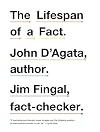
Warning: if you're anything at all like me, reading The Lifespan of a Factby John D'Agata and Jim Fingal (Knopf, 2012) is very likely to cause a major spike in your blood pressure.
This slim book presents an essay by D'Agata (published in the January 2010 issue of The Believeras "What Happens There"), alongside a series of emails between D'Agata and Fingal, who was assigned to fact-check the article prior to publication. The article concerns the suicide of 16-year-old Levi Presley, who jumped show more from the tower of the Stratosphere Hotel and Casino on 13 July 2002.
From literally the very first clause, Fingal found difficulties. D'Agata's scene-setting first paragraph contained at least eight statements that either couldn't be proven or were factually inaccurate, so Fingal began emailing D'Agata to try and make corrections. And things quickly turned ugly. D'Agata's responses to Fingal's (entirely fair) questions ranged from the snide to the sarcastic to the downright nasty. The author repeatedly maintained that he was perfectly justified in changing facts to suit his purposes for any reason whatsoever: switching the name of a bar from the Boston Saloon to the Bucket of Blood because the latter "is more interesting"; switching another suicide by jumping on the day of Presley's death to one by hanging because "I wanted Levi's death to be the only one from falling that day. I wanted his death to be more unique." You get the idea. This goes on for 123 pages, with Fingal probing for the facts, and D'Agata arguing that he could, and did, change them whenever he felt like it.
One exchange, from the last section of the piece, should give the flavor. Fingal asks D'Agata where he got information on the specific parking space Presley used the night of his death:
D'Agata: "Your nitpicking is absurd and its ruining this essay. So, as I've said, I'm not participating. Good luck."
Fingal: "In other words, you're taking your ball and going home. Very mature. You know, confirming factual details so that a piece like this has some semblance of accuracy isn't 'nitpicking,' and I think most readers would agree with me. This process is actually meant to help enhance your writing. But I can't imagine you could appreciate anything that would require you to alter your precious words, which no doubt fell into the world from your pen fully formed and immaculate."
D'Agata: "Yeah, I'm the immature one."
One can hardly blame Fingal for getting a bit snarky; I'm amazed at how long he held back.
The main thrust of D'Agata's argument throughout is that he's writing an "essay," not "journalism." This, he maintains, gives him the right to pretty much do whatever he wants. I'm not buyin' it. If you want to write an essay and smooth out some rough spots by changing a few facts here and there, you ought to tell your reader that up front. That's no big deal; easily done, and it hurts no one. D'Agata would disagree, but who's surprised at that?
The book is not enjoyable to read: it's stressful, and unpleasant, to see the abuse DAgata flings at Fingal, and to see the ridiculous excuses he comes up with for the factual misstatements he includes in the piece. That said, it's also a really fascinating look inside the fact-checking process, and I know I certainly won't read certain pieces of writing the same way again. Being published as it was right around the whole Mike Daisey kerfuffle, the book has a certain timeliness to it; I hope that it's widely read.
There are, however, some real missed opportunities. The book doesn't include any contextualization of the situation at all: mentioned only in passing (on the back cover) was that D'Agata's essay had previously been rejected by the magazine (Harper's) that originally commissioned the piece. Just a few of Fingal's interactions with editors about his exchanges with D'Agata are included, so it's difficult to get an overall sense of the process. Most notably, though, the book concludes at the end of the original draft text of the essay ... we don't get a chance to see what happened next in order to get the piece through to publishable form (presumably a whole lot of back-and-forthing with editors, I imagine). The Lifespan of a Fact doesn't include the final text of the essay as published - for that I ordered up a copy of the magazine where it appeared, because I really wanted to see how the battle ended up playing out.
As it turns out, much to my happiness, many (but not all) of Fingal's substantive issues with various elements of the essay are clarified or corrected in the final version. A couple amusing (or not) exceptions I found are cases where both Fingal and D'Agata agreethat D'Agata had made a mistake, but the errors remain in the article. That said, D'Agata's penchant for changing the names of businesses was allowed, as were a few other liberties and several outright factual misstatements.
I certainly came away from this book with a great appreciation for the fact-checkers of the world ...
http://philobiblos.blogspot.com/2012/05/book-review-lifespan-of-fact.html show less
This slim book presents an essay by D'Agata (published in the January 2010 issue of The Believeras "What Happens There"), alongside a series of emails between D'Agata and Fingal, who was assigned to fact-check the article prior to publication. The article concerns the suicide of 16-year-old Levi Presley, who jumped show more from the tower of the Stratosphere Hotel and Casino on 13 July 2002.
From literally the very first clause, Fingal found difficulties. D'Agata's scene-setting first paragraph contained at least eight statements that either couldn't be proven or were factually inaccurate, so Fingal began emailing D'Agata to try and make corrections. And things quickly turned ugly. D'Agata's responses to Fingal's (entirely fair) questions ranged from the snide to the sarcastic to the downright nasty. The author repeatedly maintained that he was perfectly justified in changing facts to suit his purposes for any reason whatsoever: switching the name of a bar from the Boston Saloon to the Bucket of Blood because the latter "is more interesting"; switching another suicide by jumping on the day of Presley's death to one by hanging because "I wanted Levi's death to be the only one from falling that day. I wanted his death to be more unique." You get the idea. This goes on for 123 pages, with Fingal probing for the facts, and D'Agata arguing that he could, and did, change them whenever he felt like it.
One exchange, from the last section of the piece, should give the flavor. Fingal asks D'Agata where he got information on the specific parking space Presley used the night of his death:
D'Agata: "Your nitpicking is absurd and its ruining this essay. So, as I've said, I'm not participating. Good luck."
Fingal: "In other words, you're taking your ball and going home. Very mature. You know, confirming factual details so that a piece like this has some semblance of accuracy isn't 'nitpicking,' and I think most readers would agree with me. This process is actually meant to help enhance your writing. But I can't imagine you could appreciate anything that would require you to alter your precious words, which no doubt fell into the world from your pen fully formed and immaculate."
D'Agata: "Yeah, I'm the immature one."
One can hardly blame Fingal for getting a bit snarky; I'm amazed at how long he held back.
The main thrust of D'Agata's argument throughout is that he's writing an "essay," not "journalism." This, he maintains, gives him the right to pretty much do whatever he wants. I'm not buyin' it. If you want to write an essay and smooth out some rough spots by changing a few facts here and there, you ought to tell your reader that up front. That's no big deal; easily done, and it hurts no one. D'Agata would disagree, but who's surprised at that?
The book is not enjoyable to read: it's stressful, and unpleasant, to see the abuse DAgata flings at Fingal, and to see the ridiculous excuses he comes up with for the factual misstatements he includes in the piece. That said, it's also a really fascinating look inside the fact-checking process, and I know I certainly won't read certain pieces of writing the same way again. Being published as it was right around the whole Mike Daisey kerfuffle, the book has a certain timeliness to it; I hope that it's widely read.
There are, however, some real missed opportunities. The book doesn't include any contextualization of the situation at all: mentioned only in passing (on the back cover) was that D'Agata's essay had previously been rejected by the magazine (Harper's) that originally commissioned the piece. Just a few of Fingal's interactions with editors about his exchanges with D'Agata are included, so it's difficult to get an overall sense of the process. Most notably, though, the book concludes at the end of the original draft text of the essay ... we don't get a chance to see what happened next in order to get the piece through to publishable form (presumably a whole lot of back-and-forthing with editors, I imagine). The Lifespan of a Fact doesn't include the final text of the essay as published - for that I ordered up a copy of the magazine where it appeared, because I really wanted to see how the battle ended up playing out.
As it turns out, much to my happiness, many (but not all) of Fingal's substantive issues with various elements of the essay are clarified or corrected in the final version. A couple amusing (or not) exceptions I found are cases where both Fingal and D'Agata agreethat D'Agata had made a mistake, but the errors remain in the article. That said, D'Agata's penchant for changing the names of businesses was allowed, as were a few other liberties and several outright factual misstatements.
I certainly came away from this book with a great appreciation for the fact-checkers of the world ...
http://philobiblos.blogspot.com/2012/05/book-review-lifespan-of-fact.html show less
Is accuracy important when trying to tell a story? I found this book delightful, interweaving the comments of the article's author, editor and fact checker. The author chooses to use facts based solely on the truthiness (a la Stephen Colbert) of the information. The fact checker battles against this by researching each line of the article to impressive depth. When he is able to confirm something, the passage is printed in black. The passages printed in red are the "facts" that cannot be show more proven or are outright wrong. There are far more red passages than black. It is interesting to see the author struggle to produce an article that is captivating and interesting, while the fact checker tries to keep him from outright lying for artistic effect. The snark in some of the exchanges between author and fact checker made this highly enjoyable. show less
New to the lyric essay, still biased to the "regular-ass" essay, but totally smitten by John D'Agata's writing, his attention to detail, the ease with which he finds meaning and metaphor in his subjects. As in "About a Mountain" I feel like his treatment of regular folk is sometimes smug so I deducted a star. That will teach him. I made the mistake of trying to read this on the elliptical machine.
Did John D'Agata plan this all along?
He's an awareness-raiser for the essay, and an envelope-pusher when it comes to genre. Was the making of this book just a 7-year plot to lean against the edges of what we expect an essay to be?
Here's what happened: D'Agata submitted a piece to The Believer for publication, a piece which was, ostensibly, a true account of the suicide of a Las Vegas teen. The article-essay also included D'Agata's own personal experience of the chain of events and explored show more the nature of our ideas about Las Vegas. But when fact-checking intern Jim Fingal got a hold of the piece, he quickly realized that it was riddled with factual inaccuracies - nearly all purposeful. ("I needed two beats there," John says to explain why he changed pink vans to purple vans; but much of his fact-massaging was significantly more...significant.)
Each page shows a section of D'Agata's work in the center with Fingal's fact-checking notes - and their correspondence - around the margins. As D'Agata responds with caustic snark and bluntly refuses to change anything, Fingal gets more nit-picky and obnoxious (at one point requesting D'Agata's mother's phone number so he can confirm that she has a cat, which D'Agata had mentioned in passing).
I predict readers will end up choosing sides - and I expect most will side with Fingal. Although a bit of a tedious read, the book was still funny and made somewhat of a comment on the boundaries between fiction and non-fiction, Truth and truth. show less
He's an awareness-raiser for the essay, and an envelope-pusher when it comes to genre. Was the making of this book just a 7-year plot to lean against the edges of what we expect an essay to be?
Here's what happened: D'Agata submitted a piece to The Believer for publication, a piece which was, ostensibly, a true account of the suicide of a Las Vegas teen. The article-essay also included D'Agata's own personal experience of the chain of events and explored show more the nature of our ideas about Las Vegas. But when fact-checking intern Jim Fingal got a hold of the piece, he quickly realized that it was riddled with factual inaccuracies - nearly all purposeful. ("I needed two beats there," John says to explain why he changed pink vans to purple vans; but much of his fact-massaging was significantly more...significant.)
Each page shows a section of D'Agata's work in the center with Fingal's fact-checking notes - and their correspondence - around the margins. As D'Agata responds with caustic snark and bluntly refuses to change anything, Fingal gets more nit-picky and obnoxious (at one point requesting D'Agata's mother's phone number so he can confirm that she has a cat, which D'Agata had mentioned in passing).
I predict readers will end up choosing sides - and I expect most will side with Fingal. Although a bit of a tedious read, the book was still funny and made somewhat of a comment on the boundaries between fiction and non-fiction, Truth and truth. show less
Awards


You May Also Like


Associated Authors
Statistics
- Works
- 9
- Also by
- 1
- Members
- 955
- Popularity
- #26,972
- Rating
- 3.8
- Reviews
- 29
- ISBNs
- 18
- Languages
- 4