
Jacques Cazotte (1719–1792)
Author of The Devil in Love
About the Author
Image credit: Jean-Baptiste Perronneau (1715–1783)
Works by Jacques Cazotte
The Devil in Love: Followed by Jacques Cazotte : His Life, Trial, Prophecies, and Revelations (1994) 30 copies, 1 review
Le Diable amoureux - suivi de la Prophétie de Cazotte rapportée par La Harpe, de ses Révélations, d'extraits de sa correspondance ainsi que… (1981) 9 copies
Biondetta 1 copy
Duizend en een zotterijen 1 copy
Der Liebesteufel 1 copy
Associated Works
Historie osobliwe i fantastyczne : nowela francuska od Cazotte'a do Apollinaire'a — Contributor — 4 copies
Tagged
Common Knowledge
- Birthdate
- 1719-10-17
- Date of death
- 1792-09-25
- Gender
- male
- Cause of death
- terrorism
- Nationality
- France
- Birthplace
- Dijon, France
- Place of death
- Paris, France
- Associated Place (for map)
- France
Members
Reviews
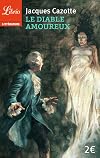
Jacques Cazotte's tale of the devil falling in love with a mortal and transforming into a beautiful woman to seduce him is one that's been known to me for a while but that I've only just gotten around to reading, and it's a lot of fun. Surprisingly more depth than I expected from what I thought would be mostly an enjoyable Gothic romp, exploring issues of self, religion, gender, love etc. The devil ends up coming across a lot more sympathetic than expected too, buttressed by the cop-out show more moralistic ending that undercuts what came before a fair bit, and along with some digressions that I tuned out of these were the main obstacles to me considering this more highly - still enjoyable though. show less

Jacques Cazotte, as the story goes, predicted whom among his friends would be meeting Madame Guillotine as the horrors of the French Revolution unfolded; sadly, his prescience didn't include himself.
Luckily, he's left behind this little gem of a book in which Beelzebub is summoned by a rank amateur (109 pages, 1772), and which although short, is a delight from beginning to end. The ending itself leaves much pause for thought and actually sent me back to the start for a second read. Within show more that 109 pages issues arise around self/other, gender identity, sexual desire, deception, reality vs. nonreality, all of which make their way through this tale; however, it's also a book that can be read totally just for fun, and one that I can definitely recommend. show less
Luckily, he's left behind this little gem of a book in which Beelzebub is summoned by a rank amateur (109 pages, 1772), and which although short, is a delight from beginning to end. The ending itself leaves much pause for thought and actually sent me back to the start for a second read. Within show more that 109 pages issues arise around self/other, gender identity, sexual desire, deception, reality vs. nonreality, all of which make their way through this tale; however, it's also a book that can be read totally just for fun, and one that I can definitely recommend. show less

This Marsilio Classics volume offers about as complete a perspective on Jacques Cazotte as one can hope for in English. The chief attraction is the short novel The Devil in Love, for which translator Stephen Sartarelli supplies both the full 1776 ending and (in a long endnote) the briefer original version of 1772. I somewhat preferred the original, in which Beelzebub/Biondetta remained as ambivalent to moral (evil/good) and metaphysical (demon/elemental) status as he/she did to gender. The show more text's debt to the "Rosicrucian" Comte de Gabalis of Montfaucon de Villars has often been noted, but Cazotte develops a few key themes through genuine plot and character into a real story, whereas de Villars basically wrote an occult treatise in a dialogue with light narrative framing. Cazotte's Spanish protagonist Alvaro experiments with magical evocation and suffers the consequences. The author claimed that "It was dreamt in one night and written in one day" (170).
Nearly as long as The Devil in Love itself is Gerard de Nerval's biographical essay on Cazotte, originally published as an introduction to an 1845 edition of the novel, but here translated from the version in Les Illuminés. Since I had recently read the latter in Peter Valente's complete 2022 translation, I skipped over Sartarelli's, just spot-checking to see that the text was substantially the same. Nerval compared The Devil in Love to the Metamorphoses of Apuleius, and he also embroidered and codified into canon the anecdotes that Sartarelli sources to an 1845 novel about Cazotte (191, n. 7). Much of the biography is trained on Cazotte's role as a Cassandra of the Revolution.
The influential occult novel Zanoni by Edward Bulwer-Lytton was almost certainly composed with an eye to Cazotte, both in terms of his fictional techniques presenting supernatural phenomena and his actual life at the close of the eighteenth century. I think that link is where Cazotte is best placed in terms of his legacy for modern occultism, despite Eliphas Levi's repeated references to his tragic career. ("The Gordian Knot of the terrible drama of '93 is still concealed in the darkest sanctuary of the Secret Societies." --Transcendental Magic, 156).
Richard Sieburth translated the 1792 Cazotte text "Revelations" included in the appendices, and he compares it to William Blake's revolutionary prophecies, although observing that the royalist Cazotte took the "reverse point of view" (195). For all that Cazotte had become a Martinist initiated through the illuminati of Lyon, his "Revelations" are thoroughly lacking in esoteric content. In substance and rhetorical form, they reminded me of nothing so much as Cold War US American Evangelical readings of the Apocalypse, substituting French Revolutionary republicans for the Soviet Union. Sieburth also contributes a fairly detailed biographical chronology for Cazotte.
Sartarelli's editorial apparatus is very robust, and in addition to his preface and dozens of explanatory notes to both Cazotte and Nerval, he reproduces the printed illustrations and a musical score from the 1772 edition of Le Diable Amoureux. There is a full bibliography. show less
Nearly as long as The Devil in Love itself is Gerard de Nerval's biographical essay on Cazotte, originally published as an introduction to an 1845 edition of the novel, but here translated from the version in Les Illuminés. Since I had recently read the latter in Peter Valente's complete 2022 translation, I skipped over Sartarelli's, just spot-checking to see that the text was substantially the same. Nerval compared The Devil in Love to the Metamorphoses of Apuleius, and he also embroidered and codified into canon the anecdotes that Sartarelli sources to an 1845 novel about Cazotte (191, n. 7). Much of the biography is trained on Cazotte's role as a Cassandra of the Revolution.
The influential occult novel Zanoni by Edward Bulwer-Lytton was almost certainly composed with an eye to Cazotte, both in terms of his fictional techniques presenting supernatural phenomena and his actual life at the close of the eighteenth century. I think that link is where Cazotte is best placed in terms of his legacy for modern occultism, despite Eliphas Levi's repeated references to his tragic career. ("The Gordian Knot of the terrible drama of '93 is still concealed in the darkest sanctuary of the Secret Societies." --Transcendental Magic, 156).
Richard Sieburth translated the 1792 Cazotte text "Revelations" included in the appendices, and he compares it to William Blake's revolutionary prophecies, although observing that the royalist Cazotte took the "reverse point of view" (195). For all that Cazotte had become a Martinist initiated through the illuminati of Lyon, his "Revelations" are thoroughly lacking in esoteric content. In substance and rhetorical form, they reminded me of nothing so much as Cold War US American Evangelical readings of the Apocalypse, substituting French Revolutionary republicans for the Soviet Union. Sieburth also contributes a fairly detailed biographical chronology for Cazotte.
Sartarelli's editorial apparatus is very robust, and in addition to his preface and dozens of explanatory notes to both Cazotte and Nerval, he reproduces the printed illustrations and a musical score from the 1772 edition of Le Diable Amoureux. There is a full bibliography. show less
That was somewhat disappointing. Any story where a Devil (or Death) turn up in human form, tends to be pretty awesome. Thats an aesthetic or plot-point or whatever that i quite enjoy.
This however was fairly bland given the setup. I'm absolutely sure its losing something in the translation but it can't be losing THAT much.
One issue plot wise is that the protagonist is constantly trying not to sleep with this woman, because it would be dishonorable or something. Ok, thats a little strange show more given this is written by a french guy and given the time period when things were a little more liberal.
I was thinking our hero is spanish so maybe this is a commentary on the spanish being more uptight than the french, but then he clearly sleeps with a lot of other women!
So the rule seems to be its only wrong to sleep with someone if there's a chance you might marry them later? Bit confusing.
Anyway, this story just never did enough with the supernatural elements, it never created that air of wrongness that you usually have in these kinds of stories and frankly the ending was very anti-climactic.
I guess it sounds like i'm completely trashing it but its still ok but far below my expectations. show less
This however was fairly bland given the setup. I'm absolutely sure its losing something in the translation but it can't be losing THAT much.
One issue plot wise is that the protagonist is constantly trying not to sleep with this woman, because it would be dishonorable or something. Ok, thats a little strange show more given this is written by a french guy and given the time period when things were a little more liberal.
I was thinking our hero is spanish so maybe this is a commentary on the spanish being more uptight than the french, but then he clearly sleeps with a lot of other women!
So the rule seems to be its only wrong to sleep with someone if there's a chance you might marry them later? Bit confusing.
Anyway, this story just never did enough with the supernatural elements, it never created that air of wrongness that you usually have in these kinds of stories and frankly the ending was very anti-climactic.
I guess it sounds like i'm completely trashing it but its still ok but far below my expectations. show less
Lists
Awards

You May Also Like


Associated Authors
Statistics
- Works
- 32
- Also by
- 2
- Members
- 477
- Popularity
- #51,682
- Rating
- 3.7
- Reviews
- 16
- ISBNs
- 74
- Languages
- 11